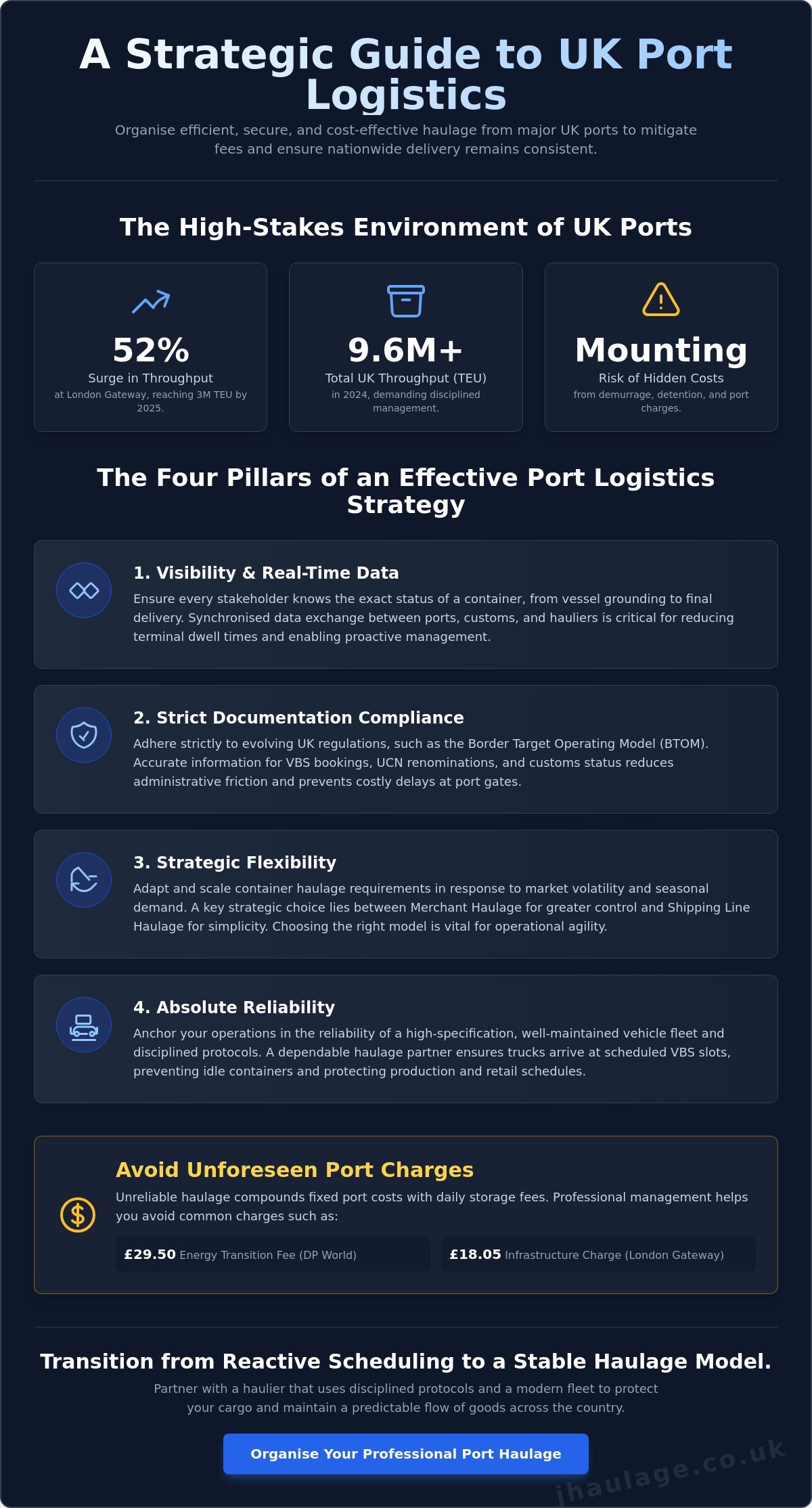
With London Gateway experiencing a 52% surge in throughput to over 3 million TEU in 2025, the margin for error in UK container movements has effectively vanished. In this high-pressure environment, effective port logistics management is no longer a simple transport task; it's a strategic necessity to avoid the mounting costs of port congestion. You likely recognise the frustration of unexpected demurrage charges and the operational paralysis caused by a lack of real-time container visibility. These bottlenecks don't just cost money; they disrupt the reliability of your entire supply chain.
This article provides a comprehensive management template designed to help cargo owners and forwarders organise efficient, secure, and cost-effective haulage from major UK ports. We'll outline a repeatable process for container collection that reduces operational downtime and mitigates the risk of detention fees. By following this disciplined framework, you can transition from reactive scheduling to a stable, professional haulage model that ensures nationwide delivery remains consistent and protected. We'll examine the specific steps required to secure your cargo and maintain a predictable flow of goods across the country.
Key Takeaways
- Master the critical final mile of the supply chain to ensure your cargo moves efficiently from the port to its destination.
- Implement a structured framework for port logistics management that prioritises real-time visibility and strict documentation compliance.
- Compare the strategic benefits of merchant haulage against shipping line options to determine which model offers the best control for your operations.
- Use our step-by-step implementation guide to organise VBS bookings and pre-arrival planning; this helps you eliminate avoidable port charges.
- Discover how a professional haulage partner uses disciplined protocols and a modern fleet to protect your cargo during nationwide transit.
Defining Port Logistics Management in the Modern Supply Chain
Effective port logistics management extends far beyond the physical lifting of a container from a vessel. It represents a comprehensive oversight of the entire transit process, ensuring that goods move through the terminal gate without unnecessary friction. In 2024, UK ports managed a total container throughput of 9,621,469 TEU. This massive volume requires a disciplined approach to scheduling and documentation to prevent supply chain bottlenecks. Professional management focuses on the final mile, which is the critical link between the maritime arrival and the inland warehouse destination. Without this strategic focus, cargo owners face significant risks from demurrage and detention charges that quickly erode profit margins.
Specialised haulage plays a vital role in maintaining supply chain velocity. When a container arrives at a major terminal, the clock begins ticking on terminal stay times. A managed approach ensures that transport is ready the moment the box is cleared for release. This proactive stance prevents the container from sitting idle, which is essential for businesses operating on just-in-time delivery models. By treating the port as a strategic node rather than a simple stop-off point, forwarders can ensure that their operations remain resilient against the operational pressures currently facing the UK's busiest trade hubs.
The Core Components of Port-Centric Logistics
Success in this sector depends on the seamless interface between maritime arrivals and inland road haulage. Modern port infrastructure, such as the facilities at London Gateway or Southampton, requires precise coordination with Vehicle Booking Systems (VBS) to maintain collection efficiency. For instance, a Port Management Overview reveals that operational success is tied to how well a facility manages its landside access. Data synchronisation is vital here; accurate information regarding UCN renominations or customs status reduces administrative friction at the port gates. When these elements are synchronised, the turnaround times for container haulage improve, maintaining the velocity required for modern retail and industrial supply chains.
Why Management Matters: Avoiding Common Bottlenecks
Poorly managed transport logistics result in hidden costs that often go unnoticed until the final invoice arrives. These include the Energy Transition Contribution of £29.50 per import laden container at DP World terminals or the £18.05 infrastructure charge at London Gateway. If a haulier is unreliable, these fixed costs are compounded by daily storage fees and late delivery penalties. High-performing inventory management relies entirely on haulage reliability. If the truck isn't present at the scheduled slot, the entire production line or retail schedule suffers. Port logistics management is a strategic coordination of transport, compliance, and timing. By partnering with a disciplined haulier, cargo owners ensure that their containers don't become liabilities sitting on the quayside.
The Four Pillars of an Effective Port Logistics Strategy
A robust port logistics management strategy relies on four foundational pillars: visibility, compliance, flexibility, and reliability. These elements work in unison to protect the integrity of the supply chain. Visibility ensures that every stakeholder knows the exact status of a container, from the moment it is grounded to its final delivery. Compliance involves a strict adherence to evolving UK regulations, such as the Border Target Operating Model (BTOM) protocols introduced in 2024. Flexibility allows a business to scale its container haulage requirements in response to market volatility, whilst reliability is anchored in the use of high-specification, well-maintained vehicle fleets.
Operational integration is the primary driver of cost reduction. Academic reviews in Port Logistics and Supply Chain Management confirm that synchronised data exchange between ports and hauliers significantly reduces terminal dwell times. When these four pillars are established, cargo owners can move away from reactive troubleshooting and towards a standardised, professional operational model. Securing a fixed haulage quote early in the planning phase provides the financial clarity needed to protect your margins against unexpected port-side surcharges.
Real-Time Communication and Data Visibility
Responsive customer support is essential for time-critical container deliveries. Digital updates prevent wasted journeys by ensuring that drivers only arrive when a container is genuinely cleared for release. This level of port logistics management eliminates the cost of failed collections at busy terminals like London Gateway. Integrating haulier data into your broader management system provides a single source of truth, allowing for more accurate inventory forecasting and warehouse labour scheduling.
Compliance and Security in Container Transport
Protecting high-value cargo requires fully insured container haulage and a deep understanding of port-specific security protocols. Each terminal has unique requirements; for example, DP World London Gateway applies a Port Security (ISPS) charge of £30.30 per import laden container, while Southampton charges £27.96. Professional hauliers ensure that all drivers meet the necessary entry requirements and that all documentation, including UCN renominations, is processed accurately. Adhering to the latest UK transport regulations is not optional; it's a fundamental requirement for maintaining a secure and uninterrupted flow of goods. This disciplined approach ensures that your cargo remains protected and compliant at every stage of the inland journey.
Merchant Haulage vs. Shipping Line Haulage: A Strategic Choice
Choosing between merchant haulage and shipping line haulage is a pivotal decision in port logistics management. While shipping line haulage is often perceived as a convenient solution, it frequently results in a loss of operational visibility. Merchant haulage, by contrast, gives the cargo owner direct control over the transport provider. This distinction is critical for businesses that require precise delivery windows at their warehouses or manufacturing sites. When you manage your own haulage, you aren't at the mercy of a carrier's third-party scheduling; you dictate the movement of your goods based on your own operational needs.
Direct partnerships often yield more competitive long-term rates because they bypass the administrative mark-ups applied by shipping lines. By establishing a relationship with a dedicated haulier, you gain transparency over port-side surcharges. For example, understanding the £21.32 import infrastructure charge at Liverpool 2 or the £13.29 charge at Immingham becomes easier when you have a direct line to the transport desk. Transitioning to this model requires booking ocean freight on a "Port-to-Port" basis. This contractual shift allows you to appoint a specialist to handle the inland leg, ensuring that your port logistics management strategy remains focused on efficiency rather than just convenience.
The Benefits of Merchant Haulage Solutions
Merchant haulage provides greater control over delivery scheduling and specific delivery windows. This accountability is vital when managing high-stakes supply chains where a missed slot can lead to production delays. You'll work directly with the transport provider, ensuring that any issues on the quayside are communicated immediately. To better plan your budget, you should review our guide on Understanding Container Transport Costs. This resource explains how direct haulage partnerships help you avoid the hidden premiums often found in carrier-arranged transport.
When to Choose a Dedicated Logistics Partner
Evaluating the complexity of your nationwide container haulage requirements is the first step in selecting a partner. For forwarders and cargo owners moving significant volumes, a haulier operating a modern fleet of over 40 trucks offers the necessary consistency and coverage. This scale ensures that your deliveries aren't compromised by vehicle availability or maintenance issues. Specialised merchant haulage is the preferred choice for professionals who prioritise reliability and want a partner that understands the specific protocols of various UK terminals. A dedicated partner acts as a strategic extension of your team, protecting your cargo and maintaining the velocity of your supply chain.
Port Logistics Management Template: Your Implementation Guide
Implementing a structured port logistics management system ensures that your cargo moves through the terminal with minimal delay. This five-phase template provides a professional framework for managing nationwide container deliveries. By following a disciplined sequence, you can eliminate the administrative errors that lead to costly terminal dwell times. This process starts long before the vessel berths and continues until the empty container is safely returned to the shipping line's designated depot.
The template is divided into logical operational stages:
- Phase 1: Pre-Arrival Planning. Organise all customs documentation and confirm that the UCN is correctly linked. At this stage, you must also secure a Vehicle Booking System (VBS) slot to ensure the haulier has a confirmed window for collection.
- Phase 2: Haulage Coordination. Select the appropriate vehicle for the cargo type and establish the inland transit schedule. This phase requires clear communication of the delivery address and any site-specific access restrictions.
- Phase 3: Execution. Manage the physical collection and inland transport process. Real-time tracking allows you to monitor the container's progress and alert the warehouse of any traffic-related delays.
- Phase 4: Final Delivery. Ensure secure offloading at the destination. Once the container is devanned, the haulier must immediately coordinate the "empty return" to avoid additional detention charges.
- Phase 5: Review. Analyse performance metrics from the completed cycle. This data helps identify recurring bottlenecks and informs improvements for future shipments.
To begin optimising your next movement, you can request a container haulage quote to secure professional transport capacity.
Pre-Collection Checklist for Cargo Owners
Verifying release notes and pin numbers before the haulier arrives is the most effective way to prevent failed collections. You should also confirm that any port-specific fees, such as the £6.50 UCN renomination charge, have been settled to avoid the container being held at the gate. For a detailed breakdown of these requirements, refer to our guide on how to organise a container collection from port for specific steps. Establishing clear delivery instructions for the inland destination ensures that the driver can complete the final mile without unnecessary operational friction.
Monitoring Performance and Supply Chain Health
Effective port logistics management requires the use of key performance indicators (KPIs) to evaluate your transport partners. You should focus on terminal turnaround times and the accuracy of documentation handling. Managing the empty return process is equally critical; delays here result in daily charges that quickly escalate. Review haulier punctuality and safety records quarterly to ensure your logistics standards remain consistent. This methodical oversight protects your supply chain from the volatility often found in UK port operations.
Professional Port Logistics: The Jagelo Haulage Standard
Jagelo Haulage applies over 15 years of operational expertise to every container movement. Our approach to port logistics management is defined by a commitment to functional reliability and strict protocol adherence. We operate a modern fleet of over 40 trucks. This capacity allows us to provide secure, nationwide transport from the UK’s primary maritime gateways. We don't view haulage as a simple physical task. Instead, we frame it as a strategic outcome that protects the integrity of your broader supply chain. This disciplined philosophy ensures that every container is handled with the precision required by corporate clients and operational managers.
Our infrastructure is built to handle the high stakes of modern trade. We maintain our vehicles to the highest industrial standards to minimise the risk of mechanical failure or transit delays. This focus on fundamentals allows us to deliver protected outcomes for every client. By integrating our 40-truck fleet into your logistics framework, you gain a partner that understands the necessity of punctuality. We follow established protocols to ensure that your cargo remains secure from the port gate to the warehouse door. Our team understands that in the logistics sector, consistency is the primary measure of quality.
Nationwide Reach with Localised Expertise
Our drivers are the backbone of our nationwide reach. They understand the specific requirements of the UK’s busiest container terminals. Navigating complex port operations requires more than just driving skills; it demands a deep knowledge of terminal layouts and gate procedures. We provide consistent haulage services from hubs like Southampton, Tilbury, and Felixstowe. For a more detailed look at one of the UK's largest ports, read our guide on Reliable Container Haulage from Felixstowe. This localised expertise ensures your cargo moves promptly, even during periods of high terminal congestion. It's this combination of massive operational reach and local knowledge that sets the Jagelo Haulage standard.
Request Your Strategic Haulage Quote
Jagelo Haulage provides bespoke solutions that meet the requirements of both merchant and shipping line haulage. Whether you're a forwarder managing multiple accounts or a cargo owner with a single high-value shipment, we offer the same disciplined standard of care. A responsive, professional partner is a critical asset in a volatile logistics market. We prioritise operational security to ensure your goods arrive exactly as scheduled. We don't rely on marketing slogans; we rely on performance and results. Our port logistics management services are designed to provide the stability your business needs to grow. Request a professional container haulage quote today to secure your supply chain with a partner you can trust.
Securing Your Supply Chain Through Operational Excellence
Establishing a disciplined framework for port logistics management is the most effective way to eliminate supply chain volatility. By prioritising merchant haulage and following a structured collection template, you can protect your operations from unnecessary terminal charges and delays. This strategic approach ensures that your cargo moves with the consistency required to maintain warehouse efficiency and customer trust. Success in this sector depends on the precise synchronisation of data and physical transport across every stage of the journey.
Jagelo Haulage provides the steadfast reliability needed to navigate the complexities of the UK’s busiest maritime hubs. With over 15 years of industry experience and a modern fleet of over 40 trucks and trailers, we offer the capacity and specialist knowledge required for all major UK container ports. We focus on the fundamentals of safety and punctuality to deliver a professional transport solution that supports your broader business goals. Our disciplined approach reduces administrative friction and maintains the velocity of your inland distribution.
Request a tailored port haulage quote for your containers to begin optimising your inland logistics. Our team is ready to help you build a more resilient and cost-effective distribution network that performs under pressure.
Frequently Asked Questions
What are the main functions of port logistics management?
Port logistics management involves the strategic coordination of container movements from the maritime terminal to the final inland destination. Its primary functions include documentation oversight, the scheduling of inland haulage, and the real-time monitoring of container status. By managing these elements, cargo owners ensure that goods move through the port gates without administrative friction or operational delays.
How can I reduce port demurrage and detention charges?
Reducing these charges requires proactive scheduling and the early settlement of all port-side fees. You should ensure that customs clearance is obtained and release notes are issued before the vessel berths. Using merchant haulage provides the direct control needed to manage the empty return process efficiently, which is the most common cause of detention penalties in the UK.
What is the difference between merchant haulage and shipping line haulage?
Merchant haulage allows the cargo owner to appoint their own transport provider, offering greater control over delivery windows and visibility. Shipping line haulage is arranged by the carrier, which often leads to a lack of direct communication with the driver. Choosing a merchant model ensures that your port logistics management strategy is focused on your specific warehouse requirements rather than the carrier's schedule.
How does a Vehicle Booking System (VBS) affect port logistics?
A Vehicle Booking System regulates terminal traffic by requiring hauliers to secure specific time slots for container collection. If a VBS slot is missed due to poor scheduling, the container remains on the quayside, often incurring storage costs. Efficient logistics management relies on a haulier's ability to synchronise vehicle arrivals with these strict terminal windows to ensure a consistent flow of goods.
What documentation is required for a container collection from a UK port?
You must provide a valid release note and a secure pin number to the haulier before they arrive at the terminal. Additionally, the container must have a correctly linked Unique Consignment Number (UCN) and confirmed customs clearance. It's also essential to verify that infrastructure charges and any energy adjustment fees have been paid to avoid the container being held by the port authority.
Why is a modern truck fleet important for port logistics?
Modern fleets are essential for maintaining operational reliability and meeting the environmental standards of UK port zones. Well-maintained vehicles reduce the risk of mechanical breakdowns that lead to missed VBS slots and failed collections. A professional fleet also ensures that high-value cargo is transported securely, providing the stability required for long-distance inland container haulage.
Can Jagelo Haulage handle same-day container deliveries?
Same-day delivery capacity depends on the container's release status and the availability of VBS slots at the specific terminal. You should check current port congestion levels and vehicle availability with our transport desk to determine the feasibility of urgent movements. We prioritise the disciplined execution of scheduled deliveries to ensure that all nationwide transport remains predictable and secure.
How do I choose the best port logistics partner for my business?
You should select a partner with extensive experience in UK port operations and a significant fleet capacity. Prioritise hauliers that demonstrate a disciplined approach to documentation and maintain transparent communication channels. A reliable partner acts as a strategic extension of your supply chain, understanding the high stakes involved in terminal-specific protocols and nationwide delivery schedules.