A professional container haulage contractor is a strategic asset rather than a simple transport provider. With UK container port throughput exceeding 9.6 million TEU in late 2024, the scale of national logistics demands a partner who prioritises operational discipline. You've likely dealt with the administrative burden of chasing ETAs or the financial impact of port delays. These bottlenecks don't just slow down deliveries; they compromise the stability of your entire supply chain.
We recognise that you value consistency and clear communication over empty marketing promises. This article explains how to identify, evaluate, and partner with a professional container haulage contractor to secure your UK operations. You'll learn how to assess a provider's ability to manage port-specific surcharges and their readiness for new regulations, such as the Smart Tachograph Version 2 mandate arriving in July 2026. We'll outline a methodical approach to choosing a partner that offers nationwide coverage and reliable port collections to keep your business moving.
Key Takeaways
- Identify the operational differences between merchant haulage and shipping line haulage to maximise supply chain flexibility and control.
- Evaluate a container haulage contractor based on fleet capacity and port experience to ensure consistent vehicle availability for inland deliveries.
- Implement efficient port-to-door strategies to reduce the administrative burden and financial impact of port storage and demurrage fees.
- Leverage a partner with a proven fifteen-year track record and a modern fleet of 40+ vehicles to secure reliable nationwide coverage.
What is a Professional Container Haulage Contractor?
A professional container haulage contractor serves as the vital link between maritime terminals and inland distribution centres. Whilst shipping lines manage the ocean transit, the haulage contractor facilitates the transition of goods to the UK road network. This role is a fundamental component of intermodal freight transport, ensuring that standardised units move seamlessly between different modes of carriage. Without this specialised service, the UK supply chain would face immediate stagnation at the water's edge, disrupting the flow of essential commercial goods.
Specialised container transport differs significantly from general haulage. General hauliers often utilise curtain-sided trailers for palletised goods, but a container haulage contractor operates with skeletal trailers designed specifically to lock and secure ISO containers. These contractors must manage high-stakes variables, including strict port time slots and heavy-lift requirements. Maintaining supply chain velocity depends on a contractor's ability to synchronise vehicle movements with vessel arrivals. This coordination prevents the rapid accumulation of port storage fees and demurrage charges that erode profit margins.
The Mechanics of Container Transport
Technical proficiency is at the core of this sector. Contractors utilise specialised equipment such as sliding bogies, which allow the trailer length to be adjusted for 20ft, 40ft, or 45ft containers. This ensures correct weight distribution across axles, maintaining legal compliance and road safety. The driver's responsibility extends beyond vehicle operation; they must manage complex port protocols, including Vehicle Booking System (VBS) entries. This precision is essential for the "last mile" of international shipping, where administrative errors lead to failed collections.
The Value of Specialised Port Logistics
Navigating major UK hubs like Felixstowe or DP World London Gateway requires deep operational knowledge. A seasoned contractor understands the specific gate-in and gate-out procedures of each terminal, which reduces the risk of expensive delays. Companies like Jagelo Haulage utilise this expertise to enhance cargo security. By following strict protocols and utilising modern fleet tracking, professional contractors provide a protected environment for high-value goods. This discipline ensures containers reach their destination intact and on schedule.
Merchant Haulage vs Shipping Line Haulage: Choosing Your Model
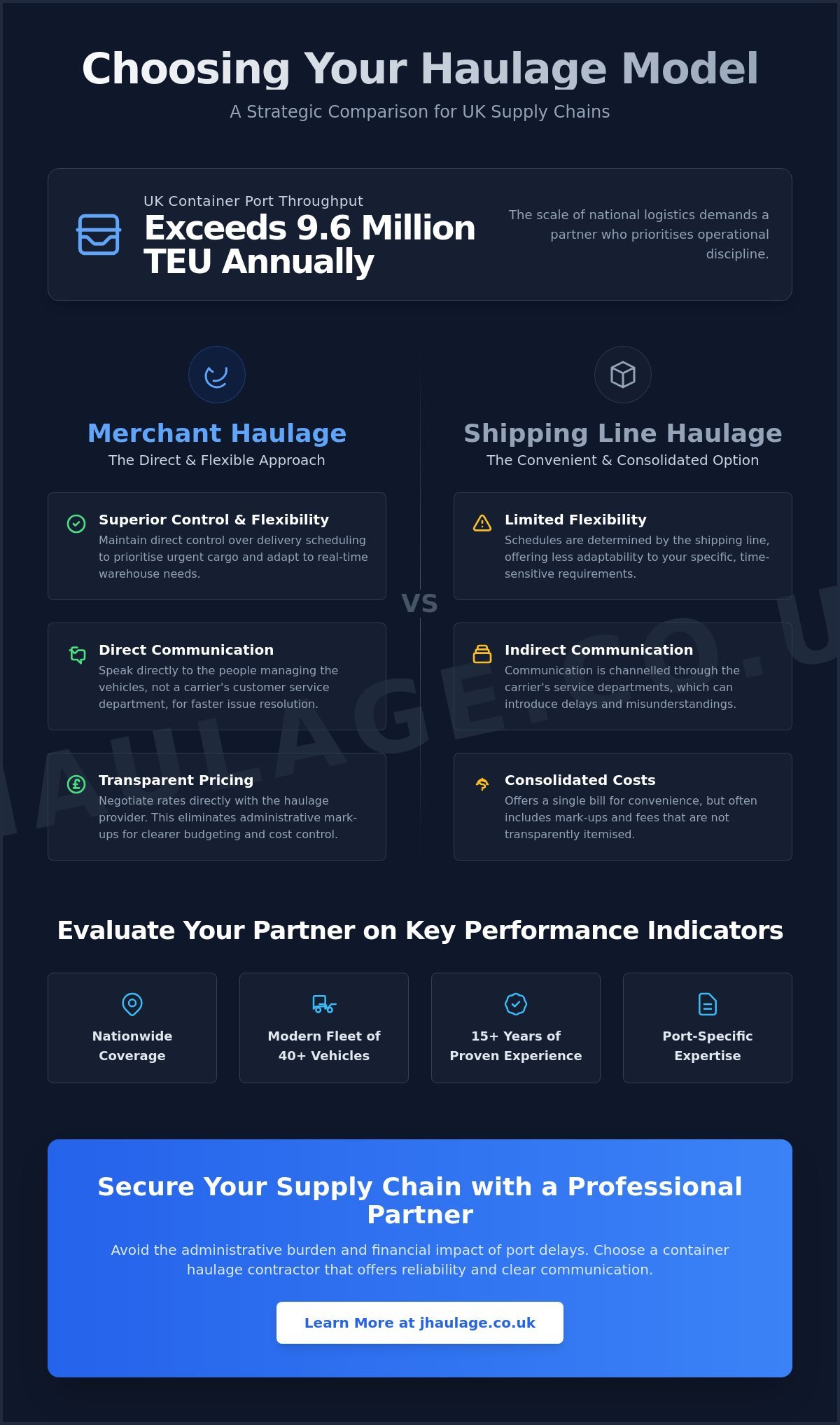
Selecting the correct commercial model is a fundamental decision for any logistics manager. The two primary options available for moving goods from port to destination are merchant haulage and shipping line haulage. Each approach carries different implications for operational control, financial predictability, and supply chain resilience. Whilst shipping line haulage offers a simplified booking process, merchant haulage allows you to appoint an independent container haulage contractor to manage the inland transit directly. The Road Haulage Association (RHA) emphasises that maintaining high professional standards and clear commercial terms is essential for protecting the interests of all parties within the transport chain.
The choice of model directly impacts your overall container transport costs. Merchant haulage typically provides a more transparent pricing structure because you negotiate rates directly with the provider. This eliminates the administrative mark-ups that shipping lines often apply to carrier-led transport. By removing the intermediary, you gain a clearer understanding of the costs associated with fuel, port surcharges, and distance, which allows for more accurate budgeting and financial discipline.
The Strategic Advantages of Merchant Haulage
Merchant haulage offers superior operational flexibility. By partnering directly with a contractor, you maintain control over delivery scheduling and can prioritise urgent cargo based on real-time warehouse requirements. This direct relationship facilitates better communication; you speak to the people actually managing the vehicles rather than a carrier's customer service department. This level of influence is vital when responding to port congestion or shifting delivery windows. It transforms transport from a passive service into a strategic outcome tailored to your specific business needs.
Understanding Shipping Line Haulage
Shipping line haulage, or carrier haulage, is often chosen for its perceived convenience. It consolidates the ocean and land legs into a single booking, which can reduce the administrative workload for businesses with straightforward requirements. However, this convenience often results in reduced visibility. Shippers using carrier haulage frequently have less influence over collection times and may struggle to obtain precise ETAs. For companies with strict production schedules or narrow delivery windows, this lack of control can create significant supply chain bottlenecks.
For businesses seeking to improve their logistical reliability, the merchant model provides a more robust and accountable framework. If you are looking to enhance the efficiency of your port collections, you can request a detailed transport quote to compare the benefits of a dedicated merchant service against your current carrier arrangements.
Key Criteria for Evaluating a Nationwide Haulage Partner
Evaluating a potential transport partner requires a methodical analysis of their operational infrastructure. A reliable container haulage contractor must possess the physical assets and administrative discipline to manage nationwide requirements. Whilst smaller operators may offer lower initial rates, they often lack the redundancy needed to handle port delays or vehicle downtime. A fleet size of approximately 40 vehicles is widely considered the "sweet spot" for reliability. This scale provides enough flexibility to absorb unexpected volume spikes whilst remaining small enough to provide a dedicated, personal level of service. Reliability requires scale; a larger fleet ensures that if one unit requires unscheduled maintenance, your delivery remains on schedule.
Beyond physical assets, you must verify industry experience and insurance credentials. Professional contractors maintain comprehensive Goods in Transit (GIT) cover and public liability insurance to protect your commercial interests. Reviewing a provider's track record in major UK ports reveals their ability to navigate complex gate-out procedures. A partner with a proven history understands the nuances of port operations, which reduces the likelihood of administrative errors and subsequent financial penalties. This level of expertise is what transforms a simple transport provider into a strategic partner. You should look for a contractor that prioritises functional reliability and clear communication over personality-driven marketing.
Fleet Standards and Compliance
Operational safety and environmental responsibility are essential markers of a professional operator. Modern fleets should consist of Euro 6 compliant vehicles to ensure access to Low Emission Zones and minimise the impact of the London Congestion Charge. Adherence to the UK government's guidance on road haulage is a baseline requirement for any professional operator. Regular maintenance programmes and RHA membership signal a commitment to industry best practices. These standards directly correlate with reduced en-route breakdowns and higher delivery success rates. Jagelo Haulage maintains these high standards across its entire fleet to ensure consistent service delivery.
Technological Integration and Visibility
Visibility is the foundation of a secure supply chain. A professional contractor utilises advanced GPS tracking and transport management systems to provide real-time data on vehicle locations. This technology allows you to monitor progress and receive proactive updates on ETAs. Automated electronic proof of delivery (ePOD) systems eliminate the delays associated with manual paperwork, providing immediate confirmation of arrival. Clear communication channels ensure that you are informed of port status changes before they become bottlenecks. This level of transparency allows your team to plan warehouse operations with precision, reducing administrative friction and improving overall efficiency.
Optimising Efficiency in UK Port-to-Door Logistics
Efficiency in port-to-door logistics is measured by the ability to move cargo without incurring unnecessary financial penalties. A professional container haulage contractor prioritises prompt collection to avoid demurrage and detention charges. Demurrage fees accrue when a container remains at the port beyond the agreed free time, whilst detention charges apply if the empty unit isn't returned to the terminal on schedule. Accurate documentation is the first line of defence against these costs. Ensuring that all release notes and customs clearances are in order before the vehicle arrives prevents gate-out failures. This discipline protects your profit margins and maintains the steady flow of goods to your facility.
Managing Vehicle Booking System (VBS) slots is another critical operational requirement. Major UK ports use these systems to regulate traffic flow and manage terminal capacity. Securing slots during peak times requires a contractor with a disciplined dispatch team. Selecting an experienced container haulage contractor ensures that vehicles don't face long wait times or gate-out rejections. This coordination extends to the warehouse, where transport schedules must align with de-vanning capacities. Efficient container turnaround ensures that trailers are released quickly, allowing the contractor to maintain a high level of service across their entire client base.
Navigating Major UK Maritime Hubs
Every port has unique operational nuances that affect transit times. Experience in container haulage from Felixstowe is particularly valuable, as this hub handles over 40% of the UK's container traffic. Southampton and London Gateway have their own specific traffic patterns and gate protocols. A contractor familiar with these hubs can navigate seasonal fluctuations and congestion more effectively than a general haulier. This specialised knowledge reduces the time spent at the terminal, ensuring that your cargo spends more time in transit and less time in queues.
Best Practices for Inland Delivery
The final leg of the journey requires precise coordination with the destination site. Deliveries must be scheduled to coincide with warehouse operating hours to prevent vehicle idling. Site accessibility is also a primary concern; 44-tonne articulated vehicles require sufficient turning circles and hardstanding areas. For time-critical industrial components, same-day delivery from the port can be a decisive factor in maintaining production schedules. Proactive communication between the driver, the transport office, and the warehouse manager ensures that de-vanning is completed efficiently, allowing the equipment to be returned to the port without delay.
If you require a partner to streamline your port-to-door movements, contact us for a professional haulage quote to secure your supply chain.
Strategic Container Transport Solutions with Jagelo Haulage
Jagelo Haulage has established a reputation for steadfast professionalism over more than fifteen years in the UK logistics sector. As a dedicated container haulage contractor, we focus on the core fundamentals of transport: punctuality, safety, and operational discipline. Our modern fleet of 40+ trucks is equipped to handle the high stakes of international trade, providing secure and consistent coverage across the country. We understand that your supply chain relies on the predictable movement of goods, and we've structured our operations to mirror that necessity. Every vehicle in our fleet is maintained to the highest standards to ensure functional reliability for every client.
We provide specialised expertise in both merchant haulage and shipping line haulage requirements. This versatility allows us to integrate seamlessly into your existing logistical framework, whether you require direct control over your transport or a carrier-led solution. By maintaining a protocol-driven approach, we ensure that every delivery is treated with the same level of corporate discipline. This consistency is what distinguishes a strategic partner from a simple service provider. Our team understands the importance of precise timing and accurate documentation, ensuring that your cargo moves through the UK road network without unnecessary friction.
Why Partner with Jagelo Haulage?
Operational managers require a partner who is both reliable and responsive. Our customer support team understands the technical requirements of port logistics and provides clear, factual updates without unnecessary jargon. We maintain a strategic presence across all major UK maritime hubs, which allows us to offer maximum flexibility for your collections and deliveries. Our no-nonsense approach to safety and cargo protection ensures that your goods are moved within a secure, highly organised environment. We prioritise the functional reliability of our fleet to minimise the risk of delays and protect your commercial interests.
Securing Your Supply Chain Today
Choosing a seasoned partner reduces the administrative friction and anxiety often associated with UK transport. Our professionally managed operations are designed to provide a strategic outcome: a stable, efficient supply chain that supports your business growth. We understand the high stakes involved in every gate-out procedure and every inland delivery. By following strict protocols and leveraging our extensive industry experience, we provide a level of security that helps you focus on your core business activities. You can contact Jagelo Haulage to discuss your nationwide container requirements and learn how our disciplined approach can enhance your logistics strategy.
Securing Your UK Supply Chain Infrastructure
A resilient supply chain depends on the operational discipline of your transport partner. You've seen that selecting a professional container haulage contractor requires a methodical assessment of fleet capacity, port expertise, and commercial transparency. By prioritising merchant haulage models and verifying a provider's ability to navigate complex port protocols, you can significantly reduce the risk of administrative bottlenecks and unexpected costs. Reliability is a strategic choice that protects your cargo and your reputation.
Jagelo Haulage provides the steadfast professionalism needed to maintain your logistical velocity. We offer over 15 years of industry experience and a modern fleet of 40+ trucks to ensure consistent, nationwide coverage. Our specialist knowledge of all major UK ports allows us to manage your collections with the precision your business demands. We invite you to discuss your container haulage requirements with our expert team to establish a secure and predictable transport framework. We look forward to supporting your operations with disciplined, results-oriented service.
Frequently Asked Questions
What is the difference between merchant haulage and shipping line haulage?
Merchant haulage is a model where the cargo owner appoints an independent container haulage contractor to manage the inland transit. This approach provides greater control over delivery schedules and direct communication with the transport office. Shipping line haulage, or carrier haulage, involves the shipping line managing the road leg as part of a combined ocean and land booking, which often results in less visibility for the final recipient.
How much does it cost to hire a container haulage contractor?
Total costs are determined by the distance between the port of entry and the final destination. Other factors include current fuel surcharges and port-specific energy adjustment mechanisms, such as those applied at London Gateway or Southampton. You should also account for potential waiting time fees if loading or unloading exceeds the standard one to two-hour window. Requesting a specific quote ensures all variables are accurately calculated.
Which UK ports do container haulage contractors typically serve?
Professional contractors provide nationwide coverage from major maritime hubs including Felixstowe, Southampton, and London Gateway. They also facilitate inland transport from regional centres such as Teesport, Liverpool, and Hull. Most large-scale operators maintain a strategic presence near these terminals to ensure they can manage high-volume collections and returns efficiently across the UK road network.
What equipment is needed for shipping container transport?
Transporting heavy containers requires a high-specification HGV tractor unit and a specialised skeletal trailer. These trailers feature twist-locks to secure the container safely to the chassis. Many contractors utilize sliding bogies, which allow the trailer length to be adjusted for 20ft, 40ft, or 45ft units. This equipment ensures correct weight distribution and compliance with UK road safety regulations for 44-tonne vehicles.
How can I avoid demurrage charges when booking container haulage?
Avoiding demurrage requires the prompt collection of containers within the port's designated free-time window. You should provide all release documentation to your container haulage contractor well in advance of the vessel's arrival. Securing Vehicle Booking System (VBS) slots early and ensuring your warehouse is ready for immediate de-vanning helps prevent the container from sitting at the terminal and accruing daily storage penalties.
What insurance should a container haulage contractor have?
A reputable contractor must hold comprehensive Goods in Transit (GIT) insurance and public liability cover. GIT insurance is essential for protecting the financial value of your cargo against damage or loss during the inland transit phase. You should verify that the contractor's policy limits are sufficient for your specific cargo type and that they adhere to Road Haulage Association (RHA) standard conditions of carriage.
Can container haulage contractors provide same-day delivery?
Same-day delivery is often achievable if the container is cleared by customs and collected from the port during the morning shift. Success depends on the distance to the destination and the availability of VBS slots at the terminal. Whilst it's a common requirement for time-critical industrial components, you should coordinate with the transport office early to ensure driver hours and vehicle positioning align with your requirements.
How do I track my container during inland transport?
Tracking is managed through integrated telematics and transport management systems (TMS). Most professional fleets are equipped with GPS tracking, allowing the transport office to provide real-time updates on vehicle location and estimated arrival times. Once the delivery is complete, electronic proof of delivery (ePOD) systems provide immediate confirmation of receipt, ensuring full visibility and accountability throughout the final leg of the journey.