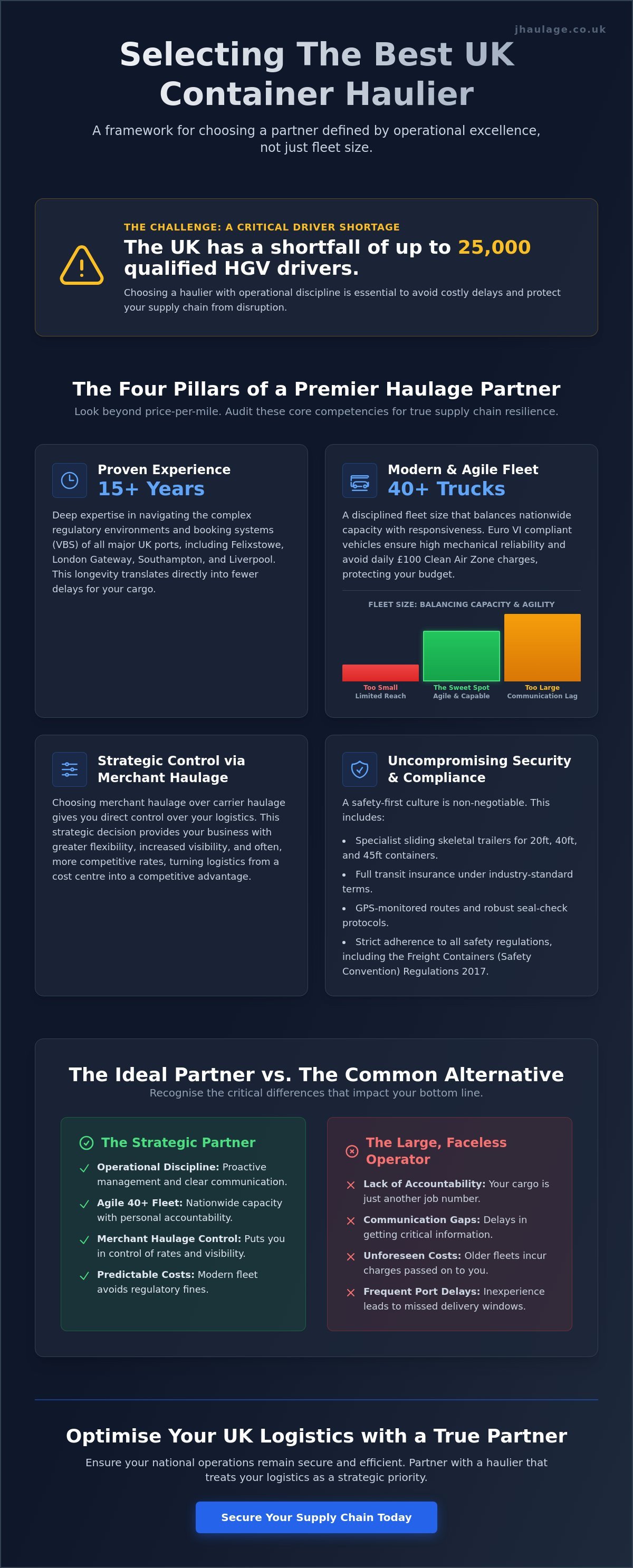
A massive fleet of trucks is no guarantee that your cargo will arrive on schedule. In a market where the UK remains short of up to 25,000 qualified HGV drivers, the best container haulier is defined by operational discipline rather than just the number of vehicles they own. You understand the frustration of missed delivery windows and the lack of accountability that often comes with large, faceless organisations. These delays don't just affect one shipment; they disrupt your entire supply chain and lead to unforeseen costs at the port.
This article outlines the essential criteria for selecting a top-tier transport partner to ensure your national operations remain secure and efficient. We will explore why direct access to operational experts and a proven track record in UK port logistics are vital for your success. You'll learn how to identify hauliers that offer nationwide coverage without compromising on service quality. By the end of this guide, you'll have a clear framework for choosing a partner that treats your logistics as a strategic priority.
Key Takeaways
- Recognise why 15 years of operational experience is required to navigate the complex regulatory environment of UK ports effectively.
- Learn how the best container haulier offers strategic control through merchant haulage, providing your business with better rates and increased visibility.
- Discover the operational benefits of a modern 40-truck fleet, which balances nationwide capacity with the agility needed for time-sensitive deliveries.
- Use a structured evaluation framework to audit a partner’s fleet maintenance standards and port access credentials to ensure supply chain resilience.
Defining Excellence in Modern Container Haulage
Excellence in container transport is measured by the consistency of the outcome. A premier provider ensures secure, port-to-door transport through disciplined operational protocols. Since the global adoption of Containerization, the industry has evolved into a complex network of timed arrivals and customs compliance. Identifying the best container haulier requires looking beyond the price per mile. It demands an audit of their experience and their ability to handle the nuances of UK port infrastructure.
Navigating the complexities of major UK ports requires deep industry knowledge. Hauliers with 15 or more years of experience understand the specific requirements of each terminal. This longevity translates into fewer delays for the client. It's the difference between a shipment that sits at the port and one that moves according to plan. Professionalism in this sector isn't just about moving a box. It's about providing a professionally managed logistics outcome that protects your bottom line. Every container movement must follow a strict protocol to maintain safety and efficiency.
The Core Components of Reliable Transport
Effective transport relies on technical precision. Professional hauliers utilise Vehicle Booking Systems (VBS) to secure precise collection slots at crowded terminals like Felixstowe or London Gateway. This system reduces idle time and ensures your cargo moves promptly. A modern fleet is equally critical for your operations. Newer vehicles, particularly those meeting Euro VI emission standards, experience less mechanical downtime and avoid high Clean Air Zone charges. Every shipment must be fully insured under industry-standard terms. This protection is a non-negotiable standard that separates professional logistics partners from basic transport providers.
National Reach and Operational Reach
Operational reach defines a haulier's capacity to support your entire supply chain. A provider must serve all major deep-sea ports, including Southampton and Liverpool, to offer true flexibility. Selecting the best container haulier means choosing a partner with a centralised operational hub. This structure allows for better coordination and consistent service levels across the country. Professional management ensures that logistics is a strategic outcome for your business. You receive a structured service that prioritises the protection of your cargo at every stage of the journey from the quay to the final destination.
Fleet Modernisation and Operational Discipline
While some operators manage hundreds of vehicles, the best container haulier often maintains a fleet size that balances capacity with strategic agility. A fleet of 40+ trucks provides enough scale to handle large-volume contracts whilst remaining small enough to ensure direct communication between operations and drivers. This avoids the communication lag common in massive organisations. It's about being responsive and reliable. When you speak to an operator, you're speaking to someone who knows exactly where your cargo is located.
Modernisation acts as the primary defence against logistics delays. Newer vehicles operate with higher mechanical reliability, which protects your delivery schedule from unexpected breakdowns. Choosing the best container haulier means selecting a partner that invests in their equipment to ensure intelligent sustainability. By utilising Euro VI compliant engines, hauliers avoid the daily £100 charges found in many UK Clean Air Zones, keeping your costs predictable. You don't want your margins eroded by avoidable regulatory fees.
Safety is a core component of operational discipline. All cargo handling must adhere to the Freight Containers (Safety Convention) Regulations 2017. This ensures every unit is structurally sound and safe for transport. Experienced Class 1 HGV drivers play a vital role here. Their expertise in secure loading and defensive driving protects your goods and ensures compliance with national road safety standards. Disciplined maintenance schedules further reinforce this safety-first approach.
Security and Protection Standards
Professional haulage requires specialist equipment. Using the correct trailers ensures weight is distributed legally and safely across all UK road networks. Standard equipment should include:
- Sliding skeletal trailers for 20ft, 40ft, and 45ft containers.
- GPS-monitored routes to ensure transit security.
- Robust seal-check protocols to prevent cargo tampering.
A safety-first corporate culture isn't just a slogan. It's a functional requirement for any business that values its inventory and its reputation. Secure transit protocols are essential to maintain the integrity of the supply chain.
Technology in the Supply Chain
Transparency is achieved through real-time tracking. You should always know the status of your delivery without having to chase an operator for an update. Digital documentation further streamlines the process at the port. This reduces the risk of clerical errors that often lead to expensive storage fees. If you require a partner that prioritises these technical standards, you can request a professional transport assessment to see how modernised logistics can support your supply chain.
Merchant Haulage: Why Strategic Control Matters
Strategic control over your supply chain begins with the decision to use merchant haulage. This model allows the cargo owner to contract a haulier directly rather than relying on the shipping line's internal transport services. Choosing the best container haulier for merchant transport ensures that your priorities remain the focus of every operation. Shipping lines often treat inland transport as a secondary task; a dedicated haulier treats it as their core competency. This direct relationship provides the visibility required to manage complex delivery schedules effectively.
Control also translates into operational agility. Merchant haulage allows for more flexible delivery requirements, including same-day pivots that shipping line bureaucracy cannot accommodate. When port congestion occurs, a dedicated partner can reroute or reschedule with minimal notice. This responsiveness is essential for maintaining a resilient supply chain. By selecting your own provider, you transition from being a number in a carrier's system to a priority client for a specialist logistics firm. This shift is vital for managing the 10% year-on-year cost increases reported across the UK haulage sector in 2024.
Adhering to the standards set by the Road Haulage Association (RHA) ensures that your partner follows industry best practices for safety and efficiency. This commitment to professional standards is a hallmark of a strategic partner rather than a sub-contracted commodity. You need a partner that understands the high stakes of your operations.
Merchant vs Shipping Line Comparisons
The primary advantage of merchant haulage is the elimination of bureaucratic layers. Direct communication with operational experts allows for immediate problem-solving. Shipping lines often use third-party sub-contractors, which creates a communication gap. Bespoke container haulage services offer tailored solutions that can significantly reduce port demurrage costs. By having a haulier ready as soon as the container is cleared, you avoid the expensive storage fees that accumulate when shipping lines fail to prioritise your inland movement.
Inland Container Logistics
Efficient port-to-door logistics are essential for businesses located far from the coast. Scheduled deliveries must be organised to match warehouse labour shifts precisely. A delay of just two hours can disrupt a whole day of warehouse operations and increase labour costs. Linking expertise in port logistics to national distribution ensures that your containers move seamlessly from the quay to the loading bay. The best container haulier understands these internal pressures and works to synchronise transport with your specific operational requirements.
A Framework for Evaluating Haulage Partners
Selecting a logistics partner requires a structured approach to ensure operational security. The best container haulier for your business isn't simply the one with the lowest rate but the one with the most disciplined operational framework. Use the following five steps to audit potential partners and ensure your supply chain remains resilient.
- Step 1: Verify National Coverage. Ensure the haulier has established port access credentials and active Vehicle Booking System (VBS) accounts for all major UK deep-sea terminals.
- Step 2: Audit Fleet Standards. Confirm that the fleet consists of modern, Euro VI compliant vehicles. This reduces mechanical downtime and avoids expensive Clean Air Zone charges in cities like Bristol or London.
- Step 3: Test Communication Lines. Assess whether you have direct access to operational experts. You shouldn't be forced to navigate a faceless automated portal during a logistics crisis.
- Step 4: Confirm Insurance and Safety. Verify that the haulier maintains high-level Goods in Transit insurance and follows RHA safety protocols for all container movements.
- Step 5: Evaluate Transparency. Request a detailed quote that accounts for port logistics complexities. A transparent breakdown of costs is the only way to avoid hidden fees later in the process.
A disciplined evaluation process prevents the service drops that often occur with unvetted providers. When you prioritise competence over initial cost, you secure a strategic outcome for your distribution network. You can request a bespoke haulage quote to begin an audit of your current transport requirements.
Questions to Ask Your Logistics Provider
Inquire specifically about their experience with merchant haulage booking processes. You need to know if they have the internal capacity to manage your specific volume. Ask for their protocol on emergency delivery requests; the best container haulier will have a clear, step-by-step procedure for handling urgent pivots. Finally, verify their ability to handle non-standard container loads, such as heavy units or out-of-gauge cargo, to ensure they can support your entire inventory range.
The Red Flags of Unreliable Haulage
Outdated equipment is a primary warning sign of an unreliable provider. Older trucks are more prone to breakdowns, which directly threatens your delivery timeline. Vague pricing is another significant red flag; if a quote lacks detail, it likely hides future port storage charges or fuel surcharges. Choosing the cheapest option often leads to hidden costs in port logistics due to poor management and delays. A lack of professional oversight at the port level results in missed VBS slots and escalating demurrage fees that erode your profit margins.
Optimising Your Logistics with Jagelo Haulage
Jagelo Haulage occupies a unique position in the UK market by combining 15 years of industry expertise with a modern 40-truck fleet. This specific scale allows us to provide the national coverage of a large operator whilst maintaining the agility of a privately owned, independent contractor. We don't view ourselves as a simple transport provider. Instead, we act as a strategic partner that prioritises the protection and efficiency of your supply chain. Identifying the best container haulier requires finding a partner that understands the high stakes of your operations. Our no-nonsense, corporate approach ensures that your logistics outcomes are managed with the highest level of discipline.
Choosing an independent partner removes the layers of bureaucracy that often hinder large-scale transport firms. You receive direct communication from operational experts who understand the nuances of your specific merchant haulage requirements. This level of personalised service is a core component of our business model. We focus on masterfully executing the fundamentals of haulage. Punctuality, protocol adherence, and functional reliability are the standards we apply to every shipment. This stoic pride in our performance helps build long-term trust with corporate clients and operational managers across the country.
Bespoke Solutions for National Operators
Inland delivery schedules require precise coordination to avoid warehouse congestion and labour inefficiency. We tailor our transport plans to meet these specific windows, ensuring your cargo arrives exactly when your facility is ready to receive it. Our responsive support team manages the complexities of UK port logistics on your behalf. This includes handling VBS bookings and navigating terminal-specific requirements. Jagelo Haulage prioritises the safety and efficiency of every container moved. We provide a structured service that transforms physical transport into a strategic advantage for your distribution network.
Secure Your Quote for 2026
Planning your logistics requirements early is essential to ensure fleet availability in an unpredictable market. As the UK logistics sector continues to face operational pressures, securing a reliable partner is the primary defence against supply chain disruption. Transitioning your merchant haulage requirements to a specialist provider allows for greater cost control and improved visibility. We provide transparent pricing that accounts for the specific challenges of port-to-door distribution. You can request a professional haulage quote from our team today to secure your transport capacity for the coming year. Selecting the best container haulier is a critical decision for your 2026 operational strategy.
Securing Your Supply Chain for Long-Term Success
Maintaining a resilient distribution network requires a partner that prioritises operational discipline over simple transport volume. You've seen how merchant haulage provides the strategic control needed to bypass shipping line bureaucracy and reduce port demurrage. By auditing fleet modernisation and port access credentials, you ensure that your cargo remains protected against mechanical downtime and regulatory charges. Selecting a partner with a transparent pricing model and direct communication lines is the only way to eliminate the hidden costs often found in port logistics.
Identifying the best container haulier means choosing a firm that treats your logistics as a strategic outcome. Jagelo Haulage provides this level of certainty through over 15 years of specialised industry experience and a modern fleet of 40+ trucks and trailers. Our professionally managed port-to-door transport operations are designed to integrate seamlessly with your warehouse schedules and national distribution goals. We understand the high stakes of the UK supply chain and maintain a safety-first culture to protect your inventory at every stage.
Get a bespoke container haulage quote for your national logistics requirements and secure the reliability your business deserves. We look forward to supporting your operational success.
Frequently Asked Questions
What is the difference between merchant haulage and shipping line haulage?
Merchant haulage is contracted directly by the cargo owner, whereas shipping line haulage is managed by the carrier. Merchant haulage offers greater strategic control and direct communication with the transport provider. Shipping line haulage often involves third-party sub-contractors; this can lead to communication gaps and less priority for your specific inland delivery schedule. Choosing merchant haulage ensures your distribution needs remain the primary focus of the operation.
How do I choose the best container haulier for my business?
Selecting the best container haulier involves auditing their fleet standards, port access credentials, and industry experience. You should look for a partner with a modern fleet of Euro VI compliant vehicles to avoid Clean Air Zone charges and mechanical downtime. Prioritise hauliers that offer direct access to operational experts rather than automated portals. This ensures high levels of accountability and responsiveness during the transit process.
Can a container haulier provide same-day delivery from UK ports?
Same-day delivery is possible if the haulier has secured a timely Vehicle Booking System (VBS) slot and the container has cleared customs. Success depends on the haulier's operational agility and their proximity to major terminals like Felixstowe or Southampton. Professional providers maintain flexible scheduling to accommodate urgent pivots. These requests must always align with driver hour regulations and the specific availability at the port terminal.
What equipment is needed for heavy container transport?
Heavy container transport requires specialised sliding skeletal trailers and high-specification Class 1 HGV tractor units. These trailers allow for optimal weight distribution across the axles to comply with UK road weight limits. Hauliers must also ensure that the vehicle's gross combination weight is rated correctly for the specific cargo. This equipment is essential for maintaining safety and legal compliance during national distribution operations.
Are all container haulage companies fully insured for national transit?
Insurance levels vary significantly between providers; you must verify their Goods in Transit and public liability coverage. Professional hauliers typically operate under Road Haulage Association (RHA) terms. These terms provide a standard framework for liability and cargo protection. Always request a copy of the insurance certificate to confirm that the indemnity limits are sufficient for the total value of your inventory.
How does a haulier manage Vehicle Booking Systems (VBS) at ports?
Hauliers manage VBS by monitoring terminal arrival windows and booking slots that synchronise with the container's release status. This process requires constant coordination between the port's digital infrastructure and the haulier's operational hub. Efficient management of these slots is critical to avoid expensive missed-slot fees. It also ensures that the vehicle is utilised effectively without unnecessary and costly idle time at the quay.
What factors influence the cost of national container haulage?
Costs are primarily influenced by distance, fuel prices, and regulatory fees such as Clean Air Zone (CAZ) charges. Fuel accounts for roughly one-third of the running costs in UK haulage, making fleet efficiency a major factor in pricing. Additional variables include port-specific surcharges and the container size. Requirements for specialised equipment, such as gensets for refrigerated cargo, will also impact the final quote.
Why is fleet modernisation important for container logistics?
Fleet modernisation is the primary defence against operational delays caused by mechanical failure. Newer vehicles are equipped with advanced telematics for real-time tracking and meet Euro VI emission standards. This is essential for entering cities with strict environmental regulations without incurring daily penalties. Choosing the best container haulier with a modern fleet ensures that your supply chain remains resilient, efficient, and compliant with evolving UK legislation.