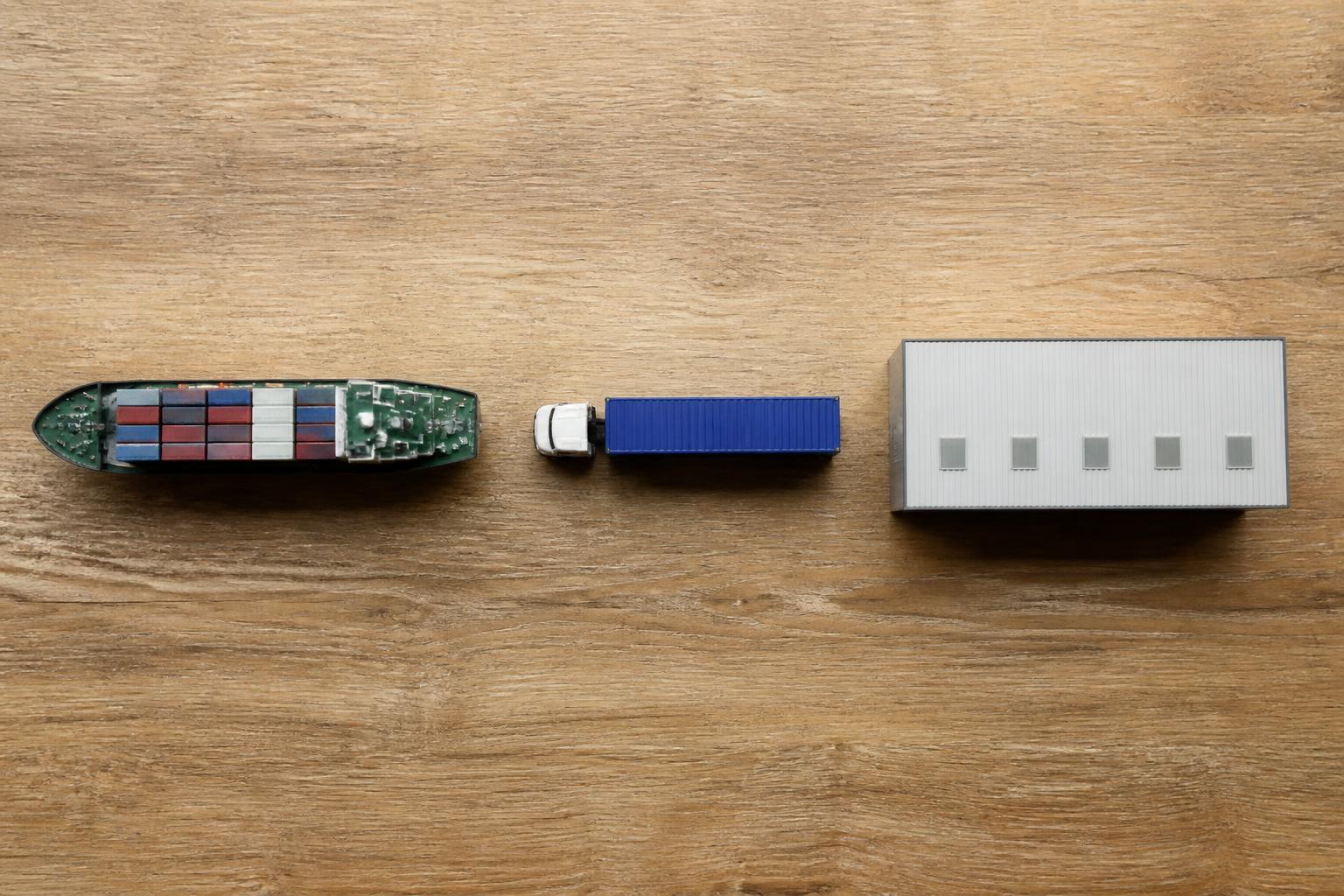
When a container is moving from quay to your warehouse, the avoidable costs usually appear before the lorry arrives. Storage starts because the box is not collected within port free time. Demurrage starts because the shipping line’s free time on the equipment runs out. Both are often the result of poor control over release, customs status, booking windows, or communication when the plan changes.
Our job is to keep that move under control. For container transport from port to warehouse in the UK, that means booking the collection ourselves as merchant haulage, checking whether the box is actually collectable before we send a vehicle, matching the port slot to the free time available, and telling you early if a container is at risk. We collect from Felixstowe, London Gateway, Tilbury, Purfleet, Southampton and Liverpool, then deliver across Great Britain using our own fleet on operator licence OF2023521, with vetted partner hauliers for overflow where needed.
Merchant haulage or line haulage: which gives you more control?
The practical difference is simple. With merchant haulage, you book us directly and we control the road move. With shipping line-arranged delivery, the line appoints the haulier and controls the inland leg through its own process.
For many importers and forwarders, merchant haulage gives better control in four areas.
First, booking control. When we act on merchant haulage, we can book the port slot around the actual release position, customs clearance and warehouse readiness. If the container is urgent, we can look for the earliest workable slot. If the warehouse has a fixed unloading window, we can plan around that rather than wait for a line-appointed movement to appear in the system.
Second, communication. When there is a problem, you need the answer from the party making the booking. If the release has not landed, if customs status is not clear, or if the port has no suitable slots left inside free time, we can tell you directly and decide the next step with you. That is harder when the road move sits inside the shipping line’s inland service and information passes through several parties.
Third, cost visibility. Merchant haulage separates the haulage charge from shipping line costs such as demurrage, detention and storage. That makes it easier to see what is driving spend. If a container incurs storage because the release was late or because the port slot could not be secured in time, that can be identified and dealt with, rather than disappearing into a broader line invoice.
Fourth, response when a box is at risk. This is where control matters most. If we can see that free time is tight, we can check whether the container is customs cleared, whether the release reference is live, whether the terminal booking is possible, and whether the delivery point can receive. If one of those elements is missing, we can raise it before the last free day. That early warning is often what prevents port storage or a failed collection.
Line haulage still suits some traffic. If the shipping line has offered a through rate that works for the shipment, or if the consignee wants a single supplier for the ocean and inland leg, line haulage may be acceptable. But where timing is tight, communication matters, or the delivery needs to be managed around warehouse constraints, merchant haulage usually gives you more practical control.
What actually changes the cost from port to warehouse
The biggest mistake in comparing container transport from port to warehouse in the UK is to look only at mileage. Distance matters, but it is only one part of the cost.
Free time is the first real driver. A move with ample free time is easier to plan than one where the release arrives late and collection has to happen immediately. If a box has one workable day left before storage starts, the collection has to be planned around that deadline. The same applies to shipping line free time on the container itself. If the box must be turned quickly after delivery, that affects whether the move can include waiting for unload, overnight standing, or a later empty return.
Waiting time is another direct cost driver. Port work and warehouse work both create waiting risk. At the delivery end, delays often come from a site not being ready, no forklift available, no safe access for the vehicle, or unloading taking longer than planned. A straightforward live unload is not the same cost as a delivery where the driver is held for hours.
Failed collections are expensive because they waste the slot, the vehicle time and often the best chance to stay inside free time. A failed collection can happen because the release is not valid, customs is not cleared, the container is on hold, the VBS booking is wrong, or the terminal cannot hand out the box for operational reasons. That is why we check the collectability of the container before dispatch wherever possible. We cover that in more detail in our guide to who can collect a container from Felixstowe and what must be in place first.
Container type also changes the job. Standard dry boxes are one thing. A 20ft ISO Container can bring weight constraints that affect vehicle planning and route choice. A 40ft ISO Container and 45ft ISO Container may affect delivery access and unloading arrangements. A Refrigerated Container adds power, temperature and urgency considerations, especially if the consignee needs a specific delivery sequence or the unit must stay on supply until unloading. We cover the practical checks in our article on choosing a reefer container haulier without extra port cost.
FCL and LCL also affect the cost structure. A straight FCL quay to warehouse delivery is usually the cleanest move. LCL is different because the container may first need to go to a deconsolidation point, or the final consignee may be receiving cargo rated by CBM rather than taking the whole box. In that case, the inland move may be linked to unpacking arrangements, handling times and warehouse booking restrictions that do not apply to a standard FCL import.
Finally, the delivery point matters. The same port collection can become a very different job depending on whether the warehouse is close to the port, in a restricted urban location, on a timed booking, or in a rural site with difficult access. A realistic haulage plan has to reflect the actual delivery conditions, not just the postcode.
How port systems and release status affect collection planning
A container is not collectable just because the vessel has discharged.
Before we book a collection, we need the release position to be right, customs status to allow movement, and the terminal system to offer a workable slot. If any one of those is missing, the vehicle can arrive at the port and still not get the box.
Release comes first. The shipping line or its UK agent must issue the release in the correct form for that port and container. If there is a problem with the bill of lading, unpaid charges, a missing authority, or a mismatch in references, release may not be live even though everyone expects the box to move. We would rather find that out before booking than at the gate.
Customs status also has to be right. In the UK, import customs formalities after Brexit are not just an EU general rule copied across. The UK system has its own procedures, and the container must be in a status that permits removal from the port. If the entry is not accepted, if there is an exam or hold, or if transit arrangements are not in place where needed, collection may not be possible.
Then there is the booking system. At Felixstowe, the Container Booking System, CBS, controls vehicle bookings. In day to day use, people may refer to CBS and CARGOES VBS interchangeably when talking about securing the vehicle slot for collection. What matters operationally is that the booking has to match the container, the terminal’s available windows and the free time available. A booking tomorrow is no good if storage starts today. A booking this afternoon is no use if release will not be live until evening.
This is why collection planning is not just “can you send a lorry”. It is “is the box released, customs cleared, and bookable inside free time”. When timing is tight, we look at the earliest realistic slot and whether same-day collection is genuinely possible, not just theoretically available in the system. For urgent cases, our guide on securing a same-day port collection in the UK sets out what needs to line up.
Matching the booking to free time is the key discipline. If there are only limited slots left before storage starts, that affects whether to collect immediately, whether to prioritise one box over another, and whether the warehouse can actually receive the container once collected. Pulling a box out of port only helps if the onward plan is workable.
Comparing coverage by port and inland delivery point
Not every haulier serves every major container port in a way that gives you real flexibility. Some may advertise national coverage but rely on ad hoc subcontracting for ports they do not regularly work. The question to ask is not only “do you cover this port”, but “can you book it, collect it reliably, and deliver it where we need it within Great Britain”.
We collect from Felixstowe, London Gateway, Tilbury, Purfleet, Southampton and Liverpool. That matters because coverage by port changes your options when vessels roll, when routing changes, or when one terminal becomes congested.
Felixstowe remains a core import gateway for many of our customers, and our base at Bridge Farm, Woolpit, Suffolk, IP30 9PQ - where we provide Woolpit Truck Repairs services - places us about 35 miles by road from the port. That proximity helps when timing is tight and when early communication matters. It also means we work daily with the local booking and collection routines that affect merchant haulage.
London Gateway, Tilbury and Purfleet are important for deliveries into the South East, London and the wider Midlands corridor, but they are not interchangeable in practice. Delivery planning depends on where the goods are actually going, the warehouse booking rules, and whether the consignee can receive a full size articulated container vehicle without issue.
Southampton often suits cargo flowing into the South and West, but the best port on paper is not always the best port in operation if the inland delivery point has a narrow receiving window or the container is running short on free time.
Liverpool is equally important for traffic into the North West, Yorkshire, the Midlands and Scotland-facing distribution patterns. If you are comparing options for western port arrivals, the real issue is not just whether a haulier can quote Liverpool, but whether it can manage the timing and communication needed to avoid extra port cost. We cover that in our article on Liverpool container haulage planned to avoid avoidable port charges.
Coverage also needs to be matched to inland delivery points. A haulier may be strong at one port but weak on certain inland lanes, especially where specialist site access, timed bookings, or repeat retail and manufacturing deliveries are involved. We deliver across Great Britain using our own 40 vehicles and 40 trailers, with vetted partner hauliers on their own operator licences taking additional volume when required. For importers and forwarders, that means the port list and the inland delivery pattern should be considered together, not separately.
What to check on equipment, liability and special cargo before booking
Before you book, confirm the equipment and cargo assumptions. Many avoidable delays start with a box type or cargo detail that was never clearly stated.
Start with the container itself. We move ISO containers including 20ft ISO Container, 40ft ISO Container and 45ft ISO Container units, but those sizes do not carry the same practical implications. A 20ft ISO Container may be straightforward dimensionally but heavy in gross weight. A 45ft ISO Container may create access issues at older sites or yards with limited turning space. If the loaded weight is high, say so at booking stage. Overweight planning is not something to leave until the collection slot has been secured.
For Refrigerated Container work, confirm whether the unit needs power before unloading, whether the receiver can unload promptly, and whether there are any product-specific handling requirements. Reefer cargo often has less tolerance for waiting and failed delivery than standard dry freight.
Then check cargo restrictions. If the load is ADR, waste, animal by-products, or animal feed, that should be declared before booking. We are an upper tier waste carrier and dealer, CBDU471791, and we are registered with APHA to carry Category 3 animal by-products, animal feed in shipping containers, quay to premises, U1433815/TRANS. But those movements still need prior confirmation because the paperwork, route planning and receiving arrangements must be right before the vehicle is dispatched.
Liability should be checked just as carefully as equipment. Standard road haulage terms do not all provide the same level of cover. Our freight liability is £6,500 per tonne under RHA 2024 conditions, which is five times the usual RHA standard of £1,300 per tonne. The same limit applies on subcontracted loads, and up to £10,000 per tonne is available by arrangement for high value freight. If your cargo value is materially above standard haulage limits, say so before the move is booked. That is the point at which additional cover can be arranged if needed.
Also confirm the delivery method. Is it a live unload at the warehouse, a grounded operation by others, or a move to another handling point linked to LCL unpacking? Is there a booking reference for the warehouse? Are there site rules for PPE, arrival notice, vehicle height, or restricted hours? These are basic checks, but they are often the difference between a clean delivery and a failed one that pushes cost back up the chain.
We have moved more than 75,000 containers since 2019, mostly as merchant haulage booked directly by importers and freight forwarders. In practice, avoiding storage and demurrage is not about one trick or one system. It comes from doing the basics properly, release checked, customs status clear, port slot booked in time, equipment matched to the load, and the consignee ready to receive. That is how we keep container transport from port to warehouse in the UK under control, and that is where avoidable cost usually disappears.
Is merchant haulage usually better than using the shipping line's delivery option?
It depends on how much control you need. merchant haulage usually gives the importer or forwarder clearer control over booking, communication and escalation when release or free time becomes tight.
What is the main risk if port collection is not planned early?
The main risk is avoidable demurrage or storage because the container is not collected within free time, or a booking is missed because release, customs or slot availability was not checked in time.
Does Felixstowe still use CARGOES VBS?
No. At Felixstowe, collections are booked on the Container Booking System or CBS, which replaced the Vehicle Booking System in January 2025.
What should I ask about freight liability before booking?
Ask for the haulier's freight liability limit, the terms it is written on, and whether the same limit applies to subcontracted loads. Check whether a higher limit is available by arrangement.
Can one haulier cover more than one UK port?
Yes. That matters if your imports land at different terminals. A haulier serving Felixstowe, London Gateway, Tilbury, Purfleet, Southampton and Liverpool can simplify planning across multiple routings.