Escort vehicle requirements UK: what transport operators need to know

Escort vehicles are not universally required by statute in the UK, but industry Codes of Practice set precise technical standards that operators must follow, and police retain the authority to mandate a Special Police Service (SPS) escort by risk assessment. Understanding the distinction between statutory obligation and authoritative guidance is the first thing any transport planner needs to get right.
The primary authorities governing this area are the National Highways Lighting and Marking Code of Practice for abnormal load self-escorting vehicles, the Construction Plant-hire Association (CPA) Code of Practice for self-escorting abnormal loads, and the Department for Transport’s Special types enforcement guide. Together, these documents define what a compliant escort vehicle looks like, when one is expected, and what happens when police decide the risk profile of a movement demands more than a private escort can lawfully provide.
The headline requirements at a glance:
- Legal status: No primary legislation compels the use of an escort vehicle for abnormal loads; self-escorting has been standard guidance-based practice since 2004, but police can require SPS where their risk assessment indicates it is necessary.
- Width and length triggers: Guidance typically sets escort expectations at widths around 4.1–4.6m on non-motorway roads, with different thresholds applying on motorways and subject to local authority or police variation.
- Beacon standard: A full-width amber lightbar meeting ECE R65 is the required beacon type; flash rates should alternate at 1–3Hz to maximise conspicuity without causing glare.
- Minimum vehicle form: Four wheels minimum, no open cargo space, must not form part of the load unit itself.
- Police discretion: If police require SPS, a notification can be rejected or movement refused until that requirement is met. Operators who have not budgeted for SPS face real commercial disruption.
Key takeaways
Escort vehicles in the UK are governed by authoritative Codes of Practice rather than primary statute, but police discretion and the ECE R65 beacon standard make technical compliance non-negotiable for any operator planning an abnormal load movement.
| Point | Details |
|---|---|
| Legal status of escorting | No primary statute compels escort use; Codes of Practice set the standard and police can mandate SPS by risk assessment. |
| Beacon requirement | A full-width ECE R65 amber lightbar is required; single rotating beacons do not satisfy the Code of Practice. |
| Minimum equipment | Carry at least 12 BS 873 cones, four BS 3143 cone lighting units, a BS EN3 fire extinguisher, and a maintained first-aid kit. |
| Private escort powers | Private escorts have no statutory authority to stop or direct traffic; any such requirement triggers an SPS obligation. |
| Jhaulage capability | Jhaulage provides specialist container and abnormal load haulage with escort coordination and SPS liaison support across major UK ports. |
Table of Contents
- What do UK escort vehicle regulations actually require by law?
- When is an escort vehicle normally expected?
- What are the technical specifications for an escort vehicle?
- What markings, signs and lighting does an escort vehicle need?
- What equipment must an escort vehicle carry?
- What are the duties and training requirements for escort drivers?
- How do you notify a movement and plan the route?
- Can private escort drivers lawfully stop or direct other traffic?
- Operator pre-journey checklist and on-route best practice
- Why proper escorting matters more than operators often assume
- Jhaulage supports abnormal and container load movements across the UK
- Sources
What do UK escort vehicle regulations actually require by law?
The legal framework for abnormal load movements sits primarily in the Road Traffic Act 1988 and the Road Vehicles (Construction and Use) Regulations 1986, supplemented by the Motor Vehicles (Authorisation of Special Types) General Order 2003 (STGO). These instruments define what constitutes a special type vehicle and set the conditions under which abnormal loads may travel on public roads. What they do not do is specify in granular detail how an escort vehicle must be equipped.
That detail lives in Codes of Practice and guidance documents endorsed by the Department for Transport and National Highways. The CPA Code of Practice makes the position explicit: self-escorting is a guidance-based practice, not a primary statutory requirement. Operators who follow the Codes of Practice are demonstrating compliance with the recognised industry standard, and courts and enforcement officers treat adherence to those codes as evidence of due diligence. Departure from them, by contrast, creates measurable enforcement risk.
The Road Vehicles Lighting Regulations 1989 do carry statutory force on the use of special warning lamps, setting the conditions under which amber beacons may lawfully be used during escorting activity. This is one area where the boundary between guidance and statute is particularly sharp: the beacon itself must comply with the Regulations, even though the broader escorting framework is guidance-based.
Police discretion operates through the Special Types enforcement guide and through the National Police Chiefs’ Council (NPCC) framework. When a police force conducts a risk assessment on a notified movement and concludes that a private escort cannot safely manage the route, it can require SPS. That requirement is not a recommendation.
The practical implication is that operators must treat the Codes of Practice as effectively binding, plan for the possibility of SPS on any complex route, and never assume that a movement is automatically self-escortable simply because it falls within typical dimensional thresholds.
Key distinctions to keep in mind:
- Primary legislation (Road Traffic Act, STGO, Lighting Regulations): legally binding, enforceable by police and DVSA.
- Codes of Practice (National Highways, CPA): authoritative guidance endorsed by DfT; courts treat compliance as evidence of due diligence.
- Police SPS decisions: discretionary but operationally mandatory once issued; operators cannot override them.
- Local authority conditions: highways authorities may impose route-specific conditions that carry statutory weight through the notification approval process.
When is an escort vehicle normally expected?
The Codes of Practice set out dimensional thresholds as guidance for when an escort is normally expected, rather than as hard statutory triggers. The National Highways Code of Practice indicates that on non-motorway roads, escort expectations typically arise at widths in the range of 4.1–4.6m, with motorways carrying different and generally higher thresholds. Length and gross weight also factor in, particularly for Category 2 and Category 3 STGO movements.
What makes this more complex in practice is that thresholds are not fixed nationally. Local authorities and police forces can alter the trigger points based on route-specific factors: bridge structures, narrow junctions, residential areas, school zones, and peak traffic periods all influence the assessment. A movement that would self-escort on a motorway corridor may require a full SPS arrangement through a market town.
The NCC has flagged growing inconsistency between police forces in deciding when SPS is required, with some forces tightening their triggers and creating commercial risk for operators who had not budgeted for a police escort. This is not a marginal concern: SPS costs are charged to the operator and can materially affect the economics of a movement.
Typical triggers where an escort is normally expected include:
- Widths at or near the low four metres range on non-motorway roads, subject to local variation.
- Lengths that require management of junctions, roundabouts or level crossings.
- Movements on routes with restricted structures, low bridges or weight-limited roads.
- Night-time movements or those during peak traffic periods where traffic management is required.
- Any movement where the load or vehicle combination requires traffic to be stopped or directed across road markings, which is a police power and therefore triggers SPS.
Who ultimately decides is the notifying authority (typically the police force covering the route) in conjunction with the relevant highways authority. If they determine that the risk profile exceeds what a private escort can manage, the movement does not proceed until SPS is arranged. Operators who plan for this contingency from the outset, rather than discovering it after a notification is rejected, avoid the most costly delays.
What are the technical specifications for an escort vehicle?
The National Highways Code of Practice sets out the vehicle specification in detail. The starting point is straightforward: an escort vehicle must have a minimum of four wheels, must not have an open cargo space, and must not form part of the load unit being escorted. Beyond those fundamentals, the specification covers visibility, colour, and the physical arrangement of markings and beacons.
Colour and conspicuity
White, yellow, and orange are the recommended body colours for escort vehicles, chosen for maximum conspicuity in varying light and weather conditions. Silver vehicles are frequently flagged by enforcement officers unless the operator has compensated with heavy retroreflective material across the vehicle’s surfaces. Company livery is permitted but must not obscure or visually compete with the front and rear legend signs, which carry specific wording and lettering-size requirements.
Mirrors and visibility
Escort drivers need clear rear and side observation to monitor the load and surrounding traffic. The Code of Practice recommends that mirrors and windows provide unobstructed sightlines, and that roof-mounted equipment, including any additional lighting, does not obstruct the driver’s ability to observe the load or the road behind. Roof obstructions that could partially obscure the amber lightbar are specifically discouraged.
Vehicle type guidance
Whilst the Code of Practice does not mandate a specific vehicle type, estate cars, vans, and purpose-built escort vehicles are the most commonly used platforms because they offer the roof space for a full-width lightbar, adequate interior storage for safety equipment, and the visibility profile that enforcement officers expect. Pick-up trucks with open cargo beds are not suitable because they fail the open cargo space requirement.
| Specification | Requirement |
|---|---|
| Minimum wheels | Four |
| Cargo space | Enclosed; no open cargo area |
| Part of load unit | Must not form part of the load |
| Recommended colours | White, yellow, orange |
| Silver vehicles | Permitted only with heavy retroreflective compensation |
| Roof obstructions | Must not obscure beacons or impair rear observation |
| Mirrors/windows | Must provide clear rear and side sightlines |
What markings, signs and lighting does an escort vehicle need?
This is where the technical requirements become most granular, and where operators most frequently encounter enforcement issues. The National Highways Code of Practice specifies beacon type, flash rate, legend wording, lettering dimensions, chevron geometry, and retroreflective material class.
Beacons and lighting
The required beacon is a full-width amber lightbar meeting ECE R65. Single rotating beacons do not satisfy this requirement for self-escorting vehicles. The Code of Practice recommends that alternating beacons operate at 1–3Hz to maximise conspicuity; flash rates above approximately 10Hz increase glare and raise the risk of an epileptic response. The lightbar must be mounted at roof level and must not be obstructed by roof-rack equipment or aerials.

Legend signs
Front and rear legend signs carry specific wording options: ‘Escort Vehicle’, ‘Escort’, ‘Abnormal Load’, or ‘Wide Load’. The minimum lettering height for front-mounted signs is 150mm; for roof-mounted signs, the minimum is 100mm. Lettering must be in a clear, legible font and must be produced in retroreflective material to the appropriate class standard. Signs must be displayed whenever the escort vehicle is operating in its escorting role and removed or covered when the vehicle is not on escort duty.
Chevrons and retroreflective strips
The rear of the escort vehicle must carry a chevron board. The Code of Practice specifies strip widths for cars and vans, with retroreflective material meeting at least RA1 class (Class 1 retroreflective sheeting), though RA2 (Class 2) is recommended for higher conspicuity. Side retroreflective strips and outline markings are also recommended, particularly for vehicles operating at night or in low-visibility conditions.
Pro Tip: Always verify that your retroreflective material carries the correct class marking before a movement. RA1 and RA2 sheeting look similar to the untrained eye but perform very differently at night, and enforcement officers can and do check material class on roadside inspections.
| Element | Specification |
|---|---|
| Beacon type | Full-width amber lightbar, ECE R65 approved |
| Flash rate | 1–3Hz alternating; above ~10Hz increases glare risk |
| Front legend lettering | Minimum 150mm height, retroreflective material |
| Roof sign lettering | Minimum 100mm height, retroreflective material |
| Legend wording options | ‘Escort Vehicle’, ‘Escort’, ‘Abnormal Load’, ‘Wide Load’ |
| Rear chevrons | Required; strip widths per Code of Practice for vehicle type |
| Retroreflective class | RA1 minimum; RA2 recommended |
| Side strips | Recommended, particularly for night operations |
What equipment must an escort vehicle carry?
The Code of Practice sets out a minimum equipment list that every escort vehicle must carry before departure. This is not advisory: an escort vehicle that arrives on site without the specified kit is not compliant, and enforcement officers treat missing equipment as a material deficiency.
Traffic cones and lighting units
The minimum requirement is 12 traffic cones meeting BS 873: Part 8:1985, together with a minimum of four cone-mounted flashing lighting units meeting BS 3143. Cones must be in serviceable condition; cracked, faded, or deformed cones do not satisfy the standard. The lighting units must be charged or have fresh batteries before departure.
Fire extinguisher and first-aid kit
A fire extinguisher to BS EN3 and BAFE standards is required. The first-aid kit must be maintained and in date; an expired or depleted kit is a compliance failure. Both items should be stored accessibly, not buried under equipment in the boot.
Communications equipment
- A two-way radio or equivalent communications device capable of maintaining contact with the load vehicle throughout the movement.
- A mobile telephone as a backup communications channel.
- Radio licences must be in order if the equipment operates on licensed frequencies; CB radio and PMR446 handhelds are commonly used on unlicensed bands and are straightforward to deploy.
Documentation to carry
- Signed route approval documents and movement notification reference numbers.
- Contact details for the relevant police control room and highways authority.
- Route maps or a printed route plan with lay-up points marked.
- The escort driver’s competency evidence or training certificate.
- Vehicle insurance documents confirming the vehicle is insured for escort use.
- Emergency contact numbers for the operator and the load vehicle driver.
What are the duties and training requirements for escort drivers?
Escort driving is a specialised role that combines route knowledge, risk assessment, and communications discipline. Equipment alone does not make an escort compliant; the driver operating that equipment must be competent to do so. The Lantra skills framework and CPA operating guidance both set out the human requirements in detail.
Driver prerequisites
The Lantra framework recommends a minimum age of 21, a full standard driving licence, and the ability to communicate in English. Competence must be demonstrated through formal training or documented operational experience. A driver who has never escorted an abnormal load and has received no structured training is not a compliant escort driver, regardless of how well-equipped the vehicle is.
Operational duties
Escort drivers carry a defined set of responsibilities during a movement:
- Maintaining continuous communications with the load vehicle driver throughout the journey.
- Conducting pre-journey route familiarisation, including identifying pinch points, low bridges, and junction geometry.
- Monitoring traffic build-up behind the load and managing safe lay-up points to allow vehicles to pass.
- Assisting vulnerable road users, including cyclists and pedestrians, at junctions and crossing points.
- Responding to incidents promptly, including deploying cones and lighting units to protect the scene.
- Liaising with police or highways authority representatives at agreed points along the route.
Pro Tip: Documented training through a recognised scheme such as Lantra materially reduces your enforcement risk. If a police officer or DVSA examiner questions driver competence at the roadside, a training certificate is far more persuasive than a verbal assurance. It also strengthens your position if a notification is challenged.
The role of driver compliance in haulage is a point Jhaulage returns to consistently: the commercial cost of a rejected notification or an enforcement stop almost always exceeds the cost of proper training upfront.
How do you notify a movement and plan the route?
The notification process for abnormal load movements in the UK operates through ESDAL (Electronic Service Delivery for Abnormal Loads), the online system managed by National Highways. Every operator planning a movement that requires notification must submit through ESDAL, providing the relevant dimensional and weight data, the proposed route, and the movement timetable.
- Register on ESDAL and create a movement record with accurate vehicle and load dimensions, gross weight, and axle configuration.
- Submit the route plan, including proposed start time, estimated duration, lay-up points, and any agreed restrictions (time windows, speed limits, road closures).
- Await responses from the notified authorities, which include the relevant police forces, National Highways, and local highways authorities along the route. Each authority has a statutory period in which to respond.
- Address any conditions or objections raised by notified authorities. If a police force requires SPS, this must be arranged before the movement can proceed.
- Confirm the movement once all authorities have responded and any conditions are agreed. Keep the confirmation reference with the movement documentation.
Route planning must go beyond the ESDAL submission. Pre-inspecting the route on foot or by car before the movement day is standard practice for complex or unfamiliar routes. Identify:
- Low bridges, weight-restricted structures, and overhead cables.
- Junction geometry that may require the load to swing wide or require traffic management.
- Lay-up points where the convoy can safely pull off the carriageway to allow traffic to pass.
- Any road works or temporary traffic management that may not yet appear on mapping systems.
If police or highways authorities request SPS or specific mitigation measures after notification, engage with them promptly and document every communication. A well-documented negotiation record protects the operator if a dispute arises later. For guidance on the broader compliance picture for heavy container movements, Jhaulage’s abnormal load haulage guide covers route planning and authority liaison in further detail.
Can private escort drivers lawfully stop or direct other traffic?
No. Private escort drivers have no statutory power to stop or direct general traffic. This is one of the most operationally significant boundaries in UK escort vehicle regulations, and misunderstanding it creates serious liability exposure.
Stopping traffic, directing vehicles across solid white lines, or requiring other road users to halt are police powers. A private escort driver who attempts any of these actions is acting outside their legal authority. If an incident occurs as a result, the operator’s insurance position may be compromised and the driver may face personal liability.
Activities that specifically require SPS rather than a private escort include:
- Stopping traffic on structures such as bridges or viaducts.
- Directing traffic across solid white lines or road markings.
- Holding traffic at junctions while the load negotiates a tight turn.
- Any situation where other road users must be compelled to stop or change their path.
The Special types enforcement guide is explicit on police authority in these situations. Operators should identify these requirements during route planning, not at the roadside. Where SPS is needed, document the decision and the liaison with the relevant police force. That documentation reduces commercial and insurance exposure if the movement is later scrutinised.
For movements involving hazardous cargo, where the interaction between escorting requirements and STGO conditions becomes more complex, Jhaulage’s hazardous cargo compliance guide provides additional context on authority liaison and special conditions.
Operator pre-journey checklist and on-route best practice
A rejected notification or an enforcement stop on the day of movement is almost always traceable to a gap in pre-journey preparation. The following checklist reflects the requirements of the Codes of Practice and the CPA operating guidance.
Pre-departure checklist
- Confirm that the escort vehicle meets the minimum specification: four wheels, enclosed cargo space, correct colour or retroreflective compensation.
- Verify that the ECE R65 full-width amber lightbar is functioning correctly and is not obstructed.
- Check that front and rear legend signs are fitted, correctly worded, and displaying retroreflective material in serviceable condition.
- Confirm that rear chevrons are fitted and that retroreflective sheeting is undamaged.
- Count and inspect the 12 traffic cones (BS 873: Part 8:1985) and four cone lighting units (BS 3143).
- Check the fire extinguisher (BS EN3/BAFE) and first-aid kit for currency and completeness.
- Test communications equipment: radio and mobile telephone, confirming contact with the load vehicle driver.
- Confirm the escort driver holds a valid licence, meets the minimum age requirement, and can produce competency evidence.
- Review the route plan, including lay-up points, pinch points, and any conditions imposed by notified authorities.
- Confirm movement notification reference numbers and carry all route approval documentation.
On-route best practice
- Maintain the agreed convoy spacing and never allow the gap between escort and load to become so large that communication is compromised.
- Use radio communications at every agreed checkpoint; do not rely solely on mobile telephone during the movement.
- At lay-up points, deploy cones and lighting units promptly to protect the stationary convoy from following traffic.
- Monitor traffic build-up regularly; if a queue exceeds a safe length, identify the next available lay-up point and use it.
- Never attempt to stop or direct other traffic; if a situation arises that requires traffic management beyond the escort’s lawful authority, contact the police immediately.
- Photograph the escort vehicle setup before departure and at any point where conditions change materially. Photographic evidence of a compliant setup is valuable if compliance is later questioned.
- Keep a written log of the movement, including departure time, lay-up times, any incidents, and arrival time. This record supports both compliance demonstration and any future notification submissions on the same route.
For a broader compliance framework that complements this checklist, the container transport compliance checklist covers the wider documentation and vehicle-check requirements for container movements.
Why proper escorting matters more than operators often assume
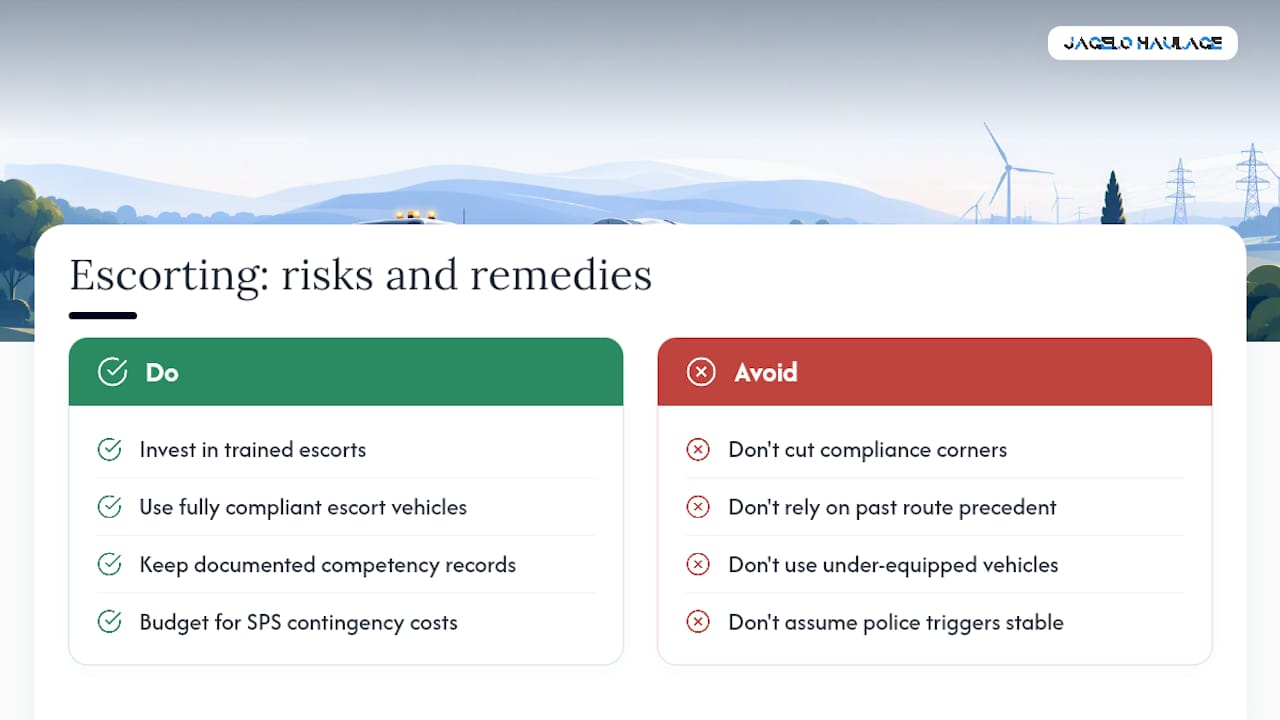
The commercial logic of cutting corners on escort compliance looks attractive until the first enforcement stop. A rejected notification costs the operator the SPS fee, any re-notification charges, and the demurrage or detention costs that accumulate while the load sits waiting. On a time-sensitive port movement, those costs can exceed the entire margin on the job within a few hours.
What the industry does not discuss enough is the asymmetry of risk. A properly equipped, trained escort with documented competency and a compliant vehicle is a strong negotiating position when a police force is deciding whether to require SPS. An operator who arrives at the notification stage with a silver estate car, no training records, and a single rotating beacon is handing the police every reason to mandate a more expensive arrangement.
The NCC’s work on abnormal load transportation has highlighted that inconsistency between forces is a real and growing problem. Some forces have tightened their SPS triggers significantly, and operators who relied on historical precedent for a particular route have found themselves facing unexpected SPS requirements. The only reliable mitigation is to build SPS contingency into every movement budget and to present the strongest possible compliance case at notification stage.
There is also a reputational dimension. Freight forwarders and port operators who contract haulage services increasingly scrutinise compliance records. A history of rejected notifications or enforcement incidents is visible within the industry and affects future contract opportunities. Investing in trained escorts and correctly equipped vehicles is not simply a regulatory obligation; it is a commercial differentiator.
Jhaulage supports abnormal and container load movements across the UK
Operators planning abnormal or oversized container movements need more than a compliant escort vehicle. They need a haulage partner with the route knowledge, authority relationships, and operational discipline to manage the full movement from port to destination without disruption.
Jhaulage provides specialist container haulage across major UK ports including Felixstowe, Tilbury, Southampton, and Liverpool, with a fleet of over 40 GPS-tracked vehicles and direct experience coordinating oversized and heavy-load movements. For movements that require escort planning, SPS liaison, or route pre-inspection, the team can support operators from the notification stage through to delivery.
If you are planning a movement that requires escort coordination or want to discuss route planning and authority liaison for an abnormal load, contact Jhaulage for a direct conversation with a specialist. The team is available 24/7 and can advise on permit requirements, SPS contingency planning, and compliant escort vehicle arrangements before you submit your ESDAL notification.
Sources
The documents below are the authoritative sources for every technical and procedural requirement covered in this article. Operators should download and retain the relevant PDFs as working references.
- Lighting and marking for abnormal load self-escorting vehicles (Code of Practice)
- Code of Practice - Construction Plant-hire Association
- Special types enforcement guide
- Lighting and marking COP for abnormal load self-escorting vehicles (National Highways)
- Our work on the transportation of abnormal loads (NCC)
The abnormal load haulage guide published by Jhaulage provides a practical operator-level overview of the full movement process, from permit applications through to port delivery, and complements the technical detail in the documents above.
This article is general information, not a substitute for advice from a qualified lawyer. Consult a qualified legal professional about your own circumstances before acting on anything here.