Role of driver compliance in haulage: 2026 guide

Driver compliance in haulage is defined as the strict observance of legal regulations and operational standards governing professional drivers, covering everything from tachograph rules and driver hours to Driver CPC training and licence verification. The role of driver compliance in haulage extends well beyond avoiding fines. It determines whether an operator retains its licence, whether drivers remain safe on public roads, and whether freight reaches its destination without regulatory interruption. UK regulatory bodies, including the Driver and Vehicle Standards Agency (DVSA) and the Traffic Commissioners, hold operators and transport managers jointly accountable for maintaining these standards across every vehicle and every shift.
What are the key UK rules drivers must comply with in haulage?
UK haulage regulations set firm limits on driver hours, rest periods, and data management. Compliance officers must know these rules precisely, because ignorance is not a defence at a public inquiry.
Driver hours and rest requirements

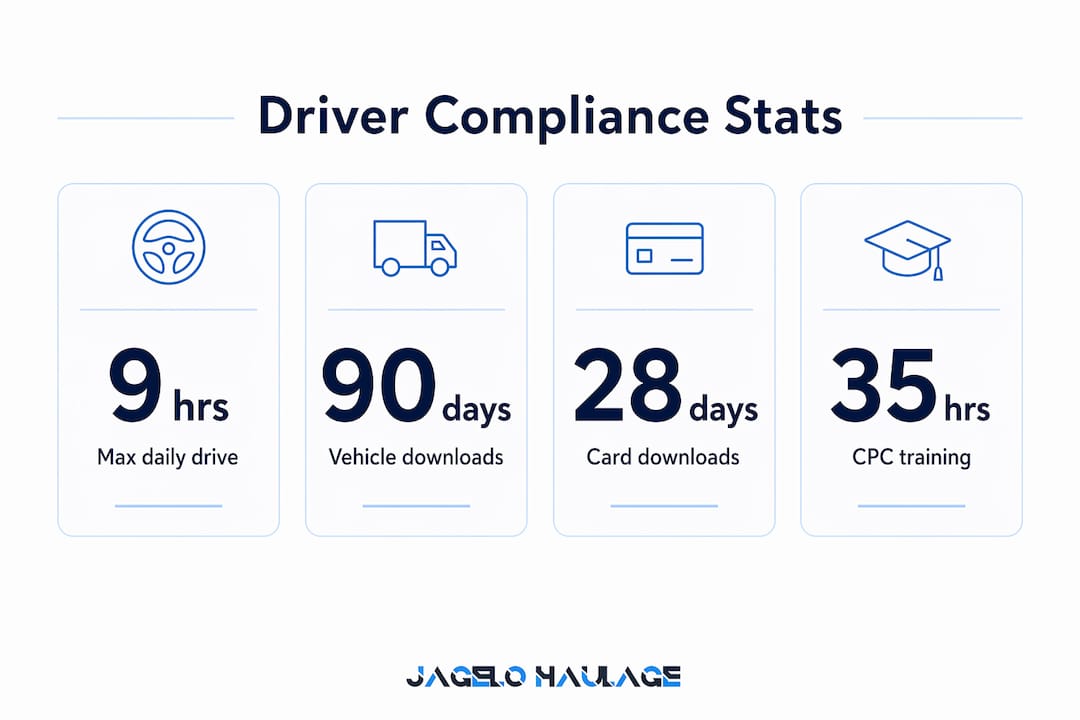
The EU drivers’ hours rules, which continue to apply in Great Britain, set a daily driving limit of nine hours (extendable to ten hours twice a week), a maximum weekly driving time of 56 hours, and a fortnightly cap of 90 hours. Drivers must take a 45-minute break after 4.5 hours of continuous driving. These limits exist because fatigue impairs judgement to a degree comparable with alcohol impairment, as Traffic Commissioners have stated publicly.
Tachograph data obligations
UK law requires tachograph data downloads at fixed intervals: vehicle unit data every 90 days and driver card data every 28 days. Transport managers carry legal responsibility for analysing this data to demonstrate continuous and effective control over their fleet. Missing a download deadline is not a minor administrative oversight. It signals to the DVSA that the operator lacks control, which can trigger a formal investigation.
Driver CPC and licence checks
Drivers must complete 35 hours of periodic CPC training every five years to retain their Driver Certificate of Professional Competence. Operators must verify that credentials are current and conduct licence checks at least every six months. Failing to do so exposes the business to penalties and, in serious cases, to licence suspension.
Pro Tip: Set calendar reminders for every driver’s CPC expiry date and tachograph download deadline. A shared compliance calendar prevents the gaps that regulators find most damning.
| Requirement | Frequency or Limit |
|---|---|
| Vehicle unit tachograph download | Every 90 days |
| Driver card tachograph download | Every 28 days |
| Driver CPC periodic training | 35 hours every 5 years |
| Licence check frequency | At least every 6 months |
| Maximum daily driving | 9 hours (10 hours twice weekly) |
How do operators ensure continuous control over driver compliance?
Continuous and effective control is the legal standard the Traffic Commissioners apply when assessing whether an operator deserves to hold a licence. Meeting that standard requires active management, not passive record-keeping.
Regulatory bodies now scrutinise signed infringement reports and documented disciplinary records rather than simply checking whether files exist. An operator who holds tachograph data but never analyses it, never issues infringement notices, and never follows up with drivers has not demonstrated control. The distinction matters enormously at a public inquiry.
Effective transport manager oversight involves five core practices:
- Regular tachograph analysis. Download and review data on the legally required schedule. Use automated analysis tools to flag infringements by category and severity, then respond in writing to each driver.
- Trend monitoring. Track infringement patterns over time. A driver who repeatedly exceeds daily driving limits by small margins is a systemic risk, not an isolated case.
- Formalised disciplinary responses. Issue written infringement notices, record the driver’s response, and file both documents. Active issue closure is what regulators expect to see.
- Empowered transport managers. Transport managers who lack autonomous decision-making authority frequently cause compliance breaches. Empowered managers can override commercial pressure and prevent licence-threatening decisions.
- Open fatigue reporting culture. Drivers must feel safe reporting tiredness without fear of commercial repercussions. Industry experts confirm that compliance must evolve into a proactive culture where fatigue reporting is standard practice.
Pro Tip: Schedule a monthly compliance review meeting with your transport manager. Review the top five infringements from the previous month and agree on corrective actions before the next DVSA check.
You can also review fleet management best practices to understand how workplace systems and scheduling policies support a genuine compliance culture.
What are the operational benefits of strong driver compliance?
Strong compliance systems produce measurable operational advantages that go well beyond avoiding regulatory penalties.
“Compliance is not just about following the law. It is about preventing fatigue-related risks that are comparable to alcohol impairment, and that is a shared responsibility between drivers and operators.” — Traffic Commissioners
The financial case for compliance is clear. Operating a vehicle over 12 tonnes in Greater London without a valid safety permit results in a £550 penalty charge notice, reduced to £275 if paid within 14 days. Multiply that across a fleet operating in urban areas, and the cost of non-compliance becomes a serious budget risk.
Beyond fines, the operational benefits of strong compliance include:
- Reduced accident risk. Fatigue management through proper rest scheduling directly lowers the probability of road incidents, protecting drivers, cargo, and third parties.
- Licence stability. Operators with clean compliance records face fewer public inquiries and retain their operator licences without interruption.
- Reliable scheduling. Drivers who are properly rested and legally compliant are less likely to be pulled off the road mid-journey by enforcement officers, reducing delivery disruptions.
- Lower insurance exposure. Insurers assess compliance records when pricing commercial vehicle policies. A documented compliance programme supports favourable terms.
- Positive regulatory relationships. The DVSA and Traffic Commissioners treat operators with strong compliance histories more favourably during routine checks and formal hearings.
Modern UK haulage operations that adopt telematics and digital fleet management tools report reductions in operational costs of up to 15%. That figure reflects fewer breakdowns, better fuel management, and reduced infringement-related disruptions across the fleet.
What challenges arise in maintaining compliance, and how can managers address them?
General haulage is particularly vulnerable to compliance difficulties. Unpredictable loads and tight schedules create frequent hours infringements that planning systems often pressure drivers to absorb silently. Logistics managers must understand where the structural weaknesses lie before they can address them.
The most common compliance failure is not driver negligence. Flawed scheduling is the primary cause of infringements, because routes and delivery windows are built without realistic rest break buffers. When a driver cannot complete a run legally within the time allocated, the system has already failed before the vehicle leaves the yard.
| Challenge | Practical mitigation |
|---|---|
| Tight scheduling with no buffer | Build mandatory rest break windows into route planning software |
| Transport manager lacks authority | Define manager’s decision-making powers in writing within the operator licence undertaking |
| Patchy driver training | Maintain a training matrix and schedule CPC modules at least 12 months before expiry |
| Fragmented compliance records | Centralise tachograph data, infringement notices, and training records in one system |
| Driver reluctance to report fatigue | Introduce anonymous fatigue reporting and remove commercial penalties for honest disclosure |
Telematics and digital compliance platforms address several of these challenges simultaneously. GPS tracking combined with smart dashcam technology gives transport managers real-time visibility of driver behaviour, vehicle location, and hours status without waiting for a manual download.
Pro Tip: Use your scheduling software to flag any run that leaves less than a 20-minute buffer before a mandatory rest break. That single rule catches the majority of planning-driven infringements before they happen.
You can cross-reference your obligations against the container transport compliance checklist published by Jhaulage, which covers driver compliance obligations for UK transport operators in detail.
Key takeaways
Driver compliance in haulage requires active management, empowered transport managers, and scheduling systems that build rest compliance in from the start, not as an afterthought.
| Point | Details |
|---|---|
| Tachograph downloads are legally fixed | Vehicle units every 90 days, driver cards every 28 days, with analysis mandatory. |
| Scheduling causes most infringements | Build rest buffers into route planning to prevent systemic driver hours breaches. |
| Transport managers need real authority | Managers without autonomous decision-making power cannot prevent licence-threatening breaches. |
| Compliance culture beats box-ticking | Open fatigue reporting and documented responses demonstrate genuine control to regulators. |
| Technology reduces compliance costs | Telematics and digital fleet tools cut operational costs and support continuous oversight. |
The compliance standard most operators are still missing
The Traffic Commissioners have been saying for years that following the law is not enough. What they want to see is evidence that an operator has a system, that the system is working, and that when it fails, someone acts on it. Most operators I encounter have the paperwork. Very few have the culture.
The single most common gap I see is the transport manager who technically holds the CPC qualification but has no real authority. Directors override scheduling decisions. Commercial pressure wins over rest compliance. The manager signs the infringement notices but cannot change the root cause. That is not continuous and effective control. That is a liability waiting to be discovered at a public inquiry.
The second gap is fatigue culture. Drivers who fear commercial consequences for reporting tiredness will not report it. They will drive. The Traffic Commissioners have been explicit that fatigue risk is comparable to alcohol impairment, and operators who create conditions where drivers hide fatigue are not compliant in any meaningful sense, regardless of what the tachograph data shows.
My recommendation is straightforward. Audit your scheduling process first, not your tachograph downloads. If your routes have no buffer time, your compliance programme is built on sand. Fix the planning, empower the manager, and the paperwork will follow naturally.
— Vytautas
Jhaulage: compliant container haulage across UK ports
Jhaulage operates a fleet of over 40 trucks and trailers across major UK ports including Felixstowe, Tilbury, Southampton, and Liverpool, with GPS tracking on every vehicle and 24/7 operational support. Compliance is not a separate function at Jhaulage. It is built into scheduling, driver management, and fleet oversight from the outset.
For logistics managers and freight operators who need a haulage partner with a demonstrable compliance record, Jhaulage offers container haulage services covering port-to-door delivery, full container load shipments, and same-day collections. Every movement is tracked, every driver is verified, and every run is planned within legal hours limits. Contact Jhaulage to discuss your container transport requirements.
FAQ
What is driver compliance in haulage?
Driver compliance in haulage is the adherence of professional drivers and their operators to UK legal requirements covering driving hours, rest periods, tachograph data management, Driver CPC training, and vehicle licensing. It is a shared responsibility between drivers, transport managers, and operators.
How often must tachograph data be downloaded in the UK?
Vehicle unit data must be downloaded every 90 days and driver card data every 28 days, with transport managers legally responsible for analysing the data to demonstrate continuous control.
What are the penalties for non-compliance in haulage?
Penalties range from fixed penalty notices to operator licence suspension. Operating a vehicle over 12 tonnes in Greater London without a valid safety permit, for example, results in a £550 fine, reduced to £275 if paid within 14 days.
How many hours of Driver CPC training are required?
Drivers must complete 35 hours of periodic Driver CPC training every five years to retain their qualification. Operators must verify credentials and conduct licence checks at least every six months.
What is the most common cause of driver hours infringements?
Flawed scheduling, not driver negligence, is the primary cause of hours infringements. Routes built without realistic rest break buffers force drivers into non-compliance before a journey begins.
Recommended
- Container transport compliance checklist UK: 2026 guide | Jagelo Haulage
- Hazardous cargo container haulage: UK compliance guide | Jagelo Haulage
- Container haulage provider selection checklist: 2026 guide | Jagelo Haulage
- UK haulage sustainability practices: a logistics manager’s guide | Jagelo Haulage