ePOD in container haulage: a practical UK guide

Electronic proof of delivery (ePOD) is a digital delivery record that replaces paper PODs and CMR notes, capturing signatures, GPS coordinates, timestamps and photographic evidence at the point of delivery. For container hauliers, the operational case is straightforward: ePOD compresses invoice cycles from the typical 30–45 days associated with paper-based processes down to approximately 3–5 days, while simultaneously creating legally defensible delivery evidence for dispute resolution and eCMR-compliant cross-border hauls.
Three gains that matter most to container operations:
- Faster invoicing and working capital. Automated invoice triggers fire the moment a consignee signs on-glass, cutting days sales outstanding (DSO) without chasing paper.
- Stronger dispute resolution. Timestamped photos and GPS-verified signatures provide clear, searchable evidence when a consignee disputes damage or shortage.
- Real-time delivery visibility for OTIF reporting. Every delivery event feeds your TMS or visibility portal, giving planners accurate on-time, in-full data by lane and customer.
Major shippers are increasingly mandating electronic proof as a condition of new contracts, so ePOD is shifting from a competitive advantage to a commercial prerequisite.
Key takeaways
ePOD in container haulage compresses invoice cycles from 30–45 days to approximately 3–5 days while creating GPS-verified, timestamped delivery evidence that resolves disputes and supports eCMR-compliant cross-border documentation.
| Point | Details |
|---|---|
| Invoice cycle compression | ePOD triggers invoicing automatically on delivery, reducing DSO from 30–45 days to approximately 3–5 days. |
| Data captured at delivery | Signature, GPS, timestamp, photographs, unit counts and exception notes form the complete ePOD record. |
| eCMR for cross-border hauls | Verify ratification status for each trade lane and mandate customer acceptance in new contracts before relying on electronic consignment notes. |
| Pilot before full roll-out | A 4–8 week pilot on 3–5 vehicles establishes baseline KPIs and surfaces integration issues at low operational risk. |
| Jhaulage ePOD capability | Jhaulage operates ePOD-enabled container moves across Felixstowe, Tilbury, Southampton and Liverpool with TMS integration and 24/7 support. |
Table of Contents
- What ePOD captures in a container-haulage operation
- How the ePOD workflow runs from depot to consignee
- Operational and commercial benefits for container hauliers
- Hardware, software and connectivity requirements
- Step-by-step implementation checklist
- Timeline and cost considerations for UK container hauliers
- Legal, audit and cross-border considerations
- KPIs that ePOD unlocks for container-haulage reporting
- Practical responses to common operational objections
- How Jagelo Haulage uses ePOD in daily container moves
- Three recommended next steps for container hauliers
- Jhaulage delivers ePOD-enabled container moves across UK ports
- Sources
What ePOD captures in a container-haulage operation
A container ePOD package is considerably richer than a signed paper CMR note. At pickup and delivery, a well-configured driver app captures:
- Consignee or sender signature (sign-on-glass, stored as a tamper-evident image)
- Timestamp (device clock synchronised to UTC, with server-side verification on sync)
- GPS coordinates (latitude/longitude at the moment of signature, linked to the consignment record)
- Photographs (container seals, unit condition, damage, pallet counts, placards for hazardous goods)
- Pallet and unit counts (scanned barcodes or manual entry cross-checked against the consignment note)
- Exception notes (shortages, refusals, damage descriptions, free-text and structured fields)
- Reefer telemetry (continuous temperature log for refrigerated containers, where the app integrates with the unit’s data logger)
The data flow runs from the driver app to a cloud archive, then into your TMS, visibility portal, ERP and invoicing system via API or flat-file integration. Linking PODs directly to consignment records in the TMS and triggering invoicing automatically is what separates a genuine ePOD implementation from simply emailing a photo of a signed note.
On legal standing: an ePOD is not a bill of lading and does not transfer title to goods. For domestic UK hauls it functions as a delivery receipt. For cross-border container moves, the eCMR protocol provides the legal basis under which an electronic consignment note carries the same standing as a paper CMR, provided both the originating and destination countries have ratified the protocol. Always verify ratification status for the specific trade lane before relying on eCMR in place of a paper note.
| Feature | Paper CMR | ePOD |
|---|---|---|
| Signature capture | Wet ink, physical document | Digital sign-on-glass, tamper-evident |
| Timestamp | Handwritten, unverified | Device/server-verified UTC timestamp |
| GPS evidence | None | Coordinates recorded at signature event |
| Photographic evidence | Separate process, easily lost | Attached to consignment record automatically |
| Availability to back office | Hours to days (courier/scan) | Seconds after sync |
| Audit retrieval | Manual file search | Searchable by consignment, date, lane |
How the ePOD workflow runs from depot to consignee
A structured workflow prevents gaps in the audit trail and keeps every team member clear on their responsibilities.
- Arrival at pickup / port gate. Driver opens the consignment in the app, scans the container number or booking reference, and photographs the seal and unit condition before loading.
- Loading verification. Pallet or unit count is entered or scanned. Any pre-existing damage is noted with photographs and exception codes.
- Sender or port agent signature. Where required, the sender or port representative signs on-glass to confirm the loaded condition.
- In-transit events. The app records GPS waypoints and any unplanned stops. For reefer containers, temperature telemetry logs continuously.
- Arrival at delivery point. Driver opens the delivery task, photographs the container seal and confirms it is intact before breaking.
- Unloading count. Units are counted against the consignment note. Discrepancies trigger a structured exception field rather than a free-text note.
- Consignee signature. The consignee signs on-glass. If they refuse, the driver selects a ‘signature refused’ exception, photographs the delivery, and the app records the GPS and timestamp regardless.
- ePOD finalisation and invoice trigger. On sync, the completed ePOD uploads to the cloud archive, the TMS updates the consignment status to ‘delivered’, and the invoicing system receives an automatic trigger.
Common exceptions to capture at delivery include: short delivery (quantity mismatch), visible damage (with photographs), consignee not present, delivery refused, and seal tampered or broken. Each exception type should have a defined back-office workflow, such as notifying the account manager within a set timeframe, so the exception does not stall the invoice.
Offline-first app design is non-negotiable for port environments and industrial estates with poor mobile coverage. The app must capture and store all fields locally, then sync automatically when connectivity is restored, preserving the original timestamp and GPS coordinates rather than overwriting them with the sync time.
Operational and commercial benefits for container hauliers
The commercial case for ePOD rests on four measurable levers, each of which compounds the others.
- Faster invoicing and reduced DSO. Automatic invoice triggers eliminate the lag between delivery and billing. Digitising PODs centralises proof of delivery inside the TMS and removes the admin hours spent locating paper notes before an invoice can be raised.
- Fewer disputes and clearer claims. Timestamped photos and GPS evidence resolve the majority of consignee disputes at first contact, reducing the time and cost of claims handling.
- Improved OTIF and planning accuracy. Every signed delivery event feeds OTIF dashboards in real time, giving planners accurate on-time, in-full data by lane, customer and driver.
- Labour savings. Removing manual POD scanning, filing and retrieval frees administrative staff for higher-value tasks. For a fleet of 20 vehicles, the cumulative hours saved across a month are material.
- Insurance and claims improvements. Photographic evidence of container condition at pickup and delivery strengthens the haulier’s position in cargo claims and can support premium negotiations with insurers.
Secondary gains include improved customer satisfaction through proactive delivery notifications, and a measurable reduction in paper consumption that contributes to sustainability reporting. Per-delivery digital capture supports CSRD-grade scope-3 emission reporting when combined with telematics, making ePOD the foundational data event for environmental as well as operational performance measurement. For hauliers already working on UK haulage sustainability practices, ePOD data provides the granular per-delivery evidence that aggregate fuel records alone cannot supply.
Hardware, software and connectivity requirements
Getting the device and integration stack right before procurement saves significant rework during roll-out.
Device checklist:
- Smartphone (minimum 5-inch screen) or ruggedised tablet for sign-on-glass legibility
- IP54 or higher ingress protection rating for port and yard environments
- Minimum 8-hour battery life under active GPS and camera use; consider in-cab charging mounts
- Rear camera of at least 12 megapixels for seal and damage photography
- Barcode and QR scanner capability (hardware scanner or software-based)
- In-cab cradle with power and, where required, a cellular signal booster for port dead zones
Software requirements:
- Offline-first architecture with local data storage and automatic sync on reconnection
- Sign-on-glass with tamper-evident storage (hash or equivalent)
- Photo attachment with automatic GPS and timestamp metadata embedded in the image file
- Barcode scanning linked directly to consignment records
- GPS capture at each workflow step, not only at delivery
- Secure data transfer (TLS 1.2 or higher) between device and cloud
- Full audit log of every field entry, edit and sync event
Integration endpoints to plan for:
- TMS (consignment status updates, automatic invoice trigger)
- Customer visibility portal or track-and-trace API
- ERP or invoicing system (delivery confirmation triggers billing run)
- Insurer API or claims portal (for direct evidence submission)
- eCMR archive or national registry where cross-border hauls require it
GPS integrity and telematics best practice are worth reviewing before specifying device requirements, particularly for fleets operating across multiple port zones where signal consistency varies.
Step-by-step implementation checklist
A phased approach limits operational risk and gives you clean data to justify full roll-out.
- Stakeholder alignment. Confirm buy-in from operations, finance, IT and drivers. Define the business case in terms of DSO reduction and dispute cost.
- Vendor selection or in-house build decision. Evaluate electronic proof of delivery software against your TMS compatibility, offline capability, eCMR readiness and support model.
- Define data fields and eCMR approach. Agree which fields are mandatory, which are optional, and whether cross-border lanes require eCMR-compliant archiving.
- Device procurement. Source devices, SIM cards and in-cab mounts. Decide whether to use existing driver smartphones or procure dedicated hardware.
- Pilot design. Select 3–5 vehicles on a single lane or customer account. Define success metrics before the pilot starts (see below).
- Driver training. Keep initial training to under two hours. Focus on the exception workflow and offline sync behaviour, as these are the two areas where drivers most often need support.
- Back-office workflow design. Map how each exception type is handled, who receives the notification, and what the SLA is for resolution.
- Integration testing. Test the full data flow: driver app → cloud → TMS → invoicing. Verify that timestamps and GPS coordinates survive the integration without modification.
- Phased roll-out. Expand by lane or depot, not all at once. Review pilot metrics before each expansion phase.
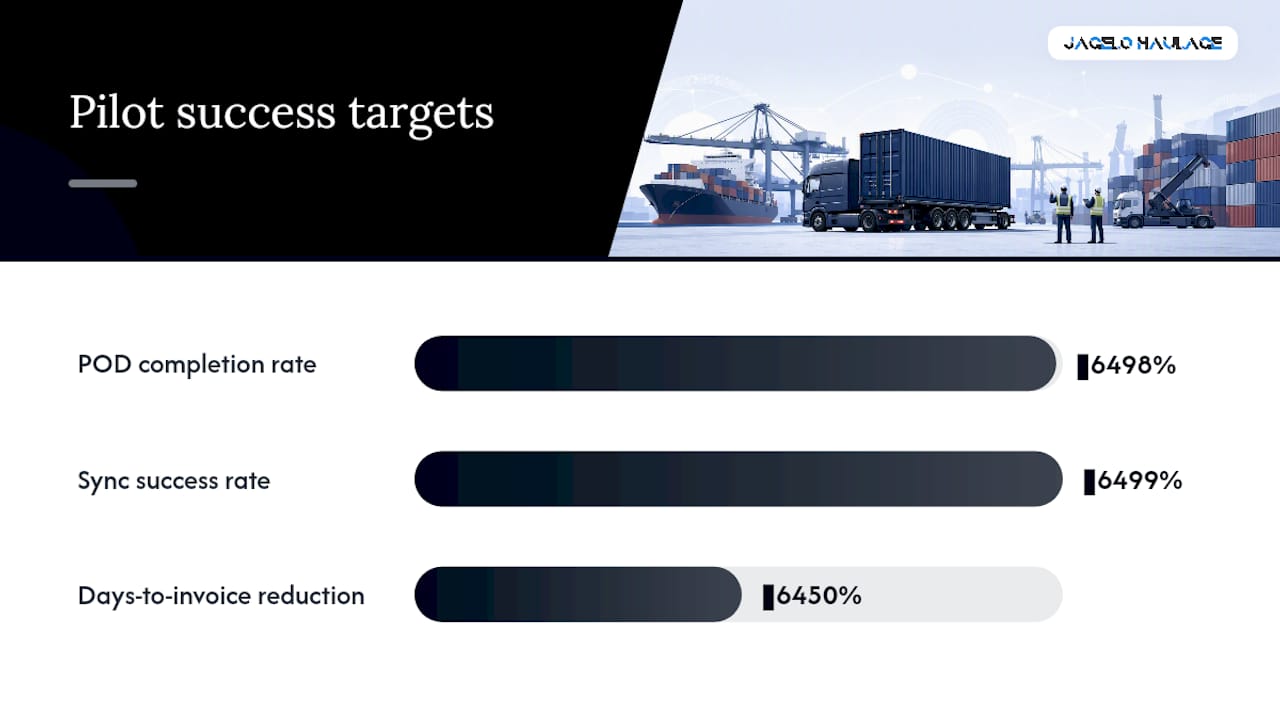
Pilot success metrics and threshold targets:
- POD completion rate: target 98% or above within four weeks
- Sync success rate: 99% or above (measures offline reliability)
- Days-to-invoice: target reduction of at least 50% versus pre-pilot baseline
- Driver exception rate: monitor for under-reporting (too low) as well as over-reporting (too high)
Pro Tip: Design a simple feedback loop during the pilot: a weekly five-minute driver debrief and a visible back-office response to every exception raised. Drivers who see their exceptions acted on adopt the system faster than those who feel the data disappears into a void. Pair this with a container haulage compliance checklist to keep regulatory requirements visible throughout the project.
Timeline and cost considerations for UK container hauliers
For a small-to-medium container haulier operating 10–50 vehicles, a realistic project timeline runs across three overlapping phases.
The pilot phase typically takes 4–8 weeks, covering device procurement, initial configuration, driver training on the selected lane, and baseline metric collection. The main variable is TMS readiness: if your TMS vendor has a pre-built ePOD integration, this phase compresses; if custom API work is needed, allow the upper end of the range.
Integration work runs in parallel with or immediately after the pilot, taking 4–12 weeks depending on the number of endpoints (TMS, ERP, visibility portal, eCMR archive). Vendor-hosted integration services, where the ePOD provider manages the connection to your TMS, reduce both cost and elapsed time significantly compared to in-house development.
Full roll-out across the fleet typically takes 2–6 months from pilot sign-off, depending on fleet size, depot geography and the complexity of exception workflows.
Cost factors to budget for include: device procurement (or a BYOD policy with a device allowance), SIM and data plans per vehicle, software licences (usually priced per driver or per vehicle per month), integration services (one-off), driver and back-office training, and ongoing vendor support. Cost-saving levers worth considering are using existing driver smartphones where the hardware meets minimum specifications, procuring licences in phases aligned to roll-out, and selecting a vendor with a pre-built connector for your TMS to avoid bespoke integration fees.
Legal, audit and cross-border considerations
For UK container hauliers moving goods across borders, the legal framework governing electronic consignment notes is the eCMR protocol, administered by UNECE. Twenty-five countries have ratified eCMR, meaning an electronic consignment note carries the same legal standing as a paper CMR on those lanes. Before relying on eCMR for a specific trade lane, verify ratification status for both the origin and destination country, and confirm that your customer and their consignee will accept an electronic note. For merchant haulage and cross-border container moves, building eCMR acceptance into new contract terms is the most practical way to avoid a parallel paper process.
GDPR checklist for ePOD data:
- Identify the lawful basis for processing delivery data (legitimate interest or contractual necessity are the most common bases for hauliers)
- Apply data minimisation: capture only the fields necessary for the delivery record and dispute resolution
- Define and document your retention policy (typically 6–7 years for commercial documents under UK contract law principles, though legal advice should confirm the period for your specific contracts)
- Establish secure transfer arrangements for any data crossing borders, including standard contractual clauses where applicable
- Maintain a process for responding to subject access requests, particularly where driver data (GPS, working hours) is captured alongside delivery data
Practical audit actions:
- Verify that timestamps are server-verified and cannot be altered after sync
- Confirm that GPS coordinates are embedded in the image metadata, not only in the database record
- Maintain an immutable audit log of every edit, deletion or re-submission event
- Define who has authority to accept a delivery in multi-party moves (port agent, freight forwarder, consignee) and ensure the app enforces that hierarchy
- Archive completed ePODs in a format that can be retrieved and presented without specialist software, in case of a legal dispute years after the delivery
KPIs that ePOD unlocks for container-haulage reporting
ePOD transforms delivery data from a paper archive into a live operational dataset. The metrics it enables directly are:
- Days to invoice (DSO): measured from delivery confirmation to invoice issue; the primary financial KPI
- POD completion rate: percentage of deliveries with a fully completed ePOD, including all mandatory fields
- Dispute rate: number of delivery disputes raised as a proportion of total deliveries, tracked by lane and customer
- OTIF by lane and customer: on-time, in-full performance calculated from arrival timestamps and unit counts
- Detention and demurrage evidence success rate: proportion of detention claims supported by timestamped arrival and departure records, directly reducing unrecoverable demurrage costs
- Average time to resolve exceptions: from exception raised to back-office closure, a proxy for the efficiency of your exception workflow
Each of these metrics is fed by specific ePOD events: the arrival scan triggers the OTIF clock, the signed delivery event closes the DSO calculation, and the exception record opens the dispute workflow. Dashboard design should map each KPI to its source event so that gaps in the data are immediately visible as workflow failures rather than reporting anomalies.
Per-delivery digital capture also supports CSRD and scope-3 emission reporting when combined with telematics. Hauliers already building ESG reporting frameworks will find that ePOD provides the per-delivery granularity that aggregate fuel and mileage data cannot.
Practical responses to common operational objections
Most roll-out problems fall into a short list of predictable categories, each with a defined fix.
- Lost signal at delivery. Offline-first apps store all data locally and sync on reconnection. Train drivers to complete the full workflow regardless of connectivity; the timestamp and GPS recorded at the time of delivery are preserved on sync.
- Consignee refuses to sign. The app should offer a ‘signature refused’ exception that records the GPS, timestamp and a photograph of the delivered goods. This is legally equivalent to a noted refusal on a paper CMR.
- GPS coordinate mismatch. Usually caused by a device that has not acquired a GPS fix before the driver opens the delivery task. Require drivers to open the app on arrival, not at the point of signature, to allow time for GPS acquisition.
- Poor photo quality. Set a minimum resolution requirement in the app configuration and display a warning if the image does not meet it. In-cab lighting guides for drivers help in low-light port environments.
- Device breakage or loss. Maintain a small pool of spare devices at each depot. Because data is cloud-synced, a replacement device can be provisioned in minutes without data loss.
- Sync failures. Monitor sync success rate as a daily operational metric. Persistent failures on a specific device usually indicate a SIM or firmware issue rather than an app problem.
Pro Tip: Keep a paper contingency pack in every cab: a blank CMR note and a pre-printed exception form. If a device fails completely, the driver completes the paper note, photographs it with a personal phone, and emails it to the back office for manual entry. Define this process in writing so drivers know exactly what to do and the back office knows to expect it. Vendor guidance consistently recommends clear exception workflows and minimal driver steps as the two factors most strongly correlated with driver adoption.
Driver adoption is almost always faster when drivers see a direct personal benefit: fewer disputed deliveries that come back to them, faster resolution of consignee complaints, and a clear record that protects them in the event of a claim.
How Jagelo Haulage uses ePOD in daily container moves
Jagelo Haulage operates a fleet of over 40 trucks and trailers across major UK ports including Felixstowe, Tilbury, Southampton and Liverpool, providing port-to-door container haulage for freight forwarders, importers and distribution centre operators. The operational profile, multi-port coverage, mixed domestic and cross-border loads, and time-sensitive port slot management, makes ePOD a practical necessity rather than an optional enhancement.
The Jagelo workflow integrates the driver app directly with the TMS, so consignment data is pre-populated on the driver’s device before departure. At the port gate, drivers photograph the container seal and confirm the unit number against the booking reference. At delivery, the consignee signs on-glass, the driver photographs the unloaded goods, and the completed ePOD syncs to the cloud archive within seconds of the driver leaving the delivery point. The TMS updates automatically, and the invoicing trigger fires without manual intervention.

For cross-border loads, Jagelo’s back-office team verifies eCMR ratification status for the relevant trade lane and confirms customer acceptance of electronic consignment notes at the contract stage. Where a paper CMR remains required, the ePOD record supplements rather than replaces it, providing photographic and GPS evidence that the paper note alone cannot carry.
Key outcomes from this approach include: a material reduction in days-to-invoice, a lower rate of disputed deliveries on lanes where photographic evidence is routinely captured, and a stronger position in detention and demurrage claims supported by timestamped arrival and departure records. For other hauliers considering roll-out, the practical lesson from Jagelo’s experience is that TMS integration is the single highest-leverage step: without it, ePOD reduces paperwork but does not compress the invoice cycle.
Three recommended next steps for container hauliers
The gap between understanding ePOD and implementing it productively is almost always a sequencing problem, not a technology problem. Three steps, taken in order, resolve it.
-
Run a scoped pilot on a single lane or customer account. A pilot of 3–5 vehicles over 4–8 weeks generates the baseline data you need to justify full investment and surfaces integration issues before they affect the whole fleet. In the UK container-haulage market, where port slot timing is unforgiving, a contained pilot limits the operational risk of a workflow change.
-
Mandate eCMR acceptance in new contracts where the trade lane supports it. Retrofitting eCMR acceptance into existing contracts is slow; building it into new agreements from the outset removes the parallel paper process that undermines the efficiency gains. Given that 25 countries have ratified the eCMR protocol, most European trade lanes are covered.
-
Measure a small set of KPIs from day one. Days-to-invoice, POD completion rate and dispute rate are sufficient for the pilot phase. Establishing a pre-pilot baseline for each metric before go-live is what makes the business case credible to finance and senior management.
Jhaulage delivers ePOD-enabled container moves across UK ports
Container hauliers who want the operational benefits of ePOD without the overhead of managing a technology implementation alongside daily port operations have a direct route: contract with a haulier whose fleet already runs ePOD-enabled workflows end-to-end.
Jhaulage’s fleet of over 40 GPS-tracked vehicles operates across Felixstowe, Tilbury, Southampton and Liverpool, with ePOD integrated into every container move. Every delivery generates a timestamped, GPS-verified digital record, linked to the consignment in the TMS and available to your team within seconds of delivery completion. Cross-border loads are handled with eCMR awareness built into the back-office process, and 24/7 support means exception management does not wait for office hours.
For freight forwarders and logistics operators who need reliable, documented container haulage across major UK ports, Jhaulage provides the combination of port coverage, tracked fleet and ePOD-enabled documentation that major shippers increasingly require as a contract condition. Contact Jhaulage to discuss your container transport requirements or request a service overview.
Sources
The following primary and industry sources provide the legal, technical and operational detail referenced throughout this guide. Consult the primary source directly for legal and technical decisions specific to your operation.
- TrucksOnTheMap: ePOD & driver apps European guide 2026
- CartonCloud: Electronic proof of delivery (ePOD)