More on merchant haulage from Jagelo Haulage
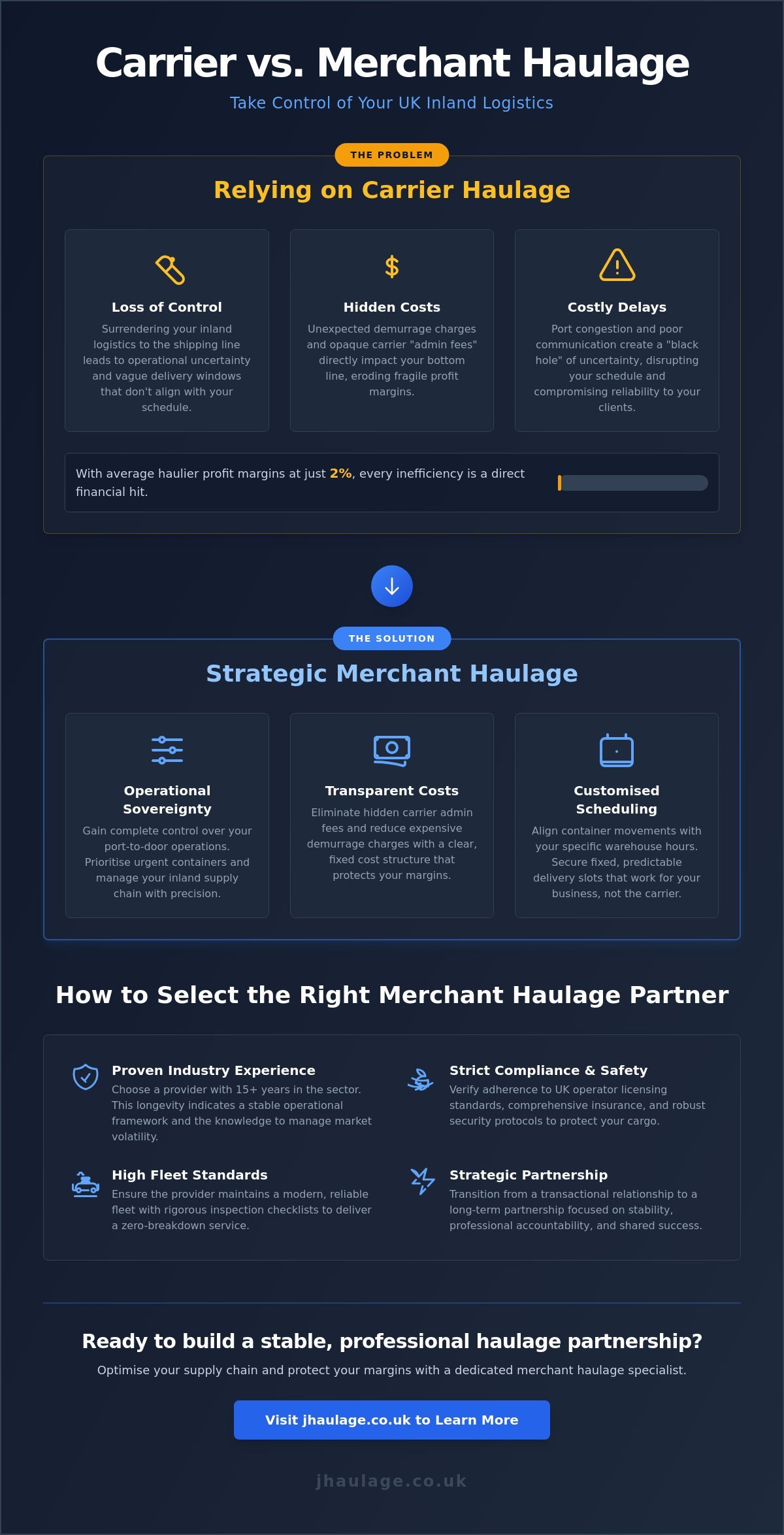
Relying on carrier haulage often means surrendering control over your inland logistics to the convenience of the shipping line. In a market where average profit margins for haulage firms sit at just 2%, every delay or hidden fee directly impacts your bottom line. Partnering with professional merchant haulage companies provides the operational sovereignty required to manage these risks effectively. You understand the frustration of vague delivery windows and the financial burden of unexpected demurrage charges that occur when communication fails. These inefficiencies disrupt your schedule and compromise your reliability to your own clients.
This guide explains how to evaluate and select the most dependable merchant haulage companies to optimise your UK supply chain and inland logistics. You'll discover how to secure fixed delivery schedules and implement transparent cost structures that protect your margins. We examine the specific criteria for choosing a haulage contractor that prioritises disciplined execution and consistent communication. By the end of this article, you'll have a clear strategy to reduce detention costs and establish a stable, professional partnership for all your container movements from UK ports.
Key Takeaways
- Evaluate the stability and industry experience of merchant haulage companies to ensure they possess the operational capacity to manage fluctuating container volumes effectively.
- Eliminate hidden carrier "admin fees" and reduce demurrage costs by switching to a transparent merchant haulage model for your inland logistics.
- Gain full control over your supply chain by prioritising hauliers that offer customisable delivery schedules tailored to your specific warehouse hours.
- Identify the essential fleet standards and specialised transport requirements necessary to maintain a reliable, zero-breakdown container delivery service.
- Learn how to transition from transactional transport to a strategic logistical partnership that provides long-term stability and professional accountability.
Understanding the Role of Merchant Haulage Companies
Merchant haulage occurs when the owner of the goods takes responsibility for organising the movement of containers between the port and the final destination. This process contrasts with carrier haulage, where the shipping line manages the entire journey. By engaging independent merchant haulage companies, businesses transition from being passive recipients of logistics services to active organisers of their own port-to-door operations. This shift is essential for companies that require precision and predictability in their inland transport. It allows for a higher degree of accountability and ensures that the movement of goods reflects the specific priorities of the business rather than the carrier's convenience.
Understanding the role of containerization is fundamental to mastering these logistics. Within the UK framework, this involves two primary phases: pre-carriage and on-carriage. Pre-carriage refers to the movement of an export container from the warehouse to the port of loading. On-carriage describes the delivery of an import container from the port of discharge to its final inland location. Merchant haulage allows the cargo owner to select a dedicated partner for these specific legs. This ensures that the transport aligns with internal warehouse schedules and eliminates the broad, inflexible operational windows typically provided by shipping lines.
The Core Mechanism of Merchant Haulage
The system functions by decoupling the "main leg" of sea transport from the final road delivery. When a business opts for merchant haulage, the contractual responsibility for the container's safety and punctuality shifts from the shipping line to the merchant and their chosen haulage contractor. This arrangement requires the merchant to manage the release of containers at the terminal; however, it provides the flexibility to use specialised equipment or prioritised booking slots. Merchant haulage represents a strategic choice that grants cargo owners complete sovereignty over their inland supply chain. By managing this process directly, firms can ensure that their logistics providers remain disciplined and focused on the safety of the cargo.
Why Control Matters in 2026
In the current logistical climate, port congestion can turn carrier delivery schedules into a "black hole" of uncertainty. Businesses using merchant haulage companies avoid these delays by maintaining direct communication with the haulage operations centre. This transparency allows for the prioritisation of urgent containers based on real-time inventory requirements. Instead of waiting for a shipping line to assign a driver, merchants can coordinate with J Haulage to ensure that high-value cargo moves exactly when needed. This level of oversight reduces the risk of expensive demurrage and ensures that the inland supply chain remains efficient. It's a method that prioritises results over simple task completion.
Essential Criteria for Selecting Merchant Haulage Partners
Selecting the right partner requires a disciplined evaluation beyond mere price points. Many businesses prioritise cost, but this approach often ignores the hidden expenses of service failure. High-quality merchant haulage companies demonstrate a commitment to functional reliability through substantial industry experience. A provider with over 15 years in the sector possesses the institutional knowledge to manage complex port logistics and fluctuating market conditions. This longevity indicates a stable operational framework that can withstand the volatility of the UK transport industry, where costs increased by approximately 10% in 2024.
Compliance remains a non-negotiable pillar of professional haulage. Reputable contractors strictly adhere to UK operator licensing standards to ensure the safety of both the cargo and the public. This commitment to regulation extends to comprehensive insurance coverage and specific security protocols for protecting cargo whilst in transit. When evaluating a potential partner, request evidence of their safety record and their adherence to standardised inspection checklists. These protocols are essential for maintaining the integrity of your supply chain.
Evaluating Operational Capacity
A contractor's fleet size directly impacts their ability to maintain consistent service levels during peak periods. A modern fleet of 40 or more vehicles provides the necessary redundancy to handle volume surges without compromising delivery windows. This capacity ensures that your inland container haulage requirements are met even when port congestion increases. Specialised equipment, such as sliding skeletal trailers or gen-set units, allows for the transport of varied container types. Scalability is essential; your haulage partner must possess the resources to grow alongside your import and export volumes.
The Human Element: Support and Reliability
Technical capability must be matched by a disciplined management structure. Professional transport operations rely on clear, direct communication to reduce logistical friction. Stoic professionalism in a haulage partner manifests as punctual arrivals, strict protocol following, and calm problem-solving. Dedicated customer support ensures that urgent deliveries receive immediate attention from staff who understand your specific warehouse requirements. If you require a partner that prioritises these operational standards, you can request a professional transport consultation to discuss your specific needs.
Reliable merchant haulage companies do not simply move goods; they provide a protected outcome for your supply chain. By focusing on these essential criteria, you secure a partnership based on competence rather than personality. This approach ensures that your inland logistics remain a source of competitive advantage.
Merchant Haulage vs Shipping Line Haulage: Strategic Advantages
Choosing between carrier and merchant haulage is a decision that impacts both operational fluidity and the financial bottom line. Shipping line haulage often prioritises the carrier's asset utilisation over the merchant's specific warehouse requirements. In contrast, merchant haulage companies provide a service model built around the unique needs of the cargo owner. This independence allows for a more disciplined approach to inland logistics. You can review a detailed Strategic Comparison of Merchant vs Shipping Line Haulage to understand how these models differ in practical application.
Direct accountability is a significant advantage of the merchant model. When you work with an independent contractor, you maintain a single point of contact for the entire road journey. This eliminates the communication delays often found when dealing with large carrier call centres. It also ensures that the haulier understands the specific international road haulage regulations applicable to your specific cargo types. This clarity of communication creates a more secure and predictable environment for your goods.
Financial Implications and Cost Control
Merchant haulage removes the opacity often found in carrier invoices. Shipping lines frequently apply "admin fees" or "documentation charges" that are difficult to forecast in advance. By negotiating directly with merchant haulage companies, you achieve better budget forecasting through fixed, transparent rates. Precise scheduling also assists in reducing detention and demurrage charges at the port. Merchant haulage provides a clearer view of total landed costs by eliminating the hidden surcharges associated with carrier-managed transport. This transparency is vital for maintaining healthy margins in a high-cost environment.
Operational Flexibility and Responsiveness
The ability to pivot during port disruptions is a core strength of the merchant model. Carrier haulage is often "fixed" and slow to react to sudden changes in customer demand or vessel delays. Independent partnerships offer a responsive alternative that can manage same-day delivery requirements or urgent warehouse prioritisation. You control the collection and delivery times. This ensures that the transport schedule suits your warehouse staff and equipment availability rather than the carrier’s vessel schedule. This operational autonomy is a key tool for maintaining supply chain sovereignty through 2026.
Fleet Standards for Reliable Merchant Haulage Operations
Leading merchant haulage companies understand that digital platforms cannot replace the reliability of a well-maintained physical fleet. In 2026, operational excellence requires a disciplined approach to vehicle standards and safety protocols. From 7 July 2026, all newly manufactured trucks must be equipped with Advanced Emergency Braking (AEB) systems to meet updated safety regulations. Professional hauliers prioritise these modern specifications to ensure the safety of the cargo and the public. A modern fleet reduces the risk of mechanical failure, which remains a primary cause of supply chain disruption. By investing in the latest vehicle technology, contractors provide a level of security that older, less reliable fleets cannot match.
Technology plays a critical role in managing a 40+ truck operation with precision. Modern operators utilise second-generation smart tachographs (G2V2) and AI-powered route optimisation to maintain strict delivery windows. These systems allow for real-time tracking and help drivers avoid congestion at major maritime hubs. Research indicates that operators using AI-powered route planning achieve fuel consumption reductions of 13.9% whilst significantly improving on-time performance. This technical capability ensures that every container movement is executed with maximum efficiency and minimal environmental impact. It reflects a commitment to the fundamentals of professional road transport.
Maintaining High Standards in Road Haulage
Top-tier merchant haulage companies treat vehicle maintenance as a core strategic function rather than a reactive necessity. Regular fleet investment serves as a marker of financial stability and operational discipline. Every vehicle in a professional fleet must be fully insured and compliant with the latest UK transport regulations, including the updated Vehicle Excise Duty and HGV Levy standards. This rigorous upkeep ensures that the contractor can provide zero-breakdown reliability for inland container haulage. Consistent maintenance directly correlates with predictable delivery schedules and protected outcomes for the client.
Professional Management of Logistics Hubs
Navigating major UK ports like Felixstowe, Southampton, and London Gateway requires expert precision and a deep understanding of local terminal protocols. Professional haulage operations master these fundamentals to ensure seamless port-to-door logistics. Disciplined coordination between the driver and the operations centre prevents unnecessary delays during the container release process. This methodical approach leads to more predictable supply chain outcomes and reduces the likelihood of incurring additional port storage fees. To secure a partner that adheres to these high operational standards, you can request a quote for reliable container deliveries to support your UK operations.
The transition to Electronic Freight Transport Information (eFTI) platforms in 2026 further enhances this professional management. By adopting digital consignment notes and compliance documents early, hauliers provide a more transparent and efficient service. This integration of physical fleet standards with modern administrative protocols defines the most reliable partners in the sector. It ensures that your cargo is always handled with corporate discipline and technical expertise.
Establishing Long-Term Partnerships with Merchant Haulage Specialists
Transitioning from transactional movements to strategic partnerships is the final step in securing your supply chain. Many businesses treat inland transport as a mere commodity. However, the most successful operators view merchant haulage companies as an extension of their own operational team. This alignment ensures that every container delivery supports broader business objectives rather than just moving cargo from the port to the warehouse. Consistency in your haulage partnership provides the stability required for long-term growth. It allows you to build a resilient logistics framework that can withstand external market volatility and rising operational costs.
A dedicated partner understands the nuances of your specific cargo and warehouse requirements. They understand your loading bay restrictions, your preferred delivery windows, and your documentation protocols. This institutional knowledge reduces the risk of operational friction and eliminates the need for constant re-education of new drivers. When you work with a professional haulage contractor, you gain a partner that prioritises the safety and efficiency of your operations above all else. This level of commitment is rarely found in the transactional environment of carrier-managed haulage where the driver often has no direct link to your business needs.
Integrating Haulage into Your Supply Chain
Collaborating with your haulier to streamline the Merchant Haulage Organisation Process is essential for peak efficiency. This collaboration involves developing a bespoke logistics plan that covers all major UK maritime hubs. By sharing your long-term volume forecasts, you allow your haulier to allocate the necessary equipment and driver capacity in advance. This proactive approach ensures that your inland container haulage remains uninterrupted during peak seasons or periods of high port congestion. It transforms your logistics from a reactive task into a strategic outcome that enhances your reputation for reliability.
The Jagelo Haulage Commitment
Jagelo Haulage provides secure, professionally managed transport for operators nationwide. We leverage over 15 years of industry experience to protect your cargo and ensure punctual deliveries. Our approach is rooted in the fundamentals of functional reliability and corporate discipline. We do not offer gimmicks; we offer a disciplined operational reach that delivers protected outcomes for your supply chain. You can contact Jagelo Haulage today for a professional container transport solution that meets your specific requirements. Our team follows protocols strictly to understand the high stakes of your supply chain.
Choosing between various merchant haulage companies ultimately comes down to trust and competence. A partner that understands the high stakes of the supply chain is an invaluable asset for any UK business. By establishing a long-term partnership with a specialist, you secure your inland logistics for 2026 and beyond. This stability allows you to focus on your core business whilst we manage the complexities of the UK road network with expert precision and quiet confidence.
Securing Your Supply Chain Sovereignty for 2026
Managing inland logistics requires a transition from passive acceptance of carrier schedules to active control of your transport routes. By partnering with professional merchant haulage companies, you eliminate the uncertainty of vague delivery windows and hidden administrative surcharges. This strategic shift ensures that your container movements align with your warehouse operations and inventory requirements. Reliability in this sector is built upon the fundamentals of disciplined maintenance and expert port navigation.
Jagelo Haulage brings over 15 years of steadfast professionalism to UK port logistics. We maintain a modern fleet of over 40 specialised trucks and trailers to ensure consistent, zero-breakdown performance. Our nationwide coverage serves all major maritime hubs; this provides a stable foundation for your long-term business growth. You deserve a partner that understands the high stakes of your operations and follows strict industrial protocols. Request a professional container haulage quote from Jagelo Haulage to secure a dependable inland transport solution. We look forward to supporting your logistical objectives with quiet confidence and functional expertise.
Frequently Asked Questions
What is the primary difference between merchant haulage and shipping line haulage?
Merchant haulage is organised by the cargo owner using independent contractors, whilst shipping line haulage is managed entirely by the carrier. The former allows for greater flexibility and direct accountability during the inland leg. Choosing independent merchant haulage companies ensures that the transport schedule prioritises your specific warehouse requirements rather than the carrier's vessel rotation. This distinction is critical for businesses seeking full sovereignty over their inland supply chain.
Is merchant haulage more cost-effective than carrier haulage for UK businesses?
Merchant haulage is often more cost-effective because it eliminates hidden carrier administrative fees and allows for direct rate negotiation. By bypassing the shipping line's standard surcharges, businesses can achieve better budget forecasting and lower total landed costs. This model also reduces the likelihood of expensive port storage fees through more precise scheduling. It provides a transparent financial structure that protects your operational margins and improves overall profitability.
How do I switch from carrier haulage to merchant haulage?
You switch by notifying your shipping line or freight forwarder that you'll be arranging your own transport for container movements. This requires you to provide the carrier with a letter of authority for your chosen haulage contractor. Once this administrative step is complete, your contractor manages the container release and collection process directly with the terminal. It's a straightforward transition that grants immediate control over your inland logistics and delivery windows.
Can merchant haulage companies handle deliveries from all major UK ports?
Established merchant haulage companies possess the operational reach to serve all major UK maritime hubs, including Felixstowe, Southampton, and London Gateway. These operators maintain the necessary terminal accounts and driver certifications to access every primary container port. This nationwide coverage ensures that your goods move seamlessly from the quay to your warehouse, regardless of the port of arrival. It provides a consistent solution for businesses with diverse import and export routes.
What insurance coverage should a professional merchant haulage company provide?
A professional haulage contractor must provide comprehensive Goods in Transit (GIT) insurance and Public Liability coverage as standard. These policies protect the cargo against damage or loss whilst on the UK road network. You should verify that their insurance limits align with the value of your specific goods before commencing operations. High-quality operators also adhere to strict RHA or FTA conditions of carriage, which provide a standardised legal framework for secure transport.
How much control do I retain over delivery times with merchant haulage?
You retain complete control over delivery times by coordinating directly with your haulage partner's operations centre. Unlike carrier haulage, which often provides broad delivery windows, merchant haulage allows you to specify exact times that suit your warehouse staff. This precision reduces vehicle idling time and ensures that your unloading equipment is utilised efficiently. It's a responsive model that adapts to your real-time business needs and prevents warehouse bottlenecks.
What are the risks of using an unspecialised haulage contractor for containers?
Unspecialised contractors often lack the skeletal trailers and port-specific knowledge required for efficient container transport. This can lead to delays at the terminal, incorrect vehicle configurations, and potential safety violations. Professional container hauliers understand terminal protocols and possess the specialised equipment necessary to secure 20ft and 40ft units safely. Using an inexperienced provider increases the risk of cargo damage and supply chain disruption, which can lead to significant financial losses.
How does merchant haulage impact demurrage and detention charges?
Merchant haulage significantly reduces demurrage and detention charges through disciplined scheduling and faster container turnaround. By managing the transport independently, you ensure that containers are returned to the port or depot within the carrier's free time period. This proactive management prevents the daily penalties that often accumulate when shipping lines fail to prioritise your inland deliveries. It's an essential tool for controlling port-related costs and maintaining a lean supply chain.