40+ Truck Lessons: How Jagelo Runs UK Drop and Collect
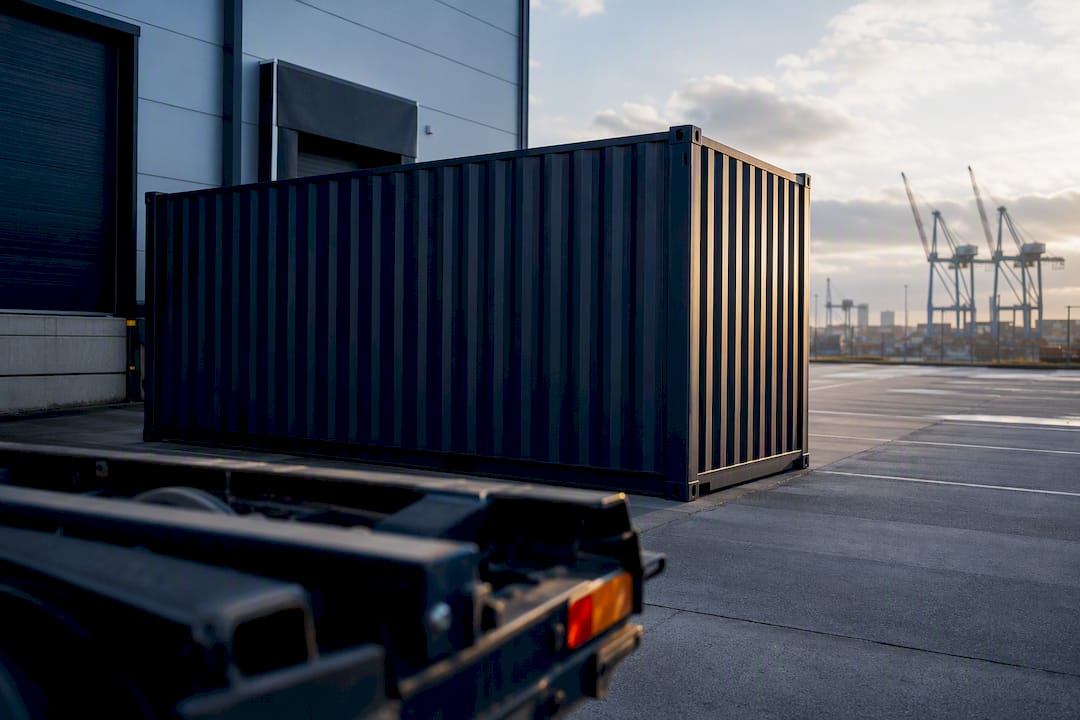
Drop-and-collect is the right call whenever a container needs to sit on-site for loading, unloading or storage rather than being turned around in the 30 to 45 minutes live loading allows. It beats live loading for staged construction work, intermittent supply chains and awkward or slow-loading cargo. The one caveat that catches operators out: confirm site access and an agreed on-site window before booking, or you risk extended-use charges eating into the savings.
TL;DR:
- Drop-and-collect is ideal for staged projects, intermittent supply chains, and cargo that cannot be handled quickly, provided site access and timing are confirmed upfront.
- Using a hiab crane is suitable for delivering empty containers in tight spaces, while sidelifters are necessary for handling loaded containers due to their stability and higher capacity.
- Proper site checks, including vehicle access, security procedures, safety zones, and turning circle clearance, prevent delays and extra charges during collection and delivery.
- Early booking and clear terms on on-site use help avoid extended charges and penalties, especially during peak periods like Christmas and Q4 retail seasons.
- The process runs smoothly when each stage is confirmed beforehand, with photographic evidence of container condition and precise scheduling supported by GPS tracking and proof of delivery.
Table of Contents
- What is drop-and-collect and when should you choose it?
- Hiab or sidelifter: which lifting equipment do you need?
- What site access and safety checks matter before booking?
- What are the hidden costs of drop-and-collect?
- How does the drop-and-collect process actually run?
- How does Jagelo Haulage run drop-and-collect across UK ports?
- How Jagelo Haulage supports your drop-and-collect bookings
- Sources
What is drop-and-collect and when should you choose it?
Drop-and-collect means the haulier delivers a shipping container to your site, leaves it there for an agreed period, and returns later to collect it once loading or unloading is complete. It is opposite live loading, where the driver waits at the kerb while the container is emptied or filled, then drives straight off. The difference matters commercially and operationally, and picking the wrong one is one of the most common false economies in container logistics.
Drop-and-collect earns its keep in a handful of recurring scenarios. Staged construction projects, where materials go in and out over days rather than hours, are the classic case. Intermittent inbound supply chains, where a warehouse only has capacity to unload part of a container at a time, are another. Delicate or awkward cargo that cannot be rushed through a 30 minute live-load slot also benefits, because drop-and-collect suits businesses without loading docks and gives ground-level access without capital spend on dock infrastructure.
The operational gains stack up:
- Driver waiting time drops to near zero, since the truck isn’t parked idle while your team loads
- Site teams gain flexibility to work around their own shift patterns rather than a driver’s clock
- Ground-level handling becomes possible without a raised dock, using a sidelifter or hiab instead
Drop-and-collect is the wrong tool for short, simple loading tasks that take minutes, and it struggles on tight urban sites with no turning circle or parking bay for a trailer to sit overnight.
Hiab or sidelifter: which lifting equipment do you need?
Equipment choice decides whether your booking succeeds or fails on the day, and it decides most of the cost too. A hiab crane is the cheaper, more flexible option for delivering empty containers. It can place a box in a tight spot a sidelifter’s rigid frame cannot reach, but its lifting capacity limits it, so it rarely handles a loaded container safely.
Sidelifters, by contrast, are usually required to collect loaded containers, because their rigid lifting geometry gives the stability a loaded 20ft, 40ft or 45ft box needs. That reliability comes at a price. A sidelifter drop can cost more than a hiab drop in some locations, a premium worth budgeting for once cargo weight enters the equation.
- Hiab: best for empty container drops, flexible placement, lower lifting capacity
- Sidelifter or side-loader: required for loaded container pickups, rigid frame, higher day rate
- Skeletal trailer: check length against your yard’s turning circle and ground bearing capacity before booking
Pro Tip: Match the lift method to the container’s state at pickup, not at delivery. A box delivered empty by hiab may need a sidelifter for the loaded collection, so confirm both legs of the job when you first speak to your haulier, not on the day.
Our detailed breakdown of skeletal trailer haulage covers dimensions and turning constraints in more depth if your site has restricted access.
What site access and safety checks matter before booking?
Failed lifts and delay charges almost always trace back to one thing: nobody checked the site properly before the truck arrived. A five-minute conversation with your haulier’s planning team, backed by photos or a short site visit, prevents most of these problems.
- Confirm vehicle access. Check width, height clearance and turning circle for a 40ft or 45ft skeletal trailer, and check the yard surface can bear a loaded sidelifter without sinking or cracking.
- Agree security procedures. Gatehouse sign-in rules, CCTV coverage, and the seal number recorded at both drop and collection should all be settled in advance.
- Set the health and safety standoff. Confirm exclusion zones around the lift, and check whether a local authority permit is needed if any part of the manoeuvre spills onto the public highway.
- Clarify who signs what. Delivery and collection paperwork should name the person authorised to sign, so liability for on-site loss or damage is never ambiguous.
On turning circles: industry practice consistently flags that 40ft and 45ft skeletal trailers need more room to manoeuvre than most yards assume, and checking this before the truck leaves the depot avoids an aborted delivery.
Our guide to preparing a container for UK port delivery walks through this checklist in more detail, and our piece on ePOD in container haulage explains how electronic proof of delivery closes the documentation loop.
What are the hidden costs of drop-and-collect?
Book early. UK port cut-offs tighten sharply in the run-up to Q4 retail peaks, and hauliers with sidelifter capacity get booked out first in those windows. Waiting until the last moment doesn’t just risk missing a slot, it often forces you onto whichever equipment is left, at a premium.
The charges that catch operators out tend to fall into a short, predictable list:
- Sidelifter uplift over a hiab rate, reflecting the equipment’s higher capability and cost
- Extended on-site fees if the container stays beyond the agreed window, sometimes alongside container rental or detention charges from the shipping line
- Missed-slot penalties when a booked collection window is not honoured on either side
- Idle-driver costs if a driver arrives and the site isn’t ready to load or unload
Extended-use charges are the one most worth negotiating upfront, because they are entirely avoidable with clear terms. Agree a confirmed loading window, a notice period for collection, and explicit liability for on-site loss or damage before the container arrives, not after.
For recurring lanes, a drop-and-hook or trailer pooling arrangement changes the economics entirely. Trailer pooling reduces dwell time and improves on-time performance on repeatable routes, though setting one up properly typically takes eight to twelve weeks from initial assessment to live running. Our cost guide to moving a shipping container breaks down how hiab and sidelifter rates compare across a full job.
How does the drop-and-collect process actually run?
A drop-and-collect job runs cleanly when each stage is confirmed before the next begins. Skipping the survey stage is the single most common cause of rework.
- Pre-book. Arrange a site survey or share photos, confirm hiab or sidelifter equipment, lock the delivery slot, and get paperwork (booking reference, container number, delivery instructions) signed off.
- Delivery day. Check placement against the agreed spot, record the seal and container numbers, and capture ePOD with photos as proof of condition on arrival.
- On-site period. Keep security measures in place, agree a communication cadence with your haulier for any change in collection timing, and respect any agreed storage limit.
- Collection. Confirm the pick-up window 24 to 48 hours ahead, make sure the site is ready and clear, and complete final checks before the trailer leaves.
Pro Tip: Photograph the container from all four sides at both drop-off and collection. It takes two minutes and settles almost any dispute about condition before it becomes a claim.
Our scheduling best practices guide covers slot coordination in more depth for operators running multiple sites.
How does Jagelo Haulage run drop-and-collect across UK ports?
Drop-and-collect only works when the haulier checks the things clients forget to. Every booking we take through Felixstowe, Tilbury, Southampton or Liverpool starts with a site access conversation, not a quote, because a sidelifter turning circle problem is far cheaper to solve on the phone than on the yard tarmac.
Our fleet of more than 40 trucks and trailers carries GPS tracking as standard, so a client waiting on a container knows exactly where it is rather than chasing a phone call. Every drop and collection is backed by ePOD, which has settled more than one dispute over container condition simply by having the timestamped photo evidence to hand. For clients moving volume on the same lane repeatedly, we’ll often recommend a short pilot before committing to a recurring allocation. It surfaces the site quirks that only show up once you’ve actually done the job.
— Vytautas
How Jagelo Haulage supports your drop-and-collect bookings
If you’ve read this far, you already know the failure points: wrong equipment, unchecked access, and vague terms on extended on-site use. Jagelo Haulage exists to remove those variables from the booking itself.
We run port-to-door haulage across Felixstowe, Tilbury, Southampton and Liverpool with both hiab and sidelifter capability, alongside refrigerated transport and oversized or hazardous container handling for the loads standard haulage won’t touch. Every truck in our 40-plus fleet carries GPS tracking, and every job comes with round-the-clock support, so a delayed slot or a site access change gets resolved by phone in minutes rather than left to guesswork. That combination of tracked visibility and equipment flexibility is what keeps drop-and-collect predictable, even on sites with awkward turning circles or extended storage needs.
If you have a container move coming up, whether it’s a one-off drop-and-collect or a recurring lane worth pooling trailers on, request a quote or site survey and we’ll confirm the right equipment before your slot is booked.
Sources
- Shipping Container Haulage Options
- Drop & hook UK: Trailer Pooling for faster linehaul | Amazon Freight