Skeletal trailer haulage: what it is and how it works
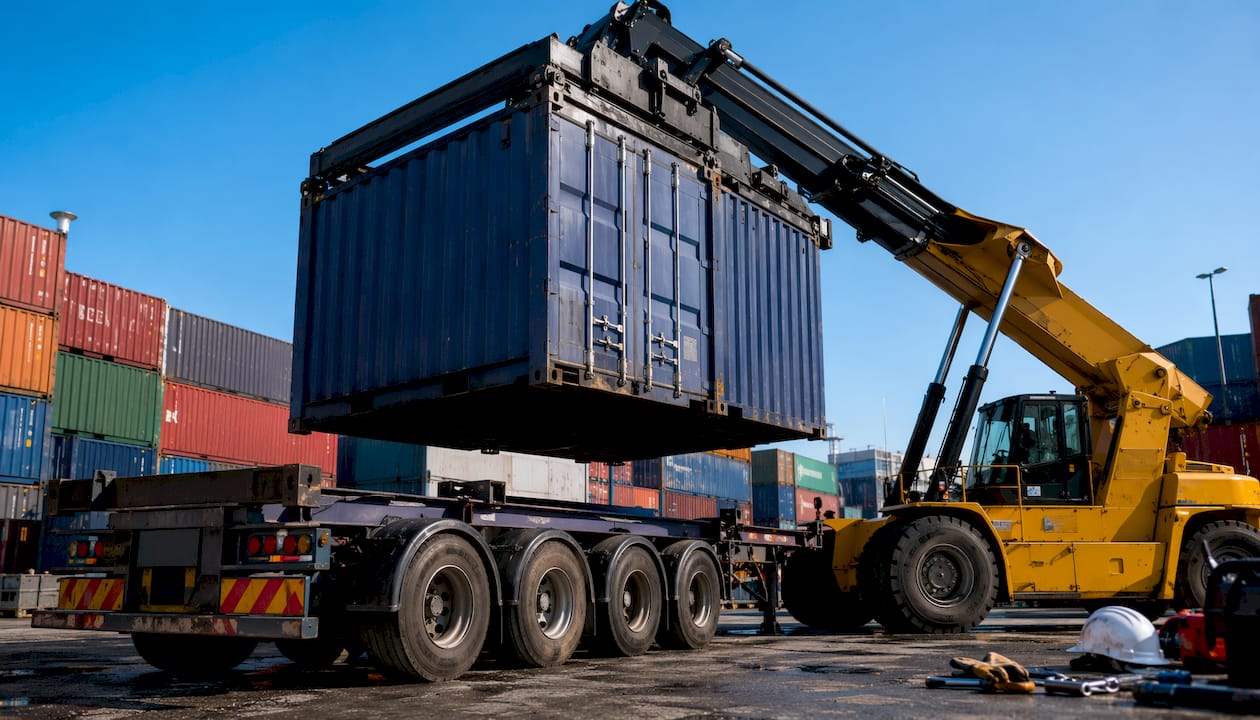
Skeletal trailer haulage is the transport method that uses an open-frame chassis, known as a skeletal trailer or “skele,” to carry ISO shipping containers securely via twistlocks mounted at each corner of the frame. Unlike flatbed or enclosed trailers, a skeletal trailer has no deck, floor, or sidewalls. Its entire structure is the chassis itself, built to align precisely with the corner castings of standard ISO containers. This minimalist design keeps tare weight low, which directly increases the payload a haulier can legally carry on UK roads.
Key characteristics of skeletal trailer haulage at a glance:
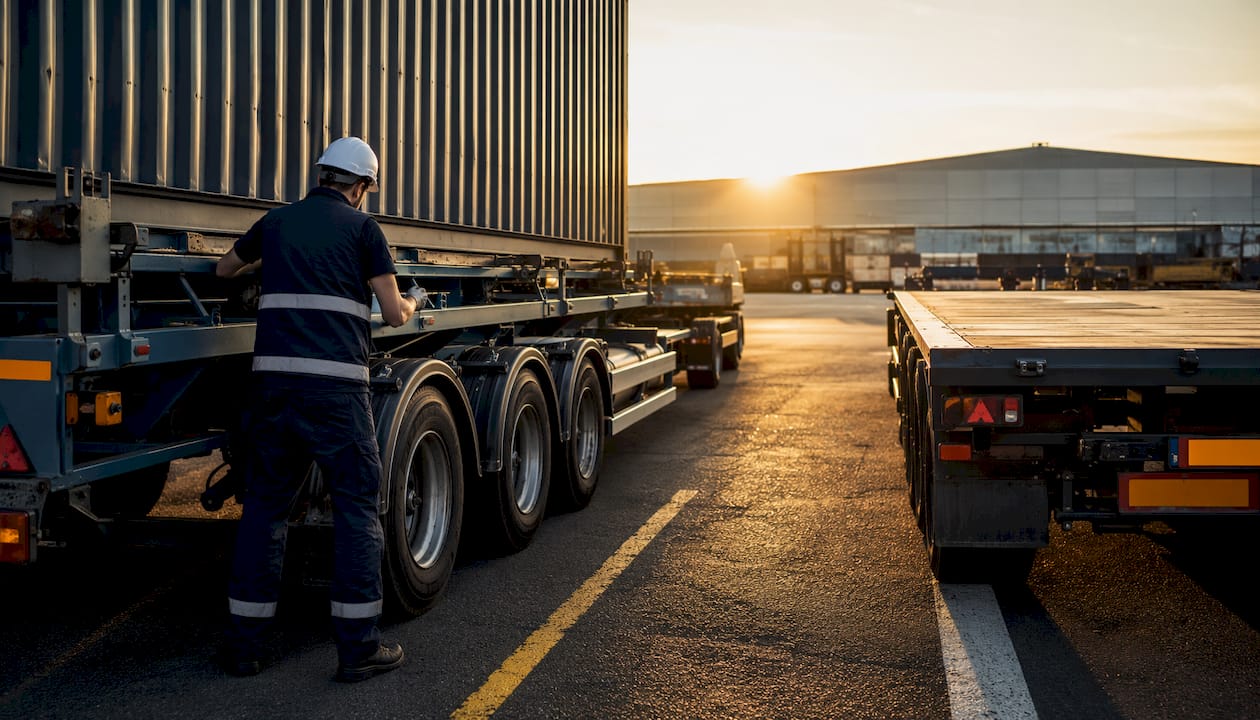
- Twistlock securing: containers lock into corner castings without ropes, straps, or additional restraints
- ISO compatibility: standard configurations accommodate 20ft, 30ft, 40ft, and 45ft containers
- Frame types: fixed-length, extendable (sliding), and gooseneck designs serve different operational needs
- Intermodal role: skeletal trailers move containers between ports, rail terminals, and distribution centres without repacking cargo
- Payload advantage: a lightweight chassis can start at as little as 4,000kg, leaving the maximum legal gross weight available for the container and its contents
What containers and configurations do skeletal trailers support?
Skeletal trailers are purpose-built for container transport across ports, logistics hubs, and long-haul road freight. The most common container sizes they accommodate are 20ft, 30ft, 40ft, and 45ft ISO units, with some specialist chassis extending to 53ft for North American configurations.
Configuration choice matters considerably in day-to-day operations:
- Fixed-length chassis: designed for a single container size, with no moving parts and the lowest maintenance burden
- Extendable (sliding) chassis: adjustable to carry different container lengths, trading mechanical simplicity for operational flexibility
- Gooseneck designs: a stepped-neck profile that lowers container height to meet European road height restrictions, particularly relevant for high-cube containers
- Tipping skeletal trailers: allow containers to be tipped for bulk discharge without removal from the trailer
- Multi-functional (split) chassis: the rear section can be detached and left at a delivery point while the tractor unit continues, reducing drop-off time and fuel costs
Loading always requires specialist equipment. Professional operations use cranes, reach stackers, straddle carriers, or forklifts to place containers onto the chassis. Sideloader cranes mounted directly on the trailer are an option, but they add considerable weight and require additional driver training.
Cargo that cannot be containerised, including loose bulk materials, palletised goods, and oversized machinery, is unsuitable for skeletal trailers. The absence of a deck means there is simply no surface to support non-containerised loads.
Skeletal trailers versus flatbed trailers: which suits container haulage?
The choice between a skeletal trailer and a flatbed trailer for container transport is not a matter of preference. It is a question of design intent.
| Dimension | Skeletal trailer | Flatbed trailer |
|---|---|---|
| Design purpose | Built exclusively for ISO containers | General cargo, machinery, and oversized loads |
| Payload efficiency | Higher: lightweight frame maximises legal payload | Lower: heavier deck and structure reduce available payload |
| Loading/unloading speed | Faster: twistlocks secure containers in minutes | Slower: requires lashing, strapping, and manual securing |
| Fuel consumption | Lower: reduced tare weight improves fuel economy | Higher: heavier structure increases fuel use on long hauls |
| Cargo flexibility | Restricted to containerised loads only | Broad: handles pallets, machinery, and non-standard cargo |
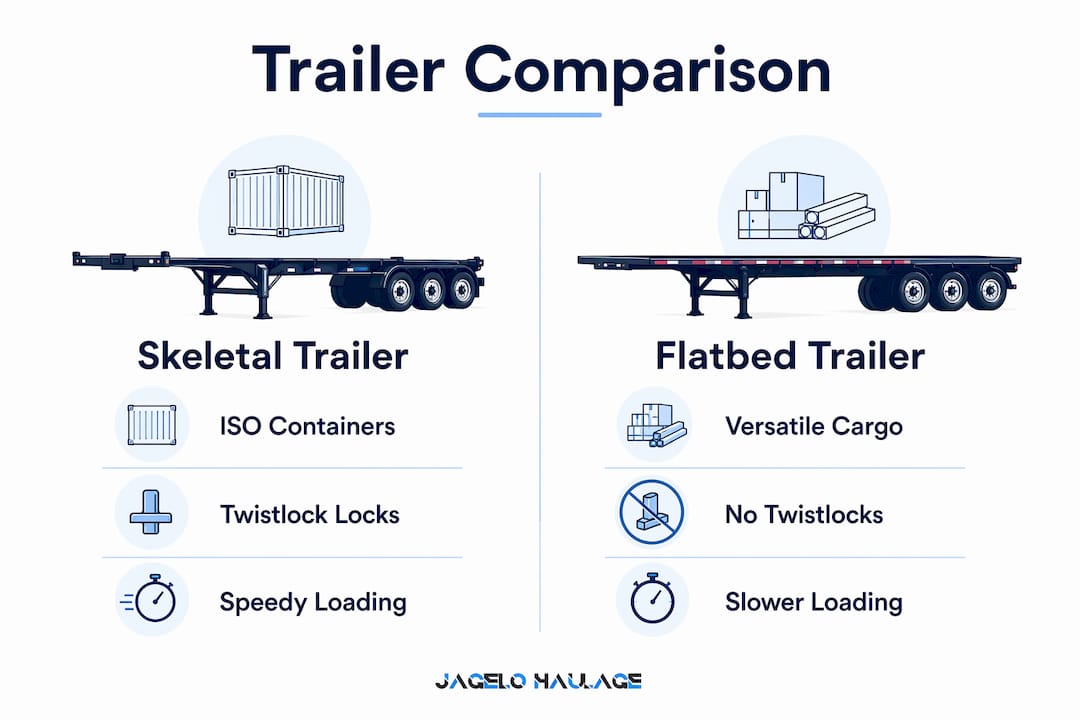
Operators using skeletal trailers report up to 30% faster loading and unloading times compared with flatbed alternatives, a direct consequence of twistlock securing versus manual lashing. For dedicated container haulage routes, particularly between UK ports such as Felixstowe, Tilbury, Southampton, and Liverpool, the skeletal trailer is the operationally correct choice.
Advantages and limitations of skeletal trailers in practice
The practical case for skeletal trailers in container haulage rests on several well-established operational benefits.
Advantages:
- Low tare weight translates directly into higher legal payload capacity on UK roads
- Twistlocks provide a secure, repeatable locking mechanism that reduces container movement and load stress during transit
- Open-frame construction gives crane operators and reach stackers unobstructed access, accelerating port turnaround
- Fixed-length chassis have no moving parts, meaning lower maintenance frequency and reduced downtime
- A low centre of gravity, achieved by carrying the container directly on the chassis rather than above a deck, improves road stability
Limitations:
- Entirely dependent on specialist loading equipment; operations without port cranes or reach stackers cannot use skeletal trailers effectively
- Unsuitable for any non-containerised cargo, restricting fleet utilisation if a business handles mixed freight
- Sliding chassis variants introduce wear on moving parts, requiring regular maintenance to prevent downtime
- Adding sideloader cranes or extra axles increases tare weight, which can erode the payload advantage and require verification against weight certificates
Pro Tip: Always check the Certificate of Loading before departure. UK transport regulations require compliance with the lowest permissible weight limit across all applicable regional rules, and an overloaded skeletal trailer risks both prosecution and container damage.
UK industry insights on skeletal trailer operations
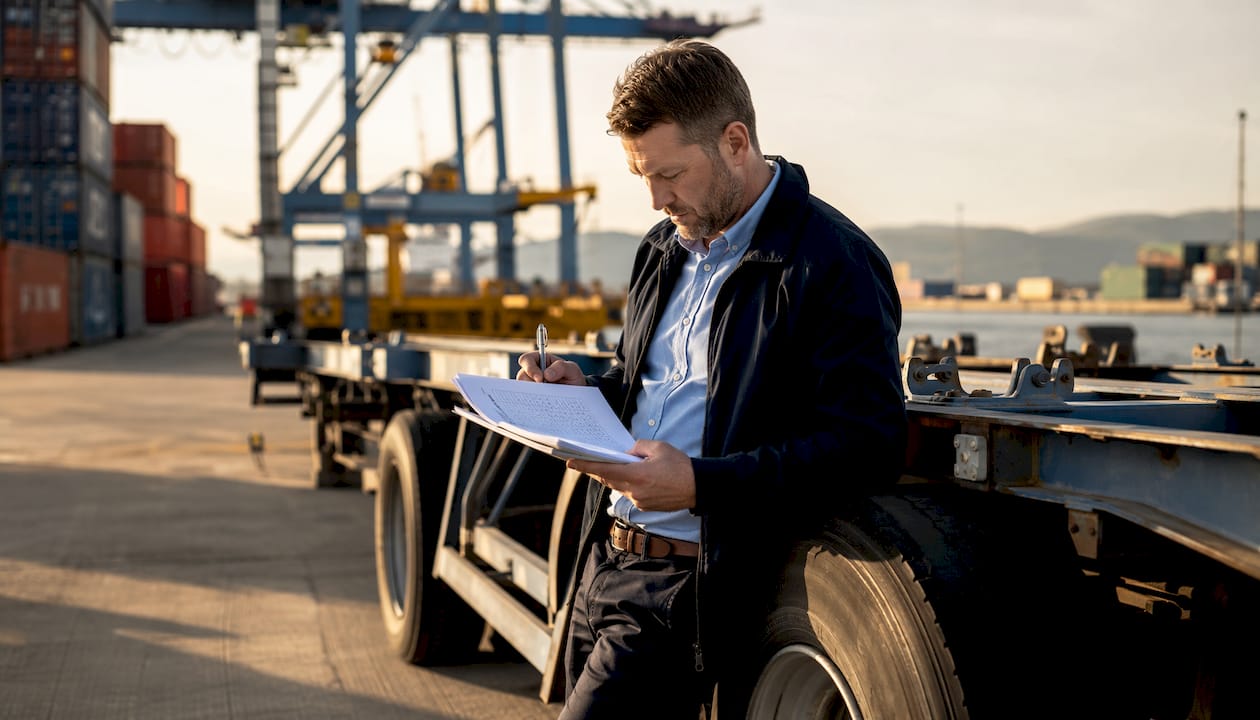
Skeletal trailers form the backbone of intermodal container transport across the UK’s major port corridors. Their ability to carry containers from ship to road without repacking or repositioning cargo is what makes them indispensable to freight forwarders and logistics operators working to tight port dwell-time windows.
At Jhaulage, our fleet of over 40 GPS-tracked trucks and trailers operates across Felixstowe, Tilbury, Southampton, and Liverpool, with container haulage at UK ports forming the core of our daily operations. Real-time tracking on every movement gives clients full visibility from port gate to delivery point, a capability that matters when demurrage and detention costs accumulate by the day.
The operational choice between fixed and extendable chassis reflects a genuine trade-off. Fixed-length skeletals offer higher reliability and lower maintenance costs, making them well-suited to high-volume, single-size container flows. Extendable chassis provide the flexibility to handle 20ft and 40ft containers within the same fleet, which suits operators managing varied container sizes across multiple clients.
Key takeaways
Skeletal trailer haulage is the most efficient and operationally correct method for transporting ISO containers by road in the UK, combining low tare weight, twistlock security, and intermodal compatibility.
| Point | Details |
|---|---|
| Twistlock security | Containers lock at ISO corner castings without additional restraints, reducing transit damage. |
| Tare weight advantage | A skeletal chassis can start at 4,000kg, maximising legal payload on UK roads. |
| Faster turnaround | Operators report up to 30% faster loading and unloading versus flatbed alternatives. |
| Fixed vs extendable chassis | Fixed-length models offer lower maintenance; extendable chassis suit mixed container-size fleets. |
| Cargo restriction | Skeletal trailers cannot carry loose, palletised, or non-containerised loads due to the absence of a deck. |
Jhaulage provides specialist container haulage services across the UK’s major ports, with a modern fleet, GPS tracking on every vehicle, and 24/7 operational support. Whether you need port-to-door delivery, same-day collection, or full container load transport, our team is ready to move your cargo efficiently and securely.