Types of haulage trailers for containers: a professional guide
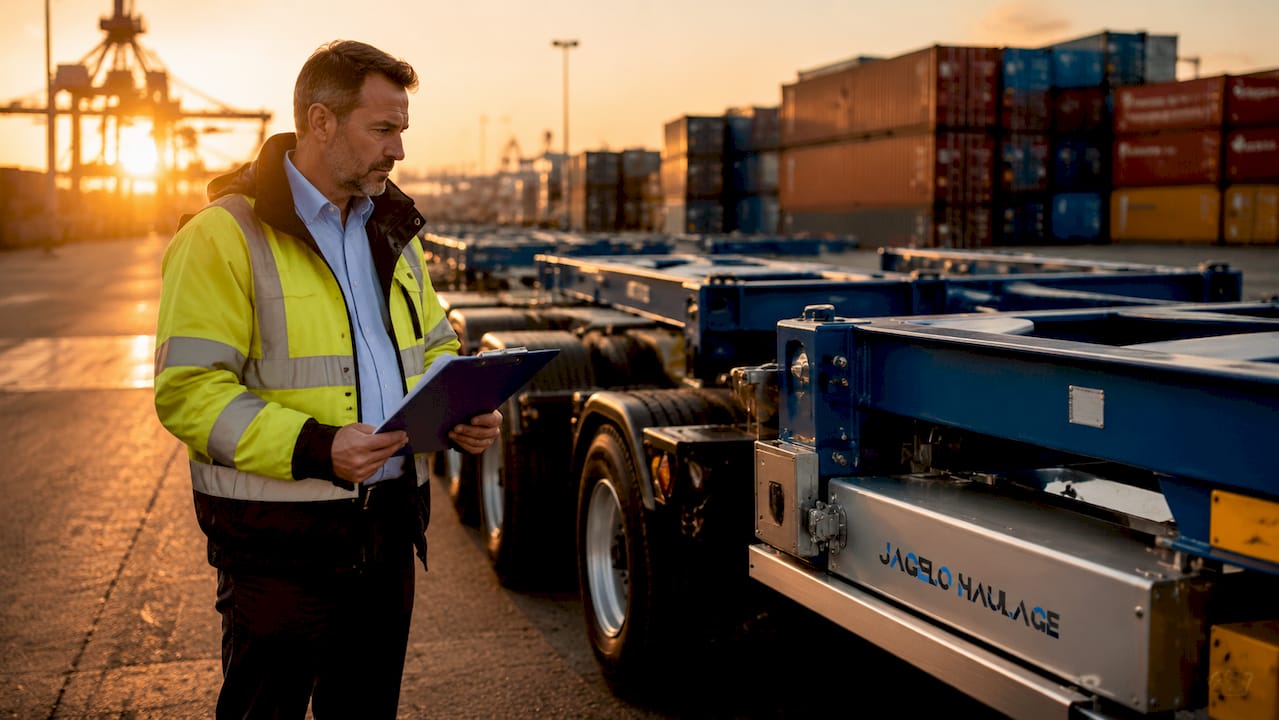
Haulage trailers for containers are specialised vehicles engineered to transport ISO shipping containers safely, efficiently, and in compliance with UK road regulations. The three primary types of container carriers are skeletal chassis trailers, flatbed container trailers, and gooseneck container trailers, each differing by deck configuration and front geometry. Choosing the wrong trailer type costs you payload efficiency, increases fuel expenditure, and risks DVSA non-compliance. For freight and logistics professionals managing port-to-door movements through Felixstowe, Tilbury, Southampton, or Liverpool, understanding these distinctions is the foundation of sound fleet planning. This guide covers every major haulage trailer option, including tri-axle chassis and extendable configurations, so you can match equipment to mission with confidence.
1. What are the types of haulage trailers for containers?
Container transport trailers fall into three core categories: skeletal chassis, flatbed, and gooseneck. Each serves a distinct operational purpose, and no single design suits every lane or container type. Skeletal trailers dominate dedicated container haulage because of their low weight and direct compatibility with ISO twist locks. Flatbeds offer flexibility for mixed freight operations. Gooseneck designs solve height clearance problems that standard chassis cannot address. Beyond these three, tri-axle and extendable chassis configurations extend the range of loads and container sizes a fleet can handle legally and efficiently.

2. Skeletal container chassis trailers
Skeletal trailers are the most widely used container transport trailers in the UK, and for good reason. Their open-frame design carries no solid deck, which reduces tare weight significantly and allows higher net payloads on the same gross vehicle weight. Payload capacity on a 40ft skeletal trailer typically ranges from 40 to 60 tonnes, depending on axle configuration and the weight of the tractor unit.
The frame integrates twist lock positions at the four corner castings of 20ft, 40ft, and 45ft ISO containers. A standard 40ft skeletal trailer uses 8–12 twist locks to secure the container at all corner points. Fixed-length skeletal trailers are lighter and simpler to maintain, while extendable skeletal variants accommodate multiple container lengths on a single chassis.
Key operational advantages of skeletal trailers include:
- Lower tare weight compared to flatbed designs, improving fuel efficiency on high-frequency port runs
- Direct compatibility with ISO corner castings on standard and high cube containers
- Faster turnaround at container yards due to simple twist lock engagement
- Reduced maintenance complexity on fixed-length models
The primary limitation is cargo exclusivity. A skeletal trailer cannot carry general freight, palletised goods, or bulk cargo without a container fitted. This makes it a poor choice for operators running mixed freight lanes.
Pro Tip: If your operation is dedicated to container haulage from ports such as Felixstowe or Tilbury, a fixed-length skeletal chassis delivers the best combination of payload capacity, fuel efficiency, and maintenance simplicity. For a broader view of how trailer choice fits into UK port logistics, the UK port transport guide from Jhaulage is worth reading.
3. How do flatbed container trailers differ from skeletal trailers?
Flatbed trailers feature a solid full deck running the entire length of the trailer. This deck allows operators to carry containers, palletised freight, machinery, and bulk items on the same vehicle. That flexibility comes at a cost: flatbeds are heavier than skeletal trailers, which reduces net payload on any given gross vehicle weight, and they carry a higher purchase price.
For companies running mixed freight lanes, where a container movement on the outbound leg is followed by a general cargo return, the flatbed is the more practical choice. The trade-off is that the added deck weight and higher fuel consumption make flatbeds less efficient on pure container circuits.
| Feature | Skeletal trailer | Flatbed trailer |
|---|---|---|
| Deck type | Open frame, no solid deck | Full solid deck |
| Tare weight | Lower | Higher |
| Cargo flexibility | Containers only | Containers and general freight |
| Purchase cost | Lower | Higher |
| Fuel efficiency | Better on container-only runs | Reduced due to added weight |
| Ideal use case | Dedicated container haulage | Mixed freight operations |
The practical implications of this comparison are clear. If your lane mix includes container movements alongside oversized items, machinery, or palletised returns, a flatbed earns its higher cost through operational versatility. If your fleet runs exclusively between ports and container depots, the skeletal chassis is the more efficient and cost-effective haulage trailer option.
- Flatbeds require ratchet strapping and additional securing equipment for non-containerised loads
- Heavier deck structure reduces payload margin on weight-sensitive routes
- Solid deck simplifies loading of non-ISO freight that lacks corner castings
4. What is the role of gooseneck container trailers?
Gooseneck trailers, also referred to as step-deck chassis, solve a specific and common problem in container haulage: height clearance on UK and European highway routes. The dropped front section of a gooseneck lowers the main deck height to 1,200–1,380 mm, compared to 1,450–1,550 mm on a standard flatbed chassis. That reduction of 70–350 mm is the difference between a High Cube container clearing a motorway bridge and triggering a height restriction violation.
High Cube ISO containers stand 2,896 mm tall, 305 mm taller than a standard 2,591 mm container. Placed on a standard flatbed, a High Cube unit can breach the 4.95 metre overall height limit on certain UK routes. A gooseneck chassis eliminates that risk by lowering the container’s ride height before it reaches the road.
Key benefits of gooseneck container trailers include:
- Compliance with height restrictions on routes that standard chassis cannot service
- Improved vehicle stability through a lower centre of gravity
- Better volume utilisation when transporting High Cube containers on long-distance lanes
- Suitability for intermodal operations where High Cube containers transfer between rail and road
The gooseneck design does introduce additional complexity at the fifth wheel coupling point. The dropped neck geometry requires compatible tractor units and careful coupling procedures. Operators should verify tractor unit compatibility before committing to a gooseneck fleet.
Pro Tip: Always check the declared height of your container before assigning a chassis. A standard 40ft container on a skeletal trailer typically clears UK height limits, but a 40ft High Cube on the same chassis may not. Deck height geometry is the primary factor in chassis selection for height-sensitive routes.
5. Tri-axle and extendable chassis for heavy loads and mixed container lengths
Tri-axle container chassis are the correct configuration for heavy 40ft ISO containers that approach or exceed the capacity of a standard tandem-axle trailer. Tri-axle chassis distribute the container’s weight across three axle groups, each rated at 21,000–24,000 kg, improving compliance with UK gross vehicle weight regulations for six-axle articulated vehicles. This configuration is particularly relevant for steel coils, machinery, and dense industrial goods shipped in 40ft containers.
Extendable or sliding chassis address a different operational challenge: running a single trailer across multiple container lengths. A sliding chassis adjusts its wheelbase to accommodate 20ft, 40ft, and 45ft containers on the same frame. For 45ft ISO container transport, an extendable chassis is often the only compliant option without investing in a dedicated fixed-length trailer.
Key considerations for tri-axle and extendable chassis include:
- Tri-axle configurations add a third axle group, increasing legal payload capacity for heavy containers
- Extendable chassis reduce fleet size requirements by covering multiple container lengths
- Sliding mechanisms introduce additional wear points and inspection demands
- Extendable chassis require more frequent maintenance checks than fixed-length equivalents
- Fleet planning should account for the higher downtime risk of extendable designs on high-frequency routes
The decision between a fixed-length and extendable chassis comes down to lane mix. A fleet running exclusively 40ft containers gains nothing from an extendable design and accepts unnecessary mechanical complexity. A fleet serving mixed container sizes across varied lanes benefits from the versatility, provided maintenance schedules are tightened accordingly.
6. How do twist locks affect trailer selection and safety?
Twist locks are the primary securing mechanism between a container and its chassis, and their type directly affects both operational efficiency and legal compliance. Three main twist lock types are used in container haulage: non-retractable, semi-automatic, and retractable. Each type presents different trade-offs between security, speed of operation, and cargo versatility.
Non-retractable twist locks are the simplest and most durable option. They remain fixed in position and require manual engagement at each corner casting. Semi-automatic locks speed up the coupling process by engaging automatically when the container is lowered onto the chassis. Retractable locks fold flush with the trailer frame when not in use, allowing the same chassis to carry non-containerised freight without the locks presenting a hazard.
“Small omissions in lock engagement can trigger defects affecting haulage performance.” DVSA roadside security checks confirm that correct lock engagement is a primary inspection point for container haulage vehicles.
Practical guidance for operators selecting trailers based on locking mechanisms:
- Verify that all twist locks carry visible lock-state indicators, showing engaged and disengaged positions clearly
- Confirm ISO compatibility between the trailer’s lock positions and the container’s corner casting dimensions
- Inspect lock engagement at every pre-departure check, not only at the point of loading
- Retractable locks suit mixed-use trailers; non-retractable locks suit dedicated container chassis where simplicity and durability are priorities
- Reliable twist-lock performance requires dynamic load testing and safety-critical verification beyond ISO compatibility alone
Selecting a trailer with the correct lock type for your operational pattern reduces DVSA defect risk and protects cargo integrity across the full journey.
Key takeaways
The best trailers for containers are those matched precisely to container size, route clearance requirements, and cargo type, with no single chassis design suitable for every operation.
| Point | Details |
|---|---|
| Skeletal chassis for dedicated runs | Fixed-length skeletal trailers deliver the best payload efficiency and lowest maintenance for port-to-depot container circuits. |
| Flatbed for mixed freight lanes | Flatbed trailers carry containers and general freight but add weight and cost that reduce efficiency on container-only routes. |
| Gooseneck for height-sensitive routes | Gooseneck chassis lower deck height to 1,200–1,380 mm, making High Cube container transport compliant on restricted routes. |
| Tri-axle for heavy 40ft loads | Tri-axle configurations distribute weight across three axle groups, supporting legal compliance for dense industrial containers. |
| Twist lock type affects compliance | Selecting the correct lock type and verifying engagement at every departure reduces DVSA defect risk and cargo loss. |
Trailer selection: what experience actually teaches you
Vytautas here. After years working closely with container haulage operations across UK ports, the single most common mistake I see is treating trailer selection as a procurement decision rather than an operational one. Operators buy a fleet of flatbeds because they want flexibility, then discover that the added tare weight is costing them payload on every single port run. The flexibility they paid for sits unused ninety percent of the time.
My honest view is that most dedicated container hauliers should run a core fleet of fixed-length skeletal trailers, supplemented by a smaller number of extendable chassis for lanes where container size varies. That split covers the majority of operational scenarios without the maintenance burden of an all-extendable fleet.
The detail that consistently gets overlooked is twist lock quality. Operators spend considerable time comparing chassis designs and almost no time verifying lock-state indicators and dynamic load ratings. A chassis with a substandard locking system is a liability regardless of how well its deck geometry suits the route. For guidance on selecting a container haulage specialist that takes equipment quality seriously, the criteria matter as much as the price.
Fleet planning for container haulage is not about finding the one best trailer type. It is about building a mix that matches your actual lane data, container size distribution, and compliance requirements. That requires honest analysis, not catalogue browsing.
— Vytautas
Jhaulage: specialist container haulage across UK ports
Jhaulage operates a fleet of over 40 trucks and trailers, all equipped with GPS tracking, serving major UK ports including Felixstowe, Tilbury, Southampton, and Liverpool. Every vehicle in the Jhaulage fleet is selected and maintained to meet the specific demands of container transport, from skeletal chassis for high-frequency port runs to configurations suited to High Cube and 45ft containers.
For freight and logistics professionals who need reliable, compliant container haulage without the operational risk of mismatched equipment, Jhaulage provides UK container haulage services with 24/7 support and full port coverage. Whether you need same-day port collection, full container load shipments, or dedicated fleet management, Jhaulage delivers with the equipment and expertise the job requires. Contact Jhaulage to discuss your container transport requirements.
FAQ
What are the main types of container transport trailers?
The three main types are skeletal chassis trailers, flatbed container trailers, and gooseneck container trailers. Each differs by deck configuration and front geometry, suiting different container sizes and route requirements.
When should you use a tri-axle chassis for container haulage?
A tri-axle chassis is the correct choice for heavy 40ft ISO containers that approach UK gross vehicle weight limits. The three axle groups distribute load more evenly, supporting legal compliance for dense industrial cargo.
What is the difference between retractable and non-retractable twist locks?
Non-retractable twist locks are fixed and durable, suited to dedicated container chassis. Retractable locks fold flush with the trailer frame, allowing the same chassis to carry non-containerised freight safely.
How does deck height affect container trailer selection?
Deck height determines whether a container clears UK highway height restrictions. Gooseneck chassis lower deck height to 1,200–1,380 mm, compared to 1,450–1,550 mm on standard flatbeds, making them necessary for High Cube container transport on restricted routes.
Are extendable chassis worth the additional maintenance cost?
Extendable chassis suit fleets running mixed container lengths across varied lanes. For operations running a single container size consistently, a fixed-length chassis is more reliable and less costly to maintain over time.
Recommended
- Road Haulage for Containers: A Professional Guide to UK Port Logistics | Jagelo Haulage
- Heavy Container Haulage: A Strategic Reference Guide for UK Logistics 2026 | Jagelo Haulage
- The Professional Guide to Cost-Effective Container Haulage in 2026 | Jagelo Haulage
- Choosing Container Haulage Specialists UK | Jagelo Haulage