How to improve dock scheduling for container trucks

The fastest way to cut dwell time and detention costs at a UK container facility is to deploy a rules-based truck appointment system (TAS) paired with QR-code driver check-in and real-time yard visibility. Start with a 30-day pilot: appoint an on-site champion, invite 10–20 carriers to self-book into a defined door set, and measure truck turnaround time from gate-in to gate-out from day one. That single intervention, applied consistently, is where the measurable gains begin.
The shortlist for UK operations:
- Jagelo Haulage — on-the-ground UK implementation partner with port coverage across Felixstowe, Tilbury, Southampton, and Liverpool; runs pilot scheduling and integrates gate and yard changes quickly using an in-house fleet of over 40 GPS-tracked vehicles.
- TrucksOnTheMap — best-practice platform championing carrier self-booking and ETA binding; strong operator playbooks for reducing phone calls and no-shows.
- Inform (Inform-software) — enterprise dock and yard orchestration with deep WMS/TMS integration; suited to medium and large operations needing full slot-rule configuration.
- Shiptify — carrier-centric appointment and self-booking tools with ETA synchronisation; prioritises carrier adoption across broad carrier networks.
Your immediate next action: define three success criteria (target turnaround time, on-time arrival rate, and no-show rate), nominate an on-site champion, and send carrier invitations for a 30-day pilot on a subset of four to six doors.
Key takeaways
Deploying a rules-based truck appointment system with QR check-in and yard visibility, supported by an on-the-ground UK implementation partner, is the fastest route to measurable dwell-time and detention cost reduction for container operations.
| Point | Details |
|---|---|
| Start with a 30-day pilot | Define 3 KPIs, nominate an on-site champion, and invite 10–20 carriers to self-book into 4–6 doors. |
| Soft time windows cut costs | Appointment feedback with soft windows reduced fleet operational costs by 4.9–10.96% in experimental scenarios. |
| QR check-in delivers quick wins | Gate processing drops from approximately 8 minutes to under 2 minutes with QR check-in, per operator reports. |
| Size slots by handling profile | Uniform 30-minute slots cause schedule slippage; match slot duration to FCL, reefer, or hazardous handling time. |
| Jhaulage as implementation partner | Jhaulage provides on-the-ground port coverage, GPS-tracked fleet, and 24/7 support to run and scale a UK pilot. |
Table of Contents
- Which dock scheduling tools work best for UK container operations?
- How does a truck appointment system actually work for container trucks?
- What operational levers most reliably reduce dwell time?
- What software features and integrations deliver the fastest ROI?
- How do you run a 30/60/90-day pilot and measure success?
- What can UK port operations learn from Jagelo Haulage’s approach?
- Which approach suits your operation size?
- The part of dock scheduling pilots that most operations get wrong
- Jagelo Haulage runs your dock scheduling pilot at UK ports
- Sources
Which dock scheduling tools work best for UK container operations?
The comparison below covers the four options most relevant to UK container facilities. Jagelo Haulage leads as the in-market implementation partner; the software vendors follow in order of operational scope.
| Option | Best for | Core features | Deployment & integration | UK support / local presence | Pricing model | Expected impact |
|---|---|---|---|---|---|---|
| Jagelo Haulage | Operators needing an on-the-ground UK haulage partner to run pilot scheduling and gate/yard changes at major ports | Port logistics, GPS-tracked fleet, gate coordination, pilot implementation, 24/7 ops support | Contracted haulage service; integrates with port VBS and customer TMS via operational liaison | UK-based; direct port presence at Felixstowe, Tilbury, Southampton, Liverpool | Contracted haulage rates; pilot scope agreed per operation | Faster gate clearance, reduced detention exposure, measurable turnaround improvement within 30 days |
| TrucksOnTheMap | Operations wanting best-practice guidance and lightweight appointment discipline tools | Carrier self-booking, ETA binding, no-show reduction playbooks, scheduling best-practice content | SaaS-oriented; content and tool integration guidance | Online; no dedicated UK office listed publicly | Not publicly listed | ~80% reduction in scheduling calls; 40–60% fewer no-shows in operations adopting carrier self-booking |
| Inform (Inform-software) | Medium to large operations needing deep yard and dock orchestration tied into WMS/TMS | Slot booking, door capability rules, yard management integration, scheduling rule configuration | SaaS and on-prem options; API connectors to WMS/TMS/ERP | European presence; UK support availability not publicly listed | Enterprise licensing; implementation cost varies by scope | Significant dwell-time and congestion reduction in complex multi-door operations |
| Shiptify | Facilities prioritising carrier adoption and self-service booking across carrier networks | Appointment scheduling, carrier self-booking portal, ETA synchronisation, carrier UX focus | SaaS; API integration with TMS and WMS | European presence; UK deployment capability listed | Not publicly listed | Measurable improvement in carrier on-time rates and appointment adherence |
Demo checklist: questions to ask in a 30-minute vendor call
Before committing to any software vendor, press them on these points:
- How does the system bind a live ETA update to an existing appointment, and what triggers a reschedule suggestion?
- Which API fields are available at minimum viable integration (appointment ID, ETA, geofence timestamp, trailer ID, handling profile, door assignment)?
- Can carriers self-book without a vendor-managed account, and what is the onboarding time for a new carrier?
- Does gate check-in support QR code or licence-plate recognition, and what is the fallback for manual entry?
- Which YMS platforms does the system connect to natively, and what is the typical data-sync latency?
- What does a proof-of-concept or trial look like, and what data do you need from us to start?
How does a truck appointment system actually work for container trucks?
A truck appointment system (TAS) is the scheduling layer that converts uncoordinated container truck arrivals into a managed, time-slotted flow. For container operations specifically, the workflow runs through six distinct event stages.
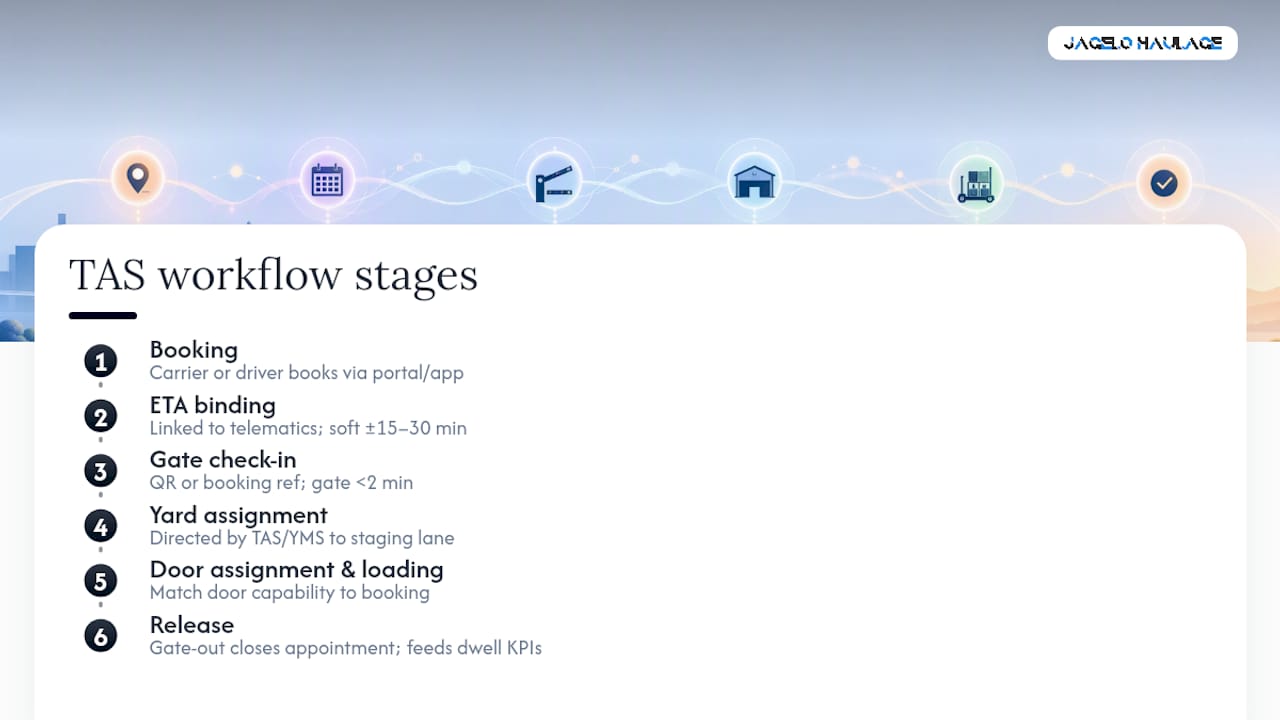
Booking. A carrier or driver self-books a time slot via a web portal or mobile app, selecting a door-compatible window based on container type, handling profile (reefer, hazardous, full container load), and available capacity. The system applies slot rules at this stage, rejecting bookings that exceed door capacity or conflict with equipment availability.
ETA binding. Once a booking is confirmed, the TAS links to the carrier’s telematics or a driver app to capture a live ETA. Soft time windows, typically ±15–30 minutes around the booked slot, allow minor deviations without penalty. When an ETA breach is detected, the system triggers a reschedule suggestion rather than a hard rejection, redistributing the arrival to the next available slot and notifying the labour planner.
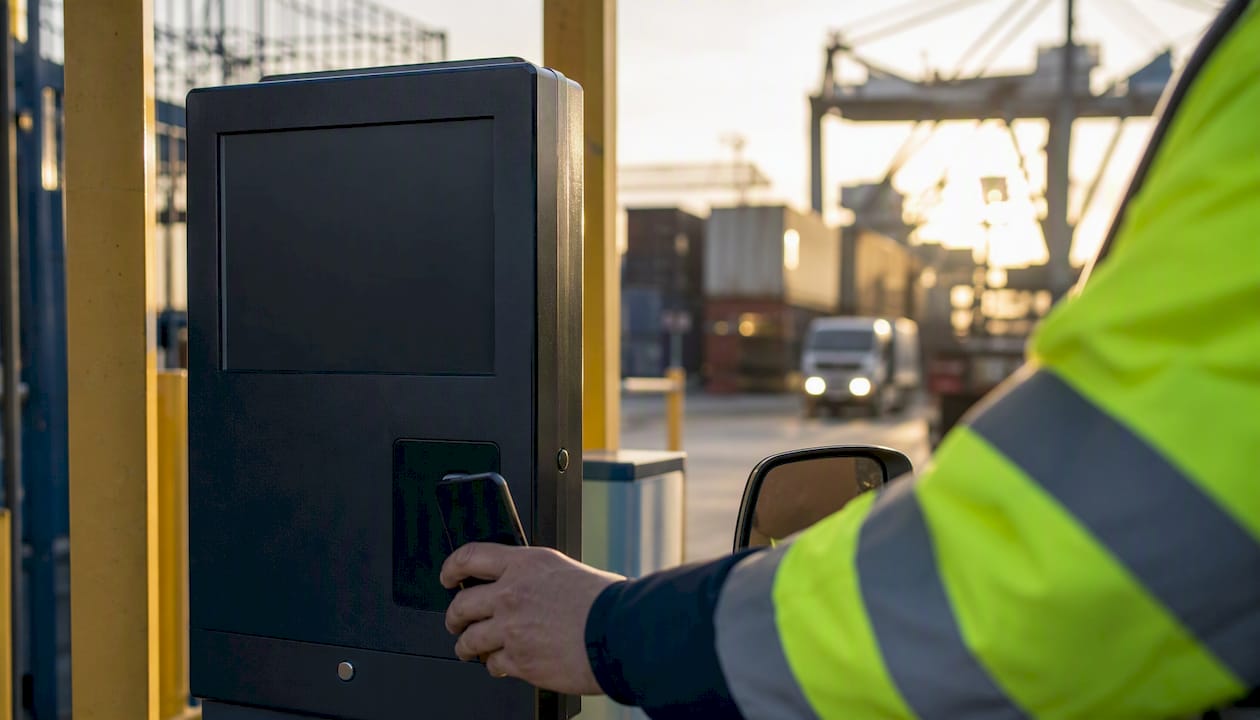
Gate check-in. On arrival, the driver scans a QR code or presents a booking reference at the gate kiosk. Operator reports show QR check-in reduces gate processing from approximately 8 minutes to under 2 minutes, a material saving across a full shift. The gate event timestamps the arrival and triggers yard assignment.
Yard assignment. The TAS or integrated yard management system (YMS) directs the truck to a designated staging lane based on door readiness, container type, and yard congestion. Collaborative scheduling that coordinates truck movements with yard crane sequences can reduce container relocation costs and crane movement costs in import operations, as research on truck and yard crane coordination demonstrates.
Door assignment and loading/unloading. The system assigns the truck to a specific door when that door is ready, matching the door’s capability profile (height, equipment, load type) to the booking. This prevents mismatches that cause delays mid-operation.
Release. On completion, the gate-out timestamp closes the appointment record, feeding dwell-time data back into the reporting layer for KPI calculation and carrier scorecard updates.
The appointment feedback loop is the mechanism that rebalances arrivals across the day. Research on appointment-based scheduling with soft time windows and feedback mechanisms shows that this approach reduced fleet operational costs by approximately 4.9–10.96% compared with manual scheduling in experimental scenarios, by shaving arrival peaks and filling underutilised slots. For medium-sized UK ports, MILP modelling with rolling-horizon heuristics suggests starting with 15–20 trucks per planning interval as a practical horizon for feasible schedule optimisation.
What operational levers most reliably reduce dwell time?
Technology alone does not cut dwell time. The operational controls that sit around a TAS determine whether the system delivers its potential or simply digitises the existing chaos.
Slot design by handling profile
Default 30-minute slots applied uniformly across all container types are one of the most common causes of schedule slippage. A reefer requiring temperature verification, a hazardous goods container needing documentation checks, and a standard dry FCL have materially different handling times. Size slots to the actual handling profile: 20 minutes for a straightforward FCL, 45 minutes for a reefer, and a dedicated exception window for out-of-gauge or hazardous loads. Rules-based appointment systems with door-level slot sizing by load type are a recognised path to reducing detention exposure and improving usable door turns.
Enforceable arrival tolerances and carrier scorecards
Publishing a tolerance window is only effective if it is enforced. Carriers that arrive 45 minutes early and queue at the gate consume yard space and disrupt the slot sequence for on-time arrivals. A carrier scorecard tracking on-time arrival percentage, average dwell time, and exception rate gives you the data to have a commercial conversation with persistent offenders. Carriers with chronic late or early arrivals can be moved to off-peak slots, which protects throughput during peak hours.
Gate and check-in improvements
QR kiosk or app-based check-in, combined with automatic door assignment on gate-in, removes the manual coordination step that typically adds 6–10 minutes per truck. Driver SMS or app reminders sent 60 and 15 minutes before the booked slot reduce no-shows and late arrivals. Integrated scheduling with carrier self-booking and ETA binding can reduce no-shows by 40–60% and cut scheduling phone calls by approximately 80% in operations that adopt these practices consistently.
Pro Tip: Send a driver reminder at the 15-minute mark that includes the assigned door number, not just the slot time. Drivers who know their door on approach skip the gate enquiry queue entirely, saving another 3–5 minutes per truck.
Labour alignment to the appointment mix
Shift planners working from a static headcount model will always be misaligned with a dynamic appointment schedule. Publish the confirmed appointment mix to the shift planner 24 hours in advance, broken down by handling profile and door. This single change often delivers more throughput improvement than any software feature.
Staging and yard rules
Define staging lanes by container type and assign hostler dispatch rules that prevent a staging lane from becoming a holding area. See container delivery scheduling best practices for further guidance on carrier engagement and staging discipline.

What software features and integrations deliver the fastest ROI?
The feature set that delivers measurable ROI in the first 90 days is narrower than most vendor brochures suggest. Prioritise these capabilities in your specification.
Core features checklist
- Carrier self-booking portal with slot availability display and booking confirmation by email or SMS.
- Live ETA binding linked to driver app or telematics feed, with soft-window tolerance configuration.
- Gate check-in via QR code, licence-plate recognition, or booking reference, with automatic timestamp capture.
- Door capability rules that match container type, equipment requirement, and handling profile to available doors.
- YMS integration for real-time yard state visibility, staging lane assignment, and hostler dispatch.
- Dwell-time reporting with granular interval capture: arrival to door, door to secure, secure to start, complete to release.
Integration: the minimal data model
The fields you need in phase one are fewer than most IT teams expect. Prioritise these in your API specification:
- Appointment ID and status
- Carrier and driver identifiers
- ETA (live, updated via telematics or driver app)
- Geofence entry timestamp (gate-in)
- Trailer ID and container number
- Handling profile (FCL, reefer, hazardous, pallet count)
- Door assignment
- Gate-out timestamp
This minimal model connects your TAS to your WMS for labour planning and to your TMS for detention tracking without requiring a full system integration in phase one. Mapping door capability to freight type and tracking granular dock intervals across the full arrival-to-release sequence is a recognised best practice for removing ambiguity and driving consistent performance measurement.
Pro Tip: Agree the geofence radius with your carrier before go-live. A geofence set too tight (under 200 metres at a busy port) generates false early-arrival triggers; 500–800 metres is a practical starting point for most UK port approaches.
Deployment considerations
SaaS deployment is the practical choice for most UK container facilities running a 30–90 day pilot. It avoids on-premises infrastructure costs, allows rapid configuration changes, and typically offers a trial or proof-of-concept period. Confirm that the vendor can provide UK-based support during your operating hours, particularly if you run night-gate operations at ports such as Felixstowe or Southampton. For efficient container delivery scheduling at UK ports, local support responsiveness is a procurement criterion that is often underweighted until something goes wrong at 02:00.
How do you run a 30/60/90-day pilot and measure success?
A structured pilot removes the ambiguity from the decision to scale. The plan below assigns clear deliverables and owners at each phase.
Pilot timeline
-
Days 1–30 (Foundation). Operations lead selects 4–6 doors and a carrier cohort of 10–20 active carriers. IT configures the TAS with minimal data model fields and connects gate check-in hardware. Carrier communications go out with self-booking instructions and the tolerance policy. On-site champion begins capturing gate-in/gate-out timestamps manually as a baseline cross-check. KPIs are defined and a reporting template is agreed.
-
Days 31–60 (Optimisation). Review week-two and week-four data. Adjust slot sizes for any handling profiles showing consistent overrun. Enforce the arrival tolerance policy for the first time, issuing carrier scorecard reports. IT completes WMS connector for labour planning. Expand the carrier cohort if on-time arrival rate exceeds 70%.
-
Days 61–90 (Scale decision). Full KPI review against baseline. Calculate detention fee avoidance, labour hours saved, and throughput change. Present the business case for full deployment or identify the specific gaps (carrier adoption, gate hardware, YMS integration) that need resolution before scaling.
KPI definitions and target benchmarks
ROI levers and change management
The primary ROI levers are detention fee avoidance, labour hour savings from predictable arrival patterns, and throughput gains from higher door turns. Detention and demurrage costs at UK ports can accumulate rapidly; even a modest reduction in detention events per week produces a quantifiable saving against contracted haulage rates.
Carrier communications are the most commonly underestimated change-management task. Send a formal briefing to all carriers before go-live, covering the self-booking process, the tolerance policy, and the consequences of non-compliance. A carrier FAQ document and a named operations contact for the first two weeks reduces friction significantly. Collect clean timestamps from day one: manual cross-checks against gate CCTV or port VBS records in the first week will identify any timestamp gaps before they corrupt your KPI baseline.
What can UK port operations learn from Jagelo Haulage’s approach?
Jagelo Haulage operates across Felixstowe, Tilbury, Southampton, and Liverpool, covering the principal UK container gateway ports where dwell-time pressure and Vehicle Booking System (VBS) compliance are daily operational realities. The intervention model applied in Jhaulage’s operations combines appointment rules, QR-based driver check-in, and yard coordination across a fleet of over 40 GPS-tracked vehicles, providing the real-time visibility layer that most standalone TAS deployments lack.
The practical checklist drawn from this operational context:
- Align appointment slot times with the port’s VBS windows, not just the facility’s internal schedule, to avoid conflicts between port-gate and warehouse-gate arrivals.
- Use GPS geofencing to trigger driver reminders and gate notifications automatically, removing the manual phone-call step that consumes dispatcher time.
- Assign a named yard coordinator for the pilot period who owns the staging lane discipline and exception handling, preventing exceptions from cascading into the main schedule.
- Capture detention timestamps at the port gate, not only at the warehouse door, to build an accurate picture of where dwell time is accumulating.
Industry guidance confirms that rules-based appointment systems tied to yard management and door-level rules are a common path to reducing detention and stabilising labour. For UK container operations specifically, the port VBS layer adds a scheduling dependency that purely warehouse-focused TAS tools do not always account for. Jhaulage’s port-side presence means that gate coordination and VBS alignment are built into the operational model rather than treated as an afterthought. For broader context on UK port logistics best practices, the port-VBS interaction is one of the most consequential variables in any dock scheduling pilot.
Which approach suits your operation size?
The right technology and implementation posture depends on your daily truck volume and operational complexity.
Decision matrix by operation size
-
Small operations (3–25 trucks per day). A lightweight SaaS TAS with carrier self-booking, QR check-in, and basic dwell-time reporting delivers the highest return for the lowest investment. No YMS integration is required in phase one. Week-one actions: select a SaaS tool with a free trial, configure 2–3 doors, and invite your five highest-volume carriers to self-book. Expected first-year impact: 20–30% reduction in turnaround time, near-elimination of scheduling phone calls.
-
Medium operations (25–100 trucks per day). Add YMS integration and live ETA binding to the core TAS. Inform or Shiptify are relevant at this scale, with Jagelo Haulage as the implementation partner for port-connected facilities. Week-one actions: map your door capability matrix, define slot sizes by handling profile, and run the minimal API integration with your WMS. Expected first-year impact: 25–35% dwell-time reduction, measurable detention fee avoidance, and labour planning improvements.
-
Large operations (100+ trucks per day). Full TAS plus YMS plus TMS integration, with rolling-horizon scheduling optimisation and carrier scorecard enforcement. At this scale, simulation-based scheduling and reinforcement-learning approaches can reduce equipment makespan and crane waiting time in complex terminal environments. Week-one actions: appoint a dedicated project lead, commission a current-state data audit (gate timestamps, dwell intervals, detention events), and issue an RFP to shortlist vendors with proven UK port deployments. Expected first-year impact: 30%+ turnaround improvement, significant throughput gains, and a defensible ROI case for capital investment.
The approach that balances speed, risk, and ROI for most UK container operations is a phased SaaS deployment starting with the minimal data model, a defined carrier cohort, and a 30-day pilot. Avoid the temptation to integrate everything in phase one; a working TAS with QR check-in and dwell-time reporting delivers more value faster than a complex integration that takes six months to stabilise.
The part of dock scheduling pilots that most operations get wrong
The technology decision in a dock scheduling pilot is usually the easier half. Carrier engagement and timestamp discipline are where most pilots stall or produce unreliable data.
Carriers will self-book consistently only if the process is genuinely simpler than calling a dispatcher. If your self-booking portal requires carrier registration, a password reset, and three confirmation screens, adoption will be low regardless of how good the underlying system is. The first two weeks of a pilot should include direct outreach to your top ten carriers by volume, a 10-minute walkthrough of the booking process, and a named contact for issues. Treat carrier onboarding as a sales process, not an IT rollout.
The cautionary note worth stating plainly: gate hardware mismatches are the single most common cause of clean-timestamp failure. A QR scanner that cannot read a damaged label, a licence-plate camera miscalibrated for a high-sided container truck, or a gate terminal that loses connectivity during a night shift will produce timestamp gaps that make your KPI data unreliable. Audit your gate hardware before go-live, confirm the fallback manual-entry process, and cross-check the first week’s timestamps against port VBS records or CCTV logs. Trailer metadata errors, particularly mismatched container numbers between the booking and the actual unit, compound this problem by creating ghost appointments that inflate your no-show rate artificially.
Jagelo Haulage runs your dock scheduling pilot at UK ports
Scheduling software sets the rules. Jhaulage puts them into practice on the ground.
Jhaulage operates a fleet of over 40 GPS-tracked vehicles across Felixstowe, Tilbury, Southampton, and Liverpool, with 24/7 operational support and direct port-gate experience. For freight forwarders and logistics operators who need dock scheduling improvements delivered rather than just specified, Jhaulage provides the implementation partner that connects appointment rules to real container movements, VBS compliance, and yard coordination from day one of a pilot.
If you are weighing an in-house deployment against an external haulage partner, consider: port access, 24/7 coverage, and VBS alignment are capabilities that take months to build internally and are available immediately through a contracted haulage arrangement. Jhaulage’s container haulage services cover the full port-to-door chain, with the operational depth to run a structured pilot and scale what works. Contact Jhaulage to scope a pilot for your facility.
Sources
The recommendations in this article draw on the following principal sources. Each is worth reviewing directly when building a vendor shortlist or preparing a business case for dock scheduling investment.
- Optimization of external container delivery and pickup scheduling based on appointment mechanism
- Collaborative scheduling optimisation for external container trucks and yard cranes under partial information (Frontiers, 2026)
- Dock scheduling best practices gain ground as hubs tackle congestion | SmartLoadingHub
- 15 dock scheduling best practices that eliminate wait times | TrucksOnTheMap