Container lashing requirements: a guide for logistics professionals
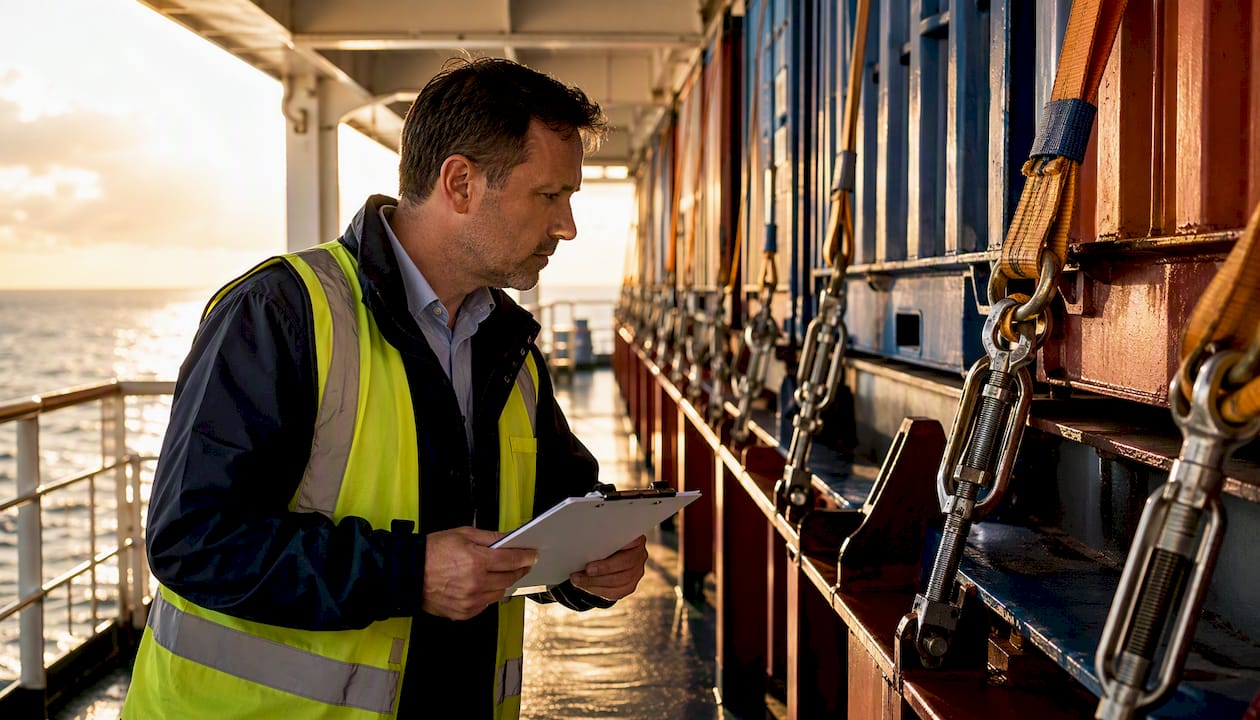
A container lashing requirement is the set of regulatory, ship-specific and technical rules that determine how containers must be secured to resist sliding, tipping, racking and loss at sea. For UK operators, the single most important immediate action is to consult the vessel’s Cargo Securing Manual (CSM) and verify that all lashing assemblies meet the Safe Working Load (SWL) and angular arrangement specified within it. Deviating from the approved stow is not a procedural technicality — deviation can compromise integrity of the entire stack.
Three quick compliance checks before you read further:
- Equipment certification: confirm every twistlock, lashing rod and turnbuckle carries a valid certificate and SWL marking traceable to the manufacturer or an approved test body
- Correct lashing angles and attachments: verify that lashings are fitted to the correct corner castings at the angles specified in the CSM or class-approved calculation
- Documented inspection: record the pre-voyage inspection in the lashing log before departure; port state control officers will ask to see it
Table of Contents
- What container lashing actually covers in practice
- The regulatory framework that governs lashing requirements
- What lashing equipment and container fittings you need to check
- How lashings are planned and calculated for a stack
- Inspection, testing and recordkeeping for lashing gear
- Pre-voyage lashing checklist for operators
- Common errors and how to avoid them
- Industry perspectives on lashing practice and automation
- How UK enforcement works and who is accountable
- Key takeaways
- The details that actually determine whether lashing holds
- Compliant container haulage across major UK ports
- Useful sources
What container lashing actually covers in practice
Container lashing is the system of fittings, rods, turnbuckles and securing arrangements that prevents containers from moving once stowed on a vessel. The term covers two distinct categories of arrangement, each addressing different load paths.
Internal lashings (also called para-lash or cross-lash arrangements) are fitted within the container stack itself, typically connecting the bottom corner casting of the upper container to the top corner casting of the lower container. Cross-lashing resists racking forces by creating a diagonal tension path across the stack width. Because top corner castings have reduced strength compared with bottom castings, proposals to attach lashings to top castings require specific consideration and approval in calculations.
External lashings run from the container’s corner castings down to deck lashing points or lashing bridges fitted to the ship’s structure. They are the primary means of restraining higher stacks and are required whenever twistlocks alone are insufficient. Twistlocks can hold two or three tiers depending on container weights; beyond that, external lashings are mandatory to provide the racking strength the stack needs.
The failure modes that lashing requirements are designed to prevent include:
- Sliding — lateral or longitudinal movement under ship motion and green-sea loads
- Tipping and overturning — rotational failure of a stack under combined roll and wind pressure
- Racking — distortion of the container structure under transverse forces, which can cause corner post failure
- Lift-out — vertical separation of containers from the stack under pitch and heave
Lashing requirements apply to on-deck stacks, hatch cover stacks, partially loaded decks and any position where the vessel’s CSM specifies a securing arrangement. Lashing bridges are required when stack heights or weights exceed what direct-to-deck lashing angles can safely accommodate. For cross-modal context on how securing considerations extend to road movement, see container loading onto trucks.
Pro Tip: When reviewing a stow plan, always check whether the stack position is inboard or outboard. Outboard stacks are exposed to greater transverse accelerations and typically require a more demanding lashing arrangement than the CSM’s inboard defaults.
The regulatory framework that governs lashing requirements
The documents governing container lashing requirements form a clear hierarchy. Knowing which to open first saves time and prevents compliance gaps.
The primary documents
- Cargo Securing Manual (CSM) — the ship-specific document approved by the flag state or classification society. It defines the approved stow positions, lashing arrangements, maximum stack weights and the fittings to be used on that vessel. The CSM is the first document to consult for any voyage.
- SOLAS Chapter VI and VII / IMO CSS Code — the international treaty framework that makes the CSM mandatory and sets the overarching principles for cargo stowage and securing. The Code of Safe Practice for Cargo Stowage and Securing (CSS Code) provides the technical annexes that underpin CSM content.
- Classification society rules and guidelines — DNV, ABS, Lloyd’s Register (LR) and IRClass each publish container securing guidelines that specify permissible forces on corner fittings and lashing assemblies. Approved classification guidelines require that container and lashing stiffness both be considered when determining forces, not just the nominal SWL.
- ISO 3874 — the international standard for series 1 freight container handling and securing, defining the dimensional and strength requirements for corner castings and fittings.
- EN 12195 family — the European standards covering lashing equipment strength, testing and marking, applicable to the equipment used in lashing assemblies.
- UK Maritime and Coastguard Agency (MCA) — the UK competent authority responsible for port state control and flag state oversight. The MCA enforces SOLAS requirements at UK ports and publishes guidance relevant to UK-flagged vessels and vessels calling at UK ports.
The consult order for a voyage
- Vessel CSM (ship-specific approved arrangements)
- IMO CSS Code annexes (technical methodology)
- Classification society rules and approved lashing software
- ISO 3874 and EN 12195 (product and equipment standards)
- MCA guidance and port authority requirements
Responsibilities under UK jurisdiction
The master bears ultimate responsibility for cargo securing on board. The shipper and packer are responsible for accurate weight declarations and correct internal packing. The stevedore is responsible for executing the lashing arrangement as specified in the CSM and the stow plan. Port state control officers from the MCA can detain a vessel if lashing arrangements are found to be non-compliant or if the CSM is absent or unapproved.
Classification society approvals and CLS (Container Lashing Software) notation tools are used to validate arrangements on large container vessels where manual calculation of thousands of positions would be impractical. Lashing calculation software is recommended for vessels carrying thousands of containers to reduce human error in load computation. For broader port logistics compliance context, the UK port logistics best practices guide covers terminal coordination and inspection readiness in detail.
What lashing equipment and container fittings you need to check
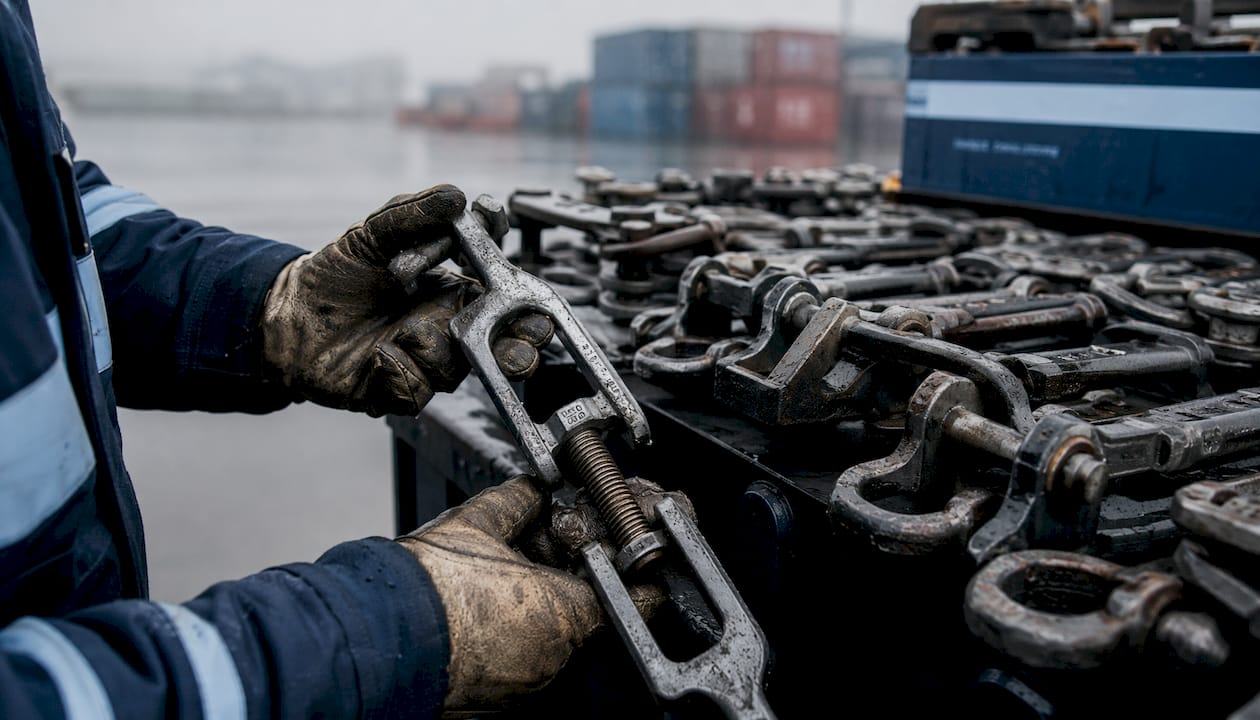
Every piece of lashing equipment must be certified, marked and traceable before it is used. The following components make up a typical securing assembly.
| Component | Typical SWL | Where applied | Inspection focus |
|---|---|---|---|
| Manual twistlock | 20 tonnes | Bottom corner castings, stack interfaces | Locking mechanism engagement, wear on cone and body |
| Semi-automatic twistlock | 20 tonnes | Bottom corner castings | Automatic release function, certification plate |
| Lashing rod (steel) | — | Corner castings to deck/bridge | Thread condition, rod straightness, stiffness |
| Turnbuckle (bottle screw) | — | Inline with lashing rod | Thread engagement depth, locking nut secured |
| Lashing cone | 20 tonnes | Stack interfaces (alternative to twistlock) | Cone geometry, body cracks |
| Lashing bridge | Structural (vessel-specific) | Deck-mounted, intermediate tier access | Structural welds, platform condition, attachment points |
| D-ring / lashing plate | Vessel-specific SWL | Deck lashing points | Weld integrity, corrosion, deformation |
| Wire/chain lashing | Varies by assembly | External lashing runs | Kinks, broken wires, chain link deformation |
Classification guidance recommends that loads on loose fittings not exceed 85% of their SWL, providing a working margin against dynamic overload.
Raised lashing platforms (lashing bridges) improve lashing angles and permit higher allowable stack weights for a given lashing strength. They are standard on larger container vessels and allow shorter rods to be used, which reduces the risk of rod buckling under compression.
Pro Tip: When inspecting turnbuckles, check that the thread engagement is at least the full barrel length on both ends — partial engagement is a common failure point under dynamic load. On steel lashing rods, any visible bend or kink is grounds for immediate rejection, regardless of whether the rod has been used before. Automatic twistlocks require manufacturer-specific inspection procedures and may need special approval for certain stow positions; never substitute them for manual fittings without verifying CSM compatibility.
How lashings are planned and calculated for a stack
Lashing calculations translate voyage conditions and stack geometry into a required number and arrangement of lashings. Understanding the inputs and outputs allows you to verify whether a shore-side or ship-side calculation is credible.
Calculation inputs
- Container stack weights — gross mass of each container, verified against the Verified Gross Mass (VGM) declaration
- Stow position — inboard or outboard, tier number, hatch cover or under-deck
- Number of tiers — directly affects the overturning moment and racking forces on lower containers
- Environmental loads — transverse and longitudinal accelerations derived from vessel motion data, wind pressure and green-sea forces
- Ship motions and centre of gravity — GM (metacentric height) and roll period affect the acceleration factors applied to each stack position
- Lashing geometry — rod length, lashing angle relative to horizontal, attachment point height
Calculation outputs
- Required number of lashings per tier and their arrangement (cross-lash, direct lash)
- Minimum SWL per lashing assembly
- Whether lashing bridges are required to achieve acceptable angles
- Whether the arrangement meets the permissible force limits for corner castings
The table below illustrates example allowable force ranges drawn from classification guidance, to give a sense of the magnitudes involved.
| Stack configuration | Transverse racking limit | Longitudinal racking limit | Corner casting tension limit |
|---|---|---|---|
| 20 ft container (bottom casting) | Per class rules | Per class rules | Per class rules |
| 40 ft container (bottom casting) | Per class rules | Per class rules | Per class rules |
| Top corner casting (where used) | Reduced — see CSM | Reduced — see CSM | Reduced — see CSM |
Exact permissible force values are vessel and class-specific; always use the figures in the approved CSM or class calculation rather than generic tables. For stacks involving heavy or out-of-gauge units, the heavy container haulage reference guide provides additional context on weight verification and stowage constraints.
When planning lashing bridges, note that elevated platforms change the longitudinal lead of lashing rods and require allowance for hatch cover and hull movements in the calculation. For large vessels, approved lashing software is the recommended method; manual calculation for thousands of positions introduces unacceptable error risk.
Inspection, testing and recordkeeping for lashing gear
Pre-voyage inspection is not optional and not a formality. Port state control officers treat inadequate inspection records as evidence of a systemic safety failure, not just an administrative shortcoming.
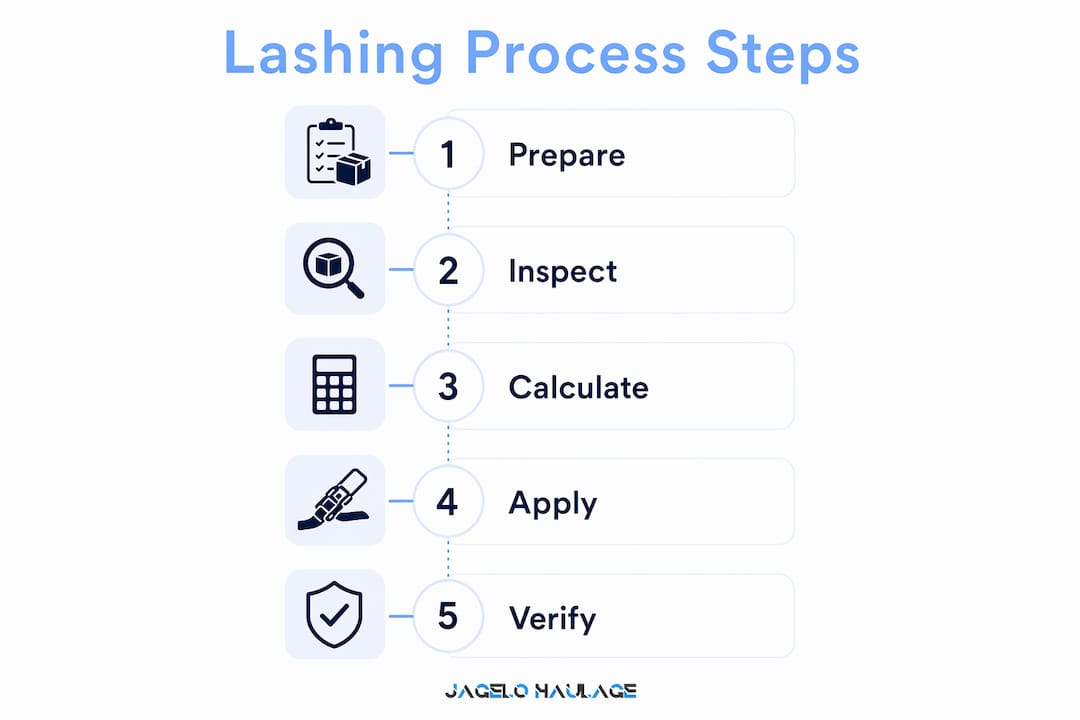
Pre-use visual checks for every component:
- No visible deformation, bending or cracking on rods, turnbuckles or twistlock bodies
- Thread condition on turnbuckles: full engagement, no stripped or corroded threads, locking nuts present and secured
- Twistlock locking mechanism: cone rotates freely to locked position and does not release under manual pull
- Lashing rods: straight, no kinks, no corrosion pitting that reduces cross-section
- D-rings and deck lashing plates: no weld cracks, no deformation, no corrosion at the base
- Wire or chain lashings: no broken wires, no kinked links, no reduction in cross-section
Inspection intervals and recordkeeping:
Lashing equipment should be formally inspected at intervals defined in the vessel’s planned maintenance system, typically every voyage or at a minimum every port call for equipment in active use. Each item must carry a tag or certificate showing its SWL, the date of last inspection and the inspector’s identity. Replacement components must be accompanied by manufacturer or approved test certificates before being placed in service.
Lashing rods must be kept tight and bear the primary restraining force during roll and pitch; twistlocks only become fully loaded after stack deflection closes the clearance gap. This means a loose rod is effectively not contributing to the securing arrangement at the moment it is most needed.
Documentation to retain:
- Equipment certificates for all fittings in use
- CSM sign-off confirming the approved arrangement was followed
- Lashing installation record signed by the responsible officer
- Pre-voyage inspection log with component-level entries
Turnbuckle locking nuts must be secured after tensioning. Overtightening is also a risk: excessive tension can pre-load corner castings beyond their design limits and cause cracking before the vessel even leaves port.
Pre-voyage lashing checklist for operators
A structured sequence prevents the most common errors. The following checklist covers the full pre-departure cycle from shore-side preparation to sign-off.
Pre-arrival checks (ashore)
- Confirm the vessel’s CSM is current, approved and accessible to the responsible officer
- Verify VGM declarations for all containers in the stow plan match the planned stack weights
- Confirm certified lashing equipment is staged and available for the stow positions planned
- Check container condition on arrival: no corner post damage, no deformed castings, no missing lashing points
On-deck securing sequence
- Position the container on the correct cell or deck position per the stow plan
- Fit and lock all twistlocks at the base of the container before releasing the crane
- Fit lashing rods to the correct corner castings at the angles specified in the CSM
- Tension turnbuckles to snug-tight, then apply the specified additional turns per the CSM or class guidance
- Secure all locking nuts on turnbuckles
- Verify lashing angles visually: rods should run at the angle shown in the CSM diagram, not vertical or near-horizontal
- Tag each lashing assembly with the inspector’s identifier and the date
Verification and sign-off
- The responsible officer (typically the chief officer) inspects the completed arrangement against the CSM
- The lashing record is completed with container numbers, positions, equipment identifiers and the officer’s signature
- A copy of the lashing record is retained on board and available for port state control inspection
Pro Tip: Plan the lashing sequence to minimise time spent at height. Fit all deck-level twistlocks first, then work upward using approved access platforms. ERGO(LASH) guidance from ABS prescribes specific working-space and fall-protection requirements for lashers; compliance with these requirements is part of the overall lashing requirement, not a separate safety matter. For a ready-to-use compliance template, the secure container load guide provides a practical UK-facing checklist.
Common errors and how to avoid them
Most lashing failures trace back to a small number of recurring mistakes. Recognising them in advance is the most effective mitigation.
Frequent operational errors:
- Exceeding declared stack weights — using inaccurate or estimated VGM figures invalidates the lashing calculation entirely
- Poor turnbuckle thread engagement — fitting a turnbuckle with only partial thread contact creates a failure point that may not be visible during a visual check
- Using worn or bent lashing rods — a rod with reduced stiffness will not transfer load correctly, even if its nominal SWL appears adequate
- Attaching lashings to top corner castings without approval — top castings have lower strength than bottom castings; using them without a specific calculation and CSM approval risks casting failure under load
- Incorrect lashing angles — a rod running too close to vertical provides minimal horizontal restraint; a rod running too close to horizontal creates excessive vertical load on the casting
- Loose lashings — a rod that is not snug-tight before departure is not contributing to the securing arrangement during the critical early stages of roll
Failure modes and consequences:
Racking failure distorts the container frame and can cause corner post compression failure, which in turn allows the stack above to collapse. Twistlock pull-out, where the cone disengages under load, typically results in the loss of the upper container. Full stack loss at sea is the most severe outcome and carries significant liability under SOLAS and UK maritime law.
Practical mitigations:
- Verify VGM against the stow plan before loading, not after
- Reject containers with deformed corner castings or missing lashing points before they reach the vessel
- Use lashing bridges for stacks of four tiers or more to achieve acceptable lashing angles without excessively long rods
- Audit twistlock condition at every port call, not just at the start of a voyage
- Treat the pre-departure checklist as a mandatory sign-off document, not a suggestion
Pro Tip: If a container arrives with a VGM that is significantly higher than the booking weight, do not assume the stow plan remains valid. Recalculate or refer back to the CSM before loading. A weight discrepancy of even a few tonnes can push a stack beyond its approved lashing capacity.
Industry perspectives on lashing practice and automation
The most persistent misconception in container securing is that lashing can be improvised at the dock when equipment is unavailable or the CSM is unclear. The correct practice is to follow the vessel’s approved CSM and calculations precisely, because any deviation — however minor it appears — can compromise the integrity of the entire stack under sea conditions the shore-side team never experienced. A ship must carry a Cargo Securing Manual; approval of that manual does not guarantee survival in foul weather, and deviations from the approved stow remove the only engineered safety margin the stack has.
AMSA’s maritime safety awareness bulletin on securing reinforces this point directly, noting that ergonomic lashing rules set requirements for working spaces, movement about the ship, fall protection and working arrangements on deck. The ERGO(LASH) guidance published by ABS prescribes specific ergonomic and fall-protection standards for lashers, recognising that the physical demands of the role create injury risk that must be managed alongside the cargo-securing objective. PPE requirements for lashers typically include hard hats, safety footwear, gloves and harnesses when working at height.
The automation trend in container securing is real and accelerating. Semi-automatic and fully automatic twistlocks reduce human exposure during securing operations and lower the risk of incorrect engagement, but they require certification and regular inspection to remain compliant. Automatic fittings cannot simply be substituted for manual ones without verifying CSM compatibility and obtaining the appropriate class approval.
For large container vessels, lashing calculation software is now the industry standard for validating arrangements across thousands of stow positions. The combination of approved software, certified equipment and a rigorously followed CSM represents the current best-practice baseline for reducing container loss risk.
How UK enforcement works and who is accountable
UK port state control, conducted under MCA authority, is the primary enforcement mechanism for container lashing compliance at UK ports. Officers board vessels and assess compliance against SOLAS requirements, with the CSM as the reference document.
Role map for a typical container voyage:
- Master — ultimate responsibility for cargo securing; must ensure the CSM is followed and lashing records are maintained
- Chief officer — operational responsibility for executing and verifying the lashing arrangement
- Shipper — responsible for accurate VGM declarations and correct packing of the container
- Packer — responsible for internal cargo securing within the container
- Terminal operator / stevedore — responsible for executing the lashing arrangement as specified in the stow plan and CSM
- Port state control officer (MCA) — inspects compliance, can issue deficiency notices and detain vessels
What UK inspectors typically check:
- CSM is on board, current and approved by the flag state or recognised organisation
- Lashing equipment certificates are present and traceable for all fittings in use
- Lashing installation records are completed and signed for the current voyage
- Evidence of approved calculations or software output for the stow arrangement
- Physical condition of lashings: no obvious slack, no missing components, no visibly damaged fittings
Responding to enforcement findings:
If an inspector identifies a deficiency, the required response is immediate rectification before departure. This means re-lashing non-compliant stacks, replacing uncertified equipment and updating records. Attempting to sail with an outstanding lashing deficiency notice is a SOLAS violation and exposes the master, operator and charterer to significant liability. For a structured approach to UK port compliance, the shipping container transport port logistics guide covers terminal coordination and inspection preparation in detail.
Key takeaways
Container lashing requirements are defined by the vessel’s Cargo Securing Manual, underpinned by SOLAS and the IMO CSS Code, and enforced in the UK by the MCA through port state control inspections.
Immediate priority actions for logistics teams:
- Obtain and read the vessel’s current, approved CSM before planning any stow
- Verify SWL markings and manufacturer certificates for every lashing component before use
- Follow the approved lashing arrangement exactly — do not improvise or substitute equipment without recalculating
- Complete and sign the lashing installation record before departure
- Escalate any non-conforming container (damaged castings, incorrect VGM, missing fittings) before it reaches the vessel
| Point | Details |
|---|---|
| CSM is the primary document | Consult the vessel’s Cargo Securing Manual first; it defines the approved arrangement for every stow position. |
| SWL and certification are mandatory | Every twistlock, rod and turnbuckle must carry a valid certificate; loads on loose fittings should not exceed 85% of SWL. |
| Lashing angles determine effectiveness | Rods at incorrect angles provide minimal restraint; verify angles against the CSM diagram before sign-off. |
| Inspection records are enforceable | MCA port state control officers check lashing logs; incomplete records are treated as a systemic failure. |
| Jhaulage supports compliant container movement | Jhaulage provides port-to-door container haulage with certified crews, GPS tracking and documentation support across major UK ports. |
The details that actually determine whether lashing holds
Most lashing failures are not caused by ignorance of the rules. They are caused by the gap between knowing the rules and applying them under time pressure at the dock. The CSM sits in the ship’s office; the stevedore is working to a tight port window; the lashing record gets signed before the last turnbuckle is checked. That sequence is where containers are lost.
The three priorities that actually matter from an operational standpoint are pre-stow communications, certified equipment staging and clear sign-off procedures. Pre-stow communications means the stow plan, VGM data and CSM requirements reach the terminal operator before the vessel berths, not after the crane is already running. Certified equipment staging means the correct fittings for the planned stow positions are physically present on deck before loading starts, not sourced from a general store mid-operation. Clear sign-off means one named officer is accountable for the lashing record, and that record is completed as a condition of departure, not retrospectively.
The regulatory framework is thorough and the equipment standards are well-developed. What the framework cannot do is substitute for the discipline of following it under operational pressure. That discipline is a management decision as much as a technical one, and it starts with the pre-voyage planning cycle, not the moment the first container touches the deck.
Compliant container haulage across major UK ports
Port-to-door container movement is only as reliable as the compliance discipline behind it. Jhaulage provides specialist container haulage across the UK’s major ports, including Felixstowe, Tilbury, Southampton and Liverpool, with a fleet of over 40 GPS-tracked trucks and trailers and 24/7 operational support.
Where lashing compliance and documentation are part of the handover requirement, Jhaulage’s crews work to certified procedures and maintain the records that port state control and freight forwarders need. Whether you require tracked port-to-door delivery, same-day container movement or support with compliance-critical shipments, the team is available around the clock. For a full picture of service coverage and to discuss your specific port logistics requirements, visit Jhaulage’s container haulage services or contact the team directly for a quote.
Useful sources
The following authoritative documents underpin the guidance in this article. Consult them in the order listed when preparing for a voyage.
Primary documents (consult first):
- Vessel Cargo Securing Manual (CSM) — ship-specific, flag-state or class-approved; the definitive reference for all stow positions and lashing arrangements on a given vessel. Used throughout this article as the primary compliance reference.
- IMO CSS Code (Code of Safe Practice for Cargo Stowage and Securing) — the international technical standard underpinning SOLAS Chapter VI/VII requirements. Provides the methodology for lashing calculations and the framework for CSM content.
- SOLAS Chapter VI and VII — the treaty-level obligations for cargo stowage and securing applicable to all vessels calling at UK ports.
Classification society rules and guidelines:
- DNV container lashing rules — DNV publishes container lashing rules and class notation requirements; relevant for vessels classed with DNV and for understanding CLS software requirements.
- ABS Guide for Ergonomic Container Lashing (ERGO(LASH)-R) — the ABS guide prescribing ergonomic and safety requirements for lashers, including working-space, fall protection and PPE standards. Referenced in the inspection and industry sections of this article.
- IRClass Guidelines on Container Securing (July 2025) — provides permissible force tables for corner fittings, SWL guidance for loose fittings and recommendations on lashing software adoption.
- CR Class Guidelines for Certification of Container Securing Systems — covers allowable forces for 20 ft and 40 ft corner fittings and the requirement to account for system stiffness in calculations.
- Lloyd’s Register Rules for Ergonomic Container Lashing — LR’s rule set for ergonomic lashing, complementing the ABS ERGO(LASH) guidance.
Equipment and product standards:
- ISO 3874 — series 1 freight container handling and securing; defines corner casting dimensions and strength requirements.
- EN 12195 family — European standards for lashing equipment, covering strength, testing and marking requirements for rods, turnbuckles and associated fittings.
UK regulatory authority:
- UK Maritime and Coastguard Agency (MCA) — the competent authority for port state control and flag state oversight in the UK. MCA guidance and detention records are publicly available and provide practical insight into what inspectors prioritise.
| Document | Primary use | Where referenced in this article |
|---|---|---|
| Vessel CSM | Approved stow arrangements and lashing specifications | Throughout — primary compliance reference |
| IMO CSS Code | Technical methodology for lashing calculations | Regulatory framework section |
| SOLAS Ch. VI/VII | Treaty-level cargo securing obligations | Regulatory framework and enforcement sections |
| ABS ERGO(LASH)-R | Ergonomic and PPE requirements for lashers | Checklist and industry insights sections |
| IRClass Container Securing Guidelines | Permissible forces and SWL guidance | Equipment, planning and calculation sections |
| ISO 3874 | Corner casting dimensions and strength | Equipment section |
| EN 12195 | Lashing equipment standards and marking | Equipment section |
| MCA guidance | UK port state control enforcement | Enforcement section |
Recommended
- Secure container load for transport: the UK guide | Jagelo Haulage
- Heavy Container Haulage: A Strategic Reference Guide for UK Logistics 2026 | Jagelo Haulage
- Container transport compliance checklist UK: 2026 guide | Jagelo Haulage
- Shipping Container Transport: The Strategic Guide to UK Port Logistics | Jagelo Haulage