Storage solutions after port delivery: a UK guide

When a container is discharged at a UK port, four primary storage categories are available to logistics planners: port-centric container yards (CY), off-dock container depots and container freight stations (CFS), inland warehouses and distribution centres, and specialist facilities covering bonded, reefer, hazardous goods, and bulk storage. The right choice depends almost entirely on dwell time and cost sensitivity. For dwell under 3–7 days, a container yard is the default; beyond free-time expiry, an off-dock depot or inland warehouse almost always delivers a lower total landed cost.
Before committing to any facility, run through these immediate checks:
- Confirm your carrier’s free-time allowance at the relevant terminal (commonly a few days depending on port and shipping line).
- Establish whether the consignment requires bonded storage to defer import duty and VAT.
- Identify your drayage window and whether same-day collection is achievable before demurrage accrues.
- Clarify commodity class: reefer, hazardous, or high-value cargo narrows your facility options immediately.
Table of Contents
- What are the main types of storage solutions after port delivery?
- Which internal warehouse storage systems suit your cargo profile?
- What handling equipment and interfaces should you verify before booking a facility?
- How do customs, bonded storage, and security requirements affect your choice?
- Understanding the cost and timeline trade-offs: demurrage, detention, and drayage
- How to choose the right post-port storage option: a decision checklist
- Integrating haulage and storage planning: an operational perspective
- Key takeaways
- Why integrated planning consistently outperforms reactive logistics
- Jhaulage: port collection and storage coordination across the UK
- Useful sources and further reading
What are the main types of storage solutions after port delivery?
Containerised post-delivery storage in the UK organises into three primary modes, with specialist facilities forming a fourth layer. Understanding what each does operationally prevents misallocation and unnecessary charges.
Port-centric container yard (CY). A CY is a designated area within the terminal where full, sealed FCL containers are held temporarily after discharge. It is the default endpoint for full container load shipments and is best suited to tight vessel connections where the cargo will move landside within the carrier’s free-time window. Once that window closes, daily demurrage accrues, making the CY expensive for any cargo that cannot be collected promptly.
Off-dock container depot and CFS. An off-dock depot sits outside the terminal gate and specialises in empty-container management, maintenance and repair (M&R) to IICL standards, and fleet management for leasing companies and NVOCCs. A container freight station (CFS) performs deconsolidation of LCL shipments, allowing multiple consignees to collect their cargo from a single inbound container. Both structures offer lower per-day storage rates than terminal tariffs, and long-term arrangements can often be negotiated into flat monthly rates. Specialist value-added services such as fumigation, labelling, kitting, and QC inspection are widely available at CFS facilities, reducing handling steps before onward delivery.
Inland warehouse and distribution centre. For medium to long-term inventory buffering, order fulfilment, and value-added processing, an inland warehouse integrated with a warehouse management system (WMS) is the appropriate choice. These facilities support pick/pack operations, cross-docking, and returns management, and are typically positioned to serve regional distribution networks rather than port-adjacent dwell.
Specialist facilities. Four sub-categories deserve separate treatment:
- Bonded warehouses allow importers to defer payment of import duty and VAT until goods leave bond for domestic consumption, a significant cash-flow tool for high-value consignments.
- Reefer and cold storage facilities provide temperature-controlled environments with plug-in points for refrigerated containers, essential for perishables and pharmaceuticals.
- Hazardous goods storage must comply with COMAH regulations and ADR classifications, with segregated bays, specialist ventilation, and trained personnel.
- Open-yard container stacking and bulk/flexi-tank storage serves liquid and powder cargo arriving in ISO tank containers or flexi-tanks, where conventional racking is impractical and ground-level access is required.
Dwell-time mapping:
| Dwell horizon | Recommended facility | Primary cost driver |
|---|---|---|
| Immediate (few days) | Port CY within free-time | Nil (within free-time) |
| Short-term (3–7 days) | Off-dock depot or CFS | Gate handling + daily TEU rate |
| Medium-term (several weeks) | CFS or inland warehouse | Daily/monthly storage + drayage |
| Long-term (90+ days) | Inland DC or bonded warehouse | Monthly storage + duty deferral |
Storage-in-transit (SIT) arrangements, used to bridge timing mismatches in consolidated or household moves, commonly run for several weeks under standard carrier or forwarder terms, with billing structured around per-pallet or per-cubic-metre daily rates plus inbound and outbound handling fees.
Which internal warehouse storage systems suit your cargo profile?
Once cargo moves off the terminal and into a depot or warehouse, the intralogistics system inside that facility determines throughput, space efficiency, and pick accuracy. Choosing the wrong racking configuration for your SKU profile is a common and costly oversight.
Selective pallet racking is the most prevalent system in UK distribution centres: every pallet is directly accessible, forklift operation is straightforward, and reconfiguration is relatively low-cost. It suits medium-to-high SKU diversity with moderate throughput. Double-deep racking sacrifices direct access to the second pallet position in exchange for roughly 30% more storage density, making it appropriate for high-volume, low-SKU-diversity operations.
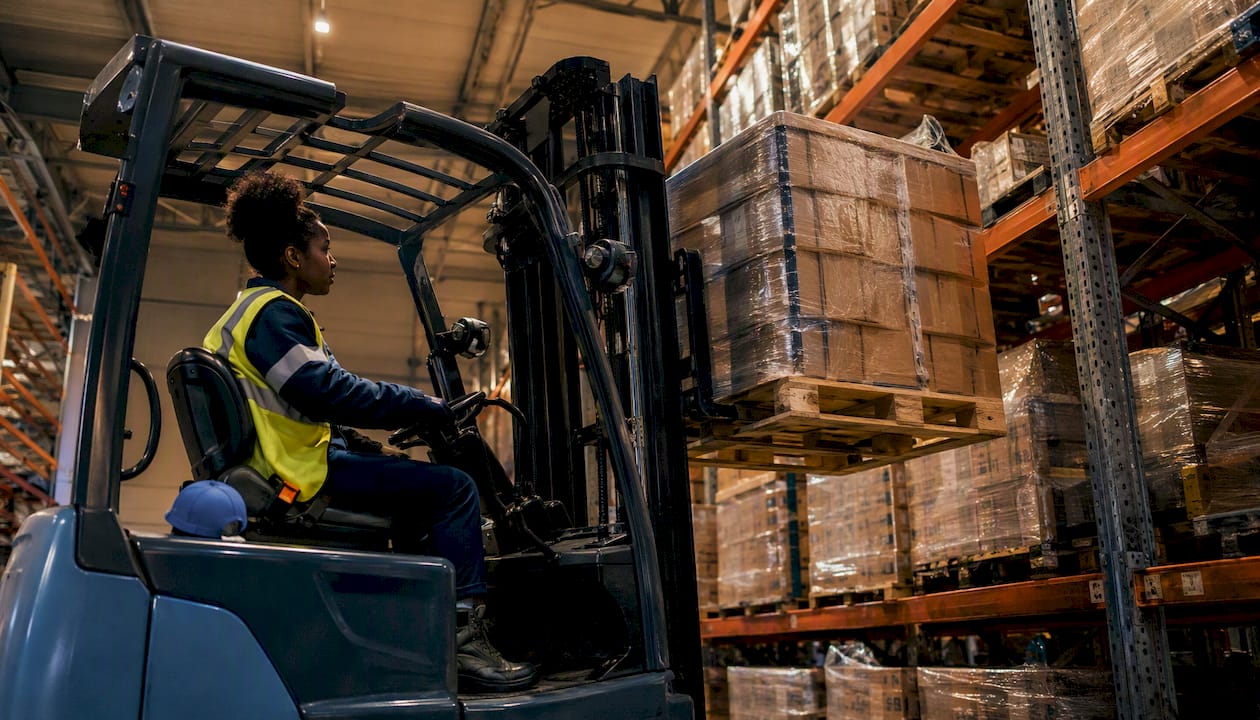
Drive-in and drive-through racking eliminates aisles entirely, allowing forklifts to enter the rack structure. Drive-in suits LIFO (last-in, first-out) operations such as seasonal buffer stock; drive-through enables FIFO (first-in, first-out) for perishables. Mobile racking mounts conventional pallet racking on motorised bases that compact together, leaving only one working aisle at a time. Space savings of up to 50% over static selective racking are achievable, though capital cost and floor-loading requirements are considerably higher.
Mezzanine floors and multi-tier shelving are suited to small-parts storage and e-commerce fulfilment where vertical space is available and pallet-level throughput is low. They extend usable floor area without expanding the building footprint.
Automated storage and retrieval systems (AS/RS) represent the high-density, high-throughput end of the spectrum. Unit-load AS/RS handles full pallets via automated cranes running in narrow aisles; mini-load and shuttle AS/RS manages totes and cartons for small-parts picking. AS/RS pays off where labour costs are high, SKU velocity is consistent, and throughput volumes justify the capital investment. Integration with a WMS and transport management system (TMS) is a prerequisite.
| System | Best for | Cost driver | Handling complexity | Specialist cargo suitability |
|---|---|---|---|---|
| Selective pallet racking | High SKU diversity, direct access | Low capital, standard forklift | Low | General; limited reefer |
| Double-deep racking | High volume, low SKU count | Moderate capital, deep-reach truck | Medium | General |
| Drive-in/drive-through | Seasonal buffer, LIFO/FIFO bulk | Moderate capital | Medium | Perishables (drive-through) |
| Mobile racking | Space-constrained facilities | High capital, floor loading | Medium | High-value, pharmaceuticals |
| AS/RS (unit-load) | High throughput, consistent velocity | High capital + WMS integration | Low (automated) | Controlled environments |
| Mezzanine/multi-tier | Small-parts, e-commerce | Moderate capital | Low to medium | Light goods only |
Pro Tip: If your SKU velocity is highly variable across seasons, selective racking with a WMS-directed slotting strategy will outperform a capital-intensive AS/RS installation. Reserve AS/RS for operations where throughput is predictable and labour availability is a genuine constraint.
What handling equipment and interfaces should you verify before booking a facility?
The handling assets available at a facility directly constrain what cargo it can accept and how quickly it can turn containers around. Verifying equipment capability before committing a booking prevents costly last-minute transfers.
Common landside equipment includes:
- Reach trucks and counterbalance forklifts for standard pallet handling inside warehouses and depots.
- Straddle carriers and top-lift/side-lift handlers for container movement within yard environments.
- Mobile cranes and container spreaders for lifting full containers onto trailers or into stack positions, particularly at facilities without fixed gantry cranes.
- Reefer plug points (typically 440V three-phase) for maintaining temperature-controlled containers in yard storage.
- Weighbridges for VGM (verified gross mass) compliance under SOLAS requirements.
Before confirming a storage appointment, check the following:
- Gate-in procedure and Vehicle Booking System (VBS) requirements at the facility.
- Maximum stack height permitted under the yard’s structural and insurance constraints.
- Floor loading ratings inside the warehouse (expressed in kN/m²) relative to your pallet weights.
- Reefer plug availability and monitoring capability if temperature-controlled cargo is involved.
- Overhead height clearance for high-cube containers (9ft 6in versus standard 8ft 6in).
- Hazardous goods segregation bays and ADR-trained personnel if the consignment carries a UN number.
- Insurance limitations: some facilities cap liability per unit, which may be insufficient for high-value cargo.
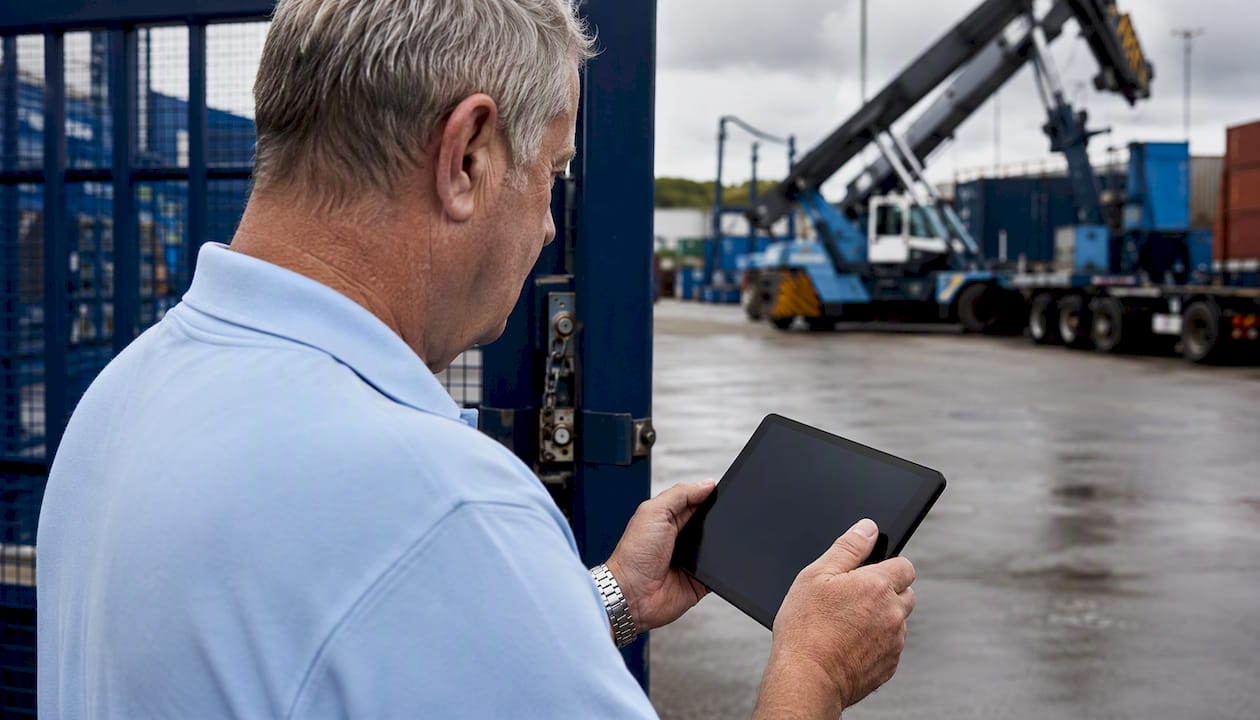
Facilities that cannot confirm these parameters in writing should be treated with caution. A missed reefer plug or an inadequate floor rating discovered at the gate will cost far more in emergency drayage than a thorough pre-booking check.
How do customs, bonded storage, and security requirements affect your choice?
Customs status is often the deciding factor between a standard off-dock depot and a bonded facility, and getting this wrong can trigger HMRC intervention and significant delays.
Bonded warehouses and customs warehousing allow importers to store goods under customs control without paying import duty or import VAT at the point of entry. Duty and VAT are deferred until the goods are released for free circulation in the UK domestic market, or until they are re-exported, which can represent a material cash-flow advantage for high-value consignments. HMRC authorises customs warehouses under the Customs Warehousing procedure; operators must hold a valid HMRC authorisation and maintain accurate inventory records that satisfy HMRC audit requirements.
HMRC guidance on customs warehousing states: “You can use a customs warehouse to store your goods without paying import duty or VAT. You only pay when the goods leave the warehouse and enter free circulation.” Importers should consult HMRC’s customs warehousing guidance directly to confirm current authorisation requirements and eligible goods categories.
Beyond bonded status, several customs and inspection flows can mandate storage independently of the importer’s preference. HMRC may place a hold pending documentary checks; the Animal and Plant Health Agency (APHA) may require phytosanitary inspection for plant-based goods; and the Office for Product Safety and Standards (OPSS) may hold regulated goods pending conformity assessment. Each of these holds requires a facility capable of maintaining the goods under customs control until clearance is granted.
Security expectations at any facility handling bonded or high-value cargo should include CCTV coverage of all storage areas, perimeter fencing with controlled access, and a documented security management plan. Operators holding Authorised Economic Operator (AEO) status provide an additional layer of assurance, as AEO certification requires HMRC to have assessed the operator’s customs compliance and security standards.
Understanding the cost and timeline trade-offs: demurrage, detention, and drayage
The single most common post-delivery pitfall is failing to model terminal storage costs before discharge. Demurrage can erode margins quickly compared with prompt drayage to an off-dock facility, yet many importers treat it as an unavoidable overhead rather than a controllable variable.
Demurrage applies to containers held inside the terminal beyond the carrier’s free-time allowance. Detention applies when a container has left the terminal but has not been returned to the carrier within the agreed return period. The two charges are distinct and can accrue simultaneously if a container is moved to an off-dock location but not emptied and returned promptly.
Typical cost components to model for any post-port storage decision:
- Terminal demurrage: daily per-TEU charge after free-time expiry, varying by port and shipping line.
- Off-dock depot daily storage: generally lower than terminal demurrage; negotiable into flat monthly rates for longer-term arrangements.
- Gate handling: inbound and outbound handling fees per container move at the depot or CFS.
- M&R charges: maintenance and repair costs if the container requires work before return.
- Drayage: cost per move from terminal to depot or warehouse, plus any onward trunking.
- Value-added services: fumigation, labelling, kitting, and inspection fees at CFS.
- Customs administration: bonded warehouse authorisation costs and inventory management fees.
Third-party warehouse and SIT costs are typically billed on a per-pallet, per-cubic-metre, or per-day basis, with separate inbound and outbound handling charges and tiered pricing for longer contract terms.
Illustrative cost-effectiveness timeline:
| Phase | Duration | Most cost-effective option | Key trigger |
|---|---|---|---|
| Free-time window | 3–7 days | Port CY | No action required |
| Post free-time, short hold | 7 days or more | Off-dock depot | Demurrage imminent |
| Medium-term buffer | Longer term | CFS or inland warehouse | Flat monthly rate negotiation |
| Long-term or duty-sensitive | 90+ days | Bonded warehouse or inland DC | Duty deferral, fulfilment integration |
For practical cost modelling, include the full landed cost (freight, terminal handling, drayage, storage, and duty), track free-time expiry dates against your cargo availability schedule, and negotiate flat monthly depot rates wherever dwell is likely to exceed three weeks. Tactics for avoiding container demurrage fees consistently point to proactive drayage scheduling as the single highest-return intervention.
How to choose the right post-port storage option: a decision checklist
Selecting the correct storage type is a structured decision, not a default. The matrix below maps the primary shipment attributes to the recommended facility type.
| Shipment attribute | Recommended storage type |
|---|---|
| Dwell under free-time, no special requirements | Port CY |
| Dwell exceeds free-time, standard cargo | Off-dock depot |
| LCL or mixed consignment requiring deconsolidation | CFS |
| Temperature-sensitive cargo | Reefer/cold storage facility |
| Hazardous goods (UN-classified) | Hazardous goods depot |
| High-value, duty-sensitive consignment | Bonded warehouse |
| Long-term inventory buffering or fulfilment | Inland DC with WMS |
| Bulk liquid or powder cargo | ISO tank depot or flexi-tank facility |
Pre-commitment checklist (run through in this order):
- Confirm the carrier’s free-time allowance at the specific terminal and calculate the demurrage exposure date.
- Establish whether the goods require bonded storage (check commodity code, duty rate, and cash-flow position).
- Verify reefer plug availability and monitoring if the cargo is temperature-controlled.
- Confirm the facility holds the appropriate HMRC authorisation, COMAH compliance, or AEO status for your cargo type.
- Check handling equipment: reach trucks, straddle carriers, or crane availability as required by container type.
- Confirm access hours and VBS booking requirements against your planned collection window.
- Validate insurance cover per unit against the declared cargo value.
- Obtain written confirmation of all applicable fees (gate handling, daily storage, M&R, value-added services) before booking.
Red flags that should trigger immediate drayage away from the terminal: free-time expiry within 24–48 hours; a container requiring M&R that the terminal cannot perform; a reefer unit with no available plug points; or a customs hold that will extend dwell beyond the free-time window. In each case, moving the container to an off-dock depot promptly is almost always the lower-cost outcome.
Integrating haulage and storage planning: an operational perspective
The most consistent source of avoidable cost in post-port logistics is the gap between when a container is available for collection and when a haulier is actually booked. That gap is where demurrage accrues, and it is almost entirely preventable with early coordination.
Port-centric warehousing services that combine drayage, transloading, bonded warehousing, and temperature-controlled storage near ports reduce landside distance and dwell time simultaneously. The principle extends to any haulier relationship: a dedicated provider with confirmed port coverage, GPS-tracked fleet, and 24/7 operational support can schedule gate-in appointments against cargo availability notifications, rather than reacting after demurrage has already begun.
A typical operational flow for a standard FCL import might run as follows: the haulier receives the cargo availability notification and books a VBS slot at the terminal; the container is collected and moved to an off-dock depot the same day; if the consignment is duty-sensitive, it is transferred under customs control to a bonded facility pending the importer’s release instruction; once released, final trunking to the distribution centre is scheduled against the WMS inbound booking. Each handoff is planned in advance, not improvised.
Pro Tip: GPS tracking on the haulage fleet is not merely a security feature. Real-time position data allows depot gate teams to prepare for inbound containers, reducing yard dwell and improving slot utilisation. When evaluating a haulier, ask specifically whether their tracking system integrates with depot gate management or provides ETA notifications.
Seasonal demand fluctuations add a further layer of complexity. Peak import periods (typically pre-Christmas and post-Chinese New Year) compress free-time windows and increase depot congestion simultaneously. Booking depot capacity in advance of peak season, rather than on a spot basis, is one of the most straightforward ways to protect against both demurrage exposure and storage unavailability. Freight consolidation planning integrated into the initial shipment design can also reduce the number of individual containers requiring storage, lowering total cost across the supply chain.
Jhaulage operates tracked container haulage across Felixstowe, Tilbury, Southampton, Liverpool, and other major UK ports, with same-day collection capability and 24/7 operational support. That port coverage, combined with a fleet of over 40 GPS-tracked vehicles, positions Jhaulage to execute the proactive drayage scheduling that prevents demurrage from accruing in the first place.
Key takeaways
Selecting the right post-port storage type requires matching dwell time, cargo class, and customs status to the appropriate facility before the container is discharged, not after free-time has expired.
| Point | Details |
|---|---|
| Check free-time immediately | Carrier free-time windows commonly span a few days; demurrage accrues daily after expiry. |
| Move to depot before free-time expires | Off-dock depots charge lower daily rates than terminals and can be negotiated to flat monthly fees. |
| Use bonded storage for duty-sensitive cargo | Bonded warehouses defer import duty and VAT until goods enter domestic circulation, improving cash flow. |
| Match intralogistics to SKU velocity | High-velocity, consistent throughput justifies AS/RS; variable SKU profiles suit selective racking with WMS slotting. |
| Jhaulage for proactive port collection | Jhaulage’s GPS-tracked fleet and 24/7 support across major UK ports enables same-day drayage to avoid terminal charges. |
Why integrated planning consistently outperforms reactive logistics
The conventional wisdom in post-port storage is to treat haulage and warehousing as sequential decisions: collect the container, then decide where it goes. That sequencing is precisely what generates avoidable demurrage, missed inspection windows, and emergency storage bookings at premium rates.
The more defensible position, grounded in how the most efficient UK import operations actually run, is to treat storage selection as part of the initial freight plan. When the haulier, the depot, and the customs broker are coordinated before the vessel arrives, free-time windows become a managed variable rather than a countdown. The difference between a container moved to an off-dock depot on day two of a five-day free-time window and one left on the terminal until day six is not just the demurrage charge on days five and six. It is also the gate slot availability, the reefer plug competition during peak season, and the M&R queue at the depot. Each of those secondary costs is invisible in a reactive model and entirely predictable in a proactive one.
The logistics professionals who consistently achieve the lowest total landed cost are not the ones with the cheapest individual service contracts. They are the ones who have eliminated the gaps between services.
Jhaulage: port collection and storage coordination across the UK
When a container arrives at Felixstowe, Tilbury, Southampton, or Liverpool, the difference between a smooth landside transfer and an escalating demurrage charge often comes down to one decision: whether your haulier is already booked and briefed before the vessel berths.
Jhaulage provides specialist container haulage services across all major UK ports, with a GPS-tracked fleet of over 40 vehicles, same-day collection capability, and 24/7 operational support. For logistics teams managing post-port storage decisions, Jhaulage’s services cover:
- Same-day port collection to prevent free-time expiry and demurrage accrual.
- Refrigerated and temperature-controlled transport for reefer and pharmaceutical cargo.
- Oversized and hazardous goods handling with appropriate documentation and routing.
- Coordination with bonded warehouses and off-dock depots for seamless custody transfer.
- GPS-tracked, real-time fleet visibility for depot gate teams and supply chain managers.
To request a quote, prepare your container number, the free-time expiry date at the relevant terminal, and your commodity class (including any UN hazard number or temperature requirement). Contact Jhaulage directly at jhaulage.co.uk to confirm availability and schedule your collection.
Useful sources and further reading
The following sources provide authoritative detail on the regulatory, operational, and commercial dimensions of post-port storage in the UK:
- VS&B Containers: Not All Storage Is the Same — the most practical comparison of CY, CFS, and off-dock depot options, including cost structure and M&R considerations. Consult this first for depot selection criteria.
- Venax: Post-Delivery Storage of Containers — analysis of hidden terminal costs and value-added services at CFS facilities. Use for demurrage modelling and CFS service scope.
- Lineage: Port-Centric Warehousing Services — covers bonded warehousing, transloading, and temperature-controlled storage near ports. The reference for bonded facility capabilities and port-centric logistics design.
- HMRC: Apply to Operate a Customs Warehouse — the primary UK regulatory source for customs warehousing authorisation, eligible goods, and HMRC audit requirements.
- GetTransport: Storage-in-Transit Guidance — practical guidance on SIT arrangements, typical hold periods of 30–90 days, and billing structures. Useful for consolidated or household-goods storage planning.
- Jhaulage: Avoiding Container Demurrage Fees — UK-focused tactical guidance on demurrage avoidance through proactive drayage scheduling.
Recommended
- Logistics for Shipping Containers: A Comprehensive Guide to UK Port Transport | Jagelo Haulage
- UK port logistics best practices: 2026 guide | Jagelo Haulage
- Shipping Container Transport: The Strategic Guide to UK Port Logistics | Jagelo Haulage
- Booking a Container Delivery Slot: A Professional Guide to UK Logistics | Jagelo Haulage