What if the empty containers currently staged at coastal ports are costing your business more in storage fees than the value of the cargo they once carried? Logistics professionals understand that equipment imbalances represent one of the most persistent drains on operational budgets. It's frustrating to manage high port charges for idle units while inland demand centres lack the necessary equipment to fulfil export orders. Strategic container repositioning services offer a methodical solution to this problem, ensuring that units move efficiently to high-demand hubs before costs escalate.
We agree that coordinating merchant haulage for empty units often introduces unnecessary complexity into your daily operations. This article shows how professional repositioning eliminates these bottlenecks and reduces your total operational overheads. We'll explore how to achieve a balanced inventory across the country, integrate seamlessly with existing port logistics, and protect your margins from rising demurrage and detention costs in 2026. This disciplined approach ensures your logistics network remains reliable and cost-effective throughout the year.
Key Takeaways
- Understand how equipment imbalances impact operational efficiency and why strategic movement is essential for maintaining supply chain stability.
- Compare the fixed costs of haulage against escalating daily terminal storage fees to protect your margins from unnecessary overheads.
- Learn how professional container repositioning services improve asset utilisation by moving empty units to high-demand inland hubs for immediate export use.
- Identify the critical criteria for selecting a haulage partner, including fleet capacity and technical expertise in both merchant and shipping line protocols.
- Discover how 15 years of industry experience and a modern fleet of over 40 trucks provide the secure, disciplined transport required for complex logistical networks.
What are Container Repositioning Services?
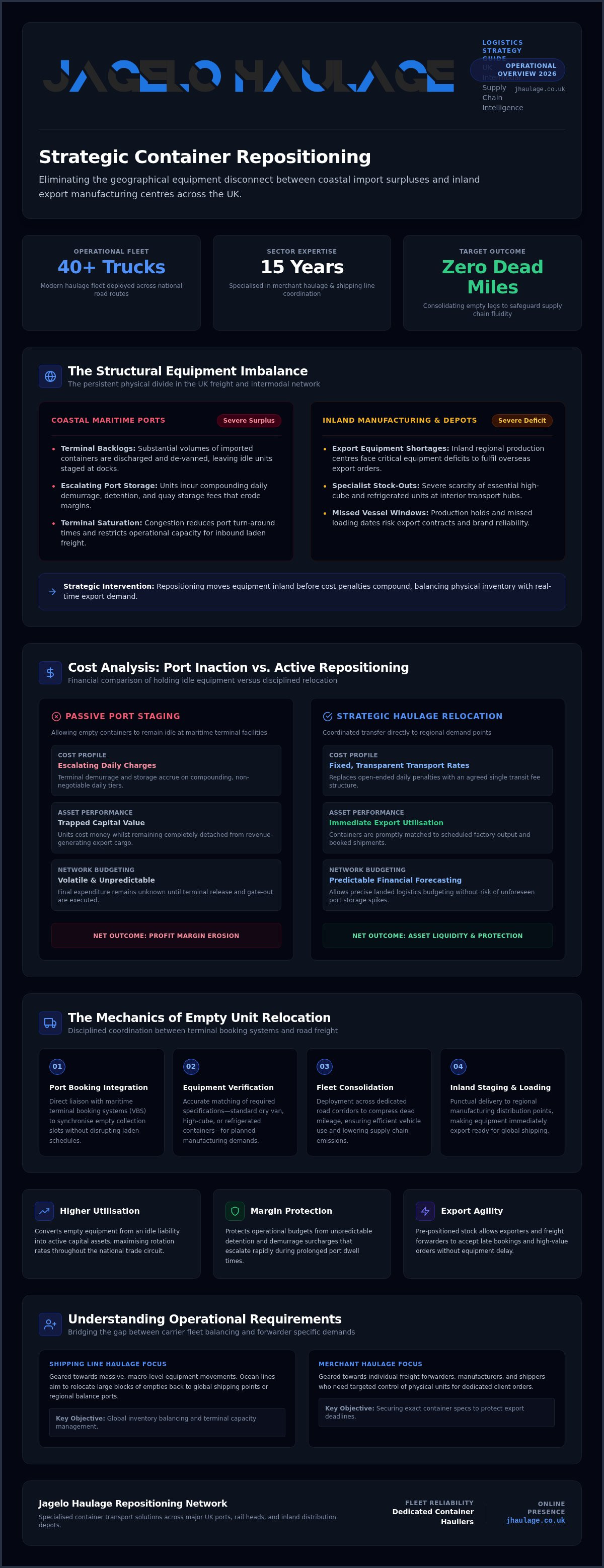
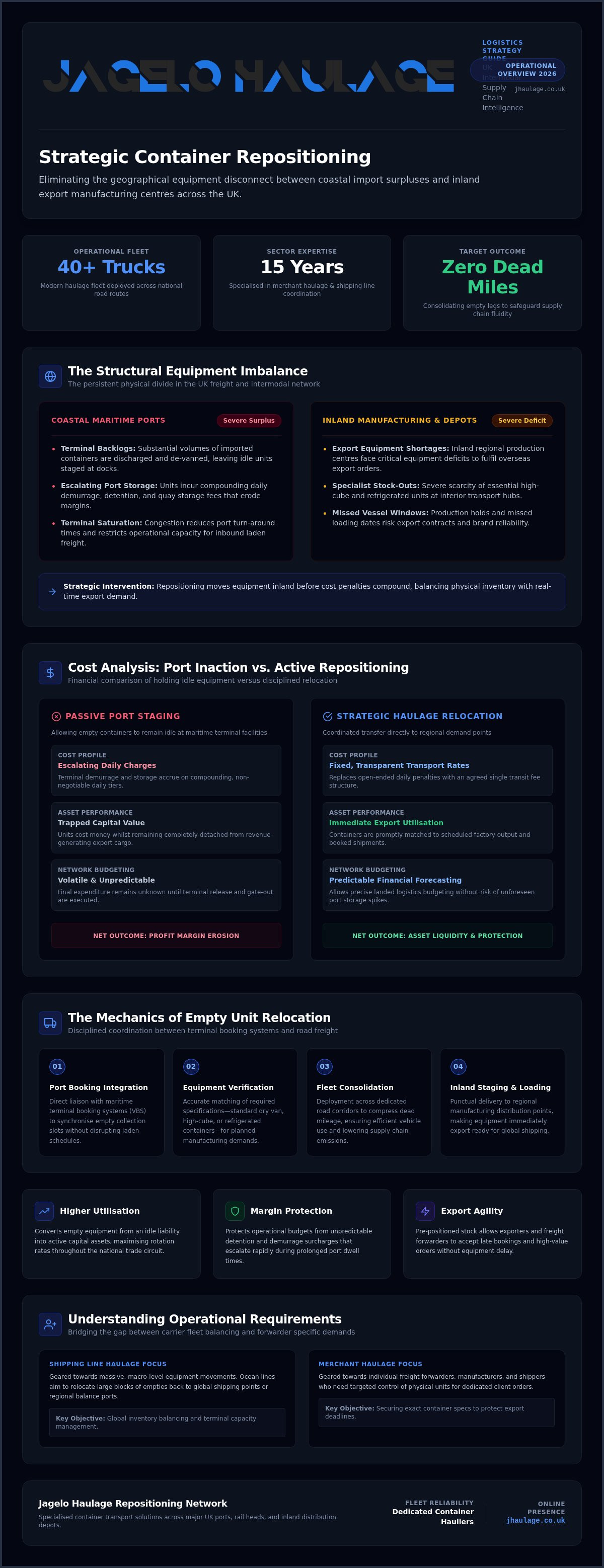
Container repositioning services involve the planned transfer of empty equipment from areas of surplus to locations where export demand is highest. In a perfectly balanced trade environment, every imported container would immediately be refilled with export goods at the same location. The reality of the UK logistics network is more complex. Most intermodal containers arrive at major coastal ports, but the demand for export units often concentrates at inland manufacturing hubs or regional distribution centres. This geographical gap creates an equipment imbalance that requires professional intervention to resolve.
The triggers for these movements are usually structural or seasonal. Port congestion can lead to a backlog of empty units that occupy valuable terminal space, while seasonal export surges in specific sectors require a rapid influx of equipment to avoid production delays. There's also a distinct difference between shipping line and merchant haulage requirements. Shipping lines often move large volumes of empties to balance their global fleets. In contrast, merchant haulage focuses on the specific needs of individual freight forwarders or shippers who must secure equipment for their own clients. Effective container repositioning services bridge these gaps by providing the physical transport capacity needed to maintain inventory liquidity.
The Mechanics of Empty Container Movement
Executing these movements requires precise coordination between terminal operators, shipping lines, and haulage contractors. Whilst laden cargo often takes priority in terminal scheduling, the movement of empty units is critical for maintaining long-term flow. Professional haulage providers must integrate with port booking systems to ensure that empty collections and deliveries don't disrupt laden schedules. This process involves managing vehicle booking slots and ensuring that the correct container type reaches the client in time for loading. Jagelo Haulage utilises a modern fleet of over 40 trucks to manage these operations, prioritising punctuality and equipment safety across the national network.
Why Repositioning is Essential for Supply Chain Fluidity
The primary goal of repositioning is to eliminate "dead miles" and maximise asset utilisation. Every mile an empty container travels represents a cost without immediate revenue, but leaving that unit at a port results in accumulating storage fees. Strategic movement ensures that equipment is available for time-sensitive exports, protecting the shipper's reputation and avoiding missed shipping windows. Disciplined fleet management allows for the consolidation of these movements, reducing operational overheads for the entire supply chain. Without these services, the UK network would face constant bottlenecks, as exporters would struggle to find the physical units needed to move their goods to market.
The Strategic Benefits of Professional Repositioning
Professional container repositioning services transform empty equipment from a logistical liability into a strategic asset. By proactively managing the flow of units, freight forwarders and shippers achieve significantly higher asset utilisation across their entire network. This approach directly reduces long-term storage overheads at major maritime hubs, where daily terminal charges can quickly erode profit margins. It's a disciplined method of ensuring that capital isn't tied up in idle equipment staged at the wrong end of the country.
There are also clear sustainability benefits associated with this practice. Consolidating empty movements reduces unnecessary vehicle mileage across the UK road network, contributing to lower carbon emissions for the broader supply chain. Reliable repositioning delivers several core advantages:
- Optimised Port Operations: Clearing empty units prevents terminal saturation and improves turn-around times.
- Cost Predictability: Replacing variable storage fees with fixed haulage costs allows for more accurate budgeting.
- Increased Responsiveness: Having equipment ready for immediate loading allows businesses to secure last-minute export contracts.
Equipment Liquidity and Export Readiness
Maintaining a steady supply of specific container types is critical for specialist exporters. Repositioning prevents "stock-outs" of high-demand equipment, such as refrigerated units or high-cube containers, which are often in short supply at inland depots. Scheduled container deliveries ensure these units are available exactly when needed, supporting a lean inventory model that prioritises flow. For a deeper look at these processes, you can read our logistics for shipping containers guide. This level of equipment liquidity is essential for businesses that operate on tight production cycles.
Operational Reliability and Risk Mitigation
Working with an experienced logistics partner for UK ports mitigates the risk of missing vessel slots. When equipment is trapped in the coastal surplus, the resulting delay can lead to missed departures and significant financial penalties. A modern fleet of over 40 trucks ensures consistency in service delivery, providing the functional reliability required for time-sensitive cargo. This disciplined execution allows businesses to respond more effectively to client demands for export equipment. If your operation requires precise equipment management, you can request a professional haulage consultation to secure your supply chain inventory.
Cost Analysis: Repositioning vs. Port Storage
Financial efficiency in logistics requires a clear comparison between fixed transport costs and variable terminal fees. Whilst a one-off haulage fee for container repositioning services might appear as an immediate expense, it often prevents the compounding daily accumulation of terminal storage charges. Port storage is rarely a linear cost. Most UK terminals implement tiered pricing structures where the daily rate increases significantly after the initial free period. By moving empty units to inland depots or client sites, businesses transform an open-ended liability into a controlled operational cost.
The hidden costs of equipment imbalances extend beyond simple storage invoices. When containers are trapped at coastal ports, businesses face the indirect expense of missed export opportunities and the subsequent need to lease additional equipment to meet inland demand. Merchant haulage provides the agility required to manage these costs effectively. Unlike shipping line haulage, which is often dictated by carrier-centric schedules, merchant-led repositioning allows freight forwarders to move units based on specific commercial priorities. This flexibility ensures that port logistics services are utilised to support, rather than hinder, the overall transport rate.
Understanding Demurrage and Detention Avoidance
Strategic repositioning serves as a critical preventative measure against excessive port fees. Timely collection from the terminal ensures that units are cleared before they enter high-cost penalty tiers. This proactive approach is essential for maintaining a lean supply chain. For a detailed breakdown of how these factors influence your budget, consult our guide to container transport costs. Avoiding detention requires disciplined coordination between the haulage provider and the terminal operator to ensure every movement occurs within the agreed free-time window.
Calculating the ROI of Repositioning Movements
To determine the return on investment for empty movements, logistics managers must compare the quote for haulage against the projected duration of port storage. Cost-benefit equilibrium in the context of empty haulage is achieved when the expense of the physical movement is lower than the total projected storage and opportunity costs of leaving the unit idle. This calculation relies on transparent pricing from haulage partners. Working with an established specialist ensures that all costs are disclosed upfront, allowing for a precise evaluation of the strategic outcome for each unit moved. Disciplined cost management in this area protects the bottom line from the volatility of port-side charges.
Selecting a Partner for Container Repositioning Services
Choosing a partner for container repositioning services requires a critical assessment of their physical infrastructure and industry expertise. It isn't enough to simply have vehicles; a provider must possess the operational depth to handle high-volume empty movements without compromising schedule integrity. A disciplined partner understands that empty units are just as vital to the supply chain as laden ones. They must demonstrate a proven track record in navigating the distinct protocols of both merchant and shipping line haulage to ensure seamless equipment flow.
National reach is another non-negotiable factor. Your chosen provider should maintain an active presence at all major UK maritime gateways. This ensures that equipment can be moved from any port of surplus to any inland point of demand with minimal delay. Responsiveness in customer support is equally important, as it prevents administrative bottlenecks during the release of empty units. A partner with 15 years of industry experience provides the functional reliability needed to manage these complex interactions effectively whilst protecting your operational timelines.
The Importance of Fleet Capacity and Modern Equipment
In the context of national logistics, a fleet size of 40+ trucks serves as a baseline for reliability. This capacity allows a haulage company to absorb fluctuations in demand whilst maintaining a consistent service level for regular repositioning routes. Modern equipment, including specialised trailers, ensures that various container types are handled safely and efficiently. For a deeper analysis of equipment standards, refer to our strategic guide to container transport fleets. Maintaining a modern fleet reduces the risk of mechanical delays and projects a professional image to your end clients.
Communication and Real-Time Logistics Management
Effective repositioning relies on proactive communication between the haulage provider and the port terminal. Responsive support teams play a vital role in preventing delays, particularly when coordinating the release of empty units from congested terminals. Understanding the nuances of port operations is what separates a basic transport provider from a strategic partner. This expertise is especially relevant when deciding between Merchant Haulage vs Shipping Line Haulage. To ensure your equipment is always where it needs to be, you can secure your repositioning capacity today through our professional booking team.
Professional Repositioning Solutions with Jagelo Haulage
Jagelo Haulage delivers container repositioning services backed by 15 years of specialised industry experience. This longevity in the sector reflects a deep understanding of the high stakes involved in supply chain management. Our modern fleet of over 40 trucks and trailers provides the physical capacity required to execute large-scale empty movements with precision. We maintain our equipment to the highest standards, ensuring that our transport solutions are both secure and consistent. We operate with a sense of stoic pride in our ability to provide protected outcomes, ensuring that every unit reaches its destination in the same condition it was collected. This disciplined approach allows us to act as a master of the fundamentals in a volatile logistics market.
Our commitment to professionally managed transport operations nationwide means that we don't just move boxes; we provide a strategic outcome for your inventory. Reliability is the cornerstone of our service. We understand that a delayed empty container can disrupt an entire loading schedule, so we prioritise punctuality and strict adherence to port protocols. Our customer service is defined by responsiveness and a no-nonsense communication style that mirrors the industrial nature of the sector. This disciplined execution establishes Jagelo Haulage as a dependable partner for freight forwarders and shipping lines who require functional reliability above all else.
Comprehensive Port Logistics Coverage
Our operational reach extends across all major UK maritime gateways, providing a truly national solution for equipment imbalances. We manage the entire process from the initial port collection to the final inland delivery, ensuring a seamless transition that minimises downtime. Every movement is a fully insured container haulage operation, providing the security and peace of mind that corporate clients require. Our drivers are trained in the specific requirements of both merchant and shipping line haulage, allowing us to navigate complex terminal environments without administrative friction. This expertise ensures that your port logistics requirements are handled with the highest level of professional competence.
Request a Quote for Your Repositioning Needs
Optimising your logistics network requires a partner that understands the fundamentals of the UK transport sector. By integrating our expertise into your supply chain, you can reduce operational overheads and ensure your equipment is always positioned for maximum utility. We invite you to streamline your operations with our expert support. Our team provides tailored logistics solutions that address the specific volume and frequency of your empty unit movements. You can request a professional haulage quote today to secure a reliable partner for your 2026 supply chain strategy.
Securing Supply Chain Stability for 2026
Effective equipment management remains the foundation of a resilient logistics network. We've established that strategic movements are essential for eliminating inventory imbalances and avoiding the escalating costs associated with terminal storage. By prioritising equipment liquidity, your business can respond more effectively to export demands whilst protecting operational margins from variable port fees.
Success in this area requires a partner with the physical infrastructure to deliver consistent results. Jagelo Haulage provides this stability through 15 years of specialist experience in UK port logistics and a modern fleet of over 40 trucks. Our nationwide coverage ensures that your units move efficiently between major shipping hubs and inland centres without administrative friction. This disciplined approach to haulage allows you to focus on core operations with the security of a masterfully managed supply chain.
It's time to transform your empty equipment from a liability into a strategic asset. You can get an expert quote for container repositioning services to secure your transport capacity for the year ahead. We look forward to supporting your logistical requirements with the professionalism and reliability your network deserves.
Frequently Asked Questions
What is the primary difference between repositioning and standard haulage?
The primary difference lies in the strategic intent of the movement. Standard haulage typically involves the delivery of laden containers to an end user, whilst container repositioning services focus on the transfer of empty units to rectify equipment imbalances. This process ensures that containers aren't staged at coastal terminals where they accumulate high storage fees. It's an essential operation for maintaining asset liquidity and ensuring that exporters have immediate access to the equipment they require.
How much can businesses save by repositioning empty containers?
Savings are achieved by replacing variable daily terminal storage charges with a predictable one-off haulage fee. Port storage costs often escalate significantly after a short free period, creating an open-ended financial liability. By proactively moving empty units to lower-cost inland locations, businesses protect their profit margins from compounding demurrage penalties. It's also a way to eliminate the indirect cost of missed export windows caused by a lack of available equipment at regional manufacturing centres.
Can Jagelo Haulage handle both merchant and shipping line repositioning?
Yes, Jagelo Haulage maintains 15 years of industry experience in both merchant and shipping line haulage protocols. Our operations are structured to handle the specific administrative requirements of each sector, ensuring that empty unit releases occur without delay. We don't just provide transport; we act as a strategic partner for freight forwarders and carriers. We utilise our modern fleet of over 40 trucks to provide the functional reliability needed for complex, high-volume movements across the country.
What container sizes are covered by your repositioning services?
Our fleet is equipped to handle all standard intermodal container sizes and types utilised in the UK logistics network. This includes 20ft and 40ft units, as well as specialised equipment such as high-cubes and refrigerated containers. We utilise modern trailers designed for the secure transport of various configurations, ensuring that each movement follows strict safety protocols. It's a versatile service that supports diverse supply chain requirements whilst maintaining the integrity and protection of the equipment throughout the journey.
How quickly can a repositioning movement be organised?
We prioritise responsiveness to meet the time-sensitive nature of UK port logistics. Our team organises repositioning movements based on current terminal availability and your specific inventory requirements. With a disciplined fleet management system and over 40 trucks, we can often respond to urgent requests for same-day delivery or collection. It's critical for avoiding port congestion penalties and ensuring that your export operations remain fluid and predictable regardless of seasonal demand spikes or terminal bottlenecks.
Do you provide repositioning services from all major UK ports?
Yes, we provide comprehensive nationwide coverage from every major UK maritime hub. Our logistics network is designed to support container repositioning services at all primary ports, ensuring a seamless link between coastal surplus areas and inland demand centres. This national reach allows us to manage equipment flow across the entire country for operators who manage inventory at multiple gateways. We maintain strict adherence to all port-specific operational protocols to ensure efficient and predictable turnarounds during every movement.
Is the transport of empty containers fully insured?
Every container movement we perform is fully insured and managed according to professional industry standards. We understand that even empty units represent a significant asset within your supply chain, so we prioritise secure and protected transport for every journey. Our 15 years of experience ensures that all safety protocols are followed strictly by our drivers and support staff. It's a commitment to functional reliability that provides the peace of mind required when coordinating complex logistical operations across the national network.