The role of port liaison in haulage: a professional guide

A port liaison in haulage is the operational bridge between a haulage company and the port authority, responsible for coordinating vehicle arrivals, managing pre-advice documentation, verifying customs clearance, and briefing drivers on site-specific safety protocols. Without this function, hauliers risk vehicle turn-backs, demurrage charges, and safety incidents at the terminal gate. The role is distinct from that of a ship agent: where a ship agent represents the vessel’s owner or charterer, the port liaison operates on behalf of the haulage firm, focusing on the land-side interface with port community systems and gate release validation.
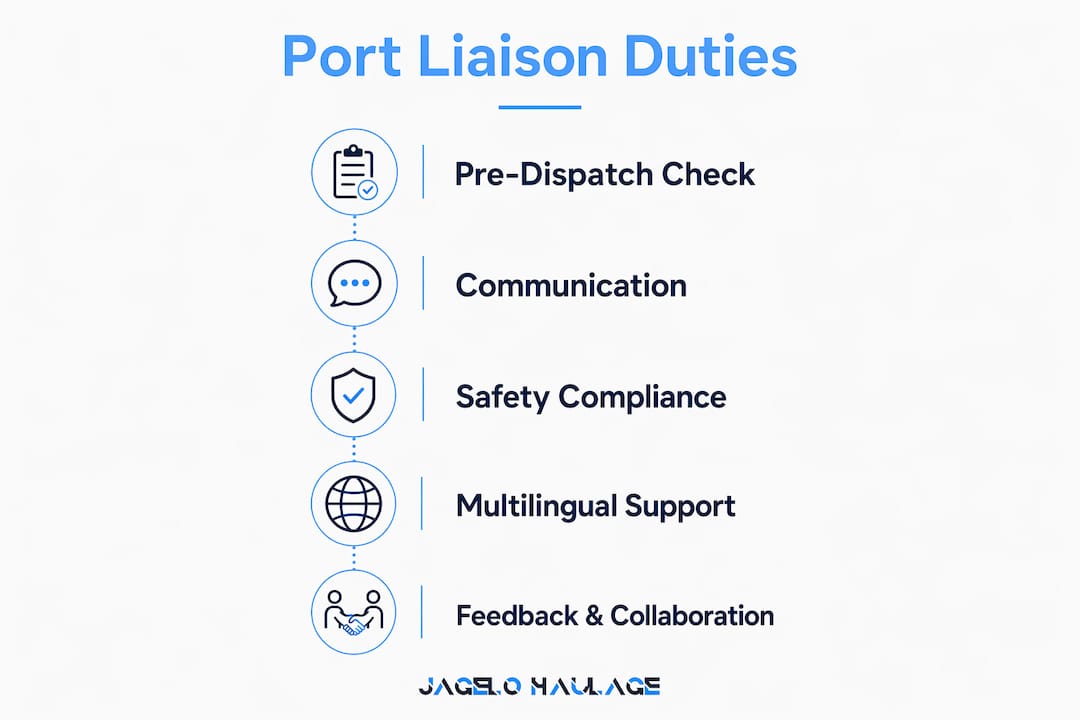
Core port liaison responsibilities include:
- Scheduling vehicle arrival slots to align with terminal capacity and avoid congestion
- Submitting and verifying pre-advice documentation and customs release status in port community systems before dispatch
- Confirming cargo availability and container status digitally prior to gate arrival
- Briefing drivers on port-specific traffic management plans, restricted zones, and personal protective equipment requirements
- Resolving access or compliance issues at the terminal gate to prevent costly vehicle rejections
Documentation accuracy is non-negotiable. A single missing customs release or incomplete pre-advice entry can trigger a vehicle turn-back, generating detention costs and disrupting the wider container haulage schedule for that day.
Table of Contents
- How port liaisons uphold safety standards at UK ports
- How effective communication improves haulage turnaround times
- Why multilingual support and relationship building matter
- Compliance with legal and regulatory requirements in the liaison role
- How liaisons raise standards through collaboration and feedback
- Day-to-day duties and professional skills of a UK port liaison
- Jhaulage: container haulage built around port liaison expertise
- Key takeaways
How port liaisons uphold safety standards at UK ports
Port environments are high-risk by definition, with heavy goods vehicles, pedestrians, reach stackers, and mobile harbour cranes operating in close proximity. The port liaison’s safety function is therefore one of the most consequential aspects of the role, not an administrative afterthought.
Key safety responsibilities include:
- Communicating site-specific traffic management plans and one-way systems to drivers before each port visit
- Confirming that drivers hold valid port induction certificates, where required by the terminal operator
- Distributing safety briefing materials covering restricted pedestrian zones, speed limits, and emergency procedures
- Escalating near-miss incidents or infrastructure hazards to the port authority promptly
- Monitoring compliance with personal protective equipment requirements at the terminal gate
Port Skills & Safety Limited, the UK’s specialist body for port workforce safety, provides frameworks and guidance that inform how hauliers and port operators structure these safety communications. Their published guidance on effective communication between ports and hauliers underscores that consistent, accurate safety briefings directly reduce the frequency of preventable incidents. Port liaisons who treat safety compliance as a live, ongoing process rather than a one-time induction tick-box are measurably more effective at protecting both drivers and port workers.
How effective communication improves haulage turnaround times
Operational efficiency at the terminal gate depends almost entirely on the quality of communication between the haulage firm and the port. Port liaisons manage this interface by coordinating scheduling, monitoring real-time status updates, and relaying changes to drivers and planners before problems compound.
Practical communication responsibilities include:
- Monitoring port community systems for live updates on vessel berthing, customs release, and container availability
- Alerting haulage planners immediately when a customs hold, vessel delay, or terminal congestion event arises
- Coordinating Vehicle Booking System (VBS) slot reservations to match actual container availability
- Communicating gate closure times, terminal operating hours, and any unplanned disruptions to the driver fleet
- Liaising with terminal operations teams to resolve pre-advice errors before a vehicle departs the yard
Proactive communication is what separates a competent port liaison from a reactive one. When a liaison identifies a customs hold at 07:00 and reroutes the driver to a different collection, the haulage firm avoids a wasted journey, a detention charge, and a missed delivery window. That kind of early intervention, repeated consistently, is what builds a haulage firm’s reputation for reliability with both port operators and end customers. For a broader view of how port-centric logistics strategy supports these operational gains, the principles apply directly to the liaison function.
Why multilingual support and relationship building matter
UK ports handle cargo from across the globe, and the driver workforce reflects that international character. A port liaison who assumes all drivers will absorb safety and operational instructions in English alone is creating a compliance gap that can have serious consequences.
Multilingual and relationship-focused responsibilities include:
- Providing safety induction materials, including leaflets and short-form videos, in the primary languages of the driver workforce
- Confirming that key operational instructions, such as gate procedures and emergency contacts, are available in translated formats
- Building working relationships with terminal duty managers, customs officers, and port authority representatives
- Participating in regular operational review meetings with port stakeholders to discuss recurring issues
- Maintaining a feedback channel so that drivers can report access problems, signage gaps, or procedural confusion
Multilingual safety induction materials are recognised by Port Skills & Safety Limited as a critical tool for ensuring consistent understanding across diverse driver groups. Relationship building goes beyond courtesy: a liaison who has an established working rapport with a terminal duty manager can resolve a gate query in minutes rather than hours, and that difference compounds across hundreds of movements per month.
Compliance with legal and regulatory requirements in the liaison role
Regulatory compliance is a core function of port liaison work, not a peripheral concern. The liaison must verify that every haulage movement meets the applicable customs, documentation, and environmental requirements before a vehicle is dispatched to the terminal.
Compliance responsibilities include:
- Verifying customs clearance status, including import entries and any Customs Examination or Border Force holds, via the relevant port community system
- Confirming verified gross mass (VGM) declarations are lodged correctly for export containers
- Adhering to pre-lodgement customs requirements, which require import declarations to be submitted before vessel arrival at certain UK ports
- Monitoring evolving maritime environmental regulations that affect documentation requirements for specific cargo types
- Ensuring haulage operations align with port authority byelaws and terminal operator access conditions
Failure to comply with pre-lodgement rules or customs clearance requirements results in vehicle turn-backs, financial penalties, and reputational damage with the terminal operator. The liaison’s role is to close these gaps before they become incidents, not to manage the fallout afterwards.
How liaisons raise standards through collaboration and feedback
Many haulage firms underestimate the value of structured feedback loops with port operators. A port liaison who systematically documents recurring terminal issues, such as signage gaps, congestion at specific gate lanes, or inconsistent pre-advice processing times, creates the evidence base needed to drive infrastructure and procedural improvements.
Collaborative improvement activities include:
- Attending port user group meetings and operational forums to raise recurring haulier concerns
- Submitting written reports on terminal delays, access problems, or safety hazards to the relevant port authority contact
- Proposing specific solutions, such as revised gate lane assignments or updated signage, rather than simply logging complaints
- Tracking whether reported issues are resolved and following up formally when they are not
- Building strategic partnerships with port authorities that extend beyond transactional interactions
Industry experts consistently emphasise that viewing the liaison role as a strategic partnership, rather than a series of transactional exchanges, leads to measurable improvements in port access, congestion management, and overall haulage efficiency. Operational feedback loops that systematically document recurring port challenges have proven effective in catalysing infrastructure improvements and refining haulage protocols.
Day-to-day duties and professional skills of a UK port liaison
The daily rhythm of a port liaison in a UK haulage operation is demanding and varied. At major terminals such as Felixstowe, Southampton, Tilbury, and Liverpool, the volume and complexity of movements means that no two days are identical.
Routine daily tasks include:
- Checking port community systems at the start of each shift for container availability, customs status, and any terminal alerts
- Allocating and confirming VBS slots for the day’s vehicle movements
- Briefing drivers individually or via a group communication channel on gate procedures, any active customs holds, and site-specific safety requirements
- Resolving pre-advice errors or documentation discrepancies before vehicles depart
- Logging all gate rejections, delays, and compliance issues for operational review
Technical proficiency with port community systems, such as those used at major UK container terminals, is a baseline requirement. Beyond systems knowledge, the role demands diplomacy, tact, and the ability to remain calm under pressure, particularly when a terminal gate issue threatens to cascade into a missed delivery window. As transport logistics manager role profiles confirm, the combination of digital planning competence and interpersonal skill is what defines an effective port liaison.
At Jhaulage, the liaison function is embedded within the operational structure supporting container movements across Felixstowe, Tilbury, Southampton, and Liverpool. The firm’s fleet of over 40 GPS-tracked vehicles depends on accurate, timely liaison work to maintain the scheduling precision that clients require.

Pro Tip: Build a daily pre-dispatch checklist that covers customs status, VBS slot confirmation, and driver safety briefing for every movement. A five-minute check before dispatch prevents a two-hour turn-back at the terminal gate.
Jhaulage: container haulage built around port liaison expertise
Port liaison work is only as effective as the haulage operation behind it. Jhaulage delivers container haulage services across the UK’s major ports with an operational structure designed around the precise documentation, scheduling, and compliance demands that port liaison work requires.
Where other hauliers treat port liaison as an administrative function, Jhaulage integrates it into every movement: pre-advice verification, customs status checks, VBS slot management, and driver briefings are standard procedure, not optional extras. The fleet of over 40 GPS-tracked vehicles provides real-time visibility for clients, while 24/7 operational support means that gate issues and customs holds are addressed immediately rather than the following morning. For logistics managers and freight forwarding teams who need a haulage partner that understands the terminal gate interface in detail, Jhaulage offers the operational depth to match. Contact Jhaulage directly to discuss your port haulage requirements and receive a tailored service proposal.
Key takeaways
The role of port liaison in haulage is a specialist coordination function that directly determines whether a haulage operation runs to schedule or incurs avoidable costs at the terminal gate.
| Point | Details |
|---|---|
| Documentation accuracy is critical | Pre-advice errors and missing customs clearances cause vehicle turn-backs and detention charges before a driver reaches the gate. |
| Safety compliance is an ongoing duty | Port liaisons must brief drivers on site-specific protocols before every visit, not just at initial induction. |
| Multilingual materials reduce risk | Providing safety and operational instructions in drivers’ primary languages closes compliance gaps that English-only briefings miss. |
| Feedback loops drive improvement | Systematically reporting terminal issues to port authorities leads to infrastructure and procedural improvements that benefit all hauliers. |
| Jhaulage embeds liaison expertise | Jhaulage integrates pre-advice verification, customs checks, and driver briefings into every container movement across UK ports. |
Recommended
- Haulage for Shipping Lines: A Comprehensive Guide to UK Port Logistics | Jagelo Haulage
- Road Haulage for Containers: A Professional Guide to UK Port Logistics | Jagelo Haulage
- How to Secure an Accurate Port Haulage Quote: The Professional Guide for 2026 | Jagelo Haulage
- Expert Container Haulage Services for UK Port Logistics | Jagelo Haulage