Peak season surcharges: what UK shippers must know in 2026

Ocean importers see it billed per container, parcel shippers per package, air forwarders per kilogram. Whoever holds the carrier contract usually absorbs it first, then passes it downstream.
Before your next booking, do three things:
- Pull the current tariff bulletin from every carrier you use and check the effective dates.
- Confirm your contract’s baseline definition, the reference point your surcharge tier is measured against.
- Flag finance now so peak-period invoices don’t trigger a dispute cycle three months later.
Pro Tip: Bookmark each carrier’s tariff page rather than relying on your account manager’s email, updates often post before the notification lands in your inbox.
Key Takeaways
Peak season surcharges are temporary, mode-specific fees that compound with fuel surcharges and port congestion to push all-in shipping costs well beyond the headline percentage carriers publish.
| Point | Details |
|---|---|
| PSS is temporary and mode-specific | Ocean bills per container, air per kilogram, parcel per package, and none of it is permanent tariff. |
| Fuel surcharges compound on PSS | Fuel percentages apply to the invoice total including PSS, so the real uplift exceeds the quoted rate. |
| Golden Week creates booking risk | Blank sailings around early October mean a paid surcharge doesn’t guarantee a confirmed slot. |
| Negotiate baselines, not just caps | SMEs without leverage for a PSS cap should still push for rolling baselines and notice-period clauses. |
| Inland haulage compounds the cost | Jhaulage manages VBS slot confirmation and documentation buffers to reduce peak-season turn-time risk at UK ports. |
Table of Contents
- What is a peak season surcharge and how does it differ from a GRI?
- When do peak surcharges hit and what does the 2026 calendar look like?
- How do surcharges compound into your all-in shipping cost?
- How can you reduce your exposure to peak surcharges?
- What should UK importers watch at Felixstowe, Tilbury, Southampton and Liverpool?
- Where to check live peak season updates
- Why the “just pay it” approach to peak surcharges is a mistake
- How Jhaulage helps you manage peak season haulage risk
- Sources
What is a peak season surcharge and how does it differ from a GRI?
A peak season surcharge (PSS) is a temporary fee layered on top of the base freight rate during a carrier-defined high-demand window, distinct from a General Rate Increase (GRI), which is a broader, often permanent adjustment to the standard tariff. Fuel surcharges are different again, calculated on the whole shipment cost, PSS included, which is why they compound rather than sit side by side.
Billing basis changes by mode:
- Ocean freight charges PSS per container, quoted as a flat fee per TEU (20ft equivalent unit) or FEU (40ft equivalent unit), sometimes varying by trade lane and equipment type.
- Air freight charges per kilogram, layered onto the base air waybill rate and usually announced with shorter notice than ocean.
- Parcel carriers apply a per-package fee, often tiered by service type and by how far a shipper’s volume has grown against their baseline.
Carriers publish these as tariff bulletins that mode-specific billing bases describe in detail, and because most shipping agreements incorporate carrier tariffs by reference, an updated bulletin can become binding without any formal contract amendment. On a UK import quote, check the line separate from the base ocean freight rate, usually labelled “PSS” or “peak surcharge”, then check whether an equipment imbalance fee or a fuel surcharge sits beneath it. Miss one line and your landed cost estimate will run short.
When do peak surcharges hit and what does the 2026 calendar look like?
Ocean peak windows typically run from June through October, with carriers announcing rates during late spring or early summer for effective dates through the autumn. Parcel peak windows behave differently. FedEx’s 2026 schedule runs from early October through mid-January, with the steepest per-package rates concentrated around late November and December.
Watch this window: Golden Week, China’s national holiday in early October, routinely triggers blank sailings as carriers manage capacity, and shippers should expect last-minute schedule changes rather than firm dates.
Monitor these dates and notice patterns:
- Ocean carrier tariff bulletins, typically posted two to four months ahead of the effective date.
- Parcel carrier surcharge schedules, usually confirmed by late summer for the autumn/winter window.
- Golden Week blank sailing announcements, which can appear with only days of notice.
Notice periods vary widely by carrier and contract type. Some ocean carriers give 30 days; others move faster when capacity tightens. Blank sailings compound the problem because a paid surcharge secures a rate, not necessarily a confirmed slot.
How do surcharges compound into your all-in shipping cost?
Modelling peak costs properly means stacking every line, not just the headline PSS. Work through it in order:
- Start with the base freight rate (per container, per kilo, or per package).
- Add the peak season surcharge itself.
- Add any General Rate Increase in effect for that lane.
- Add the fuel surcharge, calculated as a percentage of the total invoice, including the PSS you just added.
- Add handling and terminal fees, then inland haulage.
That fourth step is where most cost models go wrong. Fuel surcharges apply to the invoice total after PSS, so the effective increase runs higher than the nominal percentage quoted on the carrier’s tariff page.
For your finance checklist: confirm whether each surcharge is percentage-based or flat-fee, confirm the sequence carriers apply them in, and reforecast landed cost per unit rather than per shipment, since tiered parcel surcharges shift the maths at volume.
How can you reduce your exposure to peak surcharges?
Two sets of levers work here: what you control operationally, and what you negotiate commercially. Neither works in isolation.
Operationally, book earlier than you think you need to using supply chain visibility software to spot and mitigate cost spikes early. Carriers prioritise confirmed space during blank sailing periods, and Sea-Intelligence data on Golden Week capacity shows carriers still use LIFO-style slotting even when a shipper has paid the surcharge, so early booking and contracted space guarantees matter more than the surcharge payment itself. Holding regional inventory buffers, adjusting packaging to reduce dimensional weight charges, and spreading volume across more than one carrier all reduce your single-point exposure.
Commercially, larger shippers with committed volume can often negotiate a PSS cap, a ceiling above which the surcharge won’t rise regardless of what the carrier announces later. Smaller shippers have less leverage on caps but can still push for two things: a rolling baseline rather than one fixed to a single reference month, and a minimum notice period written into the contract.
| Mitigation lever | Best suited to | What to ask for |
|---|---|---|
| PSS cap | Enterprise shippers with committed volume | A contractual ceiling on the surcharge rate |
| Rolling baseline | Growing SMEs on parcel contracts | Baseline measured on a trailing average, not one fixed month |
| Notice-period clause | All contract sizes | 30 days minimum before a new surcharge takes effect |
| Multi-carrier coverage | Shippers with tight delivery windows | Split volume across two or more carriers per lane |
Pro Tip: If your parcel baseline is fixed to a single month, often June for many schemes, a strong sales quarter between then and peak season can push you into a higher surcharge tier automatically. Ask your account manager whether a rolling average is available before you sign.
Bring procurement in early to negotiate caps, legal to review tariff incorporation clauses, and finance to reforecast landed costs, ideally all before the summer tariff announcements land, not after.

What should UK importers watch at Felixstowe, Tilbury, Southampton and Liverpool?
Port congestion during peak season rarely stays contained to the quay. When vessel arrivals bunch up at Felixstowe, Tilbury, Southampton or Liverpool, container dwell times extend, chassis and trailer availability tightens, and haulage rates for the final inland leg climb alongside the carrier’s own PSS. Congestion linked to export surges ahead of Golden Week has a knock-on effect on UK inland haulage that many cost models simply miss, because the surcharge conversation stops at the port gate rather than following the container to the warehouse.
Jhaulage runs several checks during peak windows to keep turn-times manageable for clients:
- Confirming Vehicle Booking System (VBS) slots against realistic vessel arrival windows, not the original ETA, since rolled sailings shift everything downstream.
- Building documentation buffers into the schedule so customs paperwork isn’t the bottleneck when the vessel does arrive.
- Tracking chassis and trailer availability across our own fleet rather than relying solely on port-side equipment pools.
Expect longer lead times during September and October, and build flexibility into delivery appointments rather than fixed slots. A container that clears customs cleanly but sits waiting for a haulage slot loses most of the time advantage anyway.
Where to check live peak season updates
Carrier tariff pages remain the primary source, since tariff incorporation by reference means bulletin updates can bind your contract without a formal amendment. Cross-check against Gov for customs timing, and consult the International Maritime Organization for dangerous goods classification if your cargo falls under IMDG rules.
Worth bookmarking:
- Your carriers’ individual tariff bulletin pages, checked monthly during spring and again in late summer.
- Trade press covering blank sailings and capacity announcements, particularly around Golden Week.
- gov.uk’s customs and import documentation pages, reviewed each time your commodity codes or origin markets change.
Why the “just pay it” approach to peak surcharges is a mistake
Most guidance on peak season surcharges treats them as an unavoidable cost of doing business, pay the tariff, move on. That advice undersells how much room actually exists to negotiate, particularly around baseline definitions. A shipper fixed to a single reference month can get pushed into a higher tier purely by having a strong sales quarter, with no renegotiation involved at all. That’s a contract design flaw, not a market inevitability, and it’s fixable before the next tariff cycle if someone actually reads the baseline clause.
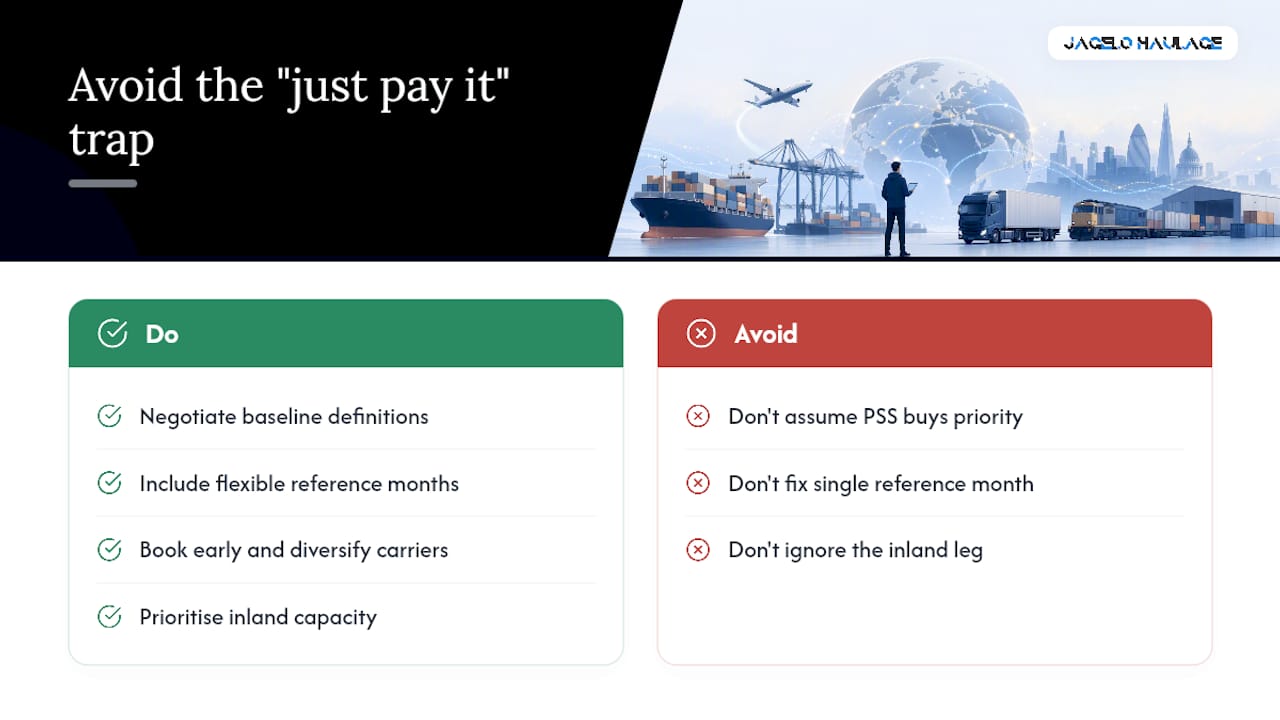
The bigger blind spot is treating the surcharge and the space guarantee as the same thing. They aren’t. Paying a PSS confirms a rate, not a slot, and carriers still prioritise higher-yield cargo during blank sailing periods regardless of who has paid what. Shippers who book early and spread volume across carriers protect their supply chains far better than those who simply budget for the fee and assume payment equals priority.
What UK importers should prioritise first isn’t the surcharge line itself. It’s the inland leg. A container that clears the port cleanly but sits waiting for haulage capacity has lost most of its time advantage anyway.
— Vytautas
How Jhaulage helps you manage peak season haulage risk
Peak season surcharges get most of the attention, but the inland leg is where delays actually cost you time, and that’s where Jhaulage focuses. As a specialist container haulage provider working across Felixstowe, Tilbury, Southampton and Liverpool, Jhaulage runs a modern fleet of over 40 trucks and trailers with GPS tracking, giving you real-time visibility on your container from the moment it clears customs.
That matters most during exactly the weeks this article covers: when vessel schedules shift, chassis availability tightens, and turn-times stretch. Jhaulage’s same-day delivery capability and 24/7 support mean you’re not left guessing whether your container will make its delivery window once it’s off the quay. Whether you’re managing full container load shipments, refrigerated cargo, or oversized freight through peak congestion, dedicated port-to-door haulage removes one major variable from your cost model.
If your team is already reforecasting landed costs for the autumn window, get in touch with Jhaulage’s container haulage specialists to discuss dedicated capacity for your peak-season volumes.
Sources
- Carrier Peak Season Surcharges 2026: FedEx, UPS and Ocean Line Rate Guide | GoFreight
- FedEx unveils 2026 peak season fees, higher home delivery prices loom | Supply Chain Dive
- Shippers should expect last‑minute blanked sailings as Golden Week looms | The Loadstar
- Gov