How shipping lines operate UK ports: 2026 guide
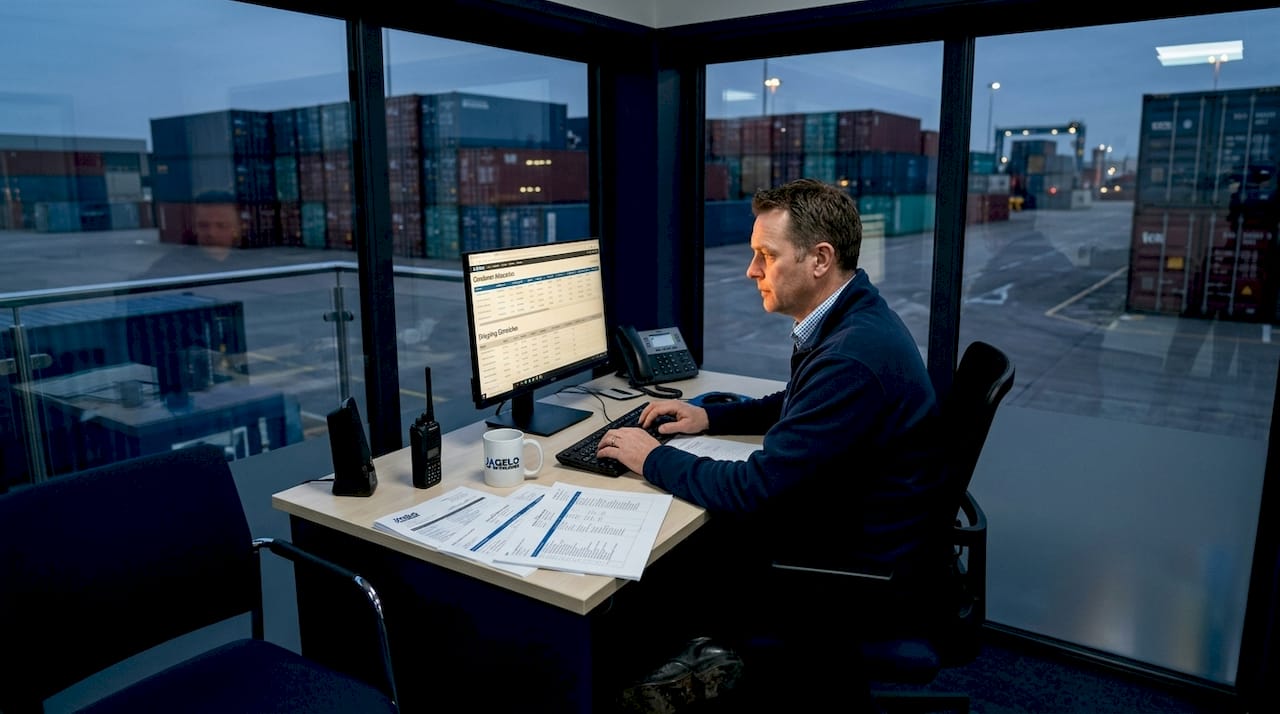
Few logistics professionals fully appreciate the scale of orchestration that takes place before a single container moves off a quay. Understanding how shipping lines operate UK ports requires examining a tightly sequenced chain involving vessel scheduling, pilotage, cargo planning, terminal coordination, customs clearance, and environmental compliance. Each stage depends on precise alignment between multiple parties. Miss one handoff and the entire chain slows. This guide breaks down each operational stage with the specificity that importers, exporters, and freight professionals need to anticipate delays, ask the right questions, and make their supply chains more resilient.
Table of Contents
- Key takeaways
- How shipping lines operate UK ports: the framework
- UK port freight volumes and vessel call planning
- Vessel arrivals: scheduling, pilotage, and compliance
- Cargo planning and terminal coordination
- Customs and road haulage in the operational chain
- Environmental compliance and UK ETS
- Vytautas’s perspective: what most logistics professionals miss
- Connecting port operations with specialist haulage
- FAQ
Key takeaways
| Point | Details |
|---|---|
| Scale defines scheduling complexity | UK ports handled 429.7 million tonnes in 2024, and freight volume directly shapes how shipping lines allocate vessel calls. |
| Pre-arrival planning is operational, not administrative | Cargo manifests and stowage plans are live inputs that drive terminal crane and yard decisions, not paperwork filed after the fact. |
| Customs and haulage complete the chain | GVMS compliance and accurate Goods Movement References are as critical to container flow as any quayside process. |
| Environmental compliance is now embedded in operations | From July 2026, UK ETS covers maritime emissions at berth, changing how shipping lines plan port time and calculate costs. |
| Coordination failures cascade quickly | When any stakeholder in the port call system misaligns, container throughput slows across the entire operational chain. |
How shipping lines operate UK ports: the framework
The phrase “shipping line operations” covers far more than vessel movement. In industry terms, the full process is referred to as a port call, which encompasses everything from advance scheduling through to the final gate-out of containers onto road transport. Port operations are distinct from terminal operations: port operations concern system-wide management of vessels, berths, and multiple stakeholders, whereas terminal operations focus on the physical execution of crane cycles, yard stacking, and gate movements.
Shipping lines sit at the centre of this system. They do not control the terminal or the port authority, but they initiate and sequence the entire chain. Their schedules dictate when berths must be available, when stevedores need to be mobilised, when customs documentation must be submitted, and when road hauliers must arrive to collect containers. Every other party in the port call process responds to the shipping line’s schedule.
UK port freight volumes and vessel call planning
The starting point for understanding shipping line processes in UK ports is grasping the sheer volume of freight involved. UK ports handled 429.7 million tonnes in 2024, with major ports accounting for 421.0 million tonnes. Imports made up 232.3 million tonnes at major ports, exports contributed 102.2 million tonnes, and domestic traffic accounted for the remaining 86.1 million tonnes. Minor ports handled just 8.7 million tonnes in comparison.
This disparity matters operationally. Shipping lines concentrate vessel calls at major ports, including Felixstowe, Southampton, Tilbury, and Liverpool, precisely because the infrastructure, berth depth, and throughput capacity justify the cost of calling with large vessels. For detailed context on freight differences between UK ports, the gap between major and minor facilities is not merely statistical. It shapes which ports a shipping line will commit to in a seasonal schedule and how frequently they call.
Key factors that influence shipping line scheduling at UK ports include:
- Berth availability and draught restrictions, which limit which vessels can enter particular ports on a given tide
- Cargo volume thresholds, since a shipping line will only commit a vessel call if the projected cargo justifies the port disbursements
- Port congestion data and turnaround times, which directly affect schedule reliability and knock-on delays to downstream port calls
- Freight forecasting and booking cutoffs, through which shipping lines lock terminal capacity weeks in advance
Vessel arrivals: scheduling, pilotage, and compliance
Once a shipping line confirms a vessel call, the pre-arrival process begins several days before the ship reaches territorial waters. The sequence is structured and non-negotiable.
- Notice of Arrival (NOA) submission. The shipping line or its port agent submits formal arrival notification to the Harbour Authority, declaring vessel details, cargo particulars, and estimated time of arrival (ETA). This triggers berth allocation planning.
- Berth allocation confirmation. The port authority or terminal operator confirms the berth, factoring in tidal windows, berth occupancy, and crane availability. Shipping lines frequently negotiate berth windows weeks ahead for major ports.
- Pilotage arrangement. For vessels above a certain length, compulsory pilotage applies under the Pilotage Act 1987. A licensed pilot boards the vessel at the pilot station and navigates it through the harbour approaches. For large container vessels, towage tugs are also deployed to manage docking at the berth.
- VHF channel monitoring and port communications. The vessel maintains continuous radio contact with the Vessel Traffic Service (VTS) during the approach, receiving traffic separation instructions and berthing guidance.
- Mooring and gangway deployment. Once secured, the shipping line’s port agent conducts vessel formalities, including customs inward clearance, health declaration, and crew documentation checks.
UK ports treat safety compliance as a continuous governance matter. Under the Ports and Marine Facilities Safety Code (PMSC), ports must submit compliance declarations every three years. The 2026 to 2028 submission window opened on 1 January 2026 and runs through to 31 March 2026, with Duty Holders required to upload signed declarations. Shipping lines operating at UK ports need to verify that their port partners maintain current PMSC compliance, as this underpins the safety framework governing every berth call.
Pro Tip: When briefing your port agent ahead of a vessel call, confirm the berth allocation at least 48 hours in advance and verify tidal constraints for your vessel’s draught. A missed tide at a port like Southampton can set a schedule back by six to twelve hours, triggering demurrage exposure across multiple containers.
“UK port calls require seamless alignment among Port Authority, terminal operators, shipping lines, stevedores, customs, and freight forwarders. Any breakdown slows container movement.” For more on port authority and terminal responsibilities, the interplay between these stakeholders defines operational tempo.
Cargo planning and terminal coordination
Cargo planning is where shipping line processes in UK ports become most technically demanding. The process starts before the vessel departs its previous port of call.
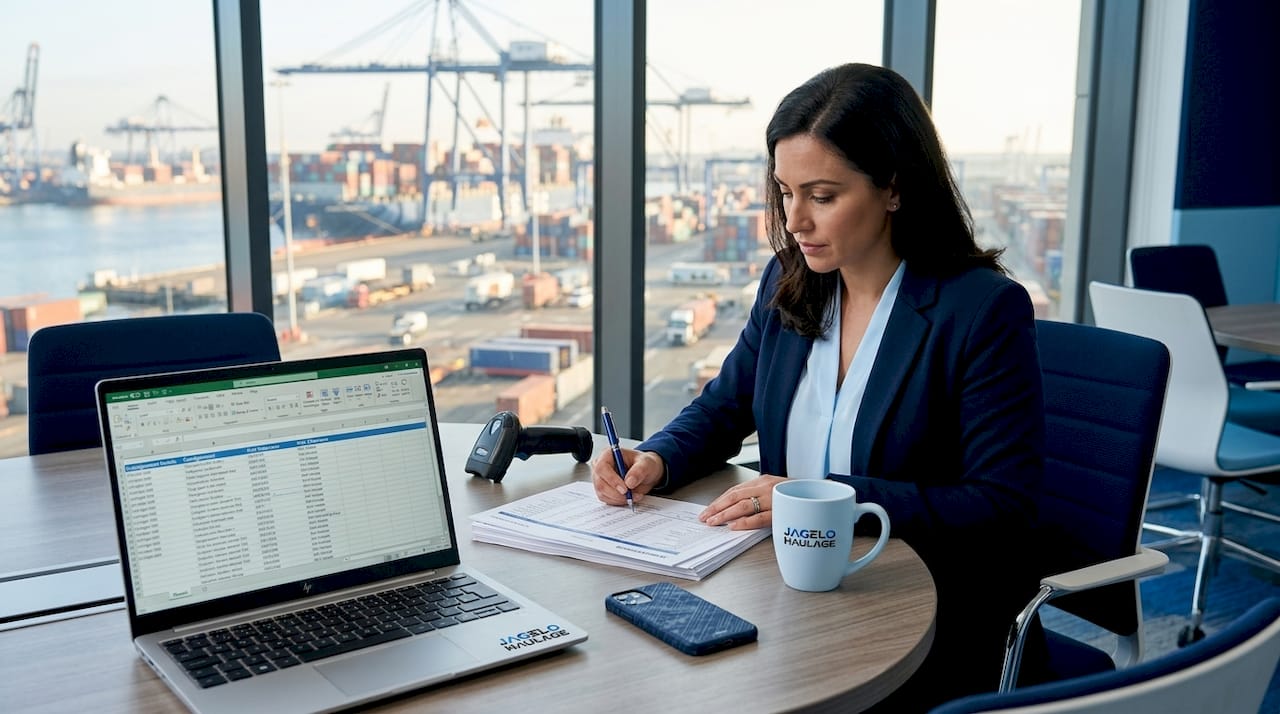
The cargo manifest lists every container on board, including container number, weight, content description, and consignee details. The bay plan (also called a stowage plan) maps the physical position of each container within the vessel’s holds and on deck. Together, these documents dictate which containers terminal cranes must discharge first, how many crane moves are required, and in what sequence containers must be stacked in the yard to enable efficient retrieval.
A common operational error is treating these documents as static paperwork. Active, live management of manifests and bay plans is the difference between a smooth port call and a congested quayside. When last-minute cargo amendments or re-weigh discrepancies occur, the terminal’s quay crane programme must be recalculated, potentially disrupting an entire shift’s work plan.
| Document | Purpose | Issued by | Used by |
|---|---|---|---|
| Cargo manifest | Full container listing with consignee data | Shipping line | Customs, terminal, freight forwarder |
| Bay plan (stowage plan) | Physical container positions on vessel | Shipping line planner | Terminal operator, stevedore |
| Dangerous goods declaration | IMDG code compliance for hazardous cargo | Shipper / freight forwarder | Shipping line, port authority |
| Customs entry (import declaration) | HMRC clearance authority | Freight forwarder | Customs, terminal gate |
Terminal coordination extends beyond the quayside. Once containers are discharged, the yard management system (YMS) assigns a stack location based on retrieval priority. Containers due for immediate collection are stacked in accessible positions; those with pending customs holds or long dwell times are stacked deeper. Shipping lines submit their expected discharge order to the terminal in advance so that yard planners can pre-position crane equipment and terminal tractors accordingly.
Pro Tip: Submit your pre-arrival notification of dangerous goods no later than 24 hours before vessel arrival at UK ports. Late IMDG submissions frequently result in containers being held off the vessel entirely, triggering costly re-booking and additional freight charges.
Customs clearance runs in parallel with physical terminal operations. Freight forwarders must lodge import declarations through CHIEF or CDS (Customs Declaration Service) before containers can be released from the terminal. The shipping line’s documentation cutoff, typically 24 to 48 hours before vessel arrival for import cargo, creates a hard deadline that the entire documentation chain must respect.
Customs and road haulage in the operational chain
The shipping line’s operational responsibility does not end when containers are discharged onto the terminal. The final link in the chain is the movement of containers through the port gate and onto road transport.
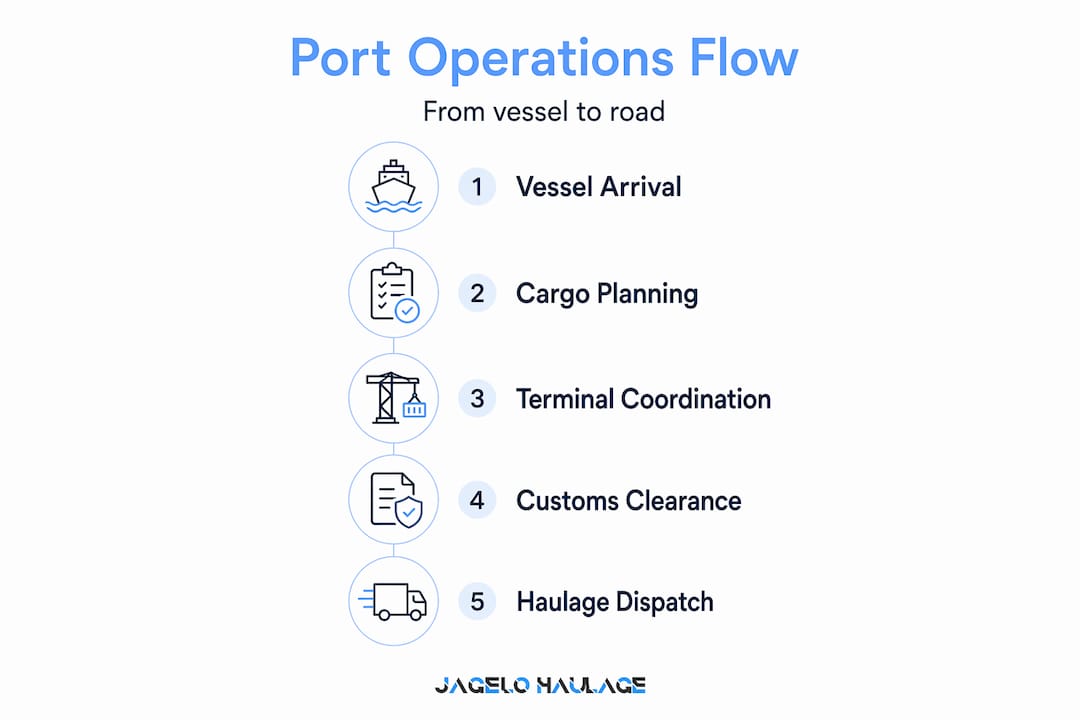
The Goods Vehicle Movement Service (GVMS) governs vehicle access to UK port terminals and processes border movements. Hauliers must present a valid Goods Movement Reference (GMR) to access the terminal gate for container collection. HMRC research has identified significant friction points across different user roles: traders, hauliers, and drivers each encounter distinct challenges in preparing and presenting accurate GMR documentation.
Operational challenges that arise at this stage include:
- Delayed customs clearance, which prevents GMR generation and holds containers at the terminal beyond free storage periods, triggering demurrage charges
- Inaccurate cargo weight or description declarations, which can trigger HMRC examination holds requiring physical inspection before release
- Vehicle Booking System (VBS) slot mismatches, where the haulier’s booked collection slot does not align with the container’s actual readiness status at the terminal
- Detention costs, which accumulate when shipping line containers (under merchant haulage arrangements) are not returned to the port empty depot within the agreed free days
GVMS is operationally a gatekeeper. Errors in GMR preparation do not simply delay a single vehicle. They can cascade into missed VBS slots, extended terminal dwell, and additional crane repositioning costs that affect subsequent vessel calls at the same berth. Shipping lines, freight forwarders, and hauliers must treat GVMS preparation with the same rigour as any other operational document in the port call chain.
Environmental compliance and UK ETS
The most significant recent development affecting shipping operations in UK ports is the inclusion of maritime emissions in the UK Emissions Trading Scheme. From 1 July 2026, UK ETS covers emissions on domestic UK port voyages for vessels of 5,000 GT and above, including emissions generated whilst at berth.
The first compliance period runs from 1 July to 31 December 2026, with a “double surrender” requirement: shipping lines must surrender allowances for both 2026 and 2027 emissions by April 2028. This structure compresses the financial exposure into a single payment window and requires shipping lines to track berth time and fuel consumption at UK ports from the outset.
| Scheme | Coverage start | Berth emissions included | Surrender deadline |
|---|---|---|---|
| UK ETS (maritime) | 1 July 2026 | Yes | April 2028 (2026 and 2027 combined) |
| EU ETS (maritime) | 1 January 2024 | Yes (at EU ports) | April annually |
“Inclusion of maritime emissions in UK ETS repositions port operations beyond commercial throughput, embedding environmental compliance deeply into operational planning for shipping lines.”
Operationally, this means shipping lines must now factor Monitoring, Reporting, and Verification (MRV) data into their berth planning. Longer berth occupancy driven by slow cargo operations, equipment breakdowns, or documentation delays does not merely affect schedule; it generates additional emissions liability that must be covered by purchased allowances. Shipping lines are therefore incentivised to pressure terminals for faster crane cycles and to minimise idle berth time, a dynamic that will reshape how terminal performance is measured and contracted going forward.
Vytautas’s perspective: what most logistics professionals miss
In my experience working closely with container haulage operations across Felixstowe, Tilbury, and Southampton, the most persistent source of delay is not vessel schedules or crane capacity. It is the disconnect between what the shipping line assumes has happened and what has actually occurred on the ground.
I have seen manifests submitted on time but with weight discrepancies that only surface when a container is placed on a weigh bridge at the terminal gate. That single error then delays the GMR, holds the haulier at the gate, and burns a VBS slot that cannot be recovered until the following day. The financial exposure from one unchecked data point can reach hundreds of pounds in demurrage, detention, and repositioning costs before anyone realises the root cause.
What I have found actually works is treating cargo documentation as a continuous process rather than a pre-departure task. Freight forwarders who update declarations in real time, as cargo changes occur at the shipper’s end, avoid the last-minute corrections that break terminal planning. The same logic applies to UK ETS compliance: shipping lines that begin MRV data collection from 1 July 2026 with clean, auditable processes will find the double-surrender requirement in 2028 manageable. Those who treat it as an afterthought will face both financial and reputational exposure.
The advice I give logistics professionals is this: understand where the handoffs are in the port call chain and own your section of them completely. The shipping line cannot control customs. Customs cannot control the haulier. But you can control the accuracy of your documentation and the precision of your timing.
— Vytautas
Connecting port operations with specialist haulage
Once you understand the full sequence behind shipping line port calls, it becomes clear why the final leg, container collection and transport to destination, demands the same precision as every upstream stage.
Jhaulage specialises in container haulage at UK ports, operating across Felixstowe, Tilbury, Southampton, and Liverpool with a fleet of over 40 GPS-tracked trucks and trailers. Our teams are experienced in Vehicle Booking System scheduling, GMR preparation support, and meeting tight shipping line documentation cutoffs. Whether you require same-day collection, full container load movements, or dedicated port-to-door services, Jhaulage aligns with your shipping line’s schedule from the moment containers are discharged. Contact us to discuss how we can support your port logistics requirements with dependable, 24/7 operational coverage.
FAQ
What does a shipping line actually control at a UK port?
Shipping lines control vessel scheduling, cargo manifest and stowage planning, and the sequencing of discharge and loading operations. They rely on port authorities, terminal operators, and hauliers to execute their plans on the ground.
How does pilotage work for vessels arriving at UK ports?
For vessels above a specified length, a licensed harbour pilot boards the ship at the pilot station and navigates it into the berth. Compulsory pilotage applies at most major UK commercial ports under the Pilotage Act 1987.
What is the GVMS and why does it matter for container collection?
The Goods Vehicle Movement Service (GVMS) is the HMRC system that controls vehicle access to UK port terminals for border movements. Hauliers must present a valid Goods Movement Reference (GMR) at the terminal gate; errors in GMR preparation can delay container release and trigger demurrage charges.
When does UK ETS apply to shipping lines at UK ports?
The UK Emissions Trading Scheme applies to domestic UK port voyages for vessels of 5,000 GT and above from 1 July 2026, including emissions generated at berth. The first compliance period covers July to December 2026, with allowance surrender due in April 2028.
What is the difference between port operations and terminal operations?
Port operations cover system-wide management including berth allocation, stakeholder coordination, and vessel scheduling. Terminal operations refer to the physical execution of crane cycles, yard management, and gate processes. Shipping lines coordinate across both layers to keep their vessel calls on schedule.