How UK port infrastructure works: 2026 guide
Understanding how UK port infrastructure works is no longer optional for logistics professionals operating at the sharp end of supply chain management. The UK’s major ports handle hundreds of millions of tonnes of cargo annually, and recent shifts in cargo composition, particularly the 19% surge in container traffic in Q4 2025, are actively reshaping berth allocation, digital systems, and border management protocols. This guide explains the operational mechanics of UK port infrastructure from marine coordination through to hinterland logistics, giving you the precise knowledge needed to plan, adapt, and perform.
Table of Contents
- Key takeaways
- How UK port infrastructure works: cargo and throughput
- Marine coordination and pilotage operations
- Digital coordination and port management systems
- UK border goods movement and port logistics
- Infrastructure investment and future challenges
- My take on the real complexity beneath the surface
- How Jhaulage supports your port logistics operations
- FAQ
Key takeaways
| Point | Details |
|---|---|
| Cargo mix signals infrastructure strain | Monitor tonnage trends by category to anticipate bottlenecks in berth allocation and storage. |
| Pilotage timing is non-negotiable | Failure to provide arrival advice 12 hours before the pilot station risks vessel detention charges. |
| Digital platforms drive port efficiency | Systems like Destin8 connect berth assignment, equipment, and tariff management in real time. |
| GVMS requirements vary by port | Logistics teams must account for route-specific GVMS compliance rather than applying a uniform process. |
| Infrastructure investment targets 2050 | Major UK ports are embedding decarbonisation into capacity upgrades, with procurement frameworks already active. |
How UK port infrastructure works: cargo and throughput
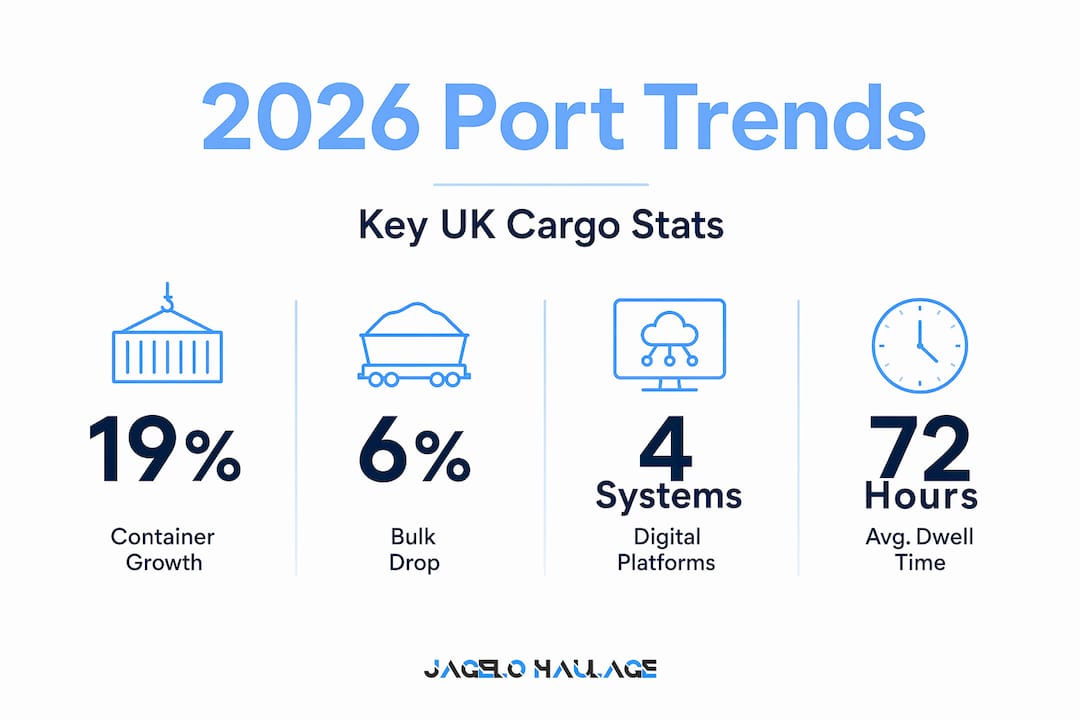
Port design is not static. It responds directly to the cargo types a port handles, and right now UK ports are in a period of meaningful transition. Liquid bulk remains the largest cargo category at 35% of total tonnage as of Q4 2025, yet it declined 6% year-on-year, largely due to the closure of Finnart Oil Terminal. Meanwhile, dry bulk grew 7% and container traffic surged, driven in part by London Gateway’s fourth berth becoming operational.
These shifts matter because each cargo type demands a fundamentally different physical and operational infrastructure. Liquid bulk requires dedicated pipelines, jetties, and storage tanks. Containers require stacking cranes, rubber-tyred gantries, and intermodal rail or road connections. Ro-Ro (roll-on/roll-off) freight, which declined 2% in Q4 2025, relies on linkspans, ramps, and high-frequency vehicle throughput lanes. When a port sees its cargo mix shift substantially, berth utilisation, storage yard configuration, and equipment procurement all need recalibration.
| Cargo type | Q4 2025 volume trend | Key infrastructure requirement |
|---|---|---|
| Liquid bulk | Down 6% | Dedicated jetties, pipelines, tank farms |
| Dry bulk | Up 7% | Open storage yards, conveyor systems |
| Containers | Up 19% | Gantry cranes, intermodal connections |
| Ro-Ro freight | Down 2% | Linkspans, vehicle lanes, marshalling areas |
For logistics providers and haulage operators at major UK ports, understanding this cargo data is not academic. It tells you which terminals will be under capacity pressure, where queue times are likely to extend, and where new infrastructure investment may create opportunity or disruption. Cargo mix shifts act as high-signal indicators of stressed or underutilised port infrastructure, and reading them correctly gives you a planning advantage.
The practical implication is this: a container terminal absorbing a 19% volume increase without proportional infrastructure investment will see extended dwell times, compressed Vehicle Booking System (VBS) slots, and tighter demurrage windows. Logistics teams who track these trends and adjust scheduling accordingly will avoid the costly detention charges that catch others off guard.
Marine coordination and pilotage operations
Before any vessel reaches a berth, it must pass through a carefully managed system of marine traffic coordination. This is where UK port operations intersect with maritime law, real-time safety management, and highly time-sensitive communication protocols. Getting this layer wrong costs money. Getting it consistently right is the mark of a professionally managed port.
Vessel Traffic Services (VTS) form the backbone of marine coordination at UK ports. Operating on a continuous 24/7 basis, VTS monitors vessel movements, provides navigational assistance, and coordinates traffic within port approach zones. Pilotage services run alongside VTS and are governed by bespoke pilotage directions specific to each port authority. At Falmouth, for instance, pilotage operates 24 hours a day, 365 days a year, with strict directions determining exactly which vessels require a licensed pilot based on size, draught, and cargo characteristics.
The procedural requirements for pilotage are precise, and non-compliance carries direct financial consequences. At Ramsgate Royal Harbour, pilots require 12 hours advance notice before a vessel arrives at the pilot station, with a further 2-hour movement advice window before departure or shift. Communication is accepted via VHF radio, telephone, or email, but the timing requirements are absolute. Failure to notify within these windows can result in vessel detention, a cost that compounds rapidly when combined with berth waiting time and cargo delays.
Typical pilotage reporting procedures at UK ports include the following requirements:
- Submit ETA (estimated time of arrival) at least 12 hours before reaching the pilot boarding position.
- Provide a 2-hour movement confirmation prior to any planned vessel movement within port.
- Maintain continuous radio watch on the designated VHF working channel throughout approach and transit.
- Declare vessel particulars (LOA, beam, draught, cargo type) at initial contact.
- Confirm pilot ladder and embarkation arrangements meet SOLAS requirements before pilot boarding.
Pro Tip: When building voyage plans for UK port calls, build pilotage notification windows into your passage planning software as hard waypoints rather than post-arrival tasks. Treating the 12-hour ETA submission as a navigational event rather than an administrative one eliminates the risk of missing the window during busy or delayed passages.
Operational safety in pilotage areas depends on bespoke pilotage directions that account for local tidal windows, berth availability, and weather constraints. No two UK port pilotage regimes are identical, which means port-specific due diligence is mandatory for each port of call.
Digital coordination and port management systems
Modern UK port operations do not run on paper. They run on integrated digital platforms that connect berth scheduling, cargo tracking, tariff management, and customer service into a single operational picture. Understanding these systems is central to understanding how UK ports function at the operational level.

One of the most widely referenced platforms in UK port operations is Destin8, a port community system used by major terminal operators and port authorities. Destin8 connects shipping agents, terminal operators, and port authorities to manage vessel and cargo movements from pre-arrival through to final release. Forth Ports, for example, assigns Customer Service Point (CSP) values to berths within its digital management infrastructure, with these values linked to platforms managing cargo and customer service at berth level.
The table below outlines the core functional areas typically covered by digital port management systems, and what they mean in practice for logistics stakeholders.
| System function | What it manages | Stakeholder impact |
|---|---|---|
| Berth scheduling | Vessel arrival slots, departure windows | Reduces conflicts, aligns road/rail collections |
| Cargo tracking | Container and unit status from gate to vessel | Enables precise collection timing |
| Tariff management | Port dues, storage charges, handling fees | Reduces billing disputes and cost surprises |
| Equipment allocation | Crane and handling resource booking | Improves turnaround time |
| Customer service portal | Agent communications, documentation status | Speeds up cargo release processes |
Digital platforms like Destin8 connect berth assignment and equipment allocation in real time, enabling operations teams to monitor capacity and tariff status simultaneously. For logistics providers, the practical value is clear: when your collection driver arrives at a terminal gate, the system should already know the container is available, the customs status is cleared, and the equipment to move it is allocated. Gaps in digital integration are where detention and demurrage costs accumulate. Tools such as container depot management software extend this digital visibility beyond the port gate into the wider supply chain.
UK border goods movement and port logistics
Post-Brexit border management has added a significant compliance layer to UK port operations, and the Goods Vehicle Movement Service (GVMS) sits at the centre of this. GVMS is not merely a customs declaration tool. It drives the actual physical movement of goods vehicles across the UK border at applicable ports, making route-specific compliance planning a core logistics competency.
GVMS is mandatory at certain UK ports for goods requiring pre-lodged customs declarations, and it works by generating a Goods Movement Reference (GMR) that consolidates all associated customs entries for a movement. Drivers present this GMR at the port, and the system confirms whether the vehicle can proceed. Ports not covered by GVMS use alternative checking arrangements, meaning you cannot apply a single compliance template across all UK port movements.
For logistics teams operating at ports like Dover, Holyhead, or the Channel Tunnel terminal, GVMS compliance involves the following steps:
- Confirm whether the specific port and route are within GVMS scope.
- Obtain all relevant customs declarations or transit documents before departure.
- Create a GMR in the GVMS portal, linking all declaration references to the movement.
- Share the GMR with the driver and haulier before the vehicle departs for the port.
- Verify GMR acceptance status before the vehicle joins the port approach queue.
- Retain GMR records for post-movement audit purposes.
The coordination between border vehicle movement systems and hinterland logistics is where many supply chains absorb unnecessary delays. Treating GVMS as a last-minute compliance task rather than an integrated logistics planning step regularly results in vehicles being held at the port boundary, incurring waiting charges and disrupting onward delivery schedules. For logistics providers selecting a UK port partner, GVMS literacy is a baseline competency, not an advanced skill.
Infrastructure investment and future challenges
UK port infrastructure is undergoing its most significant capital investment cycle in a generation, driven by two forces: the need for greater capacity to absorb rising container and dry bulk volumes, and the obligation to meet increasingly demanding decarbonisation targets. These two pressures are not always aligned, and navigating the tension between them is a defining challenge for port authorities and their logistics partners.
The Port of Dover provides the clearest current example. Costain has been appointed to deliver utility infrastructure upgrades in support of Dover’s 2050 Masterplan, with the framework valued at up to £235 million over six years. The scope encompasses electrical, mechanical, and civil utility systems, all designed to improve capacity for international trade while embedding decarbonisation at the infrastructure level. This means electrification of port equipment, enhanced resilience against climate-related disruption, and the groundwork for low-carbon vessel servicing.
Port infrastructure investment decisions increasingly incorporate decarbonisation targets alongside capacity improvements, requiring collaboration across engineering, environmental, and logistics disciplines. For logistics providers, the implication is that port access routes, terminal configurations, and equipment specifications will change materially over the next decade.
Pro Tip: When entering long-term haulage contracts that include specific UK port terminals, build in a periodic infrastructure review clause. Port masterplans like Dover’s 2050 programme regularly introduce changes to vehicle routing, gate configurations, and energy infrastructure that can affect turnaround times and cost structures for hauliers with multi-year commitments.
My take on the real complexity beneath the surface
I’ve spent considerable time working at the intersection of marine operations, border compliance, and road logistics at major UK ports, and the pattern I see repeatedly is this: the individual components work reasonably well in isolation, but the failure points are almost always at the joins.
A vessel arrives on schedule, pilotage is flawless, and the container is discharged without incident. Then it sits for 48 hours because the GVMS reference wasn’t prepared before departure, or the VBS slot wasn’t booked to align with the customs release timing. The port did everything right. The logistics chain did not.
What I find underappreciated in most discussions of port infrastructure is how much operational intelligence lives in the specific notices, directions, and system configurations that individual port authorities publish. The Ramsgate Notice to Mariners, the Forth Ports berth CSP assignments, the Falmouth pilotage directions: these are not bureaucratic formalities. They are the operating manual for each port, and the professionals who read them carefully consistently outperform those who rely on generic procedures.
The energy transition adds another layer of genuine complexity. Decarbonisation investment at ports like Dover is not just an environmental programme. It is a reconfiguration of physical infrastructure that will affect where vehicles queue, how long they wait, and what equipment they encounter at the terminal gate. Planning for it now, rather than adapting reactively, is the differentiator between logistics operations that absorb change and those that get caught by it.
— Vytautas
How Jhaulage supports your port logistics operations
Understanding port infrastructure is the foundation. Executing against it reliably is the job. Jhaulage specialises in container haulage across UK ports, covering Felixstowe, Tilbury, Southampton, Liverpool, and beyond, with a fleet of over 40 GPS-tracked trucks and trailers operating with 24/7 support. Whether you’re managing full container load shipments, coordinating port-to-door deliveries, or adapting to the capacity pressures created by the 19% container volume surge of Q4 2025, Jhaulage provides the operational precision and port knowledge that supply chains depend on.
For deeper insight into how cargo throughput trends affect haulage planning, the Jhaulage blog covers UK port logistics developments in practical, operator-level detail. Partner with a haulier that treats port intelligence as a professional discipline, not a secondary concern.
FAQ
What is the role of VTS in UK port operations?
Vessel Traffic Services (VTS) monitor and coordinate all vessel movements within UK port approach zones on a 24/7 basis, providing navigational assistance and managing traffic flow to maintain safety and berth efficiency.
How does GVMS affect hauliers at UK ports?
GVMS requires hauliers to obtain a Goods Movement Reference consolidating all customs declarations before a vehicle reaches an applicable port, with vehicles only permitted to proceed once the GMR is accepted by the system.
Why did container traffic grow so strongly at UK ports in Q4 2025?
Container traffic grew 19% year-on-year in Q4 2025, driven primarily by the opening of London Gateway’s fourth berth, which added significant throughput capacity to the UK’s container port network.
What happens if pilotage notification deadlines are missed?
Failure to provide the required arrival advice at least 12 hours before the pilot station, or movement advice 2 hours before departure, risks vessel detention charges and potential berth schedule disruption at the affected port.
What is Destin8 and why does it matter for port logistics?
Destin8 is a port community system used across major UK terminals to connect berth scheduling, cargo tracking, and tariff management, enabling logistics stakeholders to coordinate vessel and container movements with greater precision and reduced administrative delays.