Part of our guide to container haulage from Felixstowe
Felixstowe port peak season challenges in 2026
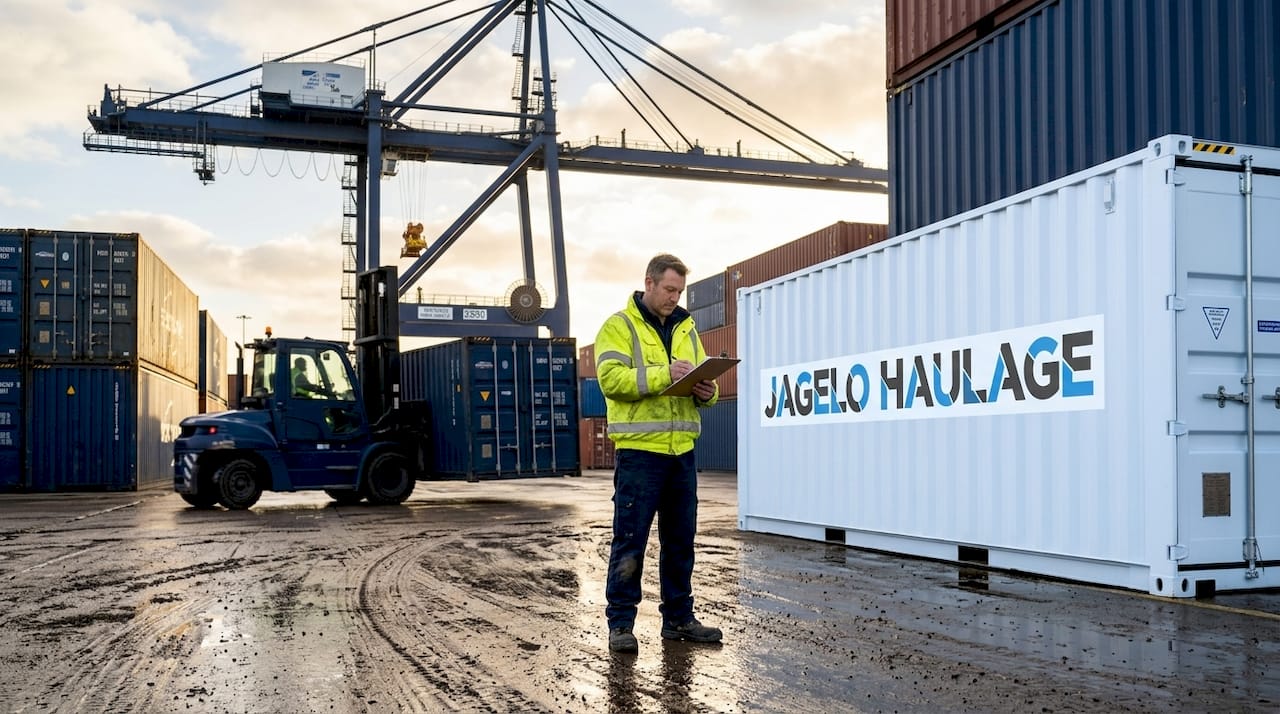
Felixstowe port peak season challenges have grown considerably more complex over recent years, testing the resilience of even the most experienced freight and logistics professionals. As the UK’s largest container port, handling well over four million TEUs annually, Felixstowe sits at the centre of British import and export supply chains. When peak season pressure arrives, the cascading effects touch every stakeholder from shipping line to final-mile drayage operator. This article breaks down the ten most pressing operational and strategic challenges you need to understand and plan around in 2026.
Table of Contents
- Key takeaways
- 1. Capacity constraints at Felixstowe port
- 2. Scheduling disruptions from vessel bunching
- 3. Labour availability and the impact of strikes
- 4. Inland transport infrastructure challenges
- 5. External market factors shifting peak season timing
- 6. Technology adoption and operational efficiency at Felixstowe
- 7. Congestion spikes and seasonal volatility
- My perspective on Felixstowe peak season planning
- How Jhaulage supports your Felixstowe operations during peak season
- FAQ
Key takeaways
| Point | Details |
|---|---|
| Capacity has limits despite expansion | The Phase 3 investment added cranes and quay length, but terminal yard constraints still create bottlenecks during volume surges. |
| Vessel bunching causes service-level delays | Even with low median wait times, specific alliance services can face delays of up to five days, disrupting drayage scheduling. |
| Peak season now starts earlier | Demand surges are shifting to June and July, forcing logistics planners to front-load capacity decisions well before traditional Q4. |
| Inland infrastructure amplifies port congestion | A14 maintenance closures and rail ramp congestion compound terminal bottlenecks independently of port performance. |
| Labour disputes carry significant throughput risk | Strike action involving crane drivers and stevedores can halt operations substantially within hours of commencement. |
1. Capacity constraints at Felixstowe port
The Phase 3 expansion represented a £200 million investment adding over 4km of quay and five super post-Panamax cranes, increasing annual capacity by 1.5 million TEUs. That is a significant uplift on paper. In practice, however, terminal yard density during peak throughput periods remains a persistent constraint. When vessel arrivals cluster, the yard fills faster than containers move out.
Stacking limitations are perhaps the least discussed but most operationally damaging element of this problem. When stack height reaches maximum safe levels, cranes operate more slowly, slot assignments become contested, and Vehicle Booking System (VBS) delays cascade outward into the drayage network. The physical infrastructure of the yard effectively sets the ceiling on throughput regardless of quay crane availability.
Key factors contributing to capacity-related bottlenecks include:
- Terminal yard utilisation exceeding safe operational thresholds during simultaneous vessel discharges
- Quay crane allocation conflicts between merchant haulage and carrier haulage containers
- Reefer plug availability becoming critically scarce during cold chain import surges
- Empty container accumulation reducing effective yard capacity ahead of export peak cycles
Pro Tip: Request your freight forwarder or shipping line to confirm free time extensions during known peak windows. Reducing demurrage and detention exposure requires proactive documentation, not reactive appeals after the fact.
2. Scheduling disruptions from vessel bunching
Vessel bunching at Felixstowe is not simply a problem of too many ships arriving at once. The underlying cause is frequently schedule slippage accumulated over weeks across the Asia-Europe trade lane, which then compresses arrivals into narrow berth windows. The result is a congestion event that the port itself did not create but must absorb entirely.
The data tells a clear story. While Felixstowe’s median wait time sits at just 0.36 days under normal conditions, specific alliance services have recorded delays of up to five days during congestion periods. This is not a port-wide failure. It is a service-specific reliability problem concentrated within certain Ocean and Premier alliance rotations.
To manage scheduling disruption effectively, consider the following:
- Monitor alliance service reliability scores weekly using tools such as Sea-Intelligence or carrier vessel tracking portals, not just port congestion indices.
- Build a two-day buffer into your container collection scheduling whenever a vessel is arriving from a port known for prior delays on that rotation.
- Maintain pre-advised customs entries for all Felixstowe arrivals so that once a vessel berths, border formalities do not add further delay to an already compressed collection window.
- Coordinate with your haulier in advance of the vessel’s revised estimated time of arrival (ETA), allowing VBS slot adjustments before the window closes.
It bears noting that Felixstowe hosts Asia-Europe services with only around 25% on-time vessel performance across key alliances. For logistics planners building drayage schedules around vessel ETAs, that figure should recalibrate every assumption about lead times.
3. Labour availability and the impact of strikes
Labour at Felixstowe covers a range of specialised roles: quay crane drivers, reach stacker operators, stevedores, vehicle planners, and gate staff. A disruption to any one of these groups reduces throughput disproportionately, because terminal operations function as an integrated system rather than a collection of independent tasks.
The risks became tangible when strike action involving crane drivers and stevedores demonstrated how quickly supply chains can destabilise. An eight-day stoppage does not simply delay containers by eight days. The downstream recovery period, during which the backlog is cleared, extends disruption for two to four weeks beyond the strike’s conclusion.
Mitigation strategies worth building into your operational planning include:
- Maintain standing diversion agreements with Liverpool or Tilbury so that a declared industrial action triggers a contingency protocol automatically rather than requiring emergency decision-making
- Pre-position buffer stock at UK distribution centres ahead of identified risk windows, particularly if your commodity is time-sensitive or seasonally critical
- Monitor Unite the Union communications and port consultation updates as a standard part of your weekly freight intelligence review
Pro Tip: If you use a haulage partner with in-cab GPS tracking and digital load management, you can redirect collections mid-journey during sudden operational disruptions without losing visibility of the container’s physical status.
4. Inland transport infrastructure challenges
The A14 corridor is the arterial road connecting Felixstowe to the national motorway network. When it works, it is merely adequate. When it does not, container drayage stalls in a way that no amount of terminal efficiency can compensate for. Routine A14 closures between junctions 51 to 46 and 38 to 42 for essential maintenance create localised gridlock that delays both collection and delivery runs, increasing driver hours, fuel consumption, and demurrage exposure simultaneously.
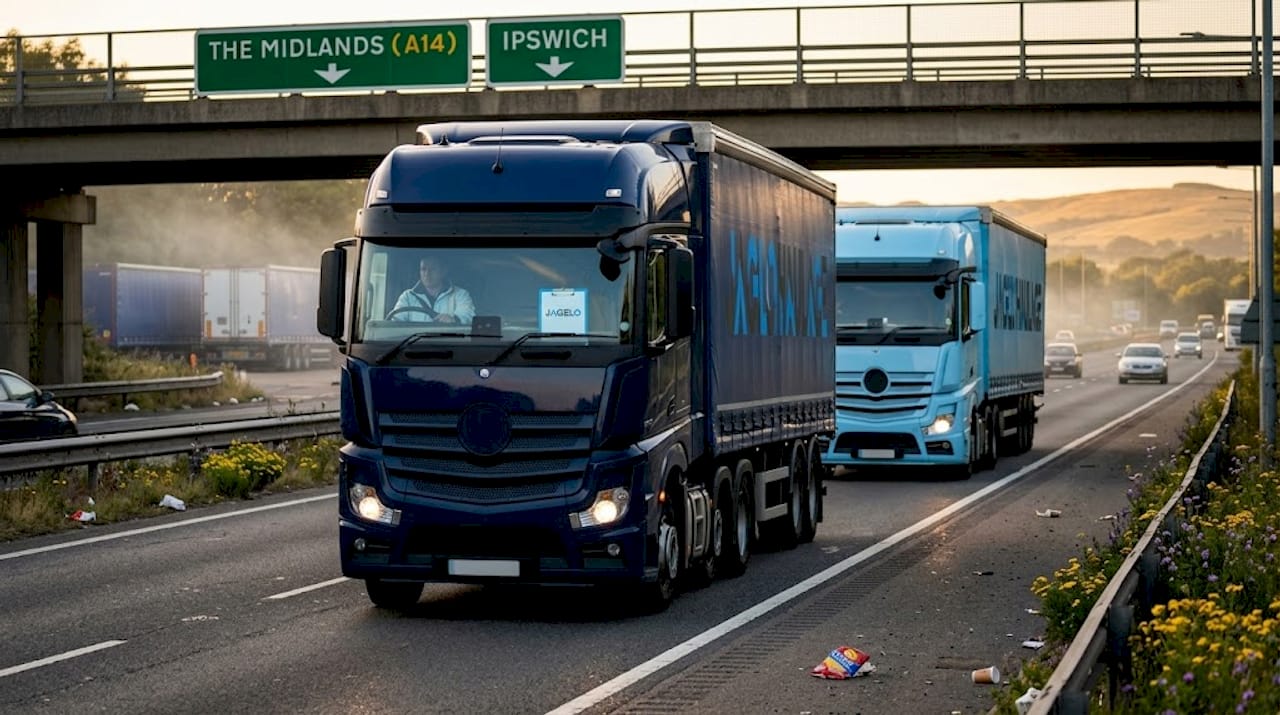
Rail intermodal services offer a partial alternative, but the Felixstowe rail ramp has its own capacity ceiling. During peak season, rail booking lead times extend and slot availability tightens, meaning the modal shift that might relieve road pressure is not always available precisely when it is most needed.
The table below summarises the key inland infrastructure variables affecting container flow from Felixstowe:
| Infrastructure element | Peak season constraint | Typical impact on drayage |
|---|---|---|
| A14 road corridor | Overnight and weekend maintenance closures | 2 to 4 hour delays per round trip |
| Felixstowe rail ramp | Booking lead time increases to 5 to 7 days | Reduced modal shift options during surges |
| M25 junction corridors | Broader south-east congestion during peak demand | Extended transit times for London and south-east deliveries |
| Haulier fleet availability | Driver shortage and HGV licence constraints | Reduced drayage capacity at highest demand point |
Drayage coordination during peak periods requires logistics managers to treat the inland network as a constraint in its own right, not merely an extension of port operations. A strategic logistics guide for Felixstowe container haulage addresses many of these downstream considerations in detail.
5. External market factors shifting peak season timing
The conventional Q4 peak season model no longer accurately describes when pressure arrives at Felixstowe. Peak season now starts as early as June and July, driven by inventory front-loading behaviour from importers reacting to geopolitical uncertainty and tariff risk. This structural shift stretches the capacity planning window considerably.
Compounding this timing change, spot rates on Asia-Europe trades are running approximately $245 per 40ft container above standard seasonal expectations as of May 2026, reflecting what traders are calling the Hormuz premium. Diesel prices are also running 29 cents higher since April 2026, feeding through into road haulage surcharges.
The external factors currently disrupting traditional peak season patterns include:
- Hormuz premium on spot freight rates inflating carrier costs and influencing vessel deployment decisions on Asia-Europe rotations
- Fuel surcharge volatility affecting carrier network reliability as operators adjust voyage speeds to manage bunker consumption
- Inventory front-loading by importers creating volume surges in Q2 rather than Q3, compressing terminal capacity ahead of the traditional peak window
- Bunker shortages contributing 30 to 40% of carrier cost structures, amplifying freight rate spikes and creating procurement strategy disruptions for logistics teams
The practical implication is that your procurement and transport booking strategy should now treat the shipping year as having two distinct peak risk windows rather than one.
6. Technology adoption and operational efficiency at Felixstowe
Technology deployment at Felixstowe has accelerated, with real-time sensor networks now forming part of operational decision-making. Skyview sensors installed at the port provide real-time wind data to inform vessel scheduling and crane operations, reducing weather-related delays that previously went unmonitored at granular levels. This is one example of how instrumentation is making previously opaque operational variables more manageable.
Digital booking systems, predictive analytics for berth planning, and electronic gate processes have each contributed to throughput improvements during non-peak periods. The limitation is that technology which works well under moderate load frequently encounters data quality and system latency problems precisely when demand is highest and decision speed matters most.
For logistics professionals, the practical benefit of port technology improvements lies primarily in visibility rather than throughput. You can now track container availability updates in closer to real time, integrate port status feeds into transport management systems (TMS), and receive automated notifications on VBS slot changes. Feeding that data into your own planning cycle is where the competitive advantage lies.
Pro Tip: Integrate your TMS directly with port community system feeds where available. Real-time container availability data reduces unnecessary driver wait time and allows slot rebooking before demurrage clocks start running.
For a broader framework on managing these operational variables, the port logistics management guide from Jhaulage provides a structured approach to resilience-building at UK container ports.
7. Congestion spikes and seasonal volatility
The contrast between low-congestion periods and peak congestion events at Felixstowe is more pronounced than most logistics managers allow for in their planning assumptions. Congestion at Felixstowe remained below 12% through Q2 2025 before spiking to 29% in November 2025. That is not a linear scaling problem. It is a non-linear surge that overwhelms processes calibrated for normal operating conditions.
The implication is that planning for peak season at Felixstowe requires you to model the port’s behaviour under stress, not under average load. Hauliers who have calibrated their turn-times, slot booking lead times, and driver scheduling around Q2 performance figures will face severe disruption when November conditions arrive. Understanding this pattern is the first step towards building a peak season plan with appropriate buffer capacity built in.
The article on Felixstowe container haulage covers how haulage operators adapt to this seasonal volatility in practical terms.
My perspective on Felixstowe peak season planning
I have spent considerable time working with freight teams that treat peak season as an intensified version of normal operations. In my experience, that framing is the root cause of most avoidable disruptions.
What I have observed is that the challenges at Felixstowe are dual-layered. There is the immediate operational risk, which is the delayed vessel, the full yard, the unavailable VBS slot. Then there is the strategic risk, which is the failure to recognise that the entire seasonality model has shifted and that the tools built for a Q4 peak are now miscalibrated for a June surge.
The professionals who navigate this best are not those with the largest fleets or the most sophisticated systems. They are the ones who treat logistics intelligence as a continuous process rather than a pre-season checklist. They monitor alliance service reliability monthly. They maintain diversion protocols that are genuinely executable, not theoretical. And they have haulage partners with the operational depth to adapt when conditions change mid-shipment.
My take on the infrastructure investment question is also perhaps contrarian. The Phase 3 expansion at Felixstowe was necessary and meaningful. But no quay extension eliminates the A14 bottleneck or makes vessel schedules more reliable. Process discipline and partnership quality outperform capital investment when the pressure is at its highest. That is where I would focus attention if I were building a peak season resilience plan today.
— Vytautas
How Jhaulage supports your Felixstowe operations during peak season
Peak season at Felixstowe places demands on haulage providers that separate the prepared from the reactive. Jhaulage operates a fleet of over 40 GPS-tracked trucks and trailers specialised in container haulage from Felixstowe, with the operational depth to handle VBS scheduling, pre-advised customs coordination, and same-day collection when vessel arrivals compress your collection window.
During peak periods, the difference between a demurrage charge and a clean collection often comes down to your haulier’s port relationships and scheduling discipline. Jhaulage’s 24/7 support model and real-time tracking capability allow logistics managers to maintain visibility and responsiveness regardless of how volatile conditions become. If you are planning your supply chain strategy for the 2026 peak season, speaking with Jhaulage’s team early in the cycle will allow you to secure capacity before it becomes contested.
FAQ
What are the main causes of freight delays at Felixstowe during peak season?
Freight delays at Felixstowe during peak season arise from a combination of vessel bunching, terminal yard congestion, A14 road closures, and labour constraints. Alliance service unreliability on Asia-Europe rotations compounds port-level delays further.
When does peak season at Felixstowe typically start?
Peak season now starts as early as June and July in many years, driven by inventory front-loading from importers responding to tariff risk and geopolitical uncertainty. This is a structural shift from the traditional September to October peak window.
How do labour strikes affect Felixstowe port operations?
Strike action involving crane drivers and stevedores can reduce throughput significantly within hours. Recovery periods following a dispute typically extend disruption two to four weeks beyond the strike’s end date due to accumulated backlog.
What is vessel bunching and why does it matter for logistics planning?
Vessel bunching occurs when schedule slippage across a trade lane compresses multiple vessel arrivals into a narrow berth window. Even when Felixstowe’s median wait time is as low as 0.36 days, specific services can face delays of up to five days, directly affecting drayage scheduling.
How can logistics professionals manage peak season shipping challenges at Felixstowe?
Managing peak season shipping at Felixstowe requires early capacity booking, proactive VBS slot management, pre-advised customs entries, standing diversion agreements to alternative ports, and working with haulage partners who have real-time tracking and 24/7 operational support.
Recommended
- Felixstowe Container Haulage That Keeps Pace | Jagelo Haulage
- Reliable Container Haulage from Felixstowe: A Guide to Port Logistics | Jagelo Haulage
- Plan overnight container storage Felixstowe: 2026 guide | Jagelo Haulage
- Reliable Container Haulage from Felixstowe Port: A Strategic Logistics Guide | Jagelo Haulage