Part of our guide to container haulage from Felixstowe
Plan overnight container storage Felixstowe: 2026 guide

When you fail to plan overnight container storage Felixstowe operations adequately, port storage fees accumulate faster than most logistics managers anticipate. Felixstowe handles nearly half of the UK’s container trade, meaning every delay you incur at the quayside compounds across the entire supply chain. Demurrage charges, congestion penalties, and missed Vehicle Booking System (VBS) slots are not abstract risks — they are operational costs that materialise within hours. This guide gives you a structured framework to select, book, and coordinate overnight container storage solutions in Felixstowe, covering prerequisites, step-by-step planning, common pitfalls, and the financial case for getting it right.
Table of Contents
- Key takeaways
- When to plan for overnight container storage
- How to plan and secure overnight storage
- Common challenges and how to address them
- Financial benefits of effective storage planning
- My perspective on planning container storage
- How Jhaulage supports your storage planning at Felixstowe
- FAQ
Key takeaways
| Point | Details |
|---|---|
| Act before congestion hits | Secure overnight storage capacity in advance, not reactively, to avoid escalating port fees. |
| Assess storage beyond cost | Evaluate facilities on reliability, access hours, visibility, and proximity to Felixstowe, not price alone. |
| Coordinate shunting early | Arrange shunting services alongside storage booking to prevent port-side container backlogs. |
| Use tracking for visibility | Implement container movement reporting to maintain real-time oversight between port, yard, and final delivery. |
| Planning yields measurable savings | Effective overnight storage planning directly reduces demurrage, detention costs, and scheduling conflicts. |
When to plan for overnight container storage
Not every container movement requires overnight storage, but recognising the triggers that make it necessary is the first discipline of effective port logistics planning. Seasonal surges — particularly pre-Christmas import peaks and post-Chinese New Year backlogs — create predictable periods when port yard capacity tightens and haulage windows shorten. Less predictably, vessel bunching caused by weather or canal disruption can land multiple ships simultaneously, overwhelming both quayside space and outbound transport availability.
The right time to engage a storage facility is not after your containers have arrived on berth. It is at the freight booking stage, when vessel arrival windows are still provisional. Port congestion at Felixstowe currently shows a median vessel waiting time of approximately 0.36 days, but that figure is volatile and rises sharply during peak periods. Planning storage in advance means you are not competing for yard space when every other haulier is making the same calls.
What to look for in a storage facility
Once you have identified the need, the evaluation criteria for a storage facility determine whether it actually supports your operation or simply displaces the problem off-quay. Storage site selection requires balancing cost with operational fit — sites that disrupt flow or reduce visibility cause hidden costs greater than any headline rate saving. The table below outlines the key criteria and why each matters.
| Requirement | Why it matters |
|---|---|
| Proximity to Felixstowe port | Shorter shunting distance reduces haulage cost and turnaround time |
| 24-hour secure access | Night-time and early-morning collection slots align with VBS availability |
| CCTV and perimeter security | Protects cargo condition and satisfies insurance requirements |
| Capacity scalability | Fluctuating volumes require facilities that can absorb short-notice additions |
| Strong transport links (A14/rail) | Enables rapid onward despatch without routing delays |
| Digital reporting and tracking | Provides real-time visibility of container status and location |
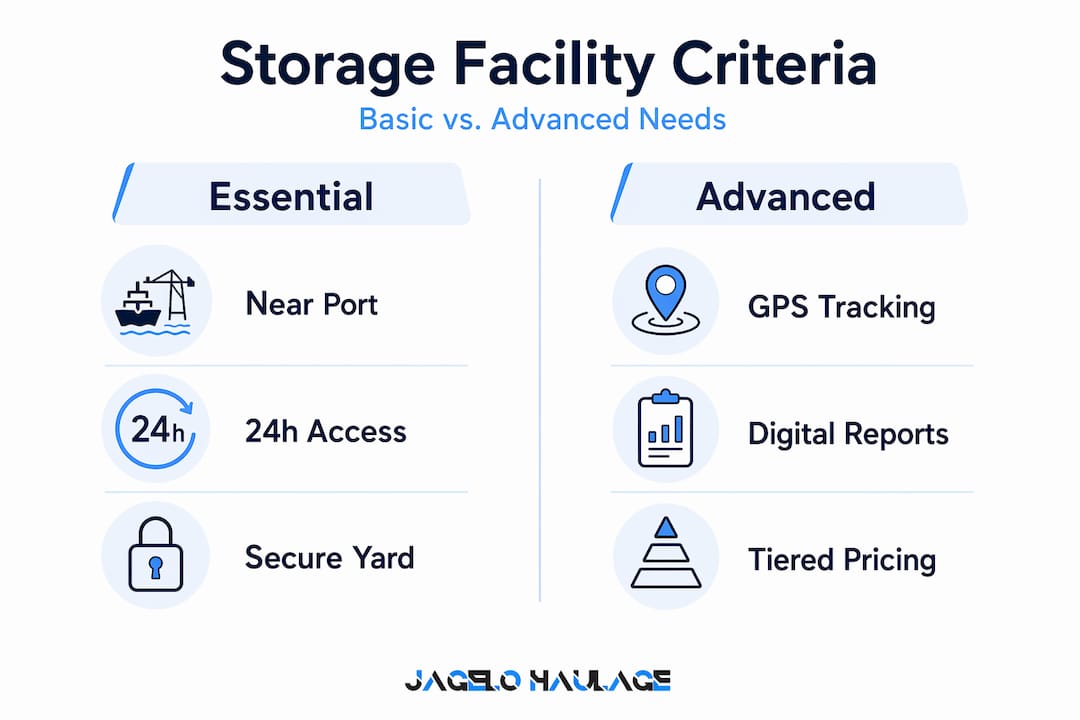
The recently approved lorry park near Felixstowe, strategically positioned close to the A14 and rail connections, offers a concrete example of the kind of facility that ticks these boxes. Its 70-space capacity and proximity to the port make it a reference point for what well-located overnight storage looks like in practice.

Pro Tip: When evaluating facilities, ask specifically for their average gate-in and gate-out processing times. A yard with excellent security but a 45-minute check-in process will cost you more in driver wait time than a slightly higher storage rate at a more efficient competitor.
How to plan and secure overnight storage
Translating storage need into a confirmed, coordinated arrangement requires a methodical sequence. The following steps reflect the operational order that delivers the least disruption and the greatest scheduling flexibility.
-
Assess container volume and arrival windows. Pull your vessel arrival schedule and calculate the number of TEUs (twenty-foot equivalent units) arriving within a 48-hour window. This gives you both the storage capacity requirement and the shunting timeline.
-
Engage storage providers at least five working days ahead. For peak periods such as Q4 import surges, extend this to three weeks. Port storage fees escalate rapidly when containers are held onsite, so confirmed off-quay space must be secured before vessel arrival.
-
Book shunting or merchant haulage services in parallel. Storage booking without confirmed haulage to move the boxes is incomplete planning. Shunting services must be carefully coordinated with port unloading schedules and haulage availability to maximise efficiency and minimise fees.
-
Align moves with VBS slot availability. Cross-reference your shunting schedule against VBS slot windows at Felixstowe. Containers that cannot be collected within the nominated VBS window revert to port storage, defeating the purpose of the arrangement. Review your container delivery scheduling processes to keep slot compliance above 90 per cent.
-
Confirm legal and compliance requirements. Verify that your chosen storage facility holds the appropriate licences for bonded or non-bonded goods, as applicable. Confirm that your transport operators carry adequate goods-in-transit insurance for the container type and cargo value involved.
-
Establish a single point of communication. Nominate one logistics coordinator as the named contact across port, haulage operator, and storage yard. Fragmented communication is the most common cause of missed collections and misrouted containers.
Pro Tip: When negotiating storage rates for overnight container storage Felixstowe facilities, request a tiered pricing structure rather than a flat daily rate. A tiered model — lower rates for the first 48 hours, escalating thereafter — creates a financial incentive that mirrors port demurrage logic and keeps your team focused on moving boxes out promptly.
Common challenges and how to address them
Even well-planned container storage solutions Felixstowe operations encounter disruption. Knowing the failure modes in advance allows you to build contingency into the plan rather than react to it under pressure.
-
Port congestion spikes. Vessel bunching, weather delays, and industrial action can compress available yard space with little notice. Maintain a secondary storage provider relationship so you have a pre-agreed overflow option ready to activate.
-
Capacity shortfalls at short notice. Storage yards near a major port fill quickly during surge periods. If your primary facility cannot accommodate volume, a shortfall discovered on the day of unloading is a serious operational failure. Confirm capacity at the booking stage and again 24 hours before arrival.
-
Security and cargo condition. Storage facilities should be assessed on reliability, visibility, and performance rather than capacity or cost alone, to avoid hidden costs under shipping pressure. Before confirming a facility, physically inspect it or request a formal audit report from the provider.
-
Communication breakdowns. The three-way relationship between port operations, your haulage contractor, and the storage yard is where most scheduling failures originate. Clear access patterns and consistent communication between all three parties are the operational foundation of effective container management.
-
Missed delivery windows. When a container misses its outbound slot from the storage yard, the onward customer delivery is compromised. Build a minimum two-hour buffer between container retrieval from storage and the confirmed delivery appointment.
Implementing a tracking and reporting system for container moves between port, storage, and final delivery is not a luxury — it is the mechanism that prevents delays from becoming missed commitments. A robust reporting system for all container movements is critical to maintaining operational oversight across the chain.
Pro Tip: GPS-tracked tractor units give you real-time visibility of container location, but the bigger gain is in the data trail. When a dispute arises about when a container left the yard, timestamped location records from GPS reporting resolve it in minutes rather than days.
Financial benefits of effective storage planning
The financial case for investing time in overnight container storage planning is not difficult to construct. The harder discipline is quantifying the cost of not planning, which tends to be distributed across multiple line items rather than appearing as a single charge.
| Scenario | Without overnight storage planning | With overnight storage planning |
|---|---|---|
| Demurrage exposure | High — containers held on port for 3 to 7 days | Low — containers moved off-quay within 24 hours |
| Port storage charges | Accumulate daily at escalating rates | Eliminated by pre-booked yard placement |
| Driver detention costs | Frequent, due to congestion and failed slot access | Minimal — shunting coordinated in advance |
| Supply chain flexibility | Constrained by port capacity | Expanded through secondary storage buffer |
| Customer delivery reliability | Vulnerable to port congestion delays | Protected by off-quay storage buffer |
Strategic use of off-site shunting reduces port-side costs and increases scheduling flexibility around unpredictable port congestion and VBS slot availability. Beyond direct fee avoidance, there is an asset management benefit: containers held in a clean, secure overnight storage yard retain better condition than those sitting exposed on a congested quayside, reducing the frequency of damage claims and repair costs.
Improved coordination between port operations and haulage scheduling also means your haulage fleet runs more productive cycles. A driver who collects from a nearby overnight storage yard at 06:00 can complete two full delivery runs before midday, compared to one run with a 09:00 port collection complicated by congestion. This is a container haulage efficiency gain that compounds over time and is directly attributable to storage planning discipline.
My perspective on planning container storage
I have worked alongside logistics teams that treat container storage as a reactive measure — something you arrange when things have already gone wrong at the port. In my experience, that approach costs significantly more than the planning it avoids. The professionals who get this right are the ones who build storage coordination into their standard pre-arrival checklist, not their exception management process.
What I find consistently underestimated is the complexity of the three-way coordination between port, haulage operator, and storage yard. Each party has its own scheduling logic, and the gaps between them are where containers get stranded. I have seen well-resourced logistics operations lose days of productivity simply because no one owned the communication between the yard and the driver allocated to the shunting run.
The other point that rarely gets enough attention is that best overnight container storage is not the cheapest overnight storage. A yard that saves you £30 per box per night but adds two hours to your collection window and provides no digital reporting is a false economy. View storage as a component of your operational control infrastructure. When you plan for container storage with that framing, the right decisions follow.
— Vytautas
How Jhaulage supports your storage planning at Felixstowe
For logistics managers who need to plan overnight container storage Felixstowe operations without rebuilding their entire process from scratch, a specialist haulage partner makes a measurable difference.
Jhaulage operates a fleet of over 40 GPS-tracked trucks and trailers, coordinating container haulage at Felixstowe and other major UK ports with 24/7 operational support. The team integrates storage coordination directly into the haulage booking process, meaning shunting, yard placement, and onward delivery are managed as a single workflow rather than three separate arrangements. If you are working through Felixstowe logistics and storage options for your 2026 import schedule, Jhaulage can provide tailored guidance on storage timing, shunting coordination, and container collection logistics. Contact the team at Jhaulage to discuss a storage and haulage solution built around your operational requirements. For further reading, explore Jhaulage’s guidance on organising a port collection and container haulage across UK ports.
FAQ
What is overnight container storage at Felixstowe?
Overnight container storage at Felixstowe refers to the use of secure off-quay facilities to hold shipping containers outside port hours, reducing demurrage exposure and maintaining supply chain flow between vessel unloading and onward delivery.
How far in advance should I book overnight container storage?
Book at least five working days ahead for standard volumes and up to three weeks in advance during peak import periods, as yard capacity near Felixstowe fills rapidly when port congestion is high.
What are the main costs avoided by planning container storage?
Effective planning eliminates or reduces port demurrage charges, daily storage escalation fees, driver detention costs, and the supply chain delays that arise when containers remain on the quayside beyond their free time allowance.
How do I choose a container storage facility near Felixstowe?
Assess facilities on proximity to the port, 24-hour secure access, digital reporting capability, scalable capacity, and transport link quality rather than on headline storage rate alone, as operational fit determines the true cost of the arrangement.
What is shunting and why does it matter for overnight storage?
Shunting is the movement of containers from the port to a nearby storage yard using short-haul tractor units. It is the operational mechanism that makes overnight storage work, freeing port yard space and enabling containers to be held securely until onward transport is confirmed.
Recommended
- Reliable Container Haulage from Felixstowe: A Guide to Port Logistics | Jagelo Haulage
- Container Haulage from Felixstowe: A Professional Guide to Port Logistics | Jagelo Haulage
- Reliable Container Haulage from Felixstowe Port: A Strategic Logistics Guide | Jagelo Haulage
- Felixstowe Container Haulage That Keeps Pace | Jagelo Haulage