Avoid £550 PCNs: London DVS 2026 checklist for fleet managers

Every HGV over 12 tonnes GVW operating in most of Greater London needs a valid HGV safety permit, and vehicles rated zero, one or two stars can only hold that permit if they carry the Progressive Safe System. Transport for London enforces this 24 hours a day, seven days a week, with no seasonal or time-based exceptions. Non-compliance triggers a Penalty Charge Notice regardless of whether the vehicle is UK-registered or from overseas.
TL;DR:
- Vehicles rated zero, one, or two stars must have the Progressive Safe System installed and evidenced before applying for a permit, with a deadline of May 2025 for compliance.
- Enforcement of the HGV safety permit is continuous, applying equally during nights, weekends, and holidays, with fines up to £550 for non-compliance.
- Confirm vehicle star ratings using TfL’s VRM checker before scheduling deliveries to avoid route or permit issues.
- Proper documentation, including clear photos and manufacturer statements specifying each of the seven PSS elements, is essential for successful application.
- Maintaining an up-to-date fleet CSV and a centralized record of all compliance evidence is critical for ongoing operational adherence and quick audits.
Table of Contents
- What the Direct Vision Standard is and where it applies in London
- Who needs a permit, and when enforcement actually runs
- Progressive Safe System: the seven mandatory requirements and what they mean in practice
- How to check DVS star ratings and apply for a permit
- Documentation, evidence and common application pitfalls
- Practical compliance checklist for fleet operators
- Timeline, key dates and what 2026 compliance looks like now
- Enforcement and penalties: what non-compliance actually costs
- How Jagelo Haulage manages DVS compliance operationally
- Why most DVS advice misses the point that matters
- Sources
What the Direct Vision Standard is and where it applies in London
The Direct Vision Standard sits inside the Mayor of London’s Vision Zero programme, a policy commitment to eliminate deaths and serious injuries from London’s transport network. DVS star ratings score how much a lorry driver can see directly through the cab windows, from zero (almost nothing) to five stars. Vehicles that score too low on direct vision must compensate with sensors, cameras and warning systems instead.
Confirming whether a route falls inside the enforcement zone matters before you schedule a delivery, not after a PCN arrives. TfL publishes a simplified zone map alongside its operator guidance, and the scheme covers most of Greater London rather than a narrow central cordon.
A few points catch operators out repeatedly:
- The permit requirement applies to non-UK-registered vehicles exactly as it applies to UK fleets.
- Postcode checking against the zone map is worth doing per route, not just once per depot.
- The zone boundary does not track the ULEZ or Congestion Charge boundary, so checking one does not confirm the other.
Who needs a permit, and when enforcement actually runs
The threshold is straightforward: any HGV with a gross vehicle weight over 12 tonnes needs an HGV safety permit to enter or operate within the zone. That covers rigid trucks, artics, tippers, skip lorries and refrigerated units alike, provided they cross the weight line. Vans and rigids under 12 tonnes fall outside the scheme entirely.
Enforcement runs continuously, which changes how operators should think about risk:
- There is no night-time, weekend or bank holiday exemption. A vehicle caught without a valid permit at 3am on a Sunday is treated the same as one caught at rush hour on a Tuesday.
- Hired, leased or borrowed vehicles still need their own valid permit tied to the correct registration mark. Assuming a rental company’s blanket cover extends to your operation is a common and costly mistake.
- Liability sits with the operator running the vehicle at the time, not necessarily the registered keeper, so subcontracted work needs the same scrutiny as your own fleet.
Progressive Safe System: the seven mandatory requirements and what they mean in practice
For vehicles rated zero, one or two stars, TfL will only issue a permit once the Progressive Safe System is fitted and evidenced. PSS replaced the older Safe System with technology designed to cut false alarms and reduce the sensory overload that plagued earlier warning kit.
The seven mandatory elements are:
- Nearside Camera Monitoring System covering the blind spot along the vehicle’s left side.
- Class V and VI mirrors, or a camera monitoring system providing equivalent coverage, for close proximity and forward-of-cab vision.
- Blind Spot Information System (BSIS) that alerts the driver to moving road users, particularly cyclists and pedestrians, near the nearside.
- Moving Off Information System (MOIS) that warns of people or objects directly in front of the cab before the vehicle pulls away.
- Side under-run protection to reduce the risk of a vulnerable road user being drawn under the vehicle in a collision.
- Audible warning that sounds when the vehicle indicates or turns left, alerting nearby pedestrians and cyclists.
- External signage warning cyclists and pedestrians to keep clear of the vehicle at close quarters.
Performance matters more than parts. TfL’s design intent for BSIS and MOIS is to distinguish moving road users from stationary street furniture, so a system that alarms every time it passes a parked car or a bollard fails the practical test even if it is technically installed. This is one of the more overlooked traps in the whole scheme: treating PSS as a hardware checklist rather than a performance standard.
For evidence, TfL requires two photographs of the fitted system plus a written statement from the manufacturer or installer confirming what has been fitted and that it meets the PSS specification.
Pro Tip: Ask your installer for a statement that names each of the seven elements individually rather than a generic “PSS compliant” line. Vague statements are one of the most common reasons applications get sent back for more evidence.
How to check DVS star ratings and apply for a permit
Before applying for anything, confirm the vehicle’s existing star rating using TfL’s DVS VRM checker. This tells you immediately whether you are dealing with a straightforward permit or a PSS retrofit case.
- Single vehicle: enter the registration mark into the VRM checker to see its current star rating and permit status.
- Bulk checking and application: for fleets running between 5 and 3,000 vehicles, download TfL’s CSV template and populate it without altering the column structure, header rows or formatting. TfL’s system reads the template mechanically, so an added column or renamed field can cause the whole batch to fail.
- UK versus non-UK plates: format registration marks exactly as issued, including the correct pattern for non-UK-registered vehicles, since mismatched formatting is a frequent cause of rejected bulk uploads.
- Submit and wait: applications are free of charge, and TfL processes both single and bulk submissions through the same portal.
There is no published guaranteed turnaround time, so building in a buffer before a vehicle needs to operate in the zone is sensible practice rather than optional caution.
Statistic Callout: A PCN for operating without a valid permit runs up to £550, reduced to £275 if paid within 14 days. Against that figure, the cost of running a vehicle through the free VRM checker before it enters London is negligible.
Documentation, evidence and common application pitfalls
TfL’s evidence bar for a PSS permit is specific: two photographs of the installed system and a manufacturer or installer statement confirming compliance. Applications regularly stumble on avoidable errors.
- Reusing paperwork from the old legacy Safe System instead of fresh PSS-specific evidence.
- Submitting a CSV that has been reformatted, resorted or had columns renamed.
- Installer statements that describe the fit generically rather than confirming each of the seven elements.
- Photos that are too dark, too distant, or fail to show the fitted components clearly.
If TfL has no star rating on record for a vehicle at all, the correct route is to contact the vehicle manufacturer directly and request written confirmation of the DVS rating, then submit that alongside the permit application.
Pro Tip: Photograph each PSS component separately rather than trying to capture everything in one wide shot. Assessors reviewing bulk applications move faster through clearly labelled, close-up evidence.
Practical compliance checklist for fleet operators
Turning TfL’s rules into daily fleet discipline is where most of the real compliance risk gets managed or missed.
- Check permit status by VRM for every vehicle before it is rostered onto a London-bound job, not just at onboarding.
- Test PSS functionality, not just presence, during routine pre-trip inspections. A BSIS unit that has failed silently is worse than no unit at all, because drivers stop watching for the hazard it was meant to flag.
- Brief drivers on what each warning means and how to respond, since kit is only useful if the person behind the wheel trusts and understands it.
- Keep the fleet CSV current, updating it whenever a vehicle is added, sold or reassigned to different routes.
- Retain installer and manufacturer statements in a central, searchable record rather than scattered across individual vehicle files.
- Name and version photo evidence consistently (registration mark, date, component) so an audit or re-application does not turn into a search exercise.
Booking installation slots well ahead of any deadline avoids the scramble that hits operators who leave retrofits until the last quarter. A container transport compliance checklist built around named categories, and a clear framework for driver compliance both reduce the chance that DVS slips through the gaps between other regulatory demands.
Pro Tip: Stage retrofits by operational priority. Vehicles that regularly run into central London should be first in the installer’s diary, with peripheral or occasional-use vehicles scheduled later.
Timeline, key dates and what 2026 compliance looks like now
Legacy Safe System permits for zero, one and two star vehicles expired on 27 October 2024 at 23:59. From 28 October 2024, PSS became the mandatory standard for any vehicle in that star bracket seeking a permit.
- 27 October 2024, 23:59: legacy Safe System permits ceased to be valid.
- 28 October 2024: PSS requirement came into force for 0–2 star vehicles.
- Grace period mechanism: operators who could evidence booked installation works were able to apply for a limited extension, with approved extensions running up to 4 May 2025.
- Now: operating in 2026 without PSS fitted to a 0–2 star vehicle means operating without a valid permit, full stop. There is no active grace-period route left to use.
Three, four and five star vehicles do not need PSS and their permits follow the standard duration TfL sets on approval, though ongoing checks and evidence retention remain sensible practice regardless of star rating.
Enforcement and penalties: what non-compliance actually costs
A PCN for a vehicle operating without a valid HGV safety permit reaches up to £550, dropping to £275 if settled within 14 days. Enforcement runs continuously and applies identically to UK-registered and foreign-registered vehicles crossing into the zone.
- Fines are the visible cost, but detention risk, delivery delays and damaged relationships with clients who expect reliable, penalty-free running are the costs that compound over a contract’s life.
- Persistent non-compliance can affect an operator’s standing with clients who audit supplier compliance as part of their own due diligence, particularly in retail and construction supply chains.
- A ULEZ and DVS overlap check is worth running alongside permit checks, since a vehicle can be DVS-compliant and still fall foul of ULEZ rules, or vice versa, and both regimes are enforced independently of one another.
How Jagelo Haulage manages DVS compliance operationally
A fleet fitted with GPS tracking gives visibility over vehicle location and status alongside compliance data rather than treating the two as separate systems. That combination matters for DVS specifically, because a permit record tied to a live vehicle location feed makes it far easier to confirm every truck entering London on a given day is carrying valid documentation.
- Central record-keeping ties installer statements and permit evidence to each vehicle rather than leaving that paperwork with individual depots or drivers.
- Maintenance and installation slots are scheduled proactively, which avoids the last-minute compliance scramble that catches operators without forward planning.
- Round-the-clock support means compliance questions get answered outside standard office hours, which matters given DVS enforcement never pauses either.
For operators facing short-term port work, seasonal peaks or cross-dock labour constraints that make retrofitting an entire fleet impractical in the short term, outsourcing specific London-bound movements to a specialist haulage partner is often more workable than retrofitting vehicles that only occasionally need to enter the zone.
Why most DVS advice misses the point that matters
Most guidance on this topic reads like a hardware shopping list: fit these seven things, get your photos, submit your form. That framing misses what TfL is actually testing for, which is behaviour under real conditions, not component presence. A BSIS unit that alarms constantly because it cannot distinguish a cyclist from a parked bin gets ignored by drivers within a fortnight, and an ignored warning system is functionally no different from having none fitted at all.
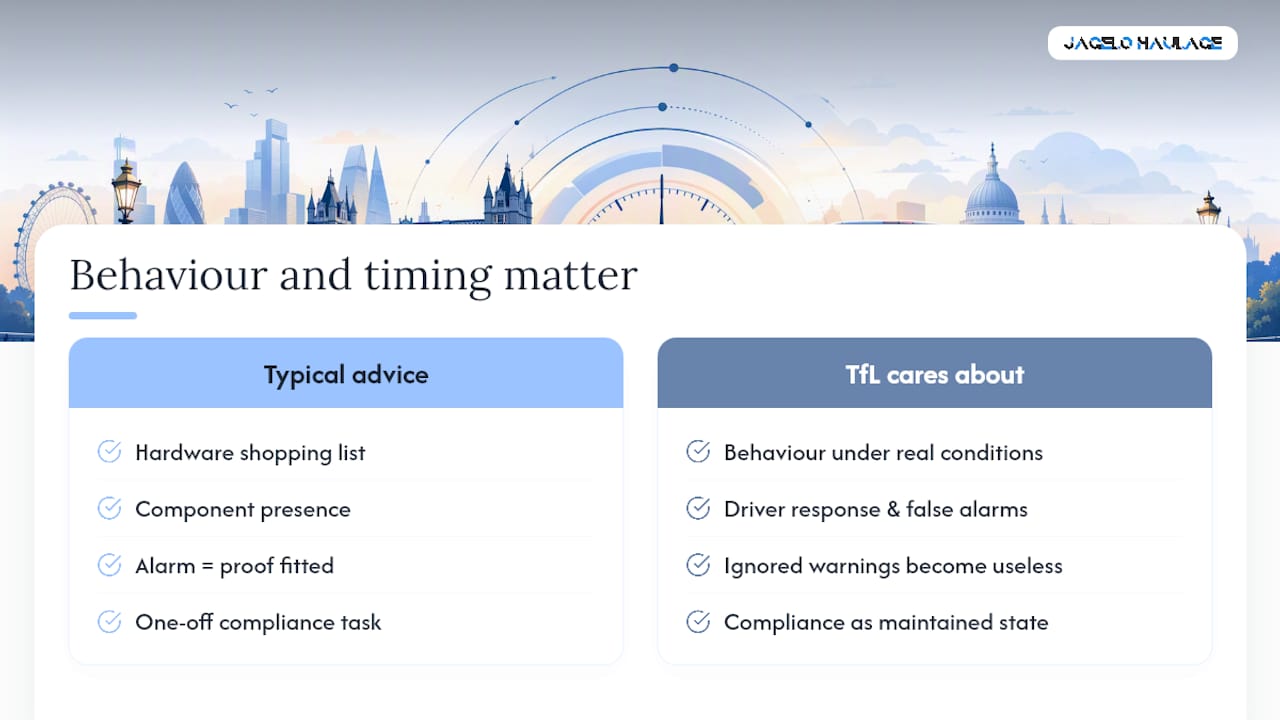
The bigger blind spot is timing discipline. Fleets that treat DVS as a one-off compliance project, ticked off once installers finish, tend to fall behind again the moment a vehicle changes hands, a rating gets reassessed, or a new addition joins the fleet unrecorded. Compliance here is a maintained state, not a completed task.
If you take one thing from this article, prioritise the CSV register over almost everything else. A fleet that knows exactly which vehicles are covered, which need retrofitting, and which evidence sits where will always outperform a fleet with excellent installers but scattered paperwork.
— Vytautas
Sources
Verify every rule directly against TfL rather than relying on secondhand summaries. Start with TfL’s DVS and HGV safety permit page, the VRM checker and application portal, and the downloadable operator guidance PDF. The RHA’s PSS briefing is a useful industry-side companion for interpreting the transition timeline.
- Direct Vision Standard and HGV Safety Permit Scheme - Transport for London
- DVS Progressive Safe System (PSS) FAQs - Road Haulage Association (RHA)