How ship scheduling affects haulage: a guide for freight forwarders

Ship schedule variability directly compresses container collection windows, raises failed-collection rates, and generates idle vehicle costs that erode haulage margins before a single container moves inland. When a vessel arrives late due to port congestion, departs early to protect its rotation, or skips a UK port call entirely, the knock-on effect reaches every contracted haulage booking downstream.
Three immediate effects haulage managers must plan for:
- Compressed retrieval windows — discharge, customs release and gate-out all shift, leaving hauliers with less time to collect before free-time expires.
- Failed collections and cancellations — early departures and port skips generate last-minute booking cancellations, creating unrecoverable vehicle positioning costs.
- Demurrage and detention exposure — delays between vessel arrival and cargo availability push containers past free-time thresholds, triggering daily charges that accumulate rapidly.
Research confirms that port congestion is the principal cause of delay in liner services, producing a cascading domino effect through every subsequent port of call and inland transport leg.
Table of Contents
- How do port congestion and ‘cut-and-run’ departures create haulage problems?
- What are the real cost impacts and KPIs to track?
- Booking and planning practices that reduce schedule variability exposure
- Which visibility tools reduce uncertainty for haulage providers?
- What contract terms protect haulage margins when schedules change?
- How Jhaulage manages schedule variability at UK ports
- Key takeaways
- An operator’s view on managing haulage risk under variable schedules
- Jhaulage: tracked container haulage built for schedule variability
- Useful sources and further reading
How do port congestion and ‘cut-and-run’ departures create haulage problems?
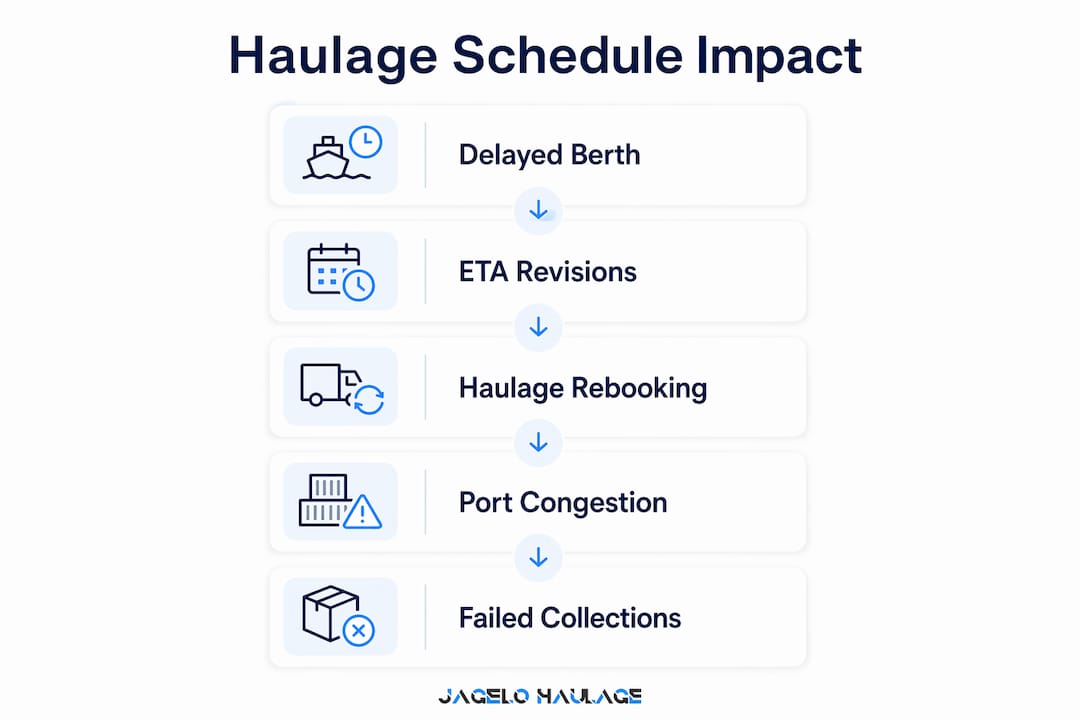
The causal chain from a berth delay to a failed haulage collection is shorter than most forwarders expect. A vessel held at anchorage burns its buffer time before it even reaches the quay. Once alongside, extended discharge operations for mega-ships carrying very large numbers of containers can lengthen alongside time significantly, and carriers under schedule pressure sometimes depart early to protect their rotation at the next port, leaving import containers on the quay with no confirmed gate-out slot.
Port skipping compounds this further. When a line omits a UK port call, import containers either remain on board to a diversion port or are transshipped, extending transit time by days. Export containers scheduled for loading are re-nominated to the next sailing. Either way, the haulage booking placed against the original ETA becomes void, and the haulier absorbs the positioning cost.
A simplified timeline illustrates where variability concentrates:
Scheduled ETA → Actual arrival (anchorage delay) → Berth allocation → Discharge complete → Customs release → Gate-out → Haulage collection
The gap between scheduled ETA and actual gate-out availability is where most operational exposure sits. Container dwell time at the terminal — driven by yard congestion, deconsolidation queues and documentation holds — adds further unpredictability after discharge is complete.
Port congestion does not merely delay a single vessel. It cascades through subsequent ports of call and the entire door-to-door multimodal transport chain, generating additional operational costs for carriers, terminal operators, inland transport providers, and ultimately importers and exporters.
Operational signals to monitor immediately:
- ETA revision notices from the carrier or vessel-tracking feed
- Berth allocation status changes on the terminal’s port community system
- Vehicle Booking System (VBS) appointment availability shifts
- Customs release timestamps versus expected gate-out window
- Port-skipping or diversion notices in carrier advisories
What are the real cost impacts and KPIs to track?
Schedule changes increase operational costs across the supply chain, affecting production schedules for importers and spoilage risk for perishable cargo. For haulage operations specifically, the primary cost items are:
- Idle vehicle cost — a truck positioned at or near the port that cannot collect generates dead mileage and lost revenue hours.
- Failed-collection cost — cancellation fees, re-booking administration and wasted driver time.
- Extra waiting and turnaround time — unrecognised queue time at the gate, which many terminal systems do not log as productive booking time.
- Demurrage and detention — charges that begin once free-time expires; see the demurrage avoidance guide for UK-specific thresholds and tactics.
- Overtime and penalty parking — extended dwell at port environs triggers driver hours compliance issues and parking charges.
| KPI | Definition | Sample unit-cost formula |
|---|---|---|
| Turnaround time | Gate-in to gate-out elapsed time per vehicle visit | Total gate time ÷ number of visits = average minutes per visit |
| On-time pickup rate | Collections completed within the booked appointment window | (On-time collections ÷ total bookings) × 100 |
| Failed-booking rate | Bookings cancelled within 24 hours of appointment | (Failed bookings ÷ total bookings) × 100 |
| Average waiting minutes | Unproductive queue time per vehicle per visit | Total queue minutes ÷ number of visits |
| Buffer hours used | Planned buffer time consumed by schedule variance | Actual collection time minus scheduled ETA-based appointment time |
Worked example: If 10 vehicles each wait an additional 60 minutes per day due to gate congestion caused by a delayed vessel, and your contracted driver cost is £25 per hour, the weekly idle cost is 10 × 1 hour × £25 × 5 days = £1,250 per week from a single disruption event. Multiply across a fleet of 40 vehicles on multiple lanes and the exposure becomes material within a single month.
Booking and planning practices that reduce schedule variability exposure
The most effective planning shift is treating carrier ETAs as dynamic inputs rather than fixed guarantees. Carrier ETA is one milestone within a chain that includes origin cut-off, transshipment, customs release and inland haulage; any link can slip.
Procurement and booking checklist for haulage buyers:
- Build a minimum 24-hour buffer between the carrier’s published ETA and the haulage appointment booking.
- Complete customs entries and pre-arrival documentation before the vessel berths, not after.
- Stagger bookings across a two-day window rather than concentrating all collections on the first available day.
- Confirm terminal cut-off expectations and VBS appointment availability before issuing the haulage instruction.
- Nominate an alternate collection day in the booking instruction so the haulier can re-slot without a fresh instruction.
- Establish a dynamic re-nomination protocol: define the ETA variance threshold (e.g. six hours or more) that triggers an automatic rebooking review.
- Align customs broker and haulier communication so release notifications reach the haulier in real time, not via a forwarded email chain.
For port-specific guidance on managing collections at Felixstowe, the Felixstowe collection best practices guide covers VBS appointment discipline and pre-gate documentation requirements in detail.
Pro Tip: Set an internal trigger rule: any ETA revision of six hours or more automatically initiates a haulage rebooking review. Do not wait for the terminal to confirm a new gate-out slot before contacting your haulier. Early communication preserves appointment availability and avoids cancellation charges.
Which visibility tools reduce uncertainty for haulage providers?
Real-time data sharing between shipping lines, terminals and haulage providers materially improves schedule recoverability. The practical toolkit for haulage planners covers three layers.

Live vessel and terminal feeds: AIS-based vessel tracking platforms provide ETA updates ahead of official carrier notifications. Terminal berth dashboards, where accessible via port community systems, show berth allocation and discharge progress. Container flow management and appointment-system discipline at the terminal directly reduce external queue times and gate unpredictability.
Automated alert rules: Configure ETA variance alerts at a defined threshold (typically four to six hours) to trigger SMS or email notifications to the haulage planner. Gate-status APIs from terminals such as Felixstowe’s Freightman system or DP World’s port community platform can feed directly into transport management systems (TMS), enabling automated rebooking triggers without manual intervention.
Implementation priorities for SMEs: Start with a single AIS feed subscription and one terminal dashboard login before investing in full TMS integration. The marginal cost of a vessel-tracking subscription is low relative to one week of idle vehicle costs from a missed ETA.
Shipping lines benefit from detailed operation plans provided by port operators when sailing towards the port. Willingness from port operators to share accurate berth allocation information facilitates proper scheduling decisions and assists in alleviating port congestion for all supply chain participants.
Pro Tip: Ask your terminal or carrier IT contact for a gate-status data feed or API endpoint. Many UK terminals provide structured data exports on request, even without a formal EDI agreement. A lightweight webhook or scheduled pull into a spreadsheet dashboard costs almost nothing to set up and gives planners a 30-minute advantage over manual tracking.
What contract terms protect haulage margins when schedules change?
Fair risk allocation in haulage contracts begins with precise operational definitions. Vague force majeure clauses that transfer all schedule-change risk to the haulier are the most common source of commercial dispute when a vessel skips a port or departs early.
Checklist of contract items to include or clarify:
- Waiting-time compensation: define the free-waiting period (typically 60–90 minutes from appointment time) and the hourly rate payable thereafter.
- Short-notice cancellation window: specify the minimum notice period (e.g. four hours before appointment) below which a cancellation fee applies.
- Gate queue recognition: state explicitly that time spent queued at the terminal gate counts towards the waiting-time clock, not just time inside the terminal.
- Minimum notice for booking changes: require the shipper or forwarder to provide at least 24 hours’ notice for appointment amendments.
- Capacity-priority rules: define how standby capacity is allocated when multiple bookings are disrupted simultaneously by a single vessel event.
Red-flag clauses to avoid:
- Broad force majeure language that includes “port delays” without a minimum duration threshold, allowing any delay to void waiting-time obligations.
- Appointment acceptance rules that treat a VBS slot as confirmed only after terminal acknowledgement, leaving the haulier unprotected during system outages.
- Demurrage-sharing arrangements that assign terminal-side delays to the haulier’s account without a corresponding right to claim against the carrier.
Sample clause language (adapt with legal advice):
“Waiting time shall be calculated from the booked appointment time or gate-in time, whichever is earlier, and shall include time spent in the external terminal queue as evidenced by GPS timestamp. Waiting time exceeding [X] minutes shall be charged at [£Y] per hour or part thereof.”
Pro Tip: When negotiating SLA terms, insist on a definition of ‘queued at gate’ that references GPS timestamp evidence. Many terminal systems do not log external queue time, so GPS data from the haulier’s fleet is often the only objective record available.
How Jhaulage manages schedule variability at UK ports
Jhaulage operates a substantial fleet of GPS-tracked trucks and trailers across Felixstowe, Tilbury, Southampton and Liverpool, with 24/7 operational support to manage the real-time rebooking demands that schedule variability creates. Each major port lane carries a built-in buffer allocation, calibrated to that port’s typical ETA variance and gate-throughput patterns.
When a vessel skips a port call or departs early, Jhaulage’s planning team receives an ETA revision alert and initiates a re-nomination review within the hour, reallocating affected bookings to the next available gate slot and notifying the freight forwarder before the original appointment window closes. GPS fleet tracking provides timestamp evidence for waiting-time claims, protecting both Jhaulage and its clients when terminal-side delays generate compensation entitlements.
Jhaulage’s approach to port-side variability is built on the principle that a haulage provider’s value is measured not when schedules run smoothly, but when they do not. Standby capacity, real-time visibility and pre-agreed re-nomination protocols are what separate a reliable haulage partner from a reactive one.
For freight forwarders managing multi-port programmes, Jhaulage’s lane-specific knowledge of VBS systems, customs release workflows and terminal appointment disciplines at each port reduces the administrative burden of managing schedule variability across a complex import programme. Contact the Jhaulage team via jhaulage.co.uk for a lane-specific operational consultation.
Key takeaways
Ship schedule variability translates directly into haulage cost and operational disruption unless freight forwarders build buffer rules, real-time visibility, and contractual protections into every contracted lane.
| Point | Details |
|---|---|
| Port congestion cascades | Congestion at one port delays all subsequent calls and compresses haulage collection windows across the entire rotation. |
| Buffer planning is non-negotiable | Allow a minimum 24-hour buffer between carrier ETA and haulage appointment to absorb schedule variance. |
| Track five core KPIs | Monitor turnaround time, on-time pickup rate, failed-booking rate, average waiting minutes, and buffer hours used. |
| Contracts must define queue time | Waiting-time clauses must reference GPS timestamp evidence and include external gate queue time explicitly. |
| Jhaulage provides standby capacity | Jhaulage’s GPS-tracked fleet across Felixstowe, Tilbury, Southampton and Liverpool includes pre-agreed re-nomination protocols for schedule disruptions. |
An operator’s view on managing haulage risk under variable schedules
The conventional wisdom in freight forwarding is to focus schedule-risk management on the ocean leg: track the vessel, monitor the ETA, and react when the carrier issues an advisory. The problem is that by the time a formal advisory reaches your inbox, the haulage appointment window has often already been compromised.
The more productive frame is to treat the haulage leg as the most time-sensitive part of the door-to-door chain, precisely because it has the least flexibility. A vessel can slow-steam to recover time at sea. A truck cannot recover two hours of gate queue time once the driver’s hours clock is running.
For forwarders managing high-volume lanes, the priority investment is visibility infrastructure, not contractual protection. Contracts matter, but they compensate for failure after the fact. A live ETA feed and an automated rebooking trigger prevent the failure in the first place. On lower-volume or irregular lanes, the contractual protections described above carry more weight, because the operational relationship with the haulier is less continuous and the informal communication channels are thinner.
Communicate transit-time expectations to your clients in ranges, not point estimates. A forwarder who quotes “14–18 days, subject to port conditions” manages client expectations far more effectively than one who quotes “16 days” and then explains a delay. The internal trigger for contingency activation should be defined in advance: an ETA revision of six hours or more, a port-skip notice, or a VBS appointment cancellation within 12 hours of the slot.
Jhaulage: tracked container haulage built for schedule variability
When ship schedules move, the difference between a managed disruption and a costly failed collection comes down to the haulage partner you have in place before the vessel arrives.
Jhaulage provides specialist container haulage services across Felixstowe, Tilbury, Southampton and Liverpool, with GPS-tracked fleet management, standby capacity allocation, port appointment coordination and 24/7 operational support. Every booking includes real-time ETA monitoring and a pre-agreed re-nomination protocol so that when a vessel departs early or skips a port, your collections are reallocated before the appointment window closes. For refrigerated, oversized or hazardous cargo, dedicated handling capability is available across all four ports.
Request a lane-specific quote or operational consultation at jhaulage.co.uk.
Useful sources and further reading
- Liner schedule reliability: empirical analysis of disruptions and recovery measures — MDPI Journal of Marine Science and Engineering; confirms port congestion as the principal cause of liner delay and cascading inland disruption.
- Multi-objective optimisation for ship scheduling with port congestion — MDPI Journal of Marine Science and Engineering; covers how congested periods force schedule deviations and the value of carrier-terminal data sharing.
- UK container haulage crisis — Publiship; documents mega-ship alongside times and early departure practices at UK ports.
- Transit times and carrier schedules: why shipments get delayed — This Is Our Story; practical explanation of ETA as one milestone within a multi-handoff chain.
- Why sailing schedule changes matter — More Than Shipping; commercial consequences of schedule changes for forwarders, shippers and hauliers.
- Container dwell time at port: a 2026 operations guide — ContainerHub; covers terminal-side factors affecting gate-out timing and haulage collection windows.
- Container flow management at ports: a pro’s guide — ContainerHub; appointment-system discipline and yard-flow management to reduce external queue times.
- How port congestion affects logistics: 2026 guide — Jhaulage; UK-focused operational context for port congestion and its effect on contracted haulage.
Recommended
- Scheduled Container Deliveries: A Strategic Guide to UK Port Logistics in 2026 | Jagelo Haulage
- How haulage booking affects warehouse efficiency | Jagelo Haulage
- Freight forwarder vs haulier UK: how to choose | Jagelo Haulage
- Haulage for Shipping Lines: A Comprehensive Guide to UK Port Logistics | Jagelo Haulage