How port congestion affects logistics: 2026 guide

Port congestion is the reduction in port throughput efficiency caused by vessel queues and operational bottlenecks that directly disrupt shipping schedules, inflate freight costs, and destabilise supply chain reliability. As of july 2026, 3.7 million TEU, representing 11% of the global container fleet, sits trapped in port queues worldwide. That figure is not a temporary spike. It reflects a structural shift in how global trade flows, and understanding how port congestion affects logistics is now a core competency for any supply chain manager operating at scale. The financial and operational consequences extend far beyond delayed vessels, touching demurrage charges, freight rate inflation, and inland transport scheduling across every link in the chain.
What are the main causes of port congestion affecting logistics operations?
Port congestion rarely has a single cause. It emerges from the interaction of several operational and external pressures that compound one another rapidly.
Vessel bunching is one of the most disruptive patterns. Carriers operating on fixed schedules frequently arrive at ports in clusters rather than at evenly spaced intervals. A single weather event or canal delay can cause multiple vessels to arrive simultaneously, overwhelming berth allocation and yard capacity within hours.
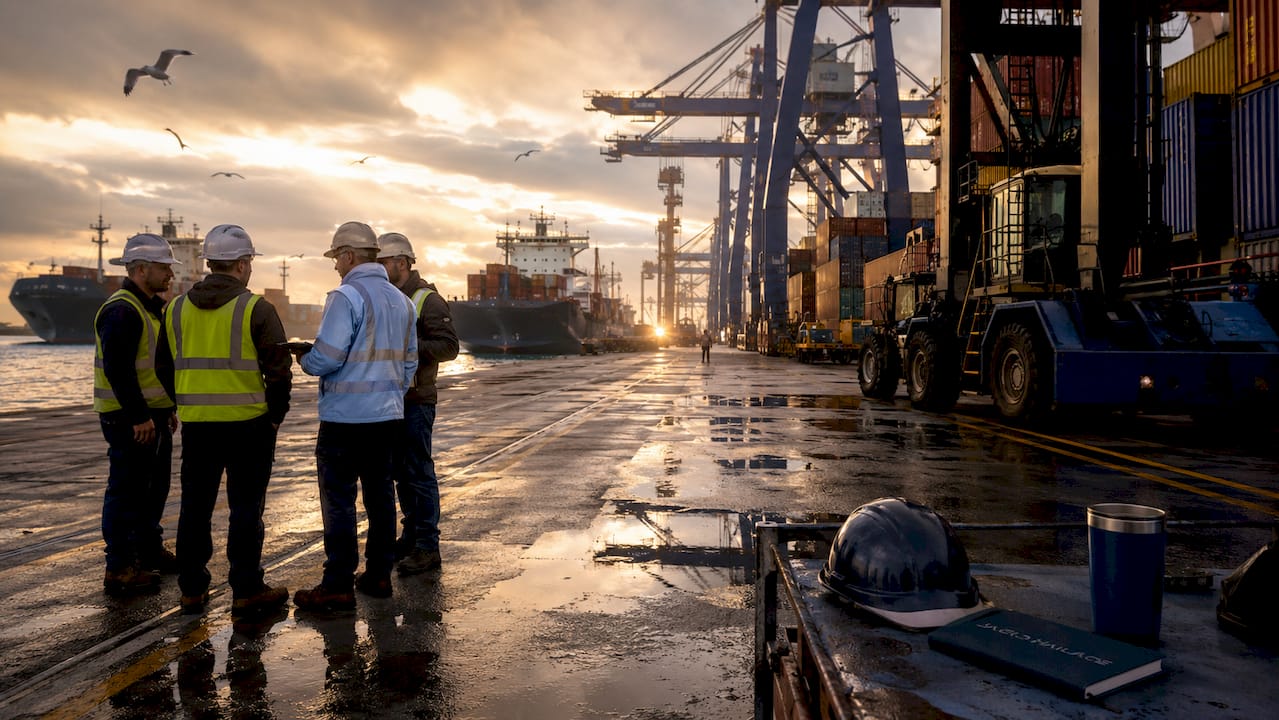
Inland throughput mismatches are equally significant. Ports often become congested not because berths are unavailable, but because the downstream logistics chain, including rail connections, trucking capacity, and warehousing, cannot absorb cargo quickly enough. When containers cannot leave the terminal, the yard fills up and incoming vessels have nowhere to discharge. The port effectively becomes a warehouse, which is the opposite of its function.
Geopolitical disruptions add a further layer of complexity. The post-Hormuz closure rerouting of cargo through alternative corridors sent volumes surging into ports that were not designed to handle them. Singapore’s import dwell time rose from 2.9 days to 9.2 days, a 218% increase from pre-conflict baselines. That kind of dwell time increase cascades directly into missed collection windows and extended detention periods for hauliers.
The remaining causes include:
- Labour constraints and equipment failures at terminals, which slow crane cycles and gate throughput
- Documentation errors, including incorrect HS codes or missing signatures, which trigger customs holds and extend port dwell unnecessarily
- Vehicle Booking System (VBS) slot mismatches, where haulage operators cannot secure collection appointments aligned with vessel discharge
Pro Tip: Pre-clear customs documentation at least 48 hours before vessel arrival. Documentation errors are the single most preventable cause of port delays, and a customs hold during peak congestion can add days to an already extended dwell time.
How does port congestion quantitatively impact shipping rates and logistics costs?
The financial consequences of port congestion are direct and measurable. When fleet capacity is trapped in queues, effective supply falls while demand remains constant, pushing spot freight rates upward. The 11% of global container capacity currently sitting in port queues functions as a market tightener, producing rate pressure equivalent to a significant reduction in vessel supply.
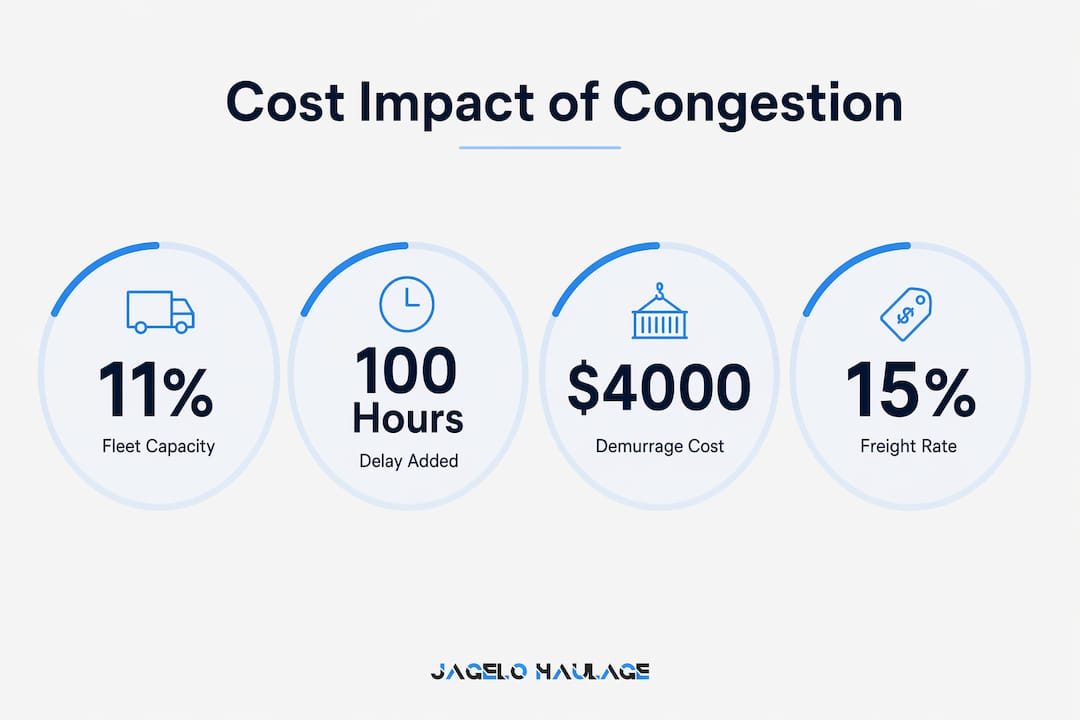
The inflationary effect extends beyond freight rates. Research published by the IMF shows that each 100-hour delay adds approximately 0.5 percentage points to consumer price inflation at peak. That figure illustrates how port-level delays translate into macroeconomic pressure, affecting the cost of goods across entire economies, not just the logistics budgets of individual operators.
For logistics professionals, the most immediate financial exposure comes from demurrage and detention charges. Demurrage is the fee levied by the shipping line when a container remains at the terminal beyond the agreed free time. Detention applies when the container leaves the port but is not returned to the carrier within the permitted period. Both charges accumulate daily, and during periods of heavy congestion, free time periods are consumed before a haulier can even secure a VBS slot.
| Cost category | Baseline conditions | Congested port conditions |
|---|---|---|
| Average port dwell time | 2–3 days | 7–10 days or more |
| Demurrage exposure | Minimal or nil | Significant daily accrual |
| Spot freight rates | Stable | Elevated due to capacity reduction |
| Consumer price inflation | Baseline | +0.5 points per 100-hour delay |
| Inland transport scheduling | Predictable | Disrupted by uncertain discharge windows |
Pro Tip: Negotiate extended demurrage free time with your shipping line before vessels arrive at congested ports. Proactive free time negotiation can save thousands in fees during high-congestion periods, particularly when discharge windows are unpredictable. For a detailed framework on managing these charges, the demurrage avoidance guide from Jhaulage covers UK port-specific tactics in depth.
What structural shifts make port congestion a persistent risk?
The most important reframe for logistics planners in 2026 is this: port congestion is no longer an exceptional disruption. It is a structural operating condition that must be built into standard planning assumptions. Treating each congestion event as an anomaly leads to reactive decision-making and avoidable cost exposure.
Research on congestion hysteresis shows that busy ports recover slowly from disruptions. Once a port accumulates a backlog, the recovery period extends well beyond the original disruption window. A single week of vessel bunching can produce three to four weeks of elevated dwell times as the system works through the backlog. This slow recovery dynamic means that even after the triggering event resolves, logistics delays continue to compound.
Several structural factors reinforce this persistence:
- Inland capacity ceilings: Rail and road haulage networks serving major ports have finite capacity. When port volumes surge, inland throughput cannot scale quickly enough to clear the backlog.
- Secondary port routing: Operators increasingly divert cargo through less-utilised ports to avoid congested primary hubs. This spreads volume but also introduces new scheduling complexity and longer inland transport legs.
- Mega-vessel concentration: The continued deployment of ultra-large container vessels concentrates cargo into fewer, larger calls, amplifying the impact of any single vessel delay on terminal operations.
- Warehousing constraints: Limited storage capacity near major ports means containers dwell on terminal rather than moving to off-dock storage, compounding yard congestion.
The practical implication is clear. Buffer times must be built into standard shipping schedules as a matter of course, not added reactively when a delay is already confirmed. Supply chain managers who treat a five-day port dwell as the norm rather than the exception will consistently outperform those who plan for two days and absorb the difference as cost. For a broader view of how port logistics management frameworks are adapting to this reality, Jhaulage’s strategic guide provides a useful reference point.
What practical strategies can logistics professionals use to manage congestion?
Managing the effects of port congestion requires a combination of pre-emptive planning, documentation discipline, and real-time coordination across the supply chain. The following steps represent the most effective operational responses available to logistics professionals today.
-
Diversify port and carrier selection. Relying on a single port of entry creates a single point of failure. Spreading volume across multiple UK ports, such as Felixstowe, Tilbury, Southampton, and Liverpool, reduces exposure to localised congestion events. Carrier diversification applies the same logic to vessel scheduling.
-
Achieve flawless documentation accuracy. Incorrect HS codes, missing signatures, and incomplete commercial invoices trigger customs holds that extend port dwell independently of vessel-related delays. A documentation audit process before each shipment eliminates the most preventable source of delay.
-
Synchronise real-time data across all chain parties. Synchronising vessel delay information with customs brokers, warehousing operators, and inland hauliers prevents cascading delays. When a vessel is confirmed late, every downstream party must adjust simultaneously. Failure to synchronise produces a bullwhip effect where each link in the chain absorbs and amplifies the original delay.
-
Negotiate demurrage free time proactively. Before a vessel arrives at a congested port, contact the shipping line to extend the free time allowance. This is a standard commercial negotiation, and most lines will accommodate the request when congestion is documented and the approach is made in advance.
-
Adjust warehousing and haulage schedules dynamically. Static collection schedules built around estimated time of arrival become liabilities during congestion. Haulage operators with flexible scheduling and GPS-tracked fleets can respond to discharge window changes without losing VBS slots or incurring unnecessary waiting time charges.
Pro Tip: Use port community system data and carrier tracking portals to monitor vessel positions at least 72 hours before arrival. Early visibility gives you time to rebook VBS slots, alert your warehouse, and notify customs before the delay becomes a crisis. For a comprehensive view of shipping cost reduction approaches that complement these operational steps, the broader e-commerce logistics context is worth reviewing.
The UK port logistics best practices guide from Jhaulage expands on several of these points with port-specific detail for Felixstowe and Southampton operations.
Key takeaways
Port congestion is now a structural operating condition, not a periodic disruption, and logistics professionals who plan accordingly will consistently reduce cost exposure and protect delivery performance.
| Point | Details |
|---|---|
| Fleet capacity loss | 11% of global container capacity is trapped in port queues, tightening supply and raising freight rates. |
| Inflationary cost link | Each 100-hour port delay adds approximately 0.5 percentage points to consumer price inflation. |
| Demurrage risk | Congestion consumes free time before collection is possible; proactive negotiation is the primary defence. |
| Structural persistence | Congestion hysteresis means ports recover slowly, so buffer times must be built into standard schedules. |
| Synchronisation imperative | Real-time coordination across customs, warehousing, and haulage is the most effective way to prevent cascading delays. |
Port congestion as the new normal: a professional perspective
Port congestion has been part of logistics for as long as container shipping has existed. What has changed is the frequency and the baseline. When I look at how supply chains were planned five years ago, the assumption was that congestion was the exception and smooth port operations were the rule. That assumption no longer holds, and planners who have not updated it are consistently absorbing costs that their competitors are avoiding.
The most underrated shift is in timing expectations. Logistics managers who build realistic buffer times into their schedules, rather than optimistic ones, are not being pessimistic. They are being accurate. A five-day dwell at Felixstowe or Tilbury is not a failure. It is the current operating reality, and quoting customers on that basis protects margins and relationships simultaneously.
Collaboration across the logistics ecosystem matters more than any single technology or tool. When a vessel is delayed, the haulier, the customs broker, the warehouse, and the importer all need to know at the same moment. The operations that handle congestion best are the ones where that communication happens automatically, not after someone notices a problem on a spreadsheet.
The competitive advantage in this environment belongs to operators who treat congestion as a planning input rather than a disruption to be managed after the fact. Flexible routing, pre-negotiated free time, and GPS-tracked haulage fleets are not premium features. They are baseline requirements for reliable port-to-door delivery in 2026.
— Vytautas
How Jhaulage supports container haulage through UK port congestion
Port congestion at Felixstowe, Tilbury, Southampton, and Liverpool creates real pressure on collection windows, demurrage exposure, and delivery timelines. Jhaulage operates a fleet of over 40 GPS-tracked trucks and trailers, giving you real-time visibility on every container movement from port gate to final destination.
When discharge windows shift and VBS slots need rebooking, Jhaulage’s 24/7 operational support means your cargo keeps moving without unnecessary dwell time accumulating. Whether you need same-day collection, full container load transport, or scheduled port-to-door delivery across the UK, Jhaulage’s container haulage services are built to absorb the unpredictability that congestion introduces. Speak to the team about tailored haulage planning for your port operations.
FAQ
What is port congestion and why does it affect logistics?
Port congestion is the build-up of vessels waiting to berth, combined with slow cargo throughput at terminals. It reduces effective shipping capacity, extends delivery timelines, and increases demurrage and freight costs across the supply chain.
How much of the global container fleet is currently affected by congestion?
As of july 2026, 3.7 million TEU, representing 11% of the global container fleet, is trapped in port queues. This capacity loss tightens market supply and drives spot freight rates upward.
How does port congestion increase shipping costs?
Congestion raises costs through three channels: elevated spot freight rates caused by reduced fleet capacity, demurrage and detention fees from extended port dwell, and the inflationary effect of delays, where each 100-hour delay adds approximately 0.5 percentage points to consumer price inflation.
What is the most preventable cause of port delays?
Documentation errors, including incorrect HS codes and missing signatures, are the most preventable cause of port delays. Correcting these before vessel arrival eliminates customs holds that compound congestion-related dwell time.
How can logistics professionals reduce the impact of port congestion?
The most effective approach combines proactive demurrage free time negotiation, flawless documentation, real-time synchronisation across all chain parties, and flexible haulage scheduling aligned to actual discharge windows rather than estimated arrival times.
Recommended
- Port to Warehouse Transport: A Strategic Guide to UK Container Logistics in 2026 | Jagelo Haulage
- Efficient Port Logistics: Strategic Trends and Operational Excellence in 2026 | Jagelo Haulage
- UK port logistics best practices: 2026 guide | Jagelo Haulage
- Scheduled Container Deliveries: A Strategic Guide to UK Port Logistics in 2026 | Jagelo Haulage