How haulage booking affects warehouse efficiency

Haulage booking is defined as the process of scheduling transport arrivals and departures in direct coordination with warehouse dock capacity, labour availability, and inventory flow. Understanding how haulage booking affects warehouse operations is the single most important factor in preventing dock congestion, idle labour, and inventory shortfalls. When transport schedules and warehouse resources are not synchronised, the consequences ripple across every function: receiving, putaway, despatch, and supply chain efficiency as a whole. The industry standard term for this discipline is dock scheduling, and it sits at the intersection of transport management and warehouse management systems (WMS).
How haulage booking affects warehouse coordination and admin workload
The most immediate impact of haulage booking on warehouse operations is the reduction of administrative labour. Self-service carrier portals reduce scheduling-related administrative labour by 70–80%, shifting warehouse staff from manual booking tasks to exception management. That figure represents a fundamental change in how warehouse coordinators spend their working day.
Manual booking methods rely on phone calls, emails, and spreadsheets. Each method introduces the risk of double-bookings, missed confirmations, and scheduling errors that cascade into dock congestion. Digital portals eliminate these failure points by giving carriers direct access to available slots, with the warehouse retaining full visibility of confirmed appointments.
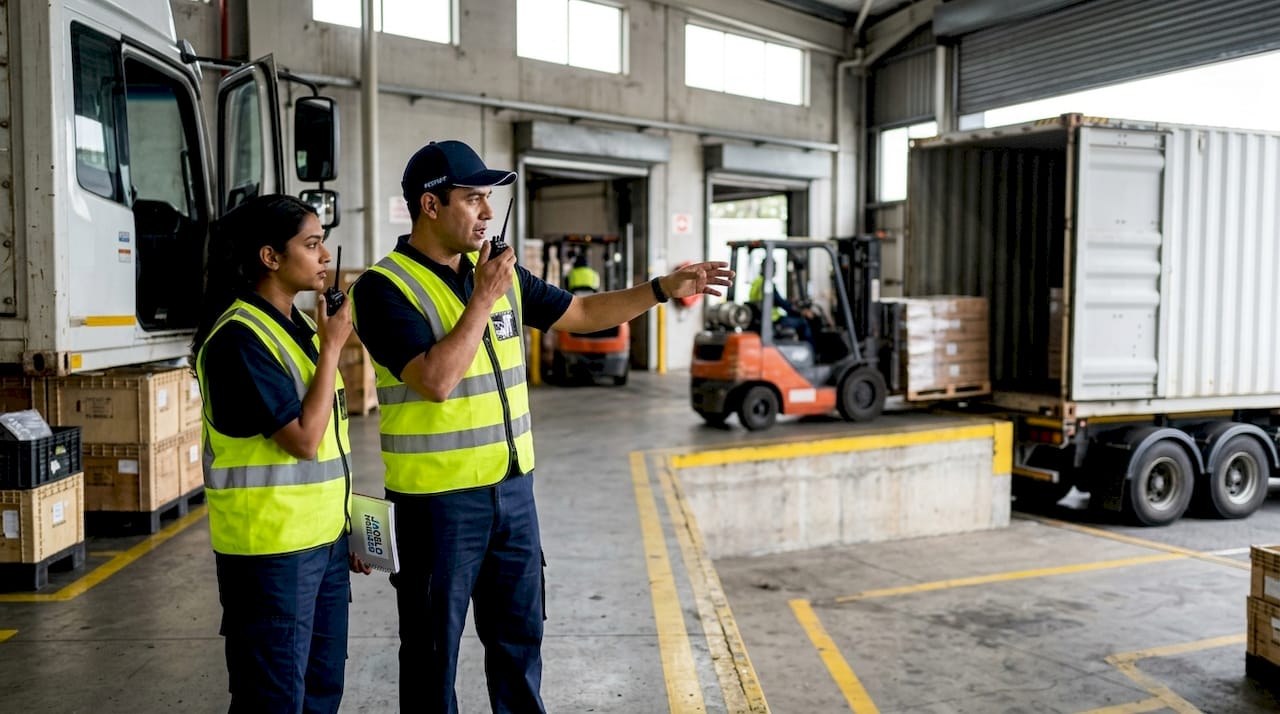
The coordination benefit extends beyond the warehouse office. When carriers book their own slots through a structured portal, they commit to specific arrival windows. Warehouse teams can then pre-assign dock doors, forklift operators, and receiving staff to each confirmed booking. This pre-assignment is what converts a reactive operation into a predictable one.
Scheduling certainty and visibility increase significantly when 90% or more of bookings shift to self-service, eliminating the overhead of phone and email coordination. That visibility is the foundation of effective labour planning.
- Digital portals remove double-booking risk by displaying real-time slot availability to all carriers.
- Confirmed appointments allow pre-assignment of dock doors, forklifts, and staff before arrival.
- Exception management replaces manual booking as the primary task for warehouse coordinators.
- Carriers gain autonomy, reducing inbound communication volume to the warehouse team.
Pro Tip: Mandate that carriers complete all required fields, including purchase order (PO) number and load type, before a booking is confirmed. Incomplete bookings are the leading cause of arrival delays that appear unrelated to transport.
What happens to labour costs when haulage booking is unreliable?
Unreliable haulage booking is a direct cause of increased warehouse operational costs. Transport unpredictability forces reactive warehouse operations, lowering throughput and driving overtime costs higher. The mechanism is straightforward: when a truck arrives outside its booked window, the labour allocated to receive it is either idle or redeployed, and both outcomes cost money.
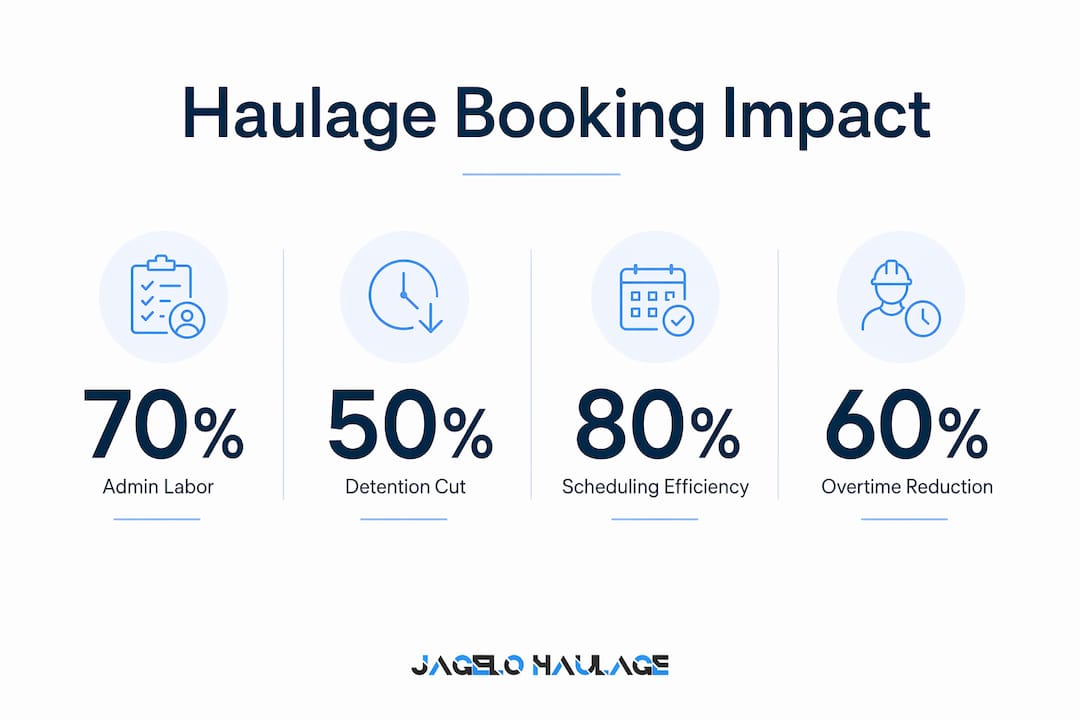
Idle labour is the most visible consequence. A receiving team assembled for a 09:00 arrival that does not appear until 13:00 represents four hours of unproductive wage cost. Multiply that across multiple dock doors and multiple shifts, and the financial impact becomes significant without a single line of overtime being recorded.
Missed receiving schedules create a secondary problem: inventory availability gaps. Warehouses operating just-in-time (JIT) replenishment models are particularly exposed. A delayed inbound shipment does not just affect the receiving dock. It affects production schedules, outbound fulfilment, and customer service levels simultaneously.
Dock congestion is the third consequence of unreliable booking. When multiple late arrivals cluster at the same time, dock doors become contested resources. Trucks queue in the yard, detention costs accumulate, and the warehouse loses control of its own throughput sequence.
- Idle labour from late arrivals generates direct wage cost without output.
- JIT inventory models break down when inbound transport schedules are inconsistent.
- Dock congestion from clustered late arrivals drives detention fees and throughput loss.
- Overtime becomes the default response to transport-driven scheduling failures.
Automated dock scheduling reduces detention events by 50% on average by synchronising warehouse readiness with confirmed carrier appointments. That reduction translates directly into lower demurrage exposure and more predictable dock utilisation.
What booking data fields are critical for warehouse capacity planning?
Effective dock scheduling requires more than a time slot. Essential booking fields include carrier name, Motor Carrier (MC) number, load type, piece count, and PO number. Each field serves a specific operational purpose, and missing any one of them degrades the quality of warehouse preparation.
The MC number identifies the carrier entity, enabling the warehouse to verify compliance history and flag carriers with poor arrival records. Load type determines which dock door is most appropriate, whether the shipment requires refrigerated handling, hazardous goods protocols, or standard receiving. Pallet count and piece count drive forklift and labour allocation decisions before the truck arrives.
Booking capacity means linking dock doors, forklift availability, and staff as interdependent constraints. A booking system that marks a slot unavailable when any one of those resources is already committed prevents overbooking at the operational level, not just the calendar level. This distinction matters enormously in high-throughput facilities.
The required booking fields for effective warehouse capacity planning are:
- Carrier name and MC number — identifies the transport entity and enables compliance verification.
- Load type — determines dock door assignment and any specialist handling requirements.
- Pallet count and piece count — drives forklift and labour pre-allocation decisions.
- PO number — links the inbound shipment to warehouse inventory records and receiving instructions.
- Estimated arrival time (ETA) — sets the labour deployment window and dock door pre-assignment.
Integration with a WMS allows these fields to trigger automatic labour allocation. When a booking is confirmed, the WMS can schedule the receiving team, reserve the dock door, and generate the putaway task sequence before the truck leaves the port. This is haulage capacity planning operating at its most effective.
Pro Tip: Enforce data accuracy at the point of booking, not at the point of arrival. Carrier compliance with load and pallet information prevents what practitioners call “phantom delays”: situations where the truck arrives on time but the warehouse is unprepared because the booking data was incomplete.
| Booking field | Warehouse function enabled |
|---|---|
| Carrier MC number | Compliance verification and carrier performance tracking |
| Load type | Dock door assignment and specialist handling preparation |
| Pallet and piece count | Forklift and labour pre-allocation |
| PO number | WMS inventory linkage and receiving task generation |
| ETA | Labour deployment scheduling and dock pre-assignment |
How does real-time technology improve haulage booking accuracy?
Static booking systems confirm a slot but cannot respond to what happens between booking and arrival. Real-time telematics integration changes this. Advanced warehouses integrate telematics to dynamically adjust dock schedules and labour allocations before trucks arrive, a practice known as predictive orchestration.
Predictive orchestration works by feeding live truck location and ETA data into the dock scheduling system. When a truck is running 45 minutes late, the system identifies the impact on the booked slot and triggers a reassignment. The dock door is released for another arrival, the labour team is redeployed, and the delayed truck receives a revised slot without requiring manual intervention from the warehouse coordinator.
“The precision required by increasing warehouse automation demands not just static bookings but adaptive, real-time capacity-driven haulage booking. Modern automated warehouses have less tolerance for late arrivals than their manual counterparts, making telematics integration a necessity rather than an option.”
Dynamic slot reassignment maintains dock utilisation even when transport schedules shift. Without it, a single delayed truck creates a cascade: the dock door sits idle, the labour team waits, and subsequent arrivals queue in the yard. With predictive orchestration, the system absorbs the disruption and redistributes resources automatically.
More precise haulage booking is critical for warehouse automation because automated systems have less tolerance for late arrivals than manual operations. A robotic goods-to-person system cannot improvise. It requires confirmed, accurate arrival data to sequence its picking and receiving workflows correctly.
The operational benefits of real-time telematics integration include:
- Live ETA updates trigger automatic dock door reassignment when delays occur.
- Labour teams receive revised deployment instructions before the truck arrives.
- Yard management systems adjust trailer spotting sequences based on live transport data.
- Dock utilisation rates improve because idle time from late arrivals is absorbed and redistributed.
Key takeaways
Haulage booking directly controls warehouse labour costs, dock utilisation, and inventory availability, making it a system design discipline rather than an administrative function.
| Point | Details |
|---|---|
| Admin labour reduction | Self-service portals cut scheduling admin labour by 70–80%, freeing coordinators for exception management. |
| Detention cost control | Automated dock scheduling reduces detention events by 50% by synchronising carrier arrivals with warehouse readiness. |
| Capacity-based booking | Linking dock doors, forklifts, and staff as constraints prevents overbooking and operational disruption. |
| Data accuracy at booking | Mandating carrier ID, load type, and pallet count at booking prevents phantom delays and unloading inefficiencies. |
| Predictive orchestration | Real-time telematics integration enables dynamic slot reassignment, maintaining dock utilisation despite transport delays. |
Why I treat haulage booking as a system design problem
Most warehouse managers I speak with treat dock scheduling as a clerical task. They assign it to a coordinator, give that person a spreadsheet or a basic calendar tool, and consider the problem solved. That approach works until it does not, and when it fails, it fails expensively.
The insight that changed how I think about this is simple: haulage booking is not about filling time slots. It is about synchronising three constrained resources simultaneously: dock doors, forklift capacity, and labour. When any one of those resources is overcommitted or idle, the entire receiving operation degrades. A booking system that only manages time slots is solving the wrong problem.
Carrier compliance enforcement is the hidden hurdle that most operations underestimate. Carriers who submit incomplete booking data are not being malicious. They are responding to a system that allows them to proceed without complete information. The fix is technical: make the booking portal reject incomplete submissions. Once you enforce data accuracy at the point of booking, phantom delays largely disappear.
Predictive orchestration is moving from a premium feature to a baseline expectation. As warehouse automation increases, the tolerance for late or inaccurate arrivals decreases. A facility running automated storage and retrieval systems cannot absorb a 90-minute arrival deviation the way a manual warehouse can. If your haulage provider cannot supply real-time ETA data, that gap will become a competitive liability faster than you expect.
— Vytautas
Jhaulage: container haulage built for warehouse precision
Warehouse managers who need reliable, time-critical container movements across UK ports rely on Jhaulage for exactly this reason. Jagelo Haulage Limited operates a fleet of over 40 GPS-tracked trucks and trailers, covering Felixstowe, Tilbury, Southampton, and Liverpool with 24/7 support and confirmed arrival windows that integrate directly with your receiving schedule.
Jhaulage’s container haulage services are built around the same capacity-based principles this article describes: confirmed bookings, accurate load data, and real-time tracking that gives your warehouse team the visibility to pre-assign dock doors and labour before the truck arrives. If reducing detention costs and idle labour is a priority for your operation, Jhaulage is the partner to speak with.
FAQ
What is dock scheduling in warehouse management?
Dock scheduling is the process of coordinating carrier arrival times with warehouse dock capacity, labour, and forklift availability. It is the operational term for what is commonly called haulage booking in a warehouse context.
How does haulage booking reduce warehouse overtime costs?
Reliable haulage booking prevents the idle labour and clustered late arrivals that force overtime. Facilities using automated dock scheduling report a 50% reduction in detention events, which directly reduces unplanned overtime expenditure.
What data fields should a carrier provide when booking a warehouse slot?
Carriers should provide their MC number, load type, pallet count, piece count, and PO number at the point of booking. Missing booking fields prevent efficient labour scheduling and cause delays that appear unrelated to transport.
What is predictive orchestration in haulage booking?
Predictive orchestration uses real-time truck telematics to adjust dock door assignments and labour deployment before a vehicle arrives. It prevents idle dock time by automatically reassigning resources when a carrier’s ETA changes.
How does haulage booking affect just-in-time inventory management?
Inconsistent haulage booking breaks JIT inventory models by creating gaps in inbound stock availability. Haulage booking reliability acts as the control mechanism that keeps inbound supply aligned with production and fulfilment schedules.