What is haulage capacity planning: a guide for logistics managers

Haulage capacity planning is defined as the process of aligning available transport resources with forecasted freight demand to maintain supply chain efficiency and control costs. For logistics managers and supply chain professionals, it is the discipline that separates reactive firefighting from disciplined, cost-controlled operations. Poor planning forces shipments onto the spot market, where rates run 20–50% higher than contracted prices during tight periods. Getting this right means knowing your fleet’s true availability, your lanes’ seasonal patterns, and your carriers’ positioning well before demand arrives.
What is haulage capacity planning and why does it matter?
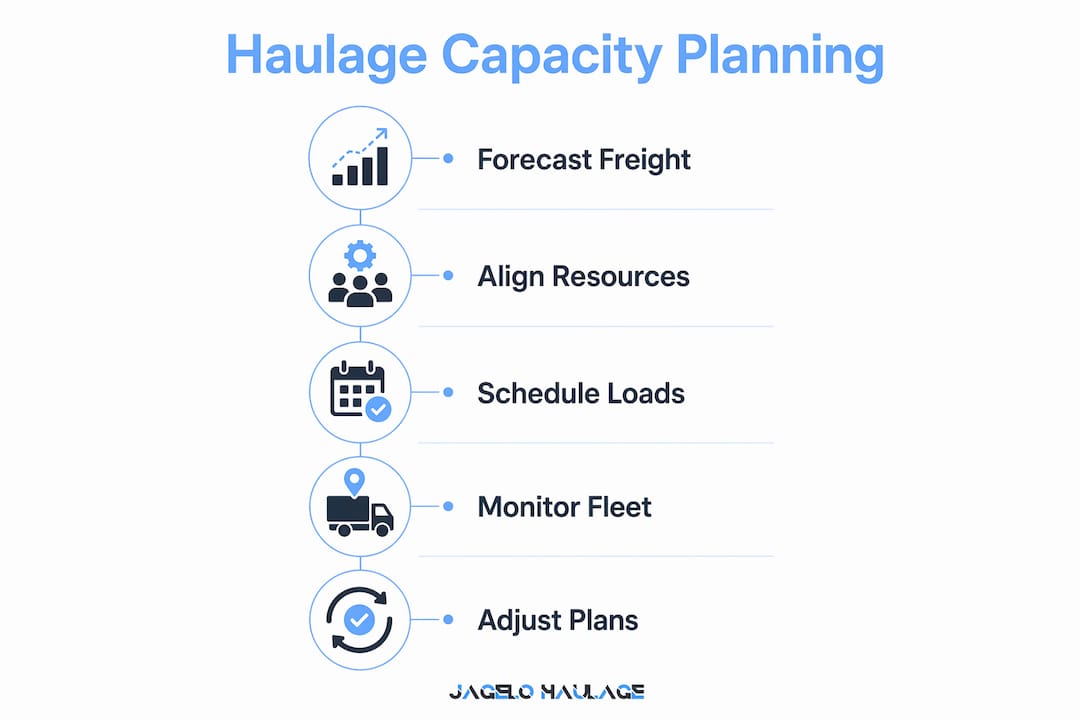
Haulage capacity planning is the structured method of forecasting freight volumes by lane and period, then matching those volumes to available vehicles, drivers, and carrier contracts. The industry term used across freight and logistics is capacity planning, and it applies equally to own-account fleets and third-party carrier networks. The goal is to prevent two equally damaging outcomes: under-capacity, which causes missed delivery windows and spot market reliance, and over-capacity, which wastes asset investment and inflates unit costs.
The importance of haulage capacity extends beyond cost. Service reliability, carrier relationships, and contract compliance all depend on it. A logistics manager who cannot confirm capacity 48 hours ahead of a collection window will face detention charges, demurrage fees at ports such as Felixstowe or Tilbury, and damaged shipper relationships. Capacity planning in logistics is therefore both a financial control and a service quality mechanism.

Proactive, data-driven planning transitions logistics operations from reactive firefighting to disciplined resource management. That shift produces measurable gains in cost and service performance.
How does haulage capacity planning optimise fleet utilisation?
Fleet utilisation is the clearest measure of whether capacity planning is working. Optimised load scheduling can improve fleet utilisation from 71% to 88%, recovering 17% of otherwise lost haulage capacity. That recovery translates directly into revenue from existing assets rather than additional capital expenditure.
Manual scheduling is the primary cause of underperformance. Manual scheduling consistently leaves 14%–22% of haulage capacity unused, highlighting the need for dispatch automation tools. Automation captures those idle resources by matching loads to vehicles based on real-time data rather than spreadsheet assumptions.
Modern dispatch tools consider three inputs simultaneously:
- Vehicle geographic positioning: the nearest available asset to the collection point, not simply the one with the largest payload
- Hours of service compliance: driver availability within legal limits, particularly relevant under UK drivers’ hours regulations
- Load compatibility: weight, dimensions, temperature requirements, and equipment type
Pro Tip: When selecting the most efficient haulage resource, prioritise network position over payload capacity. A vehicle 15 miles from the collection point with 80% load capacity will outperform a fully loaded vehicle 60 miles away on total cost and delivery reliability.
Reducing empty miles is a direct output of better utilisation planning. Every empty return leg represents a fixed cost with zero revenue contribution. Logistics capacity analysis that maps return lane opportunities against outbound commitments cuts empty mileage and improves the economics of each vehicle in the fleet.
What are common challenges and pitfalls in haulage capacity management?
The most damaging pitfall in haulage capacity management is a reactive planning mindset. Reactive planning damages tender acceptance rates and reduces capacity reliability, because carriers cannot position equipment ahead of demand spikes they were never told about. The result is a scramble for spot market capacity at precisely the moment when rates are highest.
Regional variability compounds the problem. Capacity availability varies regionally and asynchronously across lanes, meaning a logistics manager cannot treat capacity as a single uniform number across their network. A lane from Southampton to the Midlands may have surplus capacity in march while a lane from Liverpool to Scotland faces a shortage during the same week.
The financial consequences of poor planning are specific and measurable:
- Spot market premiums: rates 20–50% above contracted prices during tight capacity windows
- Detention charges: vehicles held beyond agreed free time at loading or unloading points
- Missed delivery windows: penalties under retailer or manufacturer supply agreements
- Demurrage fees: containers held at port beyond free days, particularly acute at Felixstowe and Tilbury
Cold chain logistics amplifies every one of these risks. Reefer trailer availability is structurally limited, and a delayed temperature-controlled shipment risks product spoilage and regulatory non-compliance, turning a capacity failure into a product write-off.
Understanding these pitfalls is the first step. The second step is building the data frameworks that prevent them.
Which data inputs and analytics frameworks underpin effective capacity planning?
Effective haulage capacity planning requires four categories of input data, each serving a different planning horizon.
| Data input | Planning horizon | Primary benefit |
|---|---|---|
| Historical shipment volumes by lane | Long-term (90+ days) | Identifies seasonal patterns and peak demand periods |
| Contract volumes and promotional calendars | Mid-term (30–90 days) | Aligns carrier commitments with confirmed freight demand |
| Real-time vehicle health and availability | Short-term (0–30 days) | Prevents unplanned downtime from disrupting confirmed loads |
| Driver hours and geographic positioning | Operational (0–7 days) | Maximises utilisation and compliance on live schedules |
Vehicle condition data is particularly underused. Building capacity models using actual vehicle condition data yields 30–50% more accurate forecasts than relying on vehicle age assumptions. Age-based assumptions retire assets prematurely and underestimate availability during peak periods.
Integrating predictive maintenance schedules into capacity planning converts unexpected breakdowns into manageable scheduled unavailability within a 90-day window. A vehicle flagged for a brake inspection in six weeks can be planned around. A vehicle that breaks down on collection day cannot. Jhaulage’s approach to fleet maintenance planning reflects this principle directly, integrating scheduled servicing into forward capacity commitments.
Multi-horizon planning is the framework that ties these inputs together. Short-term planning covers operational dispatch decisions. Mid-term planning covers carrier contract fulfilment and volume commitments. Long-term planning covers fleet investment, contract renewal, and network design. Each horizon requires different data and different decision-makers, but all three must connect to a single capacity model.
How does capacity planning improve cost management and service reliability?
The financial case for disciplined capacity planning centres on avoiding spot market exposure. When contracted capacity is insufficient, logistics managers pay a premium of 20–50% above contract rates for spot market haulage. Across a network handling hundreds of movements per month, that premium compounds into a material cost variance.
Tender acceptance rates improve when shippers provide accurate lead times and historical lane data to their carrier partners. Carriers who receive volume forecasts in advance can position equipment and drivers ahead of demand, rather than diverting resources to other customers. Early communication is therefore a direct lever on capacity availability and rate stability.
Service reliability gains are equally tangible. Fewer missed collection windows mean fewer retailer penalties and fewer port demurrage charges. For container haulage operations running through UK ports, a single missed booking at Felixstowe can trigger a cascade of rescheduling costs and extended port storage fees. Effective port logistics forecasting prevents that cascade before it starts.
Pro Tip: Maintain a capacity buffer of 10%–15% above your baseline forecast for peak trading periods such as pre-Christmas and post-Chinese New Year. This buffer costs less than a single week of spot market premiums and protects service commitments when demand spikes unexpectedly.
What practical steps and technology support haulage capacity planning?
Implementing effective capacity planning requires both process discipline and the right technology stack. The steps below reflect best practice for logistics managers running own-account or third-party carrier networks.
| Implementation step | Technology or method | Expected outcome |
|---|---|---|
| Build a diversified carrier network | Routing guide with primary, secondary, and spot carriers | Reduces single-carrier dependency and improves resilience |
| Deploy a Transport Management System (TMS) | TMS platforms with lane-level reporting | Centralises volume data and automates tender processes |
| Integrate predictive maintenance data | Fleet telematics and maintenance scheduling software | Converts unplanned downtime into scheduled availability gaps |
| Communicate forecasts to carriers | Structured volume forecast reports (weekly or monthly) | Improves tender acceptance and secures forward capacity |
| Monitor tender acceptance in real time | TMS dashboard or carrier portal | Identifies capacity gaps before they become operational failures |
A Transport Management System is the central tool for logistics capacity analysis. It consolidates historical lane data, live tender responses, and carrier performance metrics into a single view. Without a TMS, capacity planning relies on manual reconciliation across spreadsheets, email chains, and phone calls, which reintroduces the same errors that manual scheduling creates.
Carrier network diversification is equally critical. Diversifying your carrier base and maintaining a tiered routing guide ensures that when your primary carrier cannot accept a tender, a secondary carrier with pre-agreed rates and service standards is ready to step in. Relying on a single carrier for a high-volume lane is a structural capacity risk.
Pro Tip: Share your promotional calendar and seasonal volume forecasts with your top three carriers at least 60 days in advance. Carriers who plan around your peaks will offer better rates and higher acceptance than those responding to last-minute requests.
Efficient container delivery scheduling also depends on clear communication protocols with carriers, including confirmed booking windows, Vehicle Booking System (VBS) slot allocations at port, and agreed detention-free periods.
Key takeaways
Haulage capacity planning is the single most effective tool logistics managers have for controlling freight costs and maintaining service reliability across their supply chain.
| Point | Details |
|---|---|
| Define capacity by lane, not network | Treat each lane as a separate capacity unit with its own seasonal and regional variability. |
| Use vehicle condition data for forecasting | Actual vehicle health data produces 30–50% more accurate capacity forecasts than age-based assumptions. |
| Communicate forecasts to carriers early | Sharing volume forecasts 60+ days ahead improves tender acceptance and secures forward capacity. |
| Avoid spot market reliance | Spot market rates run 20–50% above contracted prices; proactive planning eliminates most spot exposure. |
| Integrate predictive maintenance | Scheduling planned downtime within a 90-day window prevents unplanned breakdowns from disrupting live operations. |
Why the shift from reactive to proactive planning defines 2026 logistics performance
The logistics managers I see struggling most in 2026 are not short of data. They are short of the discipline to act on it before a problem arrives. Reactive capacity management has a seductive logic: you respond to what is real, not what is forecast. The problem is that by the time the capacity shortage is real, the spot market premium is already locked in.
The most effective shift I have observed is treating capacity as a variable by lane and season, not as a single fleet number. A logistics manager who knows that their Liverpool to Glasgow lane tightens every october, and who has pre-positioned carrier commitments accordingly, will never pay spot rates on that lane. Their counterpart who discovers the tightness in week one of october will pay 30% more for the same movement.
Technology is accelerating this shift. Predictive maintenance integration, TMS-driven tender monitoring, and real-time vehicle positioning data are now accessible to mid-sized operators, not just enterprise shippers. The barrier is not cost. It is the willingness to build the process discipline around the tools. My recommendation: start with your three highest-volume lanes, build a 12-month historical volume model for each, and share that model with your primary carriers this quarter. The capacity reliability improvement will be visible within 90 days.
— Vytautas
Jhaulage: container haulage built around your capacity requirements
Jhaulage operates a fleet of over 40 GPS-tracked trucks and trailers across the UK’s major container ports, including Felixstowe, Tilbury, Southampton, and Liverpool. Every movement is planned against confirmed port slot allocations and customer delivery windows, which means your capacity commitments are backed by real asset availability rather than estimates. For logistics managers who need a container haulage specialist with the operational discipline to match your planning requirements, Jhaulage provides 24/7 support, same-day collection capability, and full container load services built for supply chain reliability.
FAQ
What is haulage capacity planning in simple terms?
Haulage capacity planning is the process of matching available vehicles, drivers, and carrier contracts to forecasted freight volumes by lane and time period. The goal is to prevent both under-capacity and over-capacity across your transport network.
How does poor capacity planning affect freight costs?
Poor planning forces shipments onto the spot market, where rates are 20–50% higher than contracted prices during tight capacity periods. Detention charges and demurrage fees at UK ports add further cost when collections and deliveries are missed.
What data do I need to plan haulage capacity effectively?
The four key inputs are historical shipment volumes by lane, contract volumes and promotional calendars, real-time vehicle health data, and driver hours availability. Combining these across short-term, mid-term, and long-term planning horizons produces the most accurate capacity forecasts.
Why does regional variability matter in capacity planning?
Capacity availability varies by lane and geography, not uniformly across a network. A lane that has surplus capacity in one region may face a shortage in another during the same period, making lane-level analysis essential for accurate planning.
How can predictive maintenance improve capacity planning?
Integrating predictive maintenance schedules converts unexpected breakdowns into planned unavailability within a 90-day window. This allows logistics managers to schedule around maintenance periods rather than absorbing unplanned downtime during live operations.