How haulage supports business growth in 2026

Most businesses treat haulage as a line item to be minimised rather than a capability to be invested in. That framing is costing them. Understanding how haulage supports business growth requires a shift in perspective: from viewing freight movement as an unavoidable overhead to recognising it as a direct contributor to delivery performance, cash flow, risk management, and scalable operations. The global logistics market is projected to grow at 7.2% CAGR to 2033, driven by real-time visibility demands and last-mile fulfilment expectations. The businesses positioned to capitalise on that growth are those already treating their haulage strategy as a competitive asset.
Table of Contents
- Key takeaways
- How haulage supports business growth through operational efficiency
- Risk management and compliance through specialist haulage
- Cash flow acceleration through smarter haulage scheduling
- Strategic haulage for scaling and sustainable growth
- My perspective: haulage is the most underestimated growth lever
- How Jhaulage supports your growth strategy
- FAQ
Key takeaways
| Point | Details |
|---|---|
| Haulage cuts operational costs | Optimised logistics can reduce operational costs by up to 15% while improving delivery performance by 20 to 30%. |
| Compliance risk sits with your provider | Specialist haulage partners absorb regulatory liability, protecting your business from fines and operational interruptions. |
| Reliable deliveries accelerate cash flow | On-time deliveries activate billing cycles predictably, reducing payment lag and freeing capital for reinvestment. |
| Outsourcing converts fixed costs to variable | Partnering with a haulage specialist removes fleet capital expenditure and allows capacity to scale with demand. |
| Haulage is a long-term growth lever | Businesses that integrate haulage into their growth strategy gain supply chain responsiveness and measurable margin protection. |
How haulage supports business growth through operational efficiency
The most immediate financial benefit of optimised haulage is cost reduction at the operational level. Prioritising logistics can reduce operational costs by 15% while improving delivery performance by 20 to 30%. Those are not marginal gains. For a business moving significant freight volumes across UK ports such as Felixstowe, Tilbury, or Southampton, a 15% cost reduction translates directly into recoverable margin.
Strategic route planning, combined with specialist equipment matched to the cargo type, removes much of the inefficiency that plagues unplanned freight movement. When a haulage provider uses a Vehicle Booking System (VBS) to schedule port collections precisely, detention costs and demurrage charges are minimised. These fees, which accumulate when containers sit at port beyond their free period, can run to hundreds of pounds per day and represent pure financial loss with no operational upside.
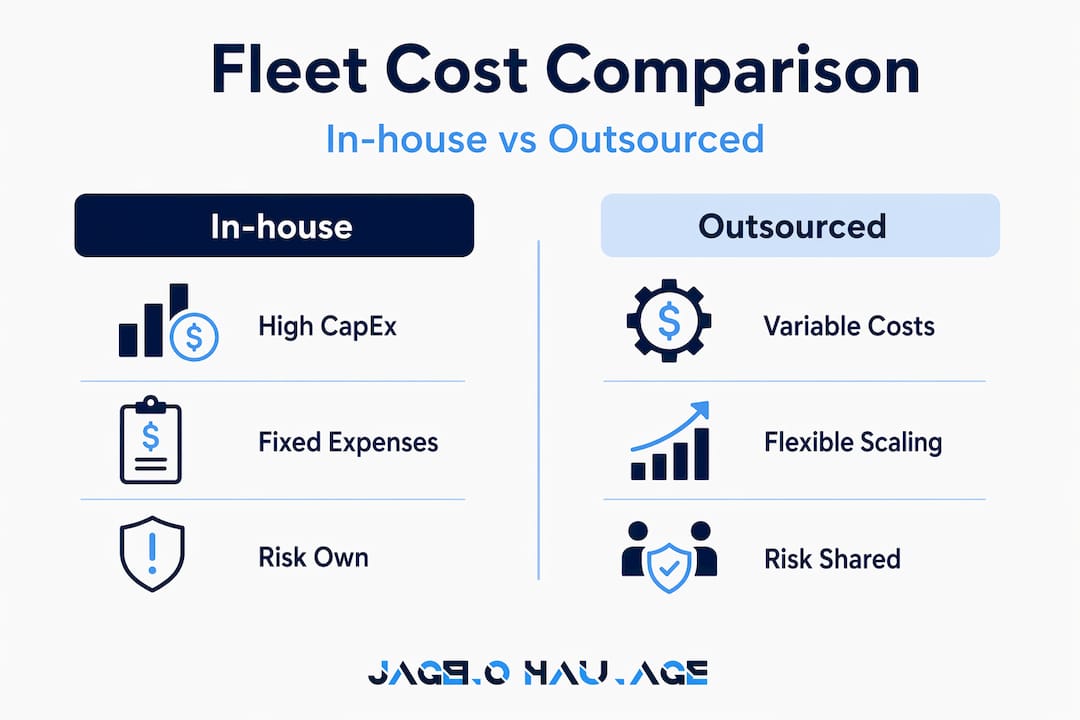
The cost comparison between maintaining an in-house fleet versus outsourcing to a specialist provider is also worth examining carefully.
| Cost factor | In-house fleet | Outsourced haulage |
|---|---|---|
| Capital expenditure | High (vehicle purchase or finance) | None |
| Maintenance and compliance | Fixed, regardless of utilisation | Absorbed by provider |
| Scaling with demand | Slow and capital-intensive | Adjustable per contract period |
| Driver recruitment and retention | Ongoing operational burden | Managed by provider |
| GPS and technology infrastructure | Additional capital investment | Included in service |
Outsourcing converts fixed capital costs into variable expenses, which is particularly valuable for businesses experiencing seasonal peaks or project-driven freight volumes. Rather than carrying the overhead of a fleet during low-demand periods, you pay for capacity when you need it and release that obligation when you do not.
The role of data and technology in haulage efficiency has grown considerably. GPS-tracked fleets provide real-time cargo visibility, allowing operations managers to anticipate delays, communicate accurately with customers, and reduce the administrative burden of exception handling. When you can see precisely where your container is between Liverpool docks and your distribution centre, you are not managing by assumption. You are managing by fact.

Pro Tip: When evaluating haulage providers, request specific data on their average port turnaround times and detention cost incidence rates. Providers who track and disclose these figures operate with a level of transparency that directly benefits your cost base.
Risk management and compliance through specialist haulage
Regulatory compliance in UK haulage is not a simple matter of holding an operator’s licence. It spans driver hours regulations under Working Time Directive rules, vehicle maintenance standards enforced by the Driver and Vehicle Standards Agency (DVSA), permit requirements for abnormal loads, and port security protocols that vary by terminal. Getting any of these wrong carries financial penalties, delayed shipments, and in serious cases, the suspension of operating licences.
Specialist haulage providers mitigate financial exposure from regulatory violations by absorbing the compliance function entirely. When you outsource container haulage to an experienced provider, you transfer a significant portion of your regulatory liability. Their operators manage permit applications, maintain vehicle roadworthiness records, and ensure driver compliance with tachograph regulations. Your exposure is reduced to contract management rather than operational compliance across a fleet.
The practical benefits of this risk transfer include:
- Reduced exposure to DVSA enforcement action, which can result in prohibition notices and immediate operational disruption.
- Permit and routing expertise for oversized or heavy consignments that require advance notice to local authorities and Highways England.
- Insurance and liability structures that place responsibility appropriately with the party best equipped to manage it.
- Continuity planning from providers who maintain reserve driver capacity and backup vehicles, protecting your supply chain from single points of failure.
“Logistics evolved from back-office utility to strategic pillar; ignoring it risks stagnation, investing unlocks growth.”
For businesses operating in sectors with tight delivery windows, such as manufacturing, retail distribution, or construction, the cost of a compliance-related interruption goes beyond the fine itself. A halted delivery that delays a production line or a retail planogram reset carries its own multiplied cost. Specialist haulage partnerships insulate your operations from that exposure.
Pro Tip: Ask potential haulage partners for their DVSA compliance rating and the date of their most recent operator compliance risk score (OCRS) assessment. A provider with a green OCRS rating has demonstrated consistent regulatory adherence, which is the profile you want managing your freight.
You can explore how outsourced haulage myths around risk and liability are often overstated, as the reality is that specialist providers carry obligations that most businesses are poorly equipped to manage internally.
Cash flow acceleration through smarter haulage scheduling
Haulage and cash flow are more closely connected than most finance directors appreciate. Delays in haulage affect entire project schedules, and in project-driven sectors, a delayed delivery is a delayed invoice. When your billing cycle is contingent on goods arriving on time, unreliable haulage functions as an indirect constraint on your cash position.
The mechanism works as follows:
- A reliable haulage partner delivers goods or materials on schedule, meeting the milestone that triggers your invoice to the end customer.
- Your invoice is raised on time, initiating the payment term clock (typically 30 to 60 days net).
- Cash arrives within the agreed payment window, giving your finance team a predictable receivables position.
- That predictability allows you to plan reinvestment, supplier payments, and payroll with confidence rather than working around freight-induced uncertainty.
The contrast with unreliable haulage is stark. A delivery delayed by 48 to 72 hours due to poor scheduling or port access failures can push an invoice into the following month’s payment run, creating a cash gap that businesses routinely fill with short-term credit at cost.
Financial strategies within the haulage sector itself illustrate this dynamic clearly. Freight factoring reduces payment lag by enabling faster cash receipt against outstanding invoices. For haulage businesses managing their own working capital, factoring is a recognised tool. For the businesses they serve, the equivalent benefit comes from choosing providers whose scheduling reliability eliminates the need for that kind of financial buffer in the first place.
A concrete example of financing unlocking haulage-led growth comes from a UK logistics operator that used £4.5 million in funding to reduce monthly repayments by approximately £23,000, directly improving cash flow available for operational expansion. That figure demonstrates how financial structuring within a haulage business translates into capacity and service improvements that benefit downstream customers.
Strategic haulage for scaling and sustainable growth
Beyond operational efficiency and cash flow, the role of freight in scaling business lies in its capacity to enable expansion without proportional increases in overhead. Growth typically demands more of everything: more capacity, more routes, more compliance management, more equipment. Handled internally, each of those requirements carries capital expenditure and management overhead. Handled through a specialist haulage partner, they become contract specifications rather than balance sheet commitments.
Companies that prioritise logistics innovation unlock new revenue streams and customer loyalty through speed and reliability. A business that can consistently offer accurate delivery windows, real-time shipment tracking, and consistent port-to-door transit times has a measurable service proposition over competitors who cannot. That service quality is a direct output of haulage strategy, not marketing.
The benefits of integrating haulage into a long-term scaling plan include:
- Supply chain responsiveness: A haulage partner with multi-port coverage (Felixstowe, Tilbury, Southampton, Liverpool) can adapt routing when a specific terminal experiences congestion or industrial action, keeping your supply chain moving.
- Capacity flexibility: Rather than owning 20 trucks for peak periods and running 12 at a loss during quieter months, you contract for the capacity you need.
- EBITDA and valuation impact: Effective haulage improves company valuations through predictable margins and scalable operations, which is a consideration that matters to any business planning an exit, a fundraise, or a merger.
- Operational management focus: When freight movement is handled by specialists, your internal team focuses on commercial growth activities rather than logistics problem-solving.
For businesses with container-dependent supply chains, the importance of supply chain management at the port interface is particularly acute. A haulage partner with established Vehicle Booking System access, strong working relationships at major terminals, and a GPS-tracked fleet covering the principal UK container ports is not merely a service provider. They are a structural component of your growth capability.
You can read Jhaulage’s detailed analysis of cost-effective container haulage to understand how specific operational decisions translate into measurable financial outcomes for UK logistics managers.
My perspective: haulage is the most underestimated growth lever
I have worked with businesses across manufacturing, retail, and infrastructure that consistently underinvest in their haulage strategy while over-investing in sales and marketing. The logic is understandable: freight feels like an input cost, not a growth driver. But I have seen the opposite proven too many times to accept that framing.
In my experience, the businesses that grow predictably are those where the supply chain operates with the same discipline as the sales function. When I look at operators who have achieved a 17.8% increase in revenue and operating profit, the underlying story is almost always a combination of operational precision and strategic freight capacity. They did not grow despite their haulage function. They grew because of it.
What I find most overlooked is the compounding effect. A business that eliminates demurrage, reduces compliance exposure, and makes its billing cycles predictable is not just saving money on three separate line items. It is creating a more agile, more fundable, and more scalable operating model. The sustainability dimension of haulage is also becoming a growth factor as procurement teams weight environmental credentials in supplier selection.
My advice is direct: treat your haulage partnership the way you treat your banking relationship. Choose for capability and alignment with your growth plans, not just for the lowest rate on today’s collection.
— Vytautas
How Jhaulage supports your growth strategy
If the case for treating haulage as a growth function resonates, the next question is practical: which provider can actually deliver on that promise?
Jhaulage operates a modern fleet of over 40 GPS-tracked trucks and trailers, with 24/7 support and dedicated coverage across Felixstowe, Tilbury, Southampton, and Liverpool. Its specialisation in container haulage across UK ports means businesses gain a partner who understands merchant haulage, demurrage management, VBS scheduling, and full container load (FCL) logistics at an operational level. Whether you need same-day collections, port-to-door delivery, or a scalable freight solution that grows with your volumes, Jhaulage provides the reliability and transparency that turns haulage from a cost function into a competitive advantage.
FAQ
How does haulage reduce operational costs?
Optimised haulage reduces costs by eliminating demurrage and detention charges through precise scheduling, converting fixed fleet costs into variable outsourced expenses, and using route planning technology to reduce mileage and fuel consumption. Research shows this approach can cut operational costs by up to 15%.
What compliance risks does a specialist haulage partner manage?
A specialist provider manages driver hours compliance, DVSA vehicle standards, abnormal load permits, and port security protocols. By absorbing these obligations, they protect your business from regulatory fines, prohibition notices, and the operational disruption that compliance failures cause.
How does reliable haulage improve business cash flow?
Reliable, on-time deliveries trigger invoices on schedule, keeping payment cycles predictable and reducing the need for short-term credit to bridge cash gaps caused by freight delays. In project-driven businesses, this effect is particularly significant because delivery milestones directly activate billing rights.
Why is outsourcing haulage better for scaling a business?
Outsourcing removes the capital expenditure of fleet ownership and replaces fixed overhead with variable, demand-responsive costs. This means a growing business can increase freight capacity without a corresponding increase in assets, headcount, or compliance obligations on its own balance sheet.
How do I choose a haulage partner aligned with my growth plans?
Prioritise providers with multi-port coverage, transparent compliance records (including a green OCRS rating), GPS-tracked fleets, and proven turnaround times at the UK container ports your supply chain relies on. A provider who can demonstrate data on detention cost rates and port dwell times is operating with the transparency that serious growth planning requires.