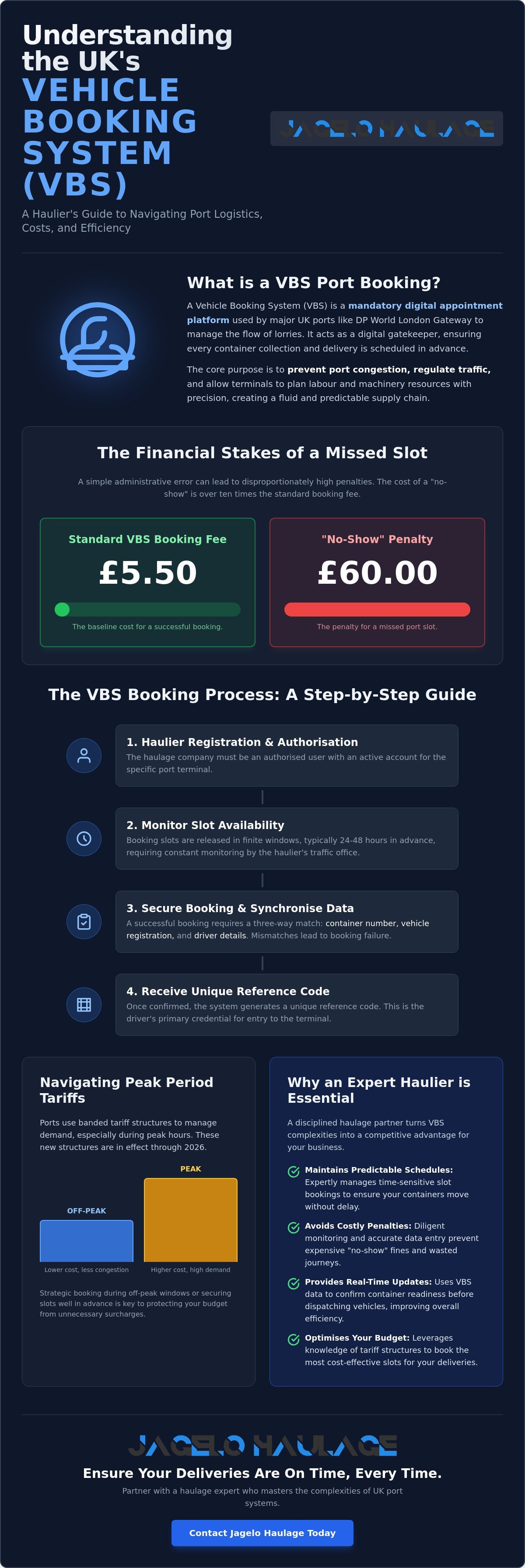
A missed port slot at the London Container Terminal can cost you £60.00 in "no-show" penalties, which is over ten times the standard £5.50 booking fee. For many transport managers, the fundamental question remains: what is a VBS port booking and why does it carry such heavy financial consequences? These systems are mandatory for all container collections and deliveries at major UK hubs like DP World London Gateway. They exist to manage traffic flow and ensure terminal efficiency; however, they often become a source of unpredictable delays and hidden costs for those who don't monitor the latest tariff changes.
You likely understand that coordinating multiple port systems is a complex task that can easily disrupt your supply chain. This article explains how the Vehicle Booking System (VBS) regulates UK port access and how professional management ensures your container deliveries remain on schedule. We'll examine the new banded tariff structures in effect through 2026, the cost benefits of off-peak bookings, and how a reliable haulage partnership provides predictable delivery timelines.
Key Takeaways
- Understand what is a VBS port booking and how this mandatory digital platform regulates every container movement across the UK's major port terminals.
- Gain insight into the registration and slot allocation process to ensure your container deliveries are organised within the most efficient operational windows.
- Learn how ports utilise banded tariff structures during peak periods and how strategic booking can protect your budget from unnecessary surcharges.
- Discover why a disciplined haulage partner is essential for navigating the complexities of port systems and maintaining predictable delivery schedules.
Defining the Vehicle Booking System (VBS) in UK Port Logistics
A Vehicle Booking System (VBS) is the primary digital interface used by major UK ports to regulate the flow of Heavy Goods Vehicles (HGVs). When businesses ask what is a VBS port booking, they're essentially enquiring about the mandatory appointment system required for every container collection or delivery at a terminal. This digital platform acts as a gatekeeper. It ensures that the transition between sea and road within the broader intermodal freight transport network remains fluid and disciplined. Professional hauliers use these systems to synchronise vehicle arrivals with vessel discharge schedules, which prevents wasted journeys and operational downtime.
The introduction of these systems was a direct response to the industrial need for better traffic management. Before VBS became standard, port gates often faced significant congestion, leading to long idling times for drivers and unpredictable delays for merchants. By requiring a pre-booked slot, ports can eliminate these bottlenecks. This creates a more secure and predictable environment for container haulage operations. The system serves as a contract of intent between the terminal and the haulier, ensuring that resources are ready when the vehicle arrives.
The Core Purpose of Port Booking Systems
The primary objective of a VBS is to regulate traffic volume at terminal gates and on the surrounding road infrastructure. By spreading vehicle arrivals across a 24-hour cycle, the system prevents the dangerous tailbacks that once plagued major UK port centres. It provides real-time data on container availability, allowing haulage contractors to verify that a box is ready for collection before dispatching a vehicle. This level of transparency improves operational efficiency for both the port authority and the transport provider. Understanding what is a VBS port booking helps merchants appreciate why their hauliers require specific lead times to secure the most efficient slots.
Why VBS is Mandatory at Major UK Terminals
VBS is mandatory because it allows terminals to plan their resources with precision. Port authorities use booking data to allocate labour and heavy machinery based on the expected volume of HGVs each hour. This disciplined approach maintains a steady rhythm in the national supply chain. It also enhances on-site safety by strictly controlling the number of vehicles permitted in the terminal at any given time. Without these mandatory slots, the sheer volume of UK container traffic would result in constant logistical friction and increased operational costs for all parties involved.
How the VBS Booking Process Operates for Container Haulage
The process of securing terminal access is a highly structured administrative task. It requires the haulier to be an authorised user with an active account at the specific port. Understanding exactly what is a VBS port booking requires a look at the administrative steps that link a container number to a specific vehicle registration and driver. Without this three-way synchronisation, the terminal will refuse entry at the gate. Successful bookings generate a unique reference code, which serves as the driver's primary credential for entry; it proves that the vehicle is expected and that the terminal has the capacity to handle the move.
Booking slots are released in finite windows, typically 24 to 48 hours before the vehicle's arrival. This short lead time requires haulage traffic offices to monitor systems constantly, especially during peak vessel arrivals. When businesses ask what is a VBS port booking in a practical sense, they're looking at a time-sensitive contract of intent between the terminal and the transport provider. If the data provided doesn't match the port's records, the booking will fail, potentially delaying the entire delivery schedule.
Securing a Time Slot
Availability is often the greatest challenge in the booking process. Hauliers must act quickly as slots are allocated in 30-minute or 1-hour windows depending on the specific terminal's policy. It's critical that the traffic office matches the VBS slot with the container's "Ready for Collection" status. If a vehicle arrives for a container that hasn't yet been cleared or discharged, the booking is wasted. By utilising resources such as London Container Terminal's VBS, hauliers can access real-time updates on container status and slot availability. For businesses seeking a partner who manages these windows with precision, you can request a haulage quote to see how we maintain schedule integrity.
Driver Identification and Security Protocols
Security is a non-negotiable component of the booking process. Every driver must be linked to the VBS reservation via a valid Port ID or biometric card. When the vehicle reaches the terminal, gate security verifies the VBS reference against the vehicle's registration number and the driver's credentials. Modern fleet telematics play a vital role here. They allow traffic managers to monitor a driver's progress in real-time, ensuring they arrive within their booked window. If a driver falls behind due to road congestion, the haulier must move or cancel the booking to avoid "no-show" penalties, which can be significantly higher than the initial booking fee.
Understanding VBS Charges and Peak Period Tariffs
Ports utilise banded tariff structures to influence haulier behaviour and manage traffic flow effectively. For example, DP World London Gateway implemented a new banded tariff structure effective from 1 February 2026 through 31 August 2026. These charges are reviewed periodically to recover costs associated with peak demand and to incentivise off-peak usage. When evaluating what is a VBS port booking from a financial perspective, it's essential to recognise that these aren't just administrative fees; they're economic levers. A flat £10 fee per vehicle was also introduced at Southampton and London Gateway in January 2025 for all full container load movements, applying to both collections and deliveries.
Efficient VBS management is a key factor in controlling overall container transport costs. If transport is arranged by a third party, these fees are typically billed directly from the port to the transport company. Professional hauliers must then manage these costs within their operational models. A disciplined approach to booking helps protect merchants from the volatility of peak-time surcharges whilst ensuring that containers move through the terminal at the most cost-effective intervals.
Peak vs Off-Peak Booking Windows
Peak periods usually coincide with standard business hours when terminal demand is highest. These windows are the most expensive because they place the greatest strain on port resources. Off-peak incentives are often offered during nights or weekends to encourage hauliers to collect containers when the gates are less congested. There is often a trade-off here for the merchant. Whilst off-peak bookings reduce the VBS fee, they may require the receiving warehouse to operate outside of standard hours. A reliable haulage partner helps you weigh these costs to find the most efficient balance for your specific supply chain requirements.
Avoiding Missed Slot Penalties and Storage Fees
The financial consequences of mismanaging a VBS slot are significant. At the Port of Tilbury's London Container Terminal, for instance, the "No Show" charge is £60.00. This is more than ten times the standard £5.50 booking fee. Late moves also carry a £20.00 penalty if the original slot isn't reused. These penalties are designed to discourage the "squatting" of slots, which prevents other hauliers from accessing the terminal.
There is a critical link between VBS efficiency and avoiding expensive port demurrage charges. If a haulier cannot secure a VBS slot before the container's "free time" at the port expires, the merchant becomes liable for daily storage fees. These costs can escalate rapidly. By maintaining a disciplined booking strategy, professional hauliers ensure that containers are collected before these penalties apply. This proactive management bridges the gap between terminal availability and your delivery schedule, preventing the hidden costs that often arise from port congestion.
The Haulier’s Role in Navigating VBS Challenges
Professional haulage companies act as the primary interface between the merchant and the port terminal. Whilst a merchant focuses on their cargo, the haulier manages the technicalities of terminal access. Understanding what is a VBS port booking involves recognising it as a live operational task. It requires constant communication between traffic offices and port authorities to ensure that every vehicle arrival is synchronised with the terminal's current workload. A disciplined transport partner doesn't just book a slot; they monitor the entire port environment to protect the client's interests.
Experienced operators anticipate "VBS rushes". These occur when slots are released for high-volume vessels, often causing a surge in digital traffic. A traffic office must be disciplined and punctual to secure preferred windows. If a haulier fails to act within minutes of a slot release, the merchant may face delays or be forced into more expensive peak-time slots. This level of coordination is what separates a strategic partner from a simple service provider. It ensures that the haulage operation remains efficient even during periods of high terminal demand.
Handling System Downtime and Port Congestion
Port systems are not immune to technical failure. When a port’s VBS goes offline, terminals often revert to manual entry procedures or temporary gate-passes to maintain traffic flow. A prepared haulier has the protocols in place to re-organise schedules immediately. They also manage driver hours when terminal turnaround times exceed expectations, ensuring compliance with safety regulations. This requires a modern, reliable fleet and a traffic team capable of making rapid decisions to protect the client's delivery timeline. If you require a partner that handles these operational shifts with quiet competence, you can request a professional haulage quote today.
Data Accuracy and Documentation
Gate rejection is often the result of poor data management. Hauliers must ensure that container numbers and PINs are correct before the vehicle reaches the terminal. When explaining what is a VBS port booking to new clients, we emphasise that it is the final link in a chain of data verification. The haulier must verify the Verified Gross Mass (VGM) before booking. At DP World London Gateway, for instance, the VGM must be provided 24 hours before the vessel's arrival to avoid the terminal using its own determined mass (TVGM). Maintaining account compliance and the "Agreement to Access VBS" is a fundamental responsibility that ensures the haulier remains an authorised terminal user.
Strategic Benefits of Expert VBS Handling for Your Business
Expert VBS management is a strategic asset that translates directly into a more resilient supply chain. When a commercial manager understands what is a VBS port booking from a strategic perspective, they can transform a technical requirement into a competitive advantage. A haulier who understands the nuances of port logistics prevents the delivery delays that often halt warehouse operations. This disciplined approach ensures that every container movement is intentional rather than reactive. By securing the most efficient slots, a transport partner helps you maintain a steady flow of goods, which is essential for maintaining stock levels and meeting customer expectations.
Strategic slot booking allows for significantly better warehouse labour planning. If you know exactly when a container will arrive, you can allocate your team and equipment with precision. This prevents the costly downtime associated with waiting for unscheduled or delayed vehicles. Professionalism in VBS handling reflects the overall security and discipline of the entire transport operation. It proves that the haulier understands the high stakes of the supply chain and prioritises the protection of your cargo throughout its journey from the port to the final destination.
Ensuring On-Time Inland Container Deliveries
Precise VBS booking is the foundation for reliable inland container haulage schedules. It creates a predictable bridge between the terminal and your facility, which is vital for meeting "just-in-time" delivery requirements. Without expert handling, the risk of containers being "rolled" or left at the terminal increases significantly. This often happens when a haulier misses a window or fails to account for terminal congestion. A disciplined partner ensures that your box moves as soon as it's cleared. This proactive management reduces the likelihood of logistical bottlenecks and keeps your distribution cycle moving without interruption.
Long-term Cost Stability through Operational Excellence
Operational excellence provides a buffer against the volatility of port pricing. You can minimise the impact of port price hikes, such as the banded tariffs used to manage peak demand, through efficient and early slot utilisation. The value of a partner who prioritises secure container transport and follows strict terminal protocol cannot be overstated. By answering what is a VBS port booking through consistent performance rather than just administrative compliance, a haulier protects your budget from unnecessary penalties. This disciplined approach positions your business as a preferred partner for shipping lines and forwarders, as they value the reliability that comes with expert port coordination.
Securing Efficiency in a Complex Port Environment
Navigating terminal access requires more than just technical knowledge; it demands a disciplined approach to every container movement. By understanding what is a VBS port booking, businesses can transition from reactive logistics to a model of predictable efficiency. This strategic shift protects your operations from the financial impact of no-show penalties and peak-time surcharges whilst ensuring your warehouse team remains productive. A well-managed slot is the difference between a fluid supply chain and a costly bottleneck.
Reliable container transport depends on a partner who manages these terminal complexities with quiet confidence. Jagelo Haulage provides this stability through over 15 years of industry experience in UK port logistics. Our modern fleet of over 40 trucks and trailers is operated by specialists in both merchant and shipping line haulage. We ensure that every booking is synchronised with your broader supply chain goals to provide protected outcomes.
Contact Jagelo Haulage for professionally managed port logistics and container transport to secure your next delivery. We look forward to supporting your operational success.
Frequently Asked Questions
Is a VBS booking required for all UK ports?
VBS bookings are mandatory at most major UK container terminals, including DP World London Gateway, Southampton, and the Port of Tilbury. Whilst these larger hubs require digital appointments to manage high traffic volumes, some smaller or specialised ports may still utilise manual gate procedures. It's essential to check the specific terminal's requirements, as failure to secure a booking at a mandatory site will result in the vehicle being refused entry at the gate.
How far in advance should a VBS slot be booked?
Booking slots are typically released in windows 24 to 48 hours before the vehicle's arrival. Demand for these slots is exceptionally high, particularly following the arrival of large container vessels. Professional hauliers monitor these release windows closely to secure the most efficient times. Securing a slot early is the best way to ensure that container deliveries remain on schedule and avoid the congestion associated with peak terminal hours.
Can a VBS booking be changed or cancelled once confirmed?
Most systems allow for changes or cancellations, though these actions often incur financial penalties. For instance, the Port of Tilbury charges a £20.00 "Late Move" fee if a booking is changed and the original slot remains unused. Cancellations must be processed within the port's specified timeframe to avoid heavy "no-show" charges. A disciplined traffic office manages these adjustments carefully to protect the merchant from unnecessary administrative costs.
Who is responsible for paying the VBS charges?
The port authority bills the registered haulier directly for all VBS booking fees and penalties. When businesses ask what is a VBS port booking in terms of billing, it's important to note that these costs are usually passed from the haulier to the merchant. These may appear as a transparent surcharge or be integrated into the overall haulage rate. This ensures the port recovers the costs of maintaining the digital infrastructure and managing terminal demand.
What happens if a driver misses their VBS appointment window?
Missing a booked window usually results in the booking being cancelled and a "no-show" penalty being applied to the haulier's account. At some terminals, this charge can be as high as £60.00 per missed slot. The driver will be denied entry to the terminal, and a new appointment must be secured before the vehicle can return. This often leads to significant delivery delays and potential additional costs for the merchant or warehouse.
Does a VBS booking guarantee that the container will be ready?
A VBS booking only guarantees the vehicle's access to the terminal; it doesn't confirm the container's status. The haulier must independently verify that the container has been discharged from the vessel and cleared for collection before making the booking. If a driver arrives with a valid booking for a container that isn't ready, the terminal will turn the vehicle away. This highlights the importance of precise coordination between the haulier and the port.
How does VBS impact the cost of merchant haulage?
VBS impacts haulage costs through fixed booking fees and variable peak-time surcharges. Understanding what is a VBS port booking helps merchants recognise why rates may fluctuate based on terminal demand. Ports use banded tariff structures to encourage off-peak collections, so choosing a haulier who can operate during nights or weekends can provide long-term cost stability. Efficient slot management is a primary factor in preventing expensive port storage and demurrage fees.
Are there different VBS systems for different UK terminals?
Different port operators utilise their own proprietary or third-party VBS platforms. For example, DP World terminals use a different system than those operated by Hutchison Ports or PD Ports. Hauliers must maintain active, compliant accounts across multiple platforms to provide comprehensive coverage of the UK's maritime hubs. This complexity requires a disciplined administrative team to manage various sets of login credentials, booking rules, and tariff structures simultaneously.