Why are UK logistics managers still paying premium rates to transport nothing but air across the motorway network? In a market where spot container rates have more than doubled since the start of 2026, the financial cost of inefficient equipment management is no longer sustainable. You're likely struggling with port congestion at hubs like Felixstowe and Tilbury, whilst the 19.5% industry fuel surcharge makes every mile of empty container repositioning UK a significant drain on your operational budget.
We understand that the pressure to reduce carbon footprints and manage driver shortages requires a disciplined, professional approach to port logistics. This guide provides the strategic framework you need to master these complexities, reduce storage fees, and ensure your supply chain remains resilient against ongoing global shipping diversions. You'll learn how merchant haulage provides the necessary flexibility to optimise container turnaround times and secure reliable national port coverage. We'll examine the impact of Smart Tachograph Version 2 mandates and how a structured logistics partnership can transform your empty returns from a sunk cost into a strategic advantage.
Key Takeaways
- Analyse why the UK's import-heavy trade requires a specific strategy for managing surplus empty TEUs at inland locations.
- Master the logistics of empty container repositioning UK to reduce operational costs and improve the flow of equipment back to major maritime hubs.
- Mitigate the financial burden of the "empty mile" by securing reliable Vehicle Booking System (VBS) slots despite ongoing port congestion.
- Evaluate the advantages of merchant haulage to achieve greater flexibility and control over your inland container movements.
- Leverage disciplined logistics partnerships to maintain consistent capacity and professional standards across the national port network.
Understanding Empty Container Repositioning in the UK Logistics Landscape
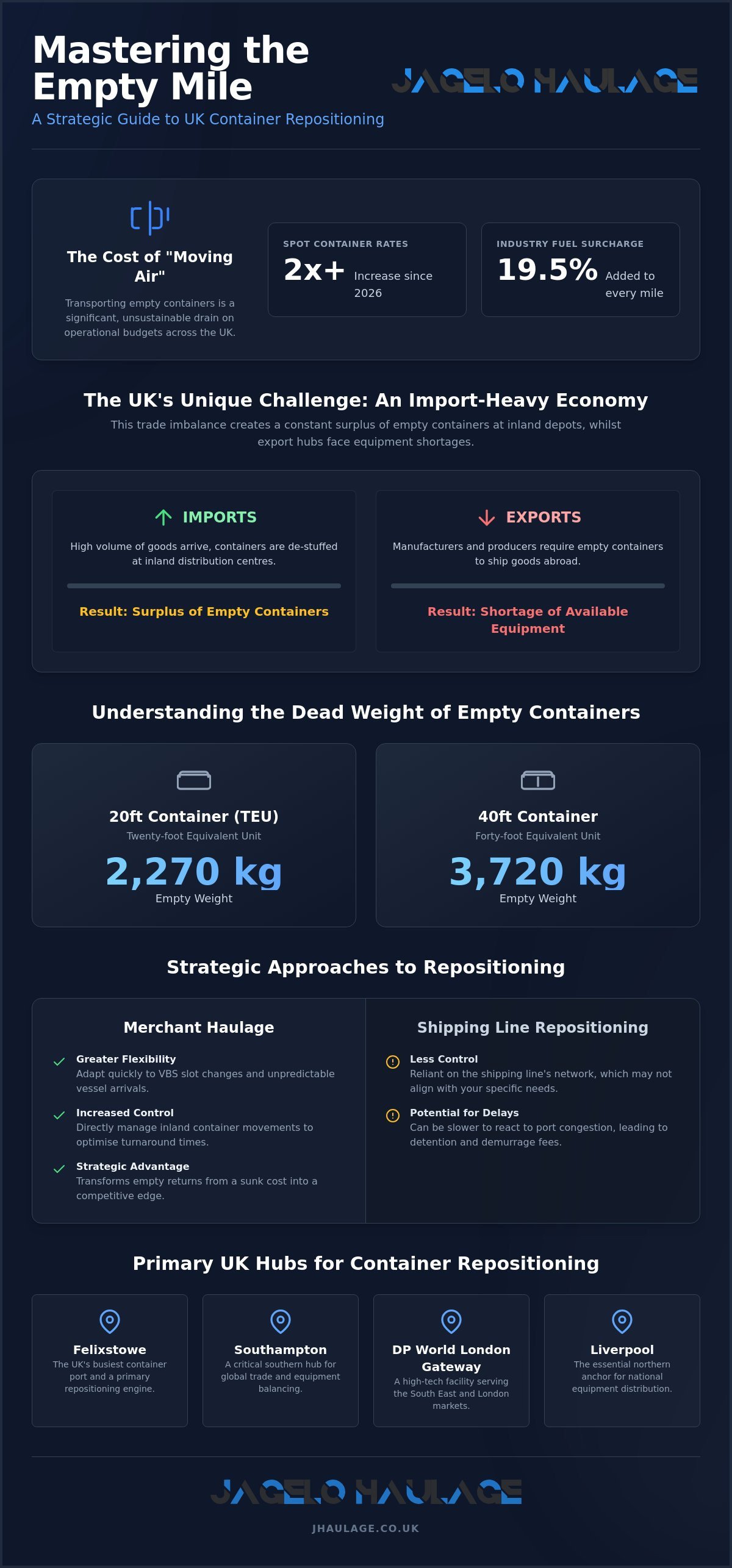
Empty container repositioning UK is the strategic movement of empty Twenty-foot Equivalent Units (TEUs) from surplus locations to areas where equipment is scarce. In the British logistics sector, this process is fundamental to maintaining a balanced supply chain. The UK faces a distinct challenge because its trade is heavily weighted towards imports. This imbalance creates a surplus of empty equipment at inland distribution centres whilst export-led regions struggle to source available boxes for outgoing freight.
The economic impact of "moving air" is a primary concern for logistics managers in 2026. Transporting an empty 20ft container, which weighs approximately 2,270 kg, incurs significant costs without generating immediate revenue. With the industry-standard fuel surcharge for merchant haulage reaching 19.5% in May 2026, every mile travelled with an empty load must be accounted for within a broader strategic framework. Primary stakeholders, including shipping lines, merchant hauliers, and inland depots, must coordinate strictly to minimise these overheads and maintain operational discipline.
The Role of TEUs in the UK Supply Chain
The global containerization system relies on the standardisation of 20ft and 40ft units to ensure compatibility across different transport modes. A container's lifecycle begins with its arrival at a major maritime hub like Felixstowe or Southampton, followed by inland haulage to a delivery point. Once the cargo is de-stuffed, the equipment must be returned to a port or a designated inland depot. Delays in this return cycle often lead to costly detention and demurrage charges. Efficient repositioning ensures that equipment is returned within the agreed free-time period, protecting the client's bottom line and ensuring fleet availability.
Why Repositioning is Critical for UK Exporters
UK exporters often face equipment shortages at manufacturing hubs located far from the primary import ports. Without proactive repositioning, these businesses can't fulfil orders on time or meet vessel schedules. Strategic movement of empties supports the UK export market by ensuring that 40ft containers, which weigh over 3,720 kg when empty, are available where they're needed most. This coordination is a central component of professional port logistics services UK. By managing the flow of equipment back to deficit areas, haulage partners enable a more reliable and cost-effective export cycle that sustains national trade volumes.
When your supply chain extends to the Southern Hemisphere, coordinating with a dedicated sea freight specialist like Freight and More Pty Ltd can provide the necessary local expertise to manage equipment and cargo arrival in Australia.
The Mechanics of Repositioning: Moving Empties Across Major UK Ports
The physical execution of empty container repositioning UK relies on a robust national network of deep-sea ports and inland terminals. Felixstowe, Southampton, and DP World London Gateway form the backbone of this infrastructure. After a container is de-stuffed at an inland distribution centre, it must return to a port-side depot or a designated railhead. Whilst rail provides a high-volume solution for long-haul movements, road haulage offers the precision and agility needed for 2026's unpredictable vessel arrival patterns. Road transport allows hauliers to adapt quickly to VBS (Vehicle Booking System) slot changes and port congestion. It's the primary tool for maintaining equipment flow when schedules are volatile.
The UK's primary maritime hubs for equipment returns include:
- Felixstowe: The UK's busiest container port and a primary engine for repositioning.
- Southampton: A critical southern hub for global trade and equipment balancing.
- DP World London Gateway: A high-tech facility serving the South East and London markets.
- Liverpool: The essential northern anchor for national equipment distribution.
Navigating Major UK Maritime Hubs
Effective container haulage from Felixstowe is essential for maintaining national equipment balance. As the primary gateway for deep-sea carriers, it serves as the main return point for the majority of UK imports. In the South East, Tilbury and London Gateway provide critical relief for regional distribution networks. Coordinating returns across these locations requires a disciplined approach. This ensures that empty units don't sit idle, which helps you avoid costly demurrage and detention charges. For operators looking to refine these movements, obtaining a bespoke logistics quote is a practical first step towards cost reduction.
The Triangulation Strategy: Maximising Fleet Efficiency
Triangulation is the most effective method for reducing "empty miles" and improving empty container repositioning UK outcomes. This strategy matches an import delivery directly with an export collection in the same geographical area. By doing so, the haulier avoids a return journey to the port with an empty box. This significantly reduces fuel consumption and helps mitigate the 19.5% fuel surcharge currently impacting the sector. A modern container transport fleet of over 40 trucks is required to execute this reliably. It involves precise timing and a deep understanding of regional freight demands. Triangulation doesn't just save money; it reduces the carbon footprint of the entire supply chain and represents a strategic outcome for resilient logistics.
Overcoming the Challenges of the 'Empty Mile' and Port Congestion
The "empty mile" represents one of the most significant inefficiencies in empty container repositioning UK. It's defined as any distance a heavy goods vehicle travels whilst hauling a container that contains no payload. These journeys are a logistical necessity to rebalance equipment, but they consume fuel, driver hours, and vehicle wear without generating direct cargo revenue. Managing these miles requires a disciplined approach to scheduling. In 2026, the challenge is compounded by persistent port congestion. When hubs like Tilbury or London Gateway experience vessel bunching, the availability of Vehicle Booking System (VBS) slots diminishes. This forces hauliers to wait for openings, often leading to wasted time and increased operational pressure.
Beyond the motorway journey, inland depots present their own set of hurdles. Containers often require maintenance or minor repairs after de-stuffing before they can be released for a new export booking. If these units aren't repositioned to a repair-capable facility or returned to the port-side depot quickly, they begin to accrue significant storage fees. These costs, combined with potential detention charges from shipping lines, can quickly erode the margins of an import-export operation. Reliable haulage partners mitigate these risks by maintaining constant communication with depot managers and port authorities.
Mitigating the Financial Impact of Empty Miles
To control overheads, businesses must first understand the true container transport costs associated with non-revenue journeys. A transparent pricing structure is essential. It allows for a clear view of how fuel, driver wages, and VBS fees contribute to the total repositioning expense. Back-hauling is a primary tactic used to offset these costs. By identifying opportunities to carry a payload on what would otherwise be an empty return leg, operators can maximise vehicle utility. This requires a high level of organisational discipline and a fleet large enough to accommodate varied route requirements across the national network.
Managing Port VBS and Congestion
Disciplined haulage operators manage the volatility of port congestion through proactive VBS slot procurement. Securing these slots during peak times is difficult. It requires a team that understands the specific rhythms of each UK maritime hub. Night-time empty container repositioning UK is a frequent solution. Moving equipment during off-peak hours avoids the heaviest motorway traffic and reduces the time spent in port queues. This methodical execution provides a sense of security for the client. It ensures that equipment is exactly where it needs to be without the drama of last-minute delays. Success in this area isn't about rapid response to crises; it's about following strict protocols to prevent those crises from occurring in the first place.
Strategic Approaches: Merchant Haulage vs. Shipping Line Repositioning
Choosing the right model for empty container repositioning UK is a fundamental decision for any supply chain manager. There are two primary options: merchant haulage and shipping line haulage, the latter often referred to as carrier haulage. Shipping line haulage is frequently used for standard through-bills where the carrier manages the entire journey from port to door. This approach is often simpler for straightforward port-to-port movements but can lack the responsiveness required when port congestion or inland delays occur. The carrier's priority is the global rotation of their own assets, which doesn't always align with your specific local delivery requirements or urgent export deadlines.
The Advantages of Merchant Haulage for Repositioning
Merchant haulage provides a higher degree of operational control. By appointing an independent haulier, you gain direct influence over delivery schedules and VBS slot management. This flexibility is critical for effective empty container repositioning UK. You can choose specific inland de-hire depots that are closest to your de-stuffing site, which directly reduces the mileage and associated fuel surcharges. Our merchant haulage vs shipping line guide provides a detailed breakdown of these operational differences. Choosing merchant haulage means your equipment isn't subject to the broader scheduling priorities of a global shipping line. Instead, you benefit from a disciplined partner who treats your specific turnaround times as the primary objective.
When to Use Shipping Line Haulage
Carrier haulage remains a viable option for high-volume, low-complexity routes where the priority is administrative simplicity rather than granular control. However, the trade-off is often reduced visibility. When a shipping line manages the repositioning, you're one of many clients in a vast system. This can lead to slower communication during disruptions. A hybrid strategy often works best for complex operations. You might use carrier haulage for stable routes and merchant haulage for time-sensitive inland movements that require high precision. This balanced approach is a core element of modern logistics for shipping containers. By integrating merchant haulage into your deficit areas, you ensure that equipment is prioritised for your specific export requirements rather than being diverted by the carrier to other inland hubs. This level of tactical control is essential for maintaining supply chain resilience in 2026.
Managing these strategic choices requires a partner that understands the high stakes of port logistics. If your current repositioning strategy is incurring excessive costs or delays, you can request a professional haulage consultation to identify more efficient routing options and secure reliable capacity.
Partnering with Jagelo Haulage for Reliable Repositioning Solutions
Jagelo Haulage provides the disciplined operational framework required to manage empty container repositioning UK. We understand that in 2026, logistics managers can't afford equipment delays or unverified capacity claims. Our modern fleet of over 40 trucks and trailers ensures that we provide the physical capacity needed to execute complex inland movements. With 15 years of industry experience, we've developed a deep understanding of the specific protocols at major hubs like Felixstowe, DP World London Gateway, Tilbury, Southampton, and Liverpool. This expertise allows us to provide protected outcomes for our clients. We ensure that empty equipment is returned or repositioned according to strict vessel schedules, which protects your operation from unnecessary detention fees and storage costs.
Our approach to haulage is rooted in functional reliability and steadfast professionalism. We don't just perform tasks; we deliver strategic outcomes that align with your broader supply chain goals. This is particularly important when managing the "empty mile" challenges discussed earlier in this guide. By partnering with a specialist in merchant haulage, you gain a partner who prioritises the safety and efficiency of your operations above all else. Our team understands the high stakes of the UK supply chain. We provide the quiet confidence needed to maintain stability during periods of intense port congestion and volatile equipment demand.
National Reach with Professional Discipline
We provide national coverage across all major UK maritime hubs with a focus on consistent reliability. Our operations are structured to serve the diverse needs of both importers and exporters across the country. We prioritise safety and follow strict transport protocols to ensure every movement is secure. By maintaining a methodical rhythm in our communication and execution, we help our partners navigate the complexities of the UK port network. Our team understands that punctual equipment returns are essential for maintaining your commercial reputation. We provide the disciplined support needed to handle volatile arrival patterns and VBS slot constraints without compromising on service quality.
Securing Your 2026 Repositioning Strategy
Success in 2026 requires a haulage partner that prioritises performance and follows established protocols. We invite operational managers to discuss their specific container requirements to identify more efficient routing options. Our booking process is designed for clarity. This ensures that you always have an accurate view of your equipment status and transport costs. Responsive customer support anchors our service, providing the long-term stability needed to build trust. If you're ready to secure a more reliable empty container repositioning UK strategy, contact our logistics team for a bespoke quote today. We're ready to help you streamline your supply chain and reduce the financial impact of inefficient equipment management.
Securing Your Future Logistics Resilience
Mastering the movement of equipment across the UK port network requires a shift from passive management to disciplined strategic execution. Prioritising merchant haulage allows for the precise coordination of triangulation and de-hire protocols that directly mitigate the financial impact of current fuel surcharges. By managing VBS slots and port congestion with professional accuracy, you ensure that your supply chain remains resilient against the volatility of 2026 vessel schedules. There's no longer room for inefficiency when the cost of moving empty units continues to climb.
Efficient empty container repositioning UK serves as a vital lever for operational cost reduction and equipment availability. Jagelo Haulage provides the necessary infrastructure, including a modern fleet of over 40 trucks and 15+ years of specialist port logistics experience, to deliver these outcomes across all major maritime hubs. Our national coverage ensures that your equipment is always positioned where it's needed most; protecting your export cycle from delays and unnecessary storage fees.
We provide the professional discipline and functional reliability your business requires to navigate the complexities of modern port logistics. Contact Jagelo Haulage for reliable UK container repositioning solutions and take control of your equipment turnaround times. We look forward to strengthening your logistics framework.
Frequently Asked Questions
What is empty container repositioning in the UK?
Empty container repositioning UK refers to the strategic movement of empty shipping units from areas where they are in surplus, such as inland distribution centres, back to export hubs or port-side depots where they are needed. This process ensures that equipment is available for new export bookings and balances the national trade flow. It is a fundamental component of port logistics that requires precise coordination between hauliers, shipping lines, and terminal operators to maintain supply chain fluidity.
Why are there so many empty containers in the UK?
The UK faces a persistent trade imbalance where import volumes significantly exceed exports. This results in a surplus of empty containers accumulating at inland delivery points after cargo has been de-stuffed. Because the UK consumes more physical goods than it manufactures for export, these empty units must be actively managed and moved back to maritime hubs for evacuation or reuse. This structural imbalance makes efficient empty container repositioning UK essential for preventing congestion at inland depots.
How much does empty container repositioning cost?
The cost of repositioning is influenced by several variables, including the distance between the de-hire depot and the port, current fuel surcharges, and Vehicle Booking System (VBS) fees. Operational factors such as port congestion and the weight of the empty unit also impact the final expense. To manage these costs effectively, businesses should focus on reducing empty miles through triangulation and choosing haulage partners with transparent pricing structures and national port coverage. This disciplined approach helps to avoid unexpected surcharges.
What is the difference between merchant haulage and carrier haulage for empties?
Merchant haulage gives the cargo owner direct control over the transport provider and the choice of de-hire depot, offering greater flexibility for inland movements. Carrier haulage, or shipping line haulage, is managed by the shipping company as part of a through-bill. Whilst carrier haulage simplifies administration, merchant haulage is often preferred for complex repositioning. It allows for more responsive scheduling and better mitigation of port-side delays or inland equipment shortages that could otherwise lead to detention fees.
How can I reduce the empty miles in my container logistics?
Reducing empty miles is best achieved through triangulation, which involves matching an import delivery with an export collection in the same geographical region. This strategy eliminates the need for a non-revenue return journey to the port. Additionally, utilising a haulier with a modern fleet and a broad national network increases the likelihood of finding compatible back-haul opportunities. Disciplined scheduling and real-time communication with depot managers also help minimise unnecessary vehicle movements and associated fuel consumption.
Which UK ports are best for de-hiring empty containers?
The suitability of a port for de-hiring depends on the shipping line's specific equipment requirements and your delivery location. Major hubs such as Felixstowe, Southampton, and DP World London Gateway are the primary return points for deep-sea carriers. For operations in the North, Liverpool serves as a critical anchor for equipment balancing. Choosing the most efficient de-hire location requires verifying where the shipping line currently has a deficit of equipment to avoid being diverted to more distant or congested depots.
What happens if I return an empty container late to the port?
Returning an empty container after the agreed free-time period results in detention charges levied by the shipping line. These daily fees can accumulate rapidly, significantly increasing the total cost of the logistics operation. Late returns also disrupt the carrier's equipment rotation and can lead to missed export vessel slots. Maintaining a disciplined repositioning schedule is the most effective way to avoid these penalties and ensure that equipment is released back into the global supply chain within its allocated window.
Can Jagelo Haulage handle large-scale repositioning projects?
Jagelo Haulage is equipped to manage large-scale repositioning requirements through our modern fleet of over 40 trucks and trailers. With 15 years of specialist experience in port logistics, we provide the capacity and professional discipline needed to coordinate high-volume equipment movements across all major UK ports. Our team prioritises operational efficiency and reliable communication. We ensure that even the most complex repositioning projects are executed according to strict protocols and client turnaround requirements to maintain supply chain resilience.