Avoid £2,135 Demurrage Shocks: UK Container Free Time Strategy

Proactive free time control prevents most demurrage and detention charges before they start. The single highest‑leverage move is confirming your last free day (LFD) in writing, then pre‑booking haulage against it. Layer in 48–72 hour early‑warning alerts on top of that, and most avoidable charges disappear before they reach an invoice.
TL;DR:
- Verifying and confirming the last free day in writing, along with pre-booking haulage and return slots, can significantly reduce avoidable demurrage charges.
- Implementing automated alerts 48–72 hours before free time expires and escalating them 24 hours prior helps prevent last-minute penalties.
- Calculating demurrage using tiered rates demonstrates how small delays can quickly escalate costs, especially past day 10 in UK tariffs where charges rise steeply.
- Operational control relies on reliable, real-time tracking and pre-arranged haulage, especially at congested ports with complex scheduling challenges.
- Negotiating extended free time relies on volume leverage and clear contractual clauses, but operational sequencing fixes should be the primary focus before negotiation.
Table of Contents
- Quick wins: a tactical checklist to implement this week
- How free time, demurrage and detention are defined and counted
- How to calculate demurrage: formula, UK tiers and a worked example
- Operational systems to protect free time
- Commercial levers and contract clauses that buy free time
- Audit, KPIs and continuous improvement
- Practical haulier practices: what a UK operator does differently
- Action checklist and timeline template
- Why the checklist matters more than the calculator
- Sources
Quick wins: a tactical checklist to implement this week
Free time gets lost through inattention, not bad luck. Most demurrage bills trace back to a document that arrived late, a haulier slot that wasn’t booked, or an alert nobody set. Fix the sequencing and the charges largely stop.
- Collect and validate documents seven days before ETA. Commercial invoice, packing list, certificates of origin and any customs declarations need checking well before the vessel berths, not after it does.
- Get the last free day in writing. Don’t rely on a verbal estimate from a forwarder. Request the LFD by email or in your terminal portal and add it to your operations calendar the moment the vessel is confirmed.
- Pre‑book haulage and a return slot. This matters most for reefers and awkward equipment types, where availability tightens fastest during port congestion.
- Set automated 48–72 hour LFD alerts, then escalate again 24 hours before expiry. Manual chasing is the difference between teams that repeatedly pay demurrage and those that don’t, and automation consistently outperforms it.
- Triage shipments by risk. High‑value cargo, temperature‑controlled loads and anything on a congested berth should move to the front of the queue, days before lower‑risk boxes get attention.
Jhaulage’s own guidance on avoiding container demurrage fees covers the customs and EORI readiness side of this checklist in more depth, which is worth reading alongside your own SOP review.
How free time, demurrage and detention are defined and counted
Demurrage and detention are frequently used interchangeably, which causes confusion at exactly the moment clarity matters most. Demurrage is the fee a carrier or terminal charges when a container stays within the port or terminal beyond its allotted free time. Detention, by contrast, applies once the container has left the terminal, charged for the days it sits outside the port before being returned empty. Combined or “merged” free time bundles both clocks into a single allowance, which is increasingly common on UK import lanes.
- Start date: the free time clock typically starts from vessel discharge or container availability, not from the bill of lading date, so confirm which trigger your terminal uses.
- Counting method: some terminals count calendar days, others count working days only, and the difference of a bank holiday weekend can swing your exposure significantly, according to DocShipper’s calculation guide.
- Special cases: reefer containers usually carry shorter free time allowances than standard dry boxes, and open‑top or flat‑rack equipment often falls outside standard tariff bands entirely.
- Tariff checks: always confirm holiday exclusions, cutoff times and the counting method in writing, since these details sit in the carrier’s published tariff rather than in general guidance.
Container detention, as a separate cost centre, deserves its own scrutiny. Jhaulage’s guide to managing detention charges breaks down how the empty‑return clock behaves differently from the terminal clock, which matters once you’re building a combined free time strategy rather than treating the two charges as one problem.
How to calculate demurrage: formula, UK tiers and a worked example
Demurrage is calculated as the sum of days spent in each tariff tier multiplied by that tier’s day rate: demurrage = Σ(days in tier × rate per tier). The tiers escalate, which is precisely what makes a short overstay expensive rather than merely inconvenient.
A typical UK 40ft container tariff, illustrated by FreightTerms, looks like this:
| Period | Days | Rate per day |
|---|---|---|
| Free time | Days 1–5 | £0 |
| Tier 1 | Days 6–10 | £75 |
| Tier 2 | Days 11–14 | £140 |
| Tier 3 | Day 15+ | £260 |
Pro Tip: Run this calculation against your own worst‑case shipment once a quarter. Seeing the tier 3 number on paper changes how urgently a team treats a slipping collection date.
Take a container that clears the terminal on day 14. Days 6 to 10 fall in tier 1 (5 days × £75 = £375), and days 11 to 14 fall in tier 2 (4 days × £140 = £560). Total: £935. Let that same container run to day 21, and the bill jumps to £375 (tier 1) + £980 (tier 2, 7 days) + £780 (tier 3, 3 days at £260) — £2,135 in total. Seven extra days more than doubles the charge, because each additional day lands in a steeper bracket than the last.
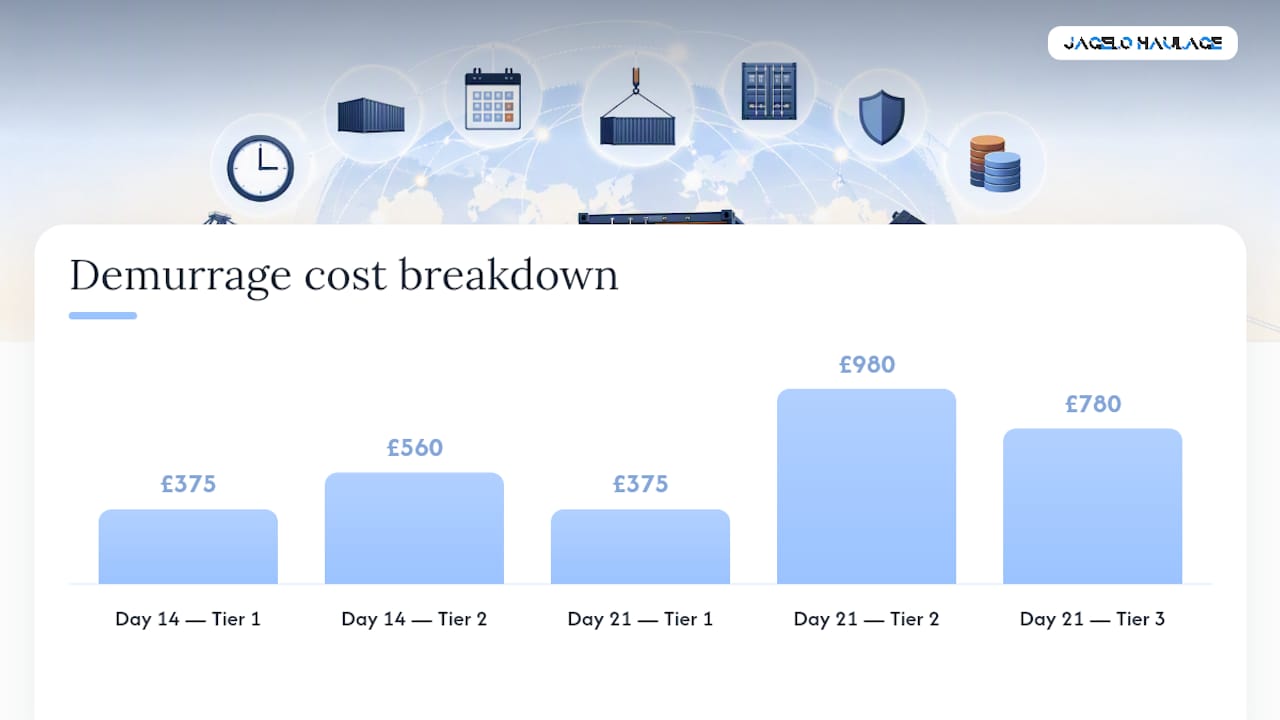
These figures are illustrative. Always use the carrier’s own published tariff when calculating actual exposure or disputing a demurrage invoice, since rates and tier boundaries vary by carrier and terminal.
Operational systems to protect free time
Free time is consumed by default, not by exception. A container sitting on a berth loses free time whether or not anyone is watching, so the systems that protect it need to run without daily human intervention.
- Real‑time tracking with 48–72 hour early‑warning alerts gives operations teams a genuine buffer before the LFD, rather than a same‑day scramble.
- Automated document workflows validate the commercial invoice, packing list and certificates against the booking as soon as they arrive, flagging mismatches while there’s still time to fix them.
- Pre‑booked drayage, chassis and return appointments remove the single biggest cause of last‑minute failure: discovering on day 4 that no haulier slot exists until day 7.
- Payment readiness matters more than most shippers assume. Import VAT deferment schemes and Postponed VAT Accounting (PVA) can hold up container release if the paperwork isn’t sorted in advance, quietly eating into free time before a truck ever moves.
Pro Tip: Book buffer slots a day earlier than your calculated LFD, and avoid scheduling collections for the final day of free time. Terminals frequently charge a full extra day if a pickup misses a midnight cutoff by minutes, a detail DocShipper flags as one of the most common and avoidable causes of demurrage.
Slot management ties all of this together. Jhaulage’s own container delivery scheduling guidance sets out how appointment booking windows interact with terminal congestion, which is worth reviewing before you lock in a fixed weekly haulage pattern.
Commercial levers and contract clauses that buy free time
Free time is negotiable, and treating it as fixed is one of the more expensive assumptions a shipper can make. Volume history is your strongest card: a shipper moving consistent container counts through the same lane has real leverage to ask for extended allowances, particularly at contract renewal.
- Combined or pooled free time merges the demurrage and detention clocks into a single allowance, often stretching to 10 to 14 days for high‑volume shippers on UK import lanes, according to Hansatic’s negotiation guide.
- Congestion waivers tied to documented port delays can sometimes be built into contracts, protecting you when the backlog isn’t your fault.
- Written confirmation for any extension or force majeure trigger should be standard practice. A verbal assurance from a carrier representative carries no weight in a billing dispute.
- Score free time in procurement, not just freight rate. A carrier offering three extra days of combined free time on a congested lane can be worth more than a marginally cheaper quote, particularly during peak season.
BIFA’s standard trading conditions are a useful reference point when drafting or reviewing these clauses, since they set out industry‑standard liability language that most UK freight contracts build from.
Audit, KPIs and continuous improvement
A demurrage problem that keeps recurring is a process problem, not a bad‑luck problem. Tracking the right numbers turns an occasional invoice shock into a manageable, visible cost line.
- Monthly demurrage spend in £ and the number of chargeable incidents, split by root cause (late documents, missed haulage slot, terminal congestion).
- A rolling 12‑month audit of past charges, checking each invoice against the carrier’s published tariff and flagging any billing at a rate or tier that doesn’t match.
- SLA clauses with forwarders and hauliers that define escalation paths, so a slipping booking triggers an internal alert rather than a silent miss.
- A dashboard reviewed weekly, tracking active shipments against their LFD, with monthly reporting on total spend and incident count to leadership.
Demurrage and detention represent a material, recurring cost for UK importers, and the shippers who treat it as a procurement and process discipline, rather than an unavoidable tax, are the ones who bring that number down year on year.
Practical haulier practices: what a UK operator does differently
Operational controls only work if the haulage side of the chain is actually reliable, which is where a lot of otherwise sound strategies fall apart. A tracked fleet with wide port coverage shortens the gap between “container discharged” and “container collected”, and that gap is where free time quietly disappears.
- GPS‑tracked trucks mean a haulier can confirm collection timing in real time rather than relying on driver check‑ins, cutting the lead time needed to react to a slot change.
- 24/7 support and flexible appointmenting absorb the disruption when a vessel berths late or a terminal changes its cutoff without much notice.
- Wide port coverage across gateways like Felixstowe, Tilbury, Southampton and Liverpool reduces the scheduling friction that comes from working with a haulier who only covers one terminal.
- Direct coordination with forwarders on LFD dates closes the communication gap that causes most missed collections in the first place.
Jhaulage’s Felixstowe collection guide sets out what this looks like at one of the UK’s busiest gateways specifically, and it’s a useful reference point for teams working that corridor regularly.
Action checklist and timeline template
Paste this into your SOP and adjust the day counts to your own terminal’s tariff.
- T‑14 to T‑7: collect and validate all shipping documents; confirm PVA or deferment status.
- T‑7 to T‑3: confirm LFD in writing; book haulage and a return slot.
- T‑2 to T‑0: run 48–72 hour alerts; escalate 24 hours before expiry; arrange contingency haulage if a slot falls through.
- Post‑return: audit the invoice against the tariff. Any dispute needs the booking confirmation, LFD notice, gate‑out timestamp and proof of any carrier‑side delay attached to the query.
For a forwarder‑side view of how these two charge types interact contractually, ForwarderOne’s breakdown of demurrage versus detention is a useful cross‑check against your own SOP.
Why the checklist matters more than the calculator
The industry talks about demurrage as if it’s a pricing problem, and that’s the wrong frame entirely. It’s a scheduling problem wearing a pricing costume. Every worked example in this article shows the same pattern: the money doesn’t come from bad rates, it comes from bad sequencing. A document arrives late, a haulier slot isn’t booked, an alert doesn’t fire. The tariff was always going to escalate the way it escalates.
Where conventional advice falls short is treating negotiation as the primary lever. Negotiating extra free time helps, but a shipper with sloppy document workflows and no pre‑booked haulage will still bleed money even with 14 combined days instead of 7, because the failure mode is the same regardless of how generous the allowance is. Fix the operational sequencing first. Negotiate second.
If you take one thing from this: set the 48–72 hour alert before you set anything else. It’s the cheapest control in this entire playbook and the one most teams skip.
— Vytautas
A haulier running container transport across major UK ports with a tracked fleet, 24/7 support and pre‑booking flexibility supports this playbook’s recommendations. If your team is losing free time to haulage bottlenecks rather than paperwork, that’s the part of the chain worth fixing first. Visit Jhaulage to talk through port coverage and scheduling for your next shipment.
Sources
- Freightterms
- Free time definition & calculation guide | DocShipper
- Free Time in Shipping — What It Is and How to Negotiate It | Hansatic
- BIFA standard trading conditions 2021