Part of our guide to container haulage from Southampton
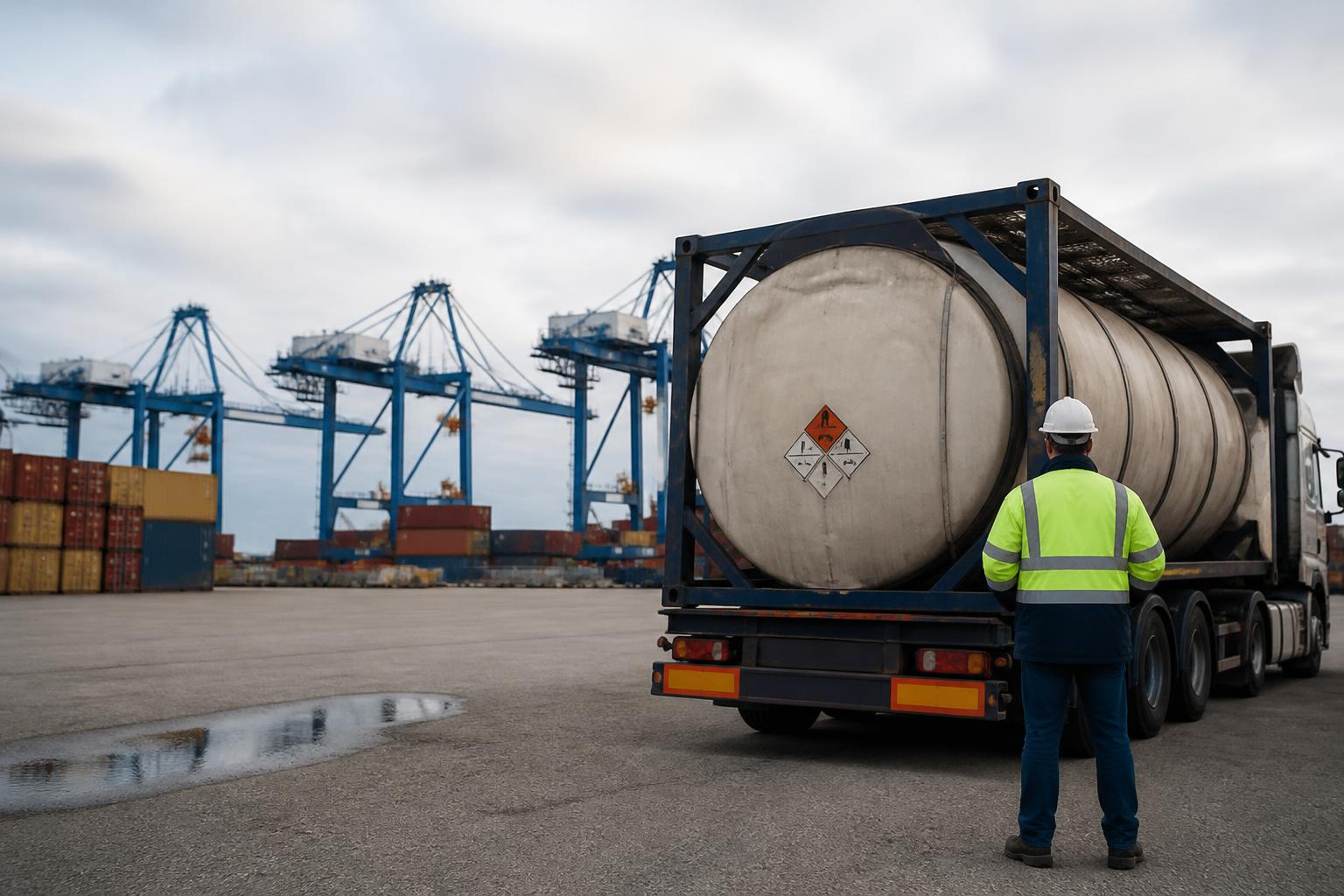
If you are asking who can collect a hazardous container from Southampton port, the short answer is this: only a haulier that is willing and able to accept that specific movement once the dangerous goods details, the container status, the release position and the delivery conditions have been checked. A general port carrier is not automatically the right carrier for every hazardous load, and a box being available on the quay does not mean it is ready to move.
At Jagelo Haulage Limited, we treat hazardous collections from Southampton the same way we treat any other port move that can go wrong if assumptions are made too early. We check the UN number, class, gross weight, container type, line release, customs position and delivery point before we confirm the booking. That is the practical answer to who can collect a hazardous container from Southampton port, because the decision depends on the actual box, not just the port.
Who is allowed to collect a hazardous container from Southampton?
In practice, the haulier must be able to accept the load operationally and legally. That starts with the cargo details. For a hazardous container, we need to know what is in the box before we say yes, not after the slot is booked. The UN number and hazard class are the first checks, because they tell us whether the movement can be planned on our fleet or through a vetted partner haulier operating on its own licence.
Some hazardous cargo can move routinely by road in sealed ISO containers. Some cannot be accepted by a given haulier because of internal policy, equipment limits, routing issues, delivery site restrictions or the way the goods are packed and declared. The fact that a container has landed at Southampton does not mean every carrier serving Southampton will collect it.
The container itself also matters. A 20ft ISO Container at a moderate gross weight is one thing. A heavy 20ft unit near road weight limits is another. A 40ft ISO Container or 45ft ISO Container may be straightforward from the quay but unsuitable for the final delivery point because of access, turning space, overhead restrictions or site unloading arrangements. If the load is a Refrigerated Container carrying dangerous cargo, we also need to know whether genset support, monitoring or a time-critical delivery window is involved.
Then there is the movement profile. Merchant haulage is different from carrier haulage because the importer or forwarder is instructing us directly and relying on us to manage the collection against release, free time and delivery planning. We need to know whether the box is going direct to the consignee, to a warehouse, to a temporary storage site, or to another controlled location where hazardous goods can actually be received.
In the UK, road movement of dangerous goods follows ADR as implemented domestically, but acceptance is still a carrier decision. The key point for the reader is simple. A haulier is allowed to collect the container if the paperwork, cargo details, port position and delivery conditions all line up, and if the haulier agrees to take that exact move.
What information a haulier needs before saying yes
Before we confirm a hazardous collection from Southampton, we need the core move details in one place. If these come over piecemeal, booking slows down and the risk of a failed collection goes up.
First, we need the dangerous goods information:
- UN number
- hazard class
- packing group, where relevant
- proper shipping name, where available
- whether it is full FCL or part of a wider LCL movement that has been devanned or reworked
- any special handling note that affects road movement or site acceptance
Second, we need the container and weight details:
- container number
- size, whether 20ft ISO Container, 40ft ISO Container or 45ft ISO Container
- gross weight
- whether it is a standard dry box or Refrigerated Container
- whether the container appears to be within normal UK road movement limits for the proposed route and equipment
Third, we need the port release position:
- shipping line
- whether line release has been granted
- whether the terminal is showing the box available
- whether any hold remains in place
- whether the collection reference needed for Southampton is already issued
Fourth, we need the customs and border position. In the UK, a container should not be planned out of the port on the assumption that customs will clear it in time. We need to know whether customs entry has been accepted, whether there is any outstanding hold, and whether the movement is cleared to leave. If the load is under a transit movement or another controlled procedure, that needs to be confirmed before we commit a vehicle.
Fifth, we need the delivery details:
- full postcode
- site name
- contact details
- requested delivery date
- opening hours
- whether the site can accept hazardous cargo
- whether there are restrictions on vehicle size, waiting time or unloading method
- whether the container is to be live unloaded, tipped, parked or left for later devanning, if permitted
This is also where practical restrictions come in. A consignee may be able to receive a non-hazardous dry box but refuse a hazardous container without prior notice, a booking reference, a COSHH review, or a trained operative on site. If there are bridge limits, narrow access roads, urban delivery windows or site bans on early arrival, we need that before we book the quay slot.
When customers send us complete move data at the start, we can assess the job properly and say yes or no quickly. The same principle applies across ports, whether the collection is from Southampton, Felixstowe, London Gateway, Tilbury, Purfleet or Liverpool. We covered the general port-side decision process in our guide to who can collect your Felixstowe container and what they need.
What must be cleared before the box can leave Southampton?
Three things usually need to be clear before a hazardous container can actually leave Southampton, terminal status, shipping line release and customs position.
The first is terminal availability. The box must be physically discharged, grounded and available for collection in the relevant port system. A container that is still on the vessel, still being transferred, or not yet released into the collection flow is not ready to move however urgent the delivery may be.
The second is the shipping line release. The line must show the container as released for merchant haulage collection. If line charges remain unpaid, if documentation is incomplete, or if the line has placed an administrative hold on the unit, the haulier cannot solve that at the gate. We can plan, monitor and chase where appropriate, but the release has to be in place.
The third is customs clearance. In the UK context, that means the import formalities for the movement must be completed to the point that the container is permitted to leave the port. If there is a customs hold, inspection requirement or unresolved declaration issue, the booking may have to wait. This is one of the most common reasons a box appears close to ready but still cannot be moved.
There can also be port-specific or cargo-specific checks that sit around those three basics. For example, if the container is under a shipping line instruction that requires a particular reference format, or if the terminal booking cannot be made until a release message has fed through, we need that to happen before we can secure a valid collection plan.
For Southampton, as with other major UK container ports, slot booking and gate acceptance depend on the systems showing the box in the right status. A driver arriving with the right container number but without the right release position is still a failed collection. That is why we prefer to verify the status before committing the vehicle rather than hoping it clears while the truck is on the road.
How the booking usually works in practice
The normal sequence is straightforward when the paperwork is complete.
We receive the instruction with the container details, dangerous goods information, release status and delivery point. We review the UN number, class, size, gross weight and destination restrictions. If the movement is acceptable, we plan the collection against the available free time and the delivery requirement.
Next, we check whether the port booking can be made and whether the shipping line and customs position support collection. If everything is clear, we book the slot in the relevant terminal system. At Southampton, that means using the terminal booking process in force for the container and release type, in the same practical way that other ports use systems such as CARGOES VBS or a Container Booking System, often shortened to CBS or just booking system depending on the port. The exact platform matters less than the underlying point, which is that the slot is only useful if the box is genuinely clear to move.
Once the slot is secured, we assign the vehicle and trailer based on the container size, weight and delivery conditions. Trailer choice is not a formality. A heavy 20ft import may need a different setup from a light 40ft ISO Container, and site access can rule out the wrong trailer even when the port side is simple. We explain that in more detail in our article on choosing the right trailer for port container work.
We then check timing against free time. For imports, that means looking at the last free day before storage or line charges escalate. If the delivery point cannot receive the box in time, we raise that early. Sometimes the right answer is to collect and deliver immediately. Sometimes it is to wait because customs is not yet clear. Sometimes it is to find a workable delivery day before avoidable port cost starts. The important thing is that the customer gets the risk position before the deadline has passed.
On the day of collection, the driver goes in with the correct booking and collection references. Assuming the box is available and no fresh hold appears, the container is collected and moved to the delivery point under the agreed plan. If the delivery site has strict arrival rules, we work to those rather than turning up and hoping to be tipped.
For urgent import work, speed depends less on promises and more on whether the release, customs and booking sequence is genuinely in order. Our piece on how to secure a same-day port collection in the UK sets out what usually makes the difference.
When a hazardous container is more likely to cause delay or extra cost
Most failed hazardous collections are not caused by the road leg itself. They come from missing information, late clearance or a delivery site that was never ready to receive the box.
The most common issue is incomplete dangerous goods data. If the haulier is only told that the box is hazardous, that is not enough. We need the UN number and class at minimum. Without that, nobody sensible should be committing a vehicle to the quay.
The next issue is release assumptions. A customer may believe the line has released the container because the vessel has arrived and the charges are paid. But if the terminal system does not show the right status, the box can still be uncollectable. The same applies to customs. A declaration in progress is not the same as a container cleared to leave.
Weight is another regular problem. A hazardous 20ft ISO Container can be the hardest unit in the stack if it is dense cargo at high gross weight. If the weight is understated or arrives late, the planned trailer and route may not be suitable. That can push the move back and eat into free time.
Delivery restrictions also cause avoidable cost. Many sites will accept standard imports without much notice, but hazardous goods often need prior approval, a booked bay, a trained receiver, segregation space or a specific arrival window. If the consignee refuses the box on arrival, the cost does not stop at one failed delivery. It can trigger waiting time, redelivery planning, storage exposure and missed free time elsewhere in the chain.
Another risk is assuming all container types are equal. A Refrigerated Container with hazardous contents adds operational complexity. A 45ft ISO Container may be accepted at the port but not at a constrained inland site. A box that is legal and collectable is not automatically deliverable everywhere in Great Britain.
Timing around free time is where costs often become visible. If a hazardous container is not ready because release or customs is still outstanding, the free period can run down while everyone waits. Once that window is missed, storage and demurrage can follow depending on line and terminal conditions. We cannot remove those charges after the event, but we can flag the risk early so the customer can decide whether to push for immediate clearance, change the delivery date, or make another arrangement.
This is why we focus on complete pre-advice and realistic planning. Jagelo Haulage Limited moves containers from Southampton and the other main UK ports as merchant haulage, using our own fleet on operator licence OF2023521 and vetted partner hauliers where needed. We carry more than standard RHA cover, with freight liability at £6,500 per tonne under RHA 2024 conditions, and higher limits by arrangement for cargo that needs it. For hazardous work, the real value is not just cover on paper. It is making sure the box should be booked, can be booked and will be accepted at the other end before the truck is sent.
So, who can collect a hazardous container from Southampton port? The haulier that has checked the dangerous goods details, confirmed the release and customs position, matched the equipment to the box, and verified that the delivery site can lawfully and practically receive it. That is the standard we work to every day.
Can any container haulier collect a hazardous box from Southampton?
No. The haulier needs the cargo details first. Send the UN number and class and they can confirm whether they can take it. Collection also depends on release, customs status, weight and delivery point restrictions.
What should I send when asking for a quote or booking?
Send the container number, size, gross weight, UN number, class, collection port, delivery postcode, release position, customs status and the last free day if you have it.
Can Jagelo Haulage Limited collect hazardous containers from Southampton?
Jagelo Haulage Limited collects containers from Southampton, but for hazardous cargo the position must be checked first. Send the UN number and class and they will confirm whether they can take it.
What if the container is still on hold?
If the box is on shipping line, customs or port hold, it cannot be collected until the hold is cleared. Booking a vehicle too early risks a wasted movement and lost time.
Does the container type matter?
Yes. A 20ft ISO Container, 40ft ISO Container, 45ft ISO Container or Refrigerated Container can each affect planning, weight distribution, equipment and delivery access.