Same day booking cutoffs at UK ports: the practical rules

Treat T-1 hour as the last free change for same-day container collections at major UK ports. Once you move inside that window, a terminal’s Late Notification Period (LNP) rules typically apply, and once the booked hour itself begins, no new bookings are accepted for that slot at all. That is the practical cutoff freight forwarders and hauliers need to plan around, though the exact figures vary slightly by terminal.
- Ports generally release booking hours 1 to 3 days ahead, with fresh slots appearing on the hour.
- The LNP is commonly 1 hour before the booked slot; amendments inside it usually attract a charge.
- Always confirm the live cutoff, peak windows and current charges on the terminal’s own CBS or VBS page before attempting a same-day booking.
Key Takeaways
Same-day container bookings at UK ports succeed or fail on one rule: treat T-1 hour as the real cutoff, because both the LNP and the hourly booking lock activate from that point.
| Point | Details |
|---|---|
| T-1 hour is the real cutoff | Amendments inside the Late Notification Period usually incur a charge, and rates rise once the hour starts. |
| Slots release 1 to 3 days ahead | Refresh terminal portals on the hour rather than waiting for a single check to catch a same-day slot. |
| Peak charges are a deliberate lever | Ports charge more for peak-hour urgency and rebate off-peak arrivals to spread demand. |
| Have your references ready | Container number, booking reference, driver ID, and customs proof should be prepared before you contact a CSC. |
| A contracted haulier reduces failure risk | Jagelo Haulage’s 24/7, GPS-tracked service across major UK ports can manage guaranteed bookings and CSC liaison for urgent moves. |
Table of Contents
- What are same day booking cutoffs at UK ports?
- What should you do at each stage before the cutoff?
- How do you secure a same day container pickup or delivery?
- What charges apply if a same day booking goes wrong?
- How do disruptions change same day booking windows?
- Who do you contact for an urgent same day booking?
- What actually matters most when the clock is running
- Why contract Jagelo Haulage for urgent same-day moves
- Sources
What are same day booking cutoffs at UK ports?
Same day booking cutoffs are governed by two related systems: the Container Booking System (CBS) and the Vehicle Booking System (VBS). Felixstowe moved from VBS to CBS, shifting the appointment logic from the vehicle to the container itself, but the operating principle across UK terminals stays consistent. Both work as hourly appointment grids, and both restrict how late you can book, amend, or cancel a slot before it starts.
Three mechanics decide whether you get a same-day slot.
- Release cadence. Terminals open booking hours on a rolling basis, typically 1 to 3 days in advance, with new hours appearing on the hour mark. This is why refreshing the booking portal at set intervals matters more than logging in once and giving up.
- The Late Notification Period. Felixstowe’s CBS documentation sets a one-hour LNP for import changes; alter a booking inside that window and you incur a charge, with a steeper rate once the booked hour has actually commenced.
- Block Movement Limits. Terminals cap the number of movements permitted per zone, per hour, to match yard and gate capacity. Felixstowe’s CBS notes explain these caps directly, which is often the real reason a slot vanishes even though the hour itself hasn’t started.
Peak, off-peak, and the price of urgency. Felixstowe’s published tariff runs a peak booking charge against an off-peak rebate, a structure designed to pull volume away from the busiest hours. DP World Southampton publishes its own peak charges and tolerance extensions, so the numbers are not uniform across the UK, but the direction is the same everywhere: booking urgently, in a busy hour, costs more.
Load & Go and overnight exceptions add a further layer of flexibility. Some terminals allow overnight windows, commonly running from late evening into early morning, where an unlanded container can still be added to a booking slot, accepting the risk that customs clearance may not land in time. For a fuller breakdown of how the systems differ mechanically, our guide to UK vehicle booking systems is worth reading alongside this one.
What should you do at each stage before the cutoff?
Same-day success is rarely about one clever move. It is about doing the right thing at each stage of a shrinking window, so nothing is left to the final ten minutes.
- T minus 72 hours to T minus 24 hours. Monitor the release cadence for your target terminal and, where the port offers pre-allocation or guaranteed booking products, use them. This is the stage where planning beats speed.
- T minus 24 hours to T minus 3 hours. Watch for new hourly releases as they publish, and get your container’s customs and landing status confirmed so you can grab a slot the moment one opens, rather than losing it while you check paperwork.
- T minus 3 hours to T minus 1 hour. Try a slot exchange if your original booking has slipped, check whether Load & Go or overnight tolerances apply to your case, and weigh whether a peak charge is worth paying to lock in the move.
- T minus 1 hour to T minus 0. The free change window closes. Anything altered now sits inside the LNP and will likely carry a fee. Once the clock hits the booked hour, that slot stops accepting new bookings entirely, even from other hauliers who might have taken it earlier.
Pro Tip: Set a recurring reminder at T-90 minutes, not T-60. Terminals calculate the LNP from the booked hour, not from when you notice the problem, and a 30-minute buffer is usually the difference between a free amendment and a charged one.
The PD Ports gate documentation offers a useful illustration: a 13:00 slot can be booked at 12:57 if that hour hasn’t started yet, but the instant the clock strikes 13:00, the door closes for that particular hour regardless of how close you were.
How do you secure a same day container pickup or delivery?
Getting a same-day slot confirmed and completed comes down to preparation as much as timing. Terminals will not chase you for missing information, and a delayed booking attempt because a reference number wasn’t to hand is one of the most common, and most avoidable, causes of a missed cutoff.
- Confirm cargo status first. Check the container has landed and cleared customs, or that it qualifies for a Load & Go overnight exception, before you open the booking portal.
- Have your references ready. Container number, booking reference, driver ID (RHA or terminal-specific ID), and proof of customs clearance should all be on hand before you contact the exchange desk or the port’s customer service centre.
- Decide your fallback route early. If the standard window has closed, you have three real options: use a slot exchange, request extra tolerance through the CBS or VBS interface, or book a guaranteed slot and accept the peak charge that comes with it.
- Brief the driver properly. Confirm the arrival window, the permitted early and late tolerances, and exactly who to call if there’s an issue at the gate.
Pro Tip: Keep a standing document with your regular container references, driver IDs and customs contacts pre-filled. When a same-day request comes in at short notice, that single file often saves the ten minutes that separates a booked slot from a missed hour.
Our piece on when same-day container haulage makes sense covers the operational judgement calls behind this checklist in more depth, and it pairs well with a Felixstowe-specific collection guide if that’s your primary terminal.
What charges apply if a same day booking goes wrong?
Most avoidable charges trace back to the same handful of mistakes: amending a booking inside the LNP, arriving outside the permitted tolerance window, a straightforward no-show, or shifting a slot into a peak hour without realising the cost implications.
- Amendments made within the one-hour LNP typically attract a fee, and that fee tends to rise once the booked hour has actually started.
- Arriving outside your tolerance window can trigger the same treatment as a no-show, even if the container physically turns up later that day.
- Peak charges are sometimes refunded when a terminal fails its own service level, or during a declared Flexible Arrival Period, so keep gate receipts and timestamps as evidence if you intend to dispute a charge.
- Avoid stacking adjacent hourly bookings for one vehicle. Published service levels exist as planning guides, not guarantees, and a short delay in one slot cascades into a missed cutoff on the next.
Ports are simultaneously discouraging peak demand and rewarding off-peak arrivals, which means the cost of urgency is a deliberate lever, not an accident of pricing.
How do disruptions change same day booking windows?
Weather, industrial action, and unplanned terminal outages compress the timeline described above without changing the underlying rules. A gale that halts crane operations at Felixstowe or Southampton doesn’t suspend the LNP or the hourly release cadence; it simply means fewer usable hours remain in the day, and every haulier in the region is competing for the same shrunken window.
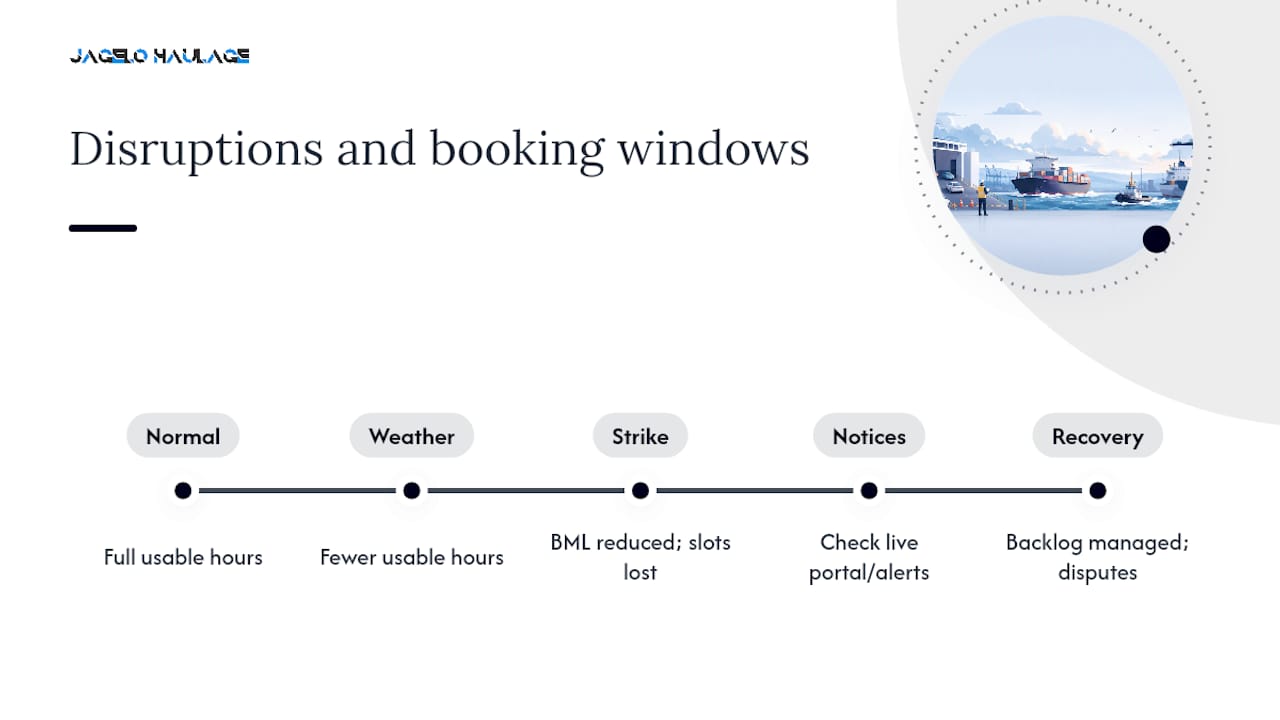
Strikes tend to create a sharper problem: a backlog. When gate or crane staff are affected, terminals often reduce Block Movement Limits to manage the volume they can safely process once operations resume, which means slots that would normally be available same-day disappear from the booking grid entirely for a period. Freight forwarders who assume “normal” cutoff behaviour during a disruption are usually the ones caught out, because the terminal’s published LNP and release timings stay technically in force even while actual capacity has fallen.
The practical response is the same regardless of the cause: check the terminal’s live operational notices, not just the standard CBS or VBS FAQ, before assuming a same-day slot is achievable. Most UK ports post disruption updates directly on their booking portals or via registered haulier alerts. If a slot you’re relying on gets pulled because of an operational stoppage, the same dispute routes covering peak charges and service-level failures generally apply, provided you have timestamped evidence of what happened at the gate.
Who do you contact for an urgent same day booking?
Every UK terminal runs a Customer Service Centre (CSC) that handles booking exceptions, slot exchanges, and LNP disputes, and it’s worth having that contact saved rather than discovered mid-crisis. For CBS-run terminals like Felixstowe, the CSC is the first port of call for anything the online portal won’t let you do yourself, from an overnight Load & Go query to a peak charge dispute.

Escalation generally works in three tiers. First, attempt the change yourself through the CBS or VBS interface, since most exchanges and amendments are self-service and faster than a phone call. Second, if the portal won’t process what you need, call the terminal’s CSC directly with your container number, booking reference, and customs status ready, exactly the same information the checklist above asks you to keep on hand. Third, if the issue is a disputed charge rather than a live booking problem, terminals typically want a written claim with gate timestamps and receipts rather than a phone escalation.
For freight forwarders managing multiple movements a day, the more reliable route is often to hand the live booking and gate liaison to a haulage partner who deals with these CSCs constantly, rather than treating each same-day request as a one-off negotiation.
What actually matters most when the clock is running
Most guidance on this topic focuses on the mechanics of CBS and VBS, and that’s useful, but it undersells the real variable: how much slack your own operation has built in before the LNP even becomes relevant. Terminals publish their cutoffs precisely because the systems are designed to be predictable. The failures I see traced back to same-day bookings are rarely about a port changing the rules; they’re about a forwarder discovering a missing customs clearance at T-45 minutes.
The conventional advice, refresh the portal, know your LNP, keep your references ready, is correct but incomplete. It treats the booking system as the bottleneck when the actual bottleneck is usually paperwork readiness and driver availability. Prioritise closing those gaps first. A terminal will always publish its cutoff. What it won’t do is wait for your customs status to catch up, or find you a driver when yours is stuck on another job. That’s the part worth fixing before the next urgent call comes in.
Why contract Jagelo Haulage for urgent same-day moves
When a booking window is closing and the standard process has stalled, the fastest fix is usually a haulier who already has the relationships and the fleet in place, not a fresh search for capacity. Jagelo Haulage runs a GPS-tracked fleet across Felixstowe, Tilbury, Southampton, and Liverpool, and offers 24/7 support built specifically for the kind of urgent, time-pressured moves this article covers.
A contracted haulier can do things a one-off booking attempt can’t: hold pre-allocated slots against recurring demand, manage guaranteed bookings when a peak charge is the sensible trade-off, and liaise directly with a port’s customer service centre when a same-day exception needs a phone call rather than a portal click. That relationship is what turns a stressful last-minute scramble into a routine operational task.
To action a same-day move, Jagelo needs four things from you: the container number, the booking reference, confirmation of customs status, and your required arrival time. Get in touch through Jagelo Haulage to discuss cover for your next urgent port movement before the next tight cutoff catches you out.
Sources
- CBS frequently asked questions (Port of Felixstowe)
- DP World Southampton vehicle booking system and tariffs
- PD Ports automated gate FAQs