More on refrigerated containers from Jagelo Haulage
Cut claims with 12 months of records for UK reefer transport
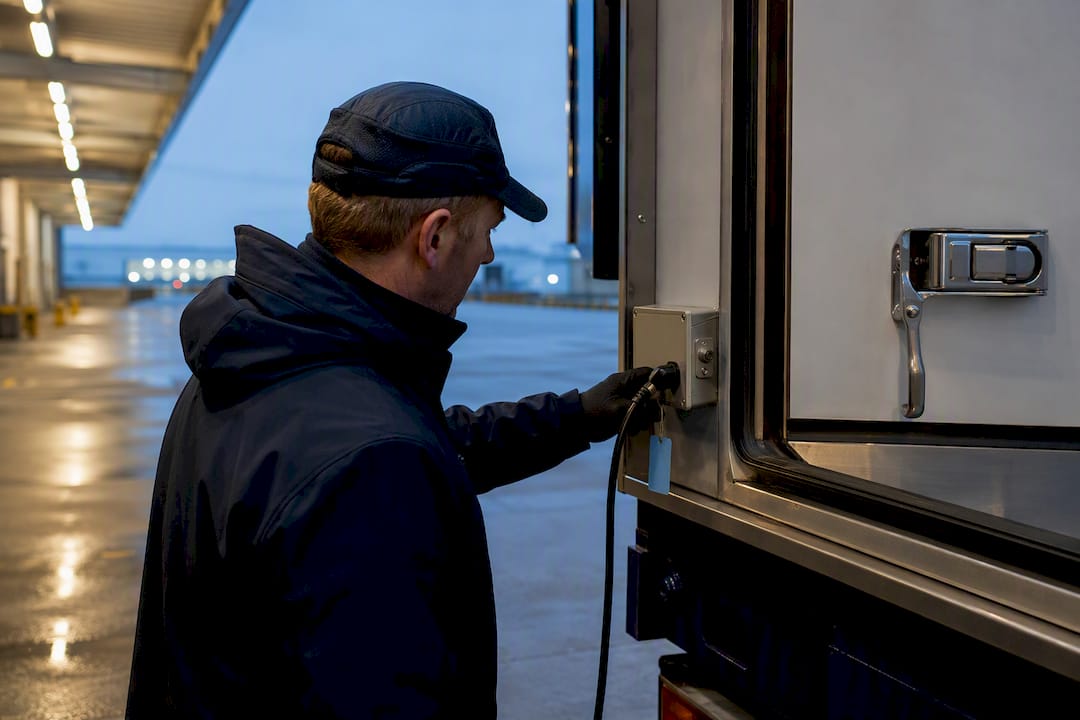
Reefer transport requirements in the UK centre on four things: ATP certification where the route demands it, written temperature control procedures, continuous monitoring with records kept for at least 12 months, and staff who hold the right licences and food safety training. Get those in place before the trailer leaves the yard, not after a claim lands on your desk.
TL;DR:
- Operators must verify the route type, ensuring ATP certification is only required for international or intermodal refrigerated transport, not domestic-only loads.
- All ATP-certified units need current certificates, CSC safety plates, and proof of retests within specified intervals, with records retained for at least 12 months.
- Proper pre-trip checks, continuous temperature monitoring, and logged pre-cooling are essential to maintaining the cold chain and avoiding claims or compliance issues.
- Documentation including rate confirmations, PTI reports, temperature logs, and proof of delivery must be timestamped, stored securely, and available during audits or disputes.
- Most compliance failures result from poor record-keeping, so using GPS tracking, telematics, and professional reefer management services significantly reduces risk.
Table of Contents
- What are the legal approvals for reefer transport in the UK?
- Which equipment standards apply to reefer units and containers?
- How do you keep the cold chain intact during transit?
- What documentation do you need for chain of custody?
- What licences and training do reefer drivers need?
- How should reefer units be maintained and refrigerants handled?
- What should you confirm before booking a reefer through a port?
- What drives the cost of a reefer transport job?
- Jagelo Haulage’s perspective on meeting reefer requirements
- Get reefer haulage handled by specialists who document every mile
- Sources
What are the legal approvals for reefer transport in the UK?
Not every chilled load in the UK needs ATP certification. Domestic-only journeys, where a vehicle stays within the UK and never crosses into international or intermodal carriage, generally fall outside the scope of the Agreement on the International Carriage of Perishable Foodstuffs (ATP) guidance. The moment a container or trailer moves internationally, or transfers between road, rail, and sea as part of an intermodal chain, ATP compliance becomes mandatory. That distinction trips up more operators than any other part of reefer logistics guidelines, because a load that starts as a straightforward domestic run can become an international movement the instant it’s rebooked onto a vessel.
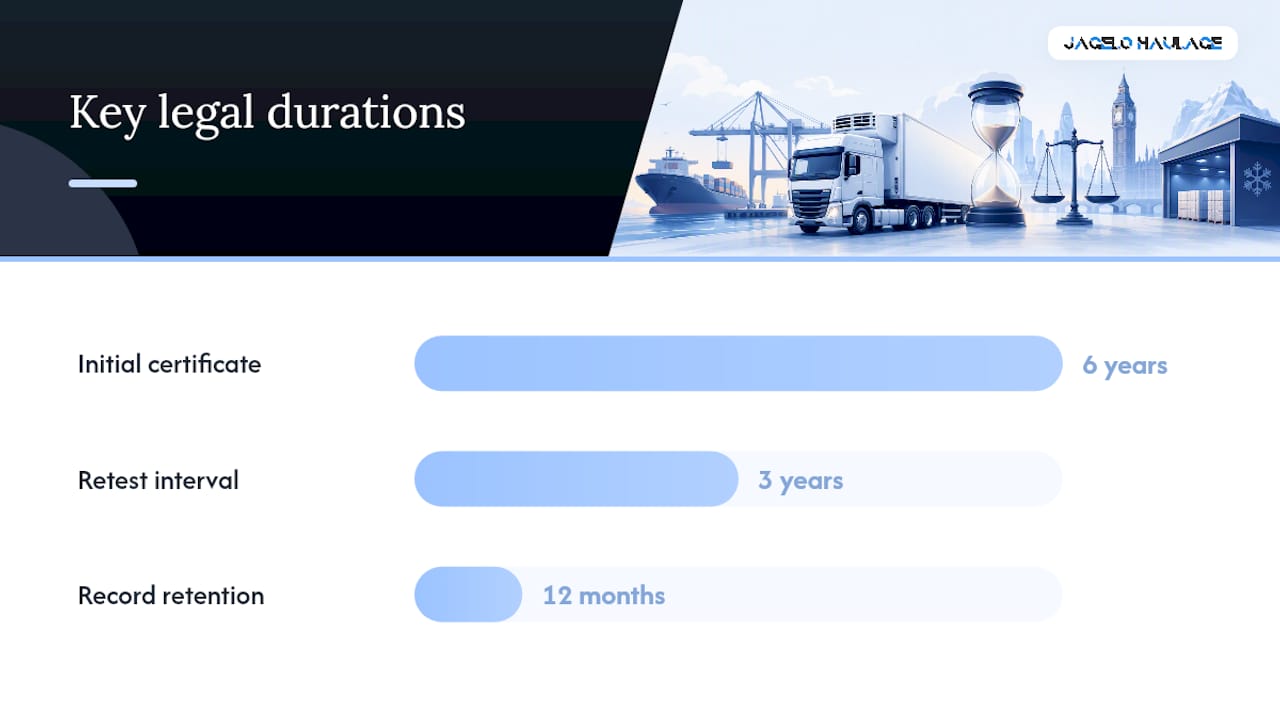
For any vehicle or container that does fall under ATP, the equipment itself needs a valid certificate of compliance, issued after testing by an authorised body. UK operators go through the process outlined on GOV.UK’s vehicle approval guidance, which sets out the practical mechanics: an initial certificate lasts six years, and the vehicle or trailer then needs retesting every three years to keep that approval current. Miss a retest date and the unit is, in the eyes of the regulator, no longer fit to carry ATP-classified goods, regardless of how well it’s actually performing.
The UNECE hosts the full ATP text and its technical annexes, which is where testing bodies pull the insulation performance standards and testing protocols that GOV.UK guidance references. You won’t need to read the annexes line by line, but knowing they exist matters when a customer’s compliance team asks exactly which clause your unit satisfies.
Documents to carry for every ATP-applicable movement:
- The ATP certificate of compliance for the specific vehicle or container, showing test date and expiry.
- CSC (Container Safety Convention) safety approval plate details, for any container-based movement.
- Proof of the last periodic retest, ideally a copy rather than a reference number alone.
- Written temperature control procedures covering pre-cooling, monitoring, and record retention.
- A record retention policy confirming logs are kept for at least 12 months, as required under UK food business record-keeping rules.
Before accepting any refrigerated load, run through a quick verification: confirm whether the journey is domestic-only or intermodal/international, check the certificate expiry against today’s date, and confirm the retest interval hasn’t lapsed. Five minutes at booking stage saves a much longer conversation with a trading standards officer later.
Which equipment standards apply to reefer units and containers?
Three broad categories of refrigerated equipment operate in UK haulage, and each carries different acceptance criteria. Integral units, built into the trailer or container structure with their own diesel-powered refrigeration engine, are the most common on UK roads and need no external power to run. Clip-on units attach to a standard container and typically rely on genset power or shore electricity at port. Shipper-owned containers (SOC) bring their own reefer machinery and their own compliance history, which means the receiving carrier needs proof of that history before agreeing to haul it.
Whatever the category, two physical items need checking before you commit to a load: the ATP certificate plate, confirming the unit’s insulation class and test date, and the CSC safety plate, confirming the structural approval is current. Both typically carry retest intervals, and a lapsed CSC plate is grounds for port refusal just as readily as a lapsed ATP certificate.

Power compatibility deserves its own line item at booking, particularly for clip-on and SOC units moving through UK ports. Standard connectors reference ISO and CEE‑17 plug specifications, and mismatches between the unit’s plug and the terminal’s available sockets are a common, entirely avoidable cause of delay. Some UK terminals have limited plug-in capacity at peak periods, so confirming a power slot is actually reserved, not just theoretically available, is worth a phone call rather than an assumption.
Pre-trip checklist before any reefer leaves the yard:
- Inspect door seals for cracking, gaps, or compression loss that would let ambient air in.
- Run the unit for a full cycle and confirm it reaches and holds set point before loading begins.
- Check fuel levels on independent diesel-powered units, particularly for longer intermodal legs.
- Inspect power connectors and cables for wear, corrosion, or bent pins.
- Confirm spare parts (fuses, belts) are carried where the route offers limited roadside support.
Pro Tip: Photograph the CSC plate and ATP certificate at every handover. A time-stamped photo takes seconds and becomes valuable evidence if a container’s compliance history is ever questioned mid-journey.
Retest intervals vary by equipment type and are usually printed directly on the plate itself. Treat the printed date as gospel. A unit that “looks fine” but sits three months past its retest window is not a defensible position in an audit, however well it happens to be running that day.
How do you keep the cold chain intact during transit?
Pre-cooling isn’t a switch you flick five minutes before loading. It’s a documented process, and the timing needs to match the commodity. Deep-frozen cargo demands a longer, controlled pre-cool cycle than chilled produce, and turning a unit on shortly before the load arrives is not an adequate substitute for reaching and holding true set point in advance. Insist on pre-cool confirmation, ideally a logged temperature reading, before a single pallet goes on.
Follow this sequence for every load:
- Confirm the set point against the rate confirmation and Bill of Lading before the trailer arrives at the loading bay, not after.
- Record pulp temperature where the commodity or contract requires it, using a calibrated probe inserted into the product itself rather than relying on ambient readings alone.
- Log pre-cool completion, noting the time the unit reached set point and held it steady.
- Monitor continuously throughout transit, whether through on-unit telematics or an independent data logger placed inside the load.
- Pull a reefer download at delivery, capturing the full temperature history as a single evidential record.
Monitoring options split into two camps. On-unit telematics, built into the reefer’s control system, give real-time visibility and typically integrate with fleet management platforms, letting a logistics manager check status remotely rather than waiting for a phone call. Independent data loggers, placed among the cargo itself, offer a second, tamper-resistant record that isn’t dependent on the unit’s own sensors reading correctly. Many operators run both, because a reefer download only proves what the unit’s own sensor recorded, and a sensor fault can mask a real temperature excursion.
Carriers must maintain written procedures for pre-cooling and continuous temperature monitoring, retaining records for at least 12 months to demonstrate compliance during audits or claims, under GOV.UK’s record-keeping guidance for food businesses. That figure isn’t a suggestion. It’s the baseline you’ll be measured against if a customer disputes a delivery six months after the fact.
Store downloads and logger exports somewhere searchable, tagged by load reference, delivery date, and customer name. A folder full of unlabelled PDF exports is technically compliant and practically useless when someone needs a specific record fast.
What documentation do you need for chain of custody?
Every reefer movement generates a paper trail, and that trail is what separates “the carrier delivered a compliant load” from “the carrier can’t prove what happened.” At booking, you need the rate confirmation stating the agreed set point in writing. At loading, you need a pre-trip inspection (PTI) report, evidence the pre-cool was completed and confirmed, and pulp temperature readings where the commodity requires them. At delivery, you need the reefer download covering the full journey, plus a signed proof of delivery.
The core document set for every load:
- Rate confirmation with the temperature set point stated explicitly, not left to verbal agreement.
- Bill of Lading matching that same set point.
- PTI report confirming the unit passed pre-trip checks.
- Pre-cool evidence, ideally a timestamped log rather than a verbal assurance.
- Pulp temperature reading, where contractually required.
- Reefer download covering the complete transit.
- Signed proof of delivery (POD), noting any exceptions at the point of handover.
Timestamp everything you can. A photo of the unit’s display panel at collection and again at delivery, a digital download exported the same day, a signed BOL scanned before the driver leaves the yard, all of it strengthens the file. Store copies for a minimum of 12 months, matching the retention period GOV.UK sets for food business records.
Pro Tip: Name your files by date, load reference, and customer in that order (e.g. “20260214_LD4471_TescoDC”) so a search for a disputed delivery takes seconds, not an afternoon of digging through inboxes.
When a claim does land, the documentation package tells its own story. A complete set showing pre-cool confirmation, a steady temperature download, and a clean PTI points firmly toward a pre-loading or product issue rather than a carriage failure. Gaps in that same set, a missing pre-cool log or an unexplained temperature spike with no download to contextualise it, tend to shift the assumption the other way. Chain of custody documentation is as important as the mechanical operation itself in defending against a claim, and treating it as core compliance rather than paperwork is what separates operators who win disputes from those who settle them.
What licences and training do reefer drivers need?
Reefer and container haulage in the UK typically requires a Category C licence for rigid vehicles or Category C+E for articulated combinations, depending on the vehicle configuration being used. Beyond the licence itself, drivers handling perishable goods benefit from Food Safety Level 2 training, which covers the basics of hygiene, cross-contamination risk, and why a chilled load can’t sit on an open tailgate in summer heat for twenty minutes while paperwork gets sorted.
Employers carry the obligation to maintain written procedures and to make sure drivers actually understand them, not just sign an acknowledgement form once. That means real competency in reading a reefer’s control panel, knowing how to take a pulp temperature reading correctly, and recognising when a unit isn’t holding set point before it becomes a six-hour problem on the motorway.
What to check and hold on file for every driver or subcontractor:
- Valid HGV licence category matching the vehicle in use (Category C or C+E).
- Food Safety Level 2 certificate, or equivalent recognised training.
- Evidence of a briefing on the specific reefer unit type they’re operating.
- A record of any competence check on temperature monitoring and pulp temperature procedure.
- For subcontracted drivers, written confirmation from the subcontractor that equivalent training has been completed.
Verifying subcontractor competence matters just as much as verifying your own staff. A subcontracted driver who’s never taken a pulp temperature reading before is a liability the moment a customer asks for proof it was done correctly.
How should reefer units be maintained and refrigerants handled?
Refrigerant recovery and servicing on reefer units fall under F-gas and ODS (ozone-depleting substances) regulations, and this isn’t a task for a general mechanic without the right certification. Only qualified technicians should handle refrigerant recovery, charging, or leak repair. Attempting it without proper certification risks both a regulatory breach and genuine environmental harm, given how potent many refrigerant gases are.
Maintenance items worth recording on a fixed schedule:
- Leak tests at intervals set by the manufacturer or servicing contract, logged with pass/fail results.
- Refrigerant charge levels, checked and recorded at each service.
- Spare parts kit contents, confirmed present and in date before longer routes.
- Unit calibration checks, confirming the control panel’s readings match an independent reference thermometer.
Hazardous cargo and foodstuffs need strict physical separation, both in storage and during transport, and the exact rules depend on the specific goods involved. This article covers reefer-specific requirements rather than the full hazardous goods framework, so where a load genuinely mixes categories, that’s a conversation for dedicated hazardous goods guidance rather than a footnote here.
What should you confirm before booking a reefer through a port?
Port and intermodal bookings fail for entirely preventable reasons more often than mechanical ones. Confirm the sequence below before the container gets anywhere near a terminal gate.
- Verify electrical compatibility at booking, checking voltage, frequency, and plug type against the terminal’s available infrastructure. ISO and CEE‑17 connector standards are the common reference point, and a mismatch discovered at the gate means a delayed booking, not a quick fix.
- Confirm a plug-in slot is actually reserved, not just theoretically available, particularly at busier UK terminals during peak season.
- Notify the carrier and port about SOC reefers in advance, providing CSC safety approval and inspection details so the receiving party isn’t discovering the container’s history on arrival.
- Agree who conducts the pre-trip inspection for shipper-owned units, since assumption on this point is a frequent cause of disputes when something goes wrong mid-transit.
- Provide all certificates ahead of arrival, giving the terminal or carrier time to flag any issue before the truck is queuing at the gate.
Booking guidance from the Container Owners Association’s SOC procedures sets this out clearly for shipper-owned equipment: valid CSC approval and advance notification aren’t optional extras, they’re the baseline expectation carriers work from. Skip that lead time and you’re gambling with demurrage charges that dwarf whatever you saved by booking late.
What drives the cost of a reefer transport job?
Reefer moves cost more than dry freight for reasons that are usually visible on the invoice, not hidden in small print. Fuel for the refrigeration unit itself, run independently of the vehicle’s engine, is a significant line item, especially on longer routes or deep-frozen loads that demand harder, more constant cooling. Telematics and monitoring fees, port electricity charges where shore power is used, and pre-cool time, which eats into the loading window, all add to the total.
- Fuel consumption for the reefer unit, separate from the tractor unit’s own fuel use.
- A deep-freeze premium, reflecting the harder, more continuous cooling demand.
- Telematics or independent data logger fees, where continuous monitoring is specified.
- Port electricity charges for shore power connections at terminals.
- Pre-cool time, particularly for frozen loads needing a longer cycle before loading.
An insulated trailer without active refrigeration can be an acceptable, cheaper alternative for short, well-insulated legs carrying goods with wide temperature tolerance, but it’s not a substitute for genuine cold chain control on longer or more sensitive routes. List every chargeable item explicitly on the rate confirmation, set point included, so there’s no ambiguity if a dispute arises later.
Jagelo Haulage’s perspective on meeting reefer requirements
Most compliance failures in reefer haulage aren’t caused by bad equipment. They’re caused by good equipment operated without the paper trail to prove it worked. A fleet of trucks and trailers fitted with GPS tracking GDPR compliance for UK fleet managers gives customers real-time visibility into where a load is and how it’s holding temperature, not just a promise that everything’s fine.
Operating across major UK ports means encountering the full range of port power configurations and booking quirks UK reefer operators face, and building pre-trip checks around that variation rather than a single standard scenario. A driver running a pre-trip inspection on an integral unit destined for a domestic delivery works to a different rhythm than one preparing a shipper-owned container for an intermodal leg through a container terminal, and both need the checks done properly, not just quickly.
Customers increasingly expect access to telematics data rather than a phone call asking for reassurance. Handing over a reefer download at delivery rather than making a customer request it after the fact is an operational habit that can change how disputes get resolved, because the evidence is already in hand before a question even arises.
Around-the-clock support matters most exactly when things go wrong at 2am on a motorway with a unit alarm sounding. Reefer transport requirements aren’t satisfied by having the right certificate in a filing cabinet. They’re satisfied by a driver who knows what to do when the display panel starts flashing an unfamiliar code three hours from delivery.
— Vytautas
Get reefer haulage handled by specialists who document every mile
This service offers a practical alternative to juggling reefer compliance in-house when your own fleet, or your subcontractors, can’t guarantee the paperwork trail this article just walked through. Rather than chasing pre-cool confirmations, pulp temperature logs, and reefer downloads across multiple hauliers, a single point of contact can manage the whole cold chain, backed by GPS-tracked equipment and real-time visibility across every load.
Jhaulage’s refrigerated container haulage service covers the major UK ports directly, with reefer temperature monitoring built into the standard offering rather than sold as an add-on. If your business is moving chilled or frozen containers through Felixstowe, Tilbury, Southampton, or Liverpool, and you’d rather your compliance file wrote itself than chase it after delivery, get in touch through Jhaulage’s main site and ask for a quote on your next reefer move.
Sources
- COA TG-03 SOC shipper owned containers: booking procedures for cargo‑worthy containers — Container Owners Association
- UNECE — Agreement on the International Carriage of Perishable Foodstuffs (ATP)