Cost reduction tips for UK logistics operators: practical steps

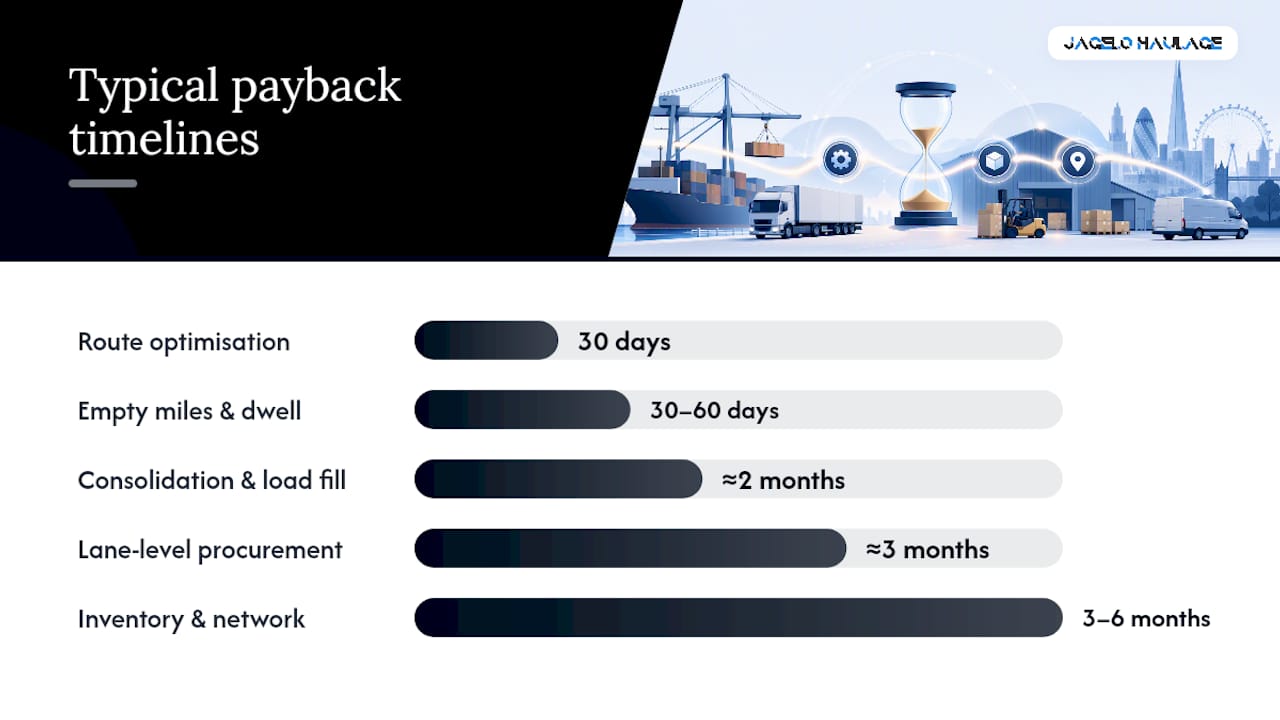
Seven moves deliver most of the savings available to a UK haulage operation: consolidation and load fill, lane-level procurement, route optimisation, a Transport Management System paired with freight audit, cutting empty miles and dwell time, tightening inventory and network design, and smarter driver scheduling with disciplined subcontractor use. Most operators see the first results within 30 to 90 days, with consolidation and route work paying back fastest and procurement or systems changes compounding over two to six months.
Here’s how the timeline typically breaks down and who should own each lever:
- Consolidation and load fill — within about two months, savings on affected lanes. Owner: transport manager.
- Lane-level procurement — within three months, achievable rate reductions depending on lane competitiveness. Owner: procurement.
- Route optimisation — 30 days for quick fixes, with one UK case study reporting a 38% fuel reduction and £140,000 in annual savings after deployment. Owner: transport planner.
- TMS plus freight audit — around three months to implement, ongoing invoice error recovery. Owner: operations/IT.
- Cutting empty miles and dwell time — 30 to 60 days, direct mileage and detention savings. Owner: transport manager.
- Inventory and network tweaks — medium term (three to six months), reduced transport frequency and storage cost. Owner: operations.
- Driver scheduling and subcontractor use — 30 to 90 days, overtime and premium-freight reduction. Owner: operations/finance.
Watch three metrics from week one: cost per shipment, empty miles as a percentage of total mileage, and invoice accuracy rate.
Pro Tip: Pull your last three months of carrier invoices before you touch anything else. You cannot fix a leak you have not measured, and most operators are surprised by what the data already shows.
Key Takeaways
Cutting UK logistics costs depends on measuring empty miles, load fill, and invoice accuracy first, then fixing consolidation, procurement, and dwell time within a 90-day window.
| Point | Details |
|---|---|
| Start with visibility | Baseline cost per shipment, empty miles, and invoice accuracy before changing anything. |
| Fix consolidation first | Enforce postcode and delivery-window rules to lift load fill within 30 to 60 days. |
| Tender lane by lane | Replace national rate cards with lane-specific tenders covering volume, seasonality, and access needs. |
| Automate the audit | Set invoice tolerance rules so only real exceptions need manual review. |
| Choose a tracked carrier | Jhaulage’s GPS-tracked fleet across major UK ports gives operators the visibility needed to validate consolidation and empty-mile savings. |
Table of Contents
- A 30 to 90 day quick-win plan to cut costs fast
- Which transport levers move the largest share of cost?
- How should you structure carrier procurement to cut rate volatility?
- What TMS and freight-audit features actually reduce cost?
- Which warehouse and inventory changes lower transport cost?
- What KPIs and governance keep savings from slipping back?
- How do you build a repeatable cost-reduction programme?
- What does container-haulage best practice look like at UK ports?
- Why most cost-reduction programmes stall before they finish
- How Jhaulage turns these tactics into delivered savings
- Frequently asked questions
- Sources
A 30 to 90 day quick-win plan to cut costs fast
The most effective sequence for freight savings is visibility first, then fixing the biggest leaks, then locking in gains through procurement and systems. Trying to negotiate rates before you understand your own cost base usually backfires.
| Phase | Focus | Key actions | Owner |
|---|---|---|---|
| Days 1 to 30 | Visibility | Audit invoices, map empty miles, baseline cost per shipment | Finance, transport manager |
| 30 to 60 days | Fix top leaks | Enforce consolidation rules, renegotiate worst-performing lanes, cut avoidable dwell time | Transport planner, procurement |
| 30 to 90 days | Procurement & systems | Run lane-level tenders, set invoice tolerance rules, launch weekly carrier scorecards | Procurement, operations |
Practical first steps that need little or no capital:
- Renegotiate the three carriers with the worst on-time or cost variance, using your own scorecard data as leverage.
- Introduce a consolidation rule (same postcode, same delivery window) and enforce it manually until your system can flag it.
- Fix routing errors that create unnecessary detours or repeated visits to the same area on different days.
- Set a 2% invoice tolerance so minor discrepancies clear automatically, freeing staff to chase the errors that matter.
- Launch a weekly carrier scorecard covering cost, on-time delivery, and claims.
Validate each win against GPS mileage logs and invoice line items, not carrier-reported figures alone. Involve your transport planner for routing, procurement for rate work, and finance to confirm the savings actually land on the P&L.
Which transport levers move the largest share of cost?
Empty miles, poor vehicle fill, and dwell time typically account for the largest controllable slice of a UK haulier’s cost base, ahead of fuel price itself. Freight cost management treats consolidation and lane-level control as the fastest levers precisely because they attack these three metrics directly.
Calculate empty miles as a percentage of total mileage run without a loaded trailer. Vehicle fill should be tracked by both weight and cube, since a trailer can be “full” on volume while carrying half its weight capacity. Dwell time is simply the gap between arrival and departure at a site, pulled from your telematics or booking system.
Consolidation rules work best when they are simple and enforced consistently: group by postcode band, by customer, by lane, and by delivery date window. A manual gate (a planner checking bookings each morning) works for smaller fleets. Larger operations need a system flag, because manual consolidation matching is inconsistent at scale.
A worked example: if a route currently runs at 70% fill and a small scheduling change lifts that to 85%, the same volume moves on fewer trailer runs. Cut one run in five off a lane costing £400 per trip, and that is £80 saved per five original trips, before fuel and driver time are even counted.
- Batch deliveries to the same customer cluster within a two-hour arrival window.
- Flag any booking under 40% fill for manual review before it is scheduled.
- Pre-book dock slots where the site allows it, rather than turning up and queuing.
Pro Tip: Ask your biggest three customers for their delivery windows a week ahead rather than a day ahead. Even a small increase in forward visibility lets you consolidate loads that would otherwise run half empty.
How should you structure carrier procurement to cut rate volatility?
Lane-level tendering beats national average rate cards because carriers price risk, seasonality, and backhaul opportunity differently on every lane. A blanket national rate either overpays on easy lanes or underpays on hard ones, and carriers will quietly shed the loss-making work first.
Build your tender pack with these fields as a minimum:
- Lane origin and destination, with postcode-level detail.
- Historic and forecast volumes, including seasonal peaks.
- Access requirements (site restrictions, curfews, appointment booking systems).
- Claims and damage history for the lane.
- Required equipment type and any specialist handling needs.
Decision rules for contract versus spot buying:
- Lanes running more than three loads a week on a stable pattern should go to contract.
- Irregular or seasonal lanes under that threshold are usually cheaper bought on spot, provided you track spot premiums against contract rates quarterly.
- Any lane with volume swings over 30% month to month needs a hybrid: a contracted base rate plus spot capacity for peaks.
Review fuel surcharge clauses for the baseline diesel price, the published index used, and how often it updates. A surcharge that only moves upward, or updates monthly against a weekly index, is a common source of hidden cost. Use scorecard data (on-time rate, claims, invoice accuracy) as a direct negotiation lever at renewal rather than a filing exercise.
Pro Tip: Ask every carrier for their surcharge formula in writing before signing. If they cannot produce it clearly, assume it favours them.
What TMS and freight-audit features actually reduce cost?
A Transport Management System earns its cost fastest when it calculates expected freight cost before a shipment moves, then flags anything the invoice does not match. TMS platforms that hold contracted rates, fuel tables, and service codes give planners a live benchmark rather than a guess.
Prioritise these features:
- Automatic consolidation flags based on postcode, customer, and delivery window.
- Expected-cost calculation at booking, compared automatically against the invoice.
- Rate tables per lane and carrier, updated on contract renewal.
- Carrier selection logic that ranks options by lane performance, not just headline rate.
Freight audit should verify weight, rate, fuel surcharge, and accessorial charges against the contract on every invoice, but set a tolerance (commonly 1 to 2% variance) so small rounding differences clear automatically. That keeps your team focused on the exceptions that carry real money.
Integration priorities are ERP for order data, WMS for shipment readiness, and telematics for actual mileage and dwell time. Operators on a tight budget should still expect measurable invoice-error recovery within the first quarter after go-live, often before the system pays for itself outright.
| Feature | Impact |
|---|---|
| Expected-cost calculation | Catches overbilling before payment |
| Consolidation flags | Reduces empty and part-loaded runs |
| Tolerance-based audit | Speeds approvals, cuts manual checking |
Which warehouse and inventory changes lower transport cost?
Dynamic safety stock, set by SKU volatility rather than a flat rule, reduces the panic shipments that inflate premium freight spend. Fast-moving lines can run lean; erratic or long-lead items need a bigger buffer. Decentralising stock closer to demand improves delivery density, but always calculate total landed cost, including the extra holding cost, not transport savings alone.
Pallet build rules matter more than most operators credit: mixed pallets built to maximise cube, with a simple check at packing, lift vehicle fill without any change to the fleet.
- Segment SKUs by demand volatility, not just volume, before setting safety stock.
- Enforce a minimum cube-fill check on every outbound pallet before loading.
- Slot fast-moving lines nearest the dispatch doors to cut internal handling time.
- Pre-stage tomorrow’s morning loads the evening before, wherever site security allows it.
Pro Tip: Run the total landed cost calculation before decentralising stock. Extra holding cost at a second site can quietly cancel out the transport saving.
What KPIs and governance keep savings from slipping back?
Savings erode quickly without a fixed reporting rhythm. Track cost per shipment, cost per pallet or per kilogram, empty miles by lane, invoice accuracy, and premium freight as a percentage of total spend.
| Cadence | Audience | Focus |
|---|---|---|
| Daily | Transport planner | Empty miles, on-time performance |
| Weekly | Operations manager | Carrier scorecards, exceptions |
| Monthly | Finance and leadership | Cost per shipment/pallet, spend trend |
Automate invoice exceptions with a tolerance rule rather than checking every line manually; route anything outside 2% to a human. Governance needs a named owner for rate-change sign-off and a clear escalation path when a lane drifts outside its cost band.
- Set one invoice tolerance threshold and apply it consistently across carriers.
- Assign a single sign-off owner for any rate change above an agreed value.
- Review the KPI set monthly against the original savings targets, not just against last month.
Pro Tip: Put the KPI dashboard in front of the same three people every week. Savings that only get reviewed at quarter-end have usually already slipped by the time anyone notices.
How do you build a repeatable cost-reduction programme?
A prepare, design, execute framework keeps a savings programme from collapsing into a single round of rate cuts that unwind within a year.
- Prepare — baseline every cost line, agree governance, and appoint an owner before touching any contract.
- Design — pilot changes on two or three lanes, build tender packs, and set clear success criteria before wider rollout.
- Execute — roll out gated by KPI performance, not by calendar date alone.
Scope a pilot narrowly: pick lanes with clean data and a motivated site team, and define success as a specific percentage saving sustained for two consecutive months, not a one-off low invoice.
- Avoid chasing the lowest headline price at the expense of service reliability.
- Do not run more than two or three initiatives in parallel; focus wins.
- Tie early savings directly to the business case for medium-term investment such as a TMS upgrade or structural network redesign.
What does container-haulage best practice look like at UK ports?
Container haulage carries its own cost traps: missed port cut-offs, incomplete documentation, and chassis or trailer delays that trigger demurrage and detention charges. A tight operational checklist protects margin far more reliably than chasing a cheaper rate per move.
- Confirm cut-off times and documentation status the day before collection, not the morning of.
- Track trailer and chassis rotation to avoid unnecessary empty repositioning between ports.
- Build in buffer time around known congestion windows at busy terminals.
- Cross-check booking references against the shipping line’s system before dispatch.
Port-specific timing discipline avoids most avoidable dwell and demurrage charges, particularly at high-volume terminals where slot availability shifts through the day.
Pro Tip: Book your return slot the moment you collect, not after delivery. Terminals fill fast, and a late booking is often what turns a routine move into a chargeable delay.

Better scheduling around known congestion windows has, in practice, eliminated repeated empty repositioning moves for operators running regular port work, converting wasted mileage directly into margin.
Why most cost-reduction programmes stall before they finish
Two mistakes explain most failed savings drives. Operators chase the lowest headline rate without checking lane fit, then discover the cheap carrier cannot hold service on that specific route. Others cut cost without tracking the service trade-off, so on-time performance quietly erodes while the invoice looks better.
Appoint one owner for the whole programme and treat logistics cost as a controllable line on the P&L, not a fixed overhead. The real prize is structural optimisation, not a single round of short-term cuts that unwinds within a year.
How Jhaulage turns these tactics into delivered savings
Consolidation and lane-level procurement work best when the carrier behind them actually has the port coverage and tracking to back it up. Jhaulage runs tracked container haulage across Felixstowe, Tilbury, Southampton, and Liverpool, with a fleet of over 40 trucks and trailers fitted with GPS tracking, so every load in this article’s consolidation and empty-miles playbook is visible in real time rather than tracked on trust.
Where the article recommends piloting changes on two or three lanes before wider rollout, that is exactly the scale Jhaulage works at with new operators. A short cost review across your busiest port lanes, backed by 24/7 support, shows where empty miles and dwell time are actually costing you before you commit to a wider contract. If your current haulage costs feel out of step with the levers covered here, start with a container haulage cost review and see what a lane-level tender against your own data actually returns.
Frequently asked questions
What are the fastest UK logistics operator cost reduction tips to implement? Consolidation rules and route fixes deliver the quickest results, typically within 30 to 60 days, because they need no new contracts or system spend, just enforced scheduling discipline.
How much can lane-level procurement actually save? Rate reductions of 3 to 10% are realistic on lanes moved from national averaging to lane-specific tendering, depending on how competitive that particular lane already was.
Do I need a TMS before I can reduce freight costs? No. Manual consolidation and invoice checks can start immediately; a TMS accelerates and scales the same controls once volumes justify the investment.
What is the single most common mistake in cost-reduction programmes? Chasing the lowest headline rate without checking whether that carrier can actually hold service on the specific lane, which erodes the saving through failed deliveries and claims.
How do I measure whether a cost-saving change is actually working? Track cost per shipment, empty miles, and invoice accuracy weekly against your baseline, and validate against GPS mileage logs rather than carrier-reported figures alone.
Sources
- Freight cost management guide: how logistics teams control shipping costs
- Ai-si
- Reduce logistics costs: complete 2026 strategy guide