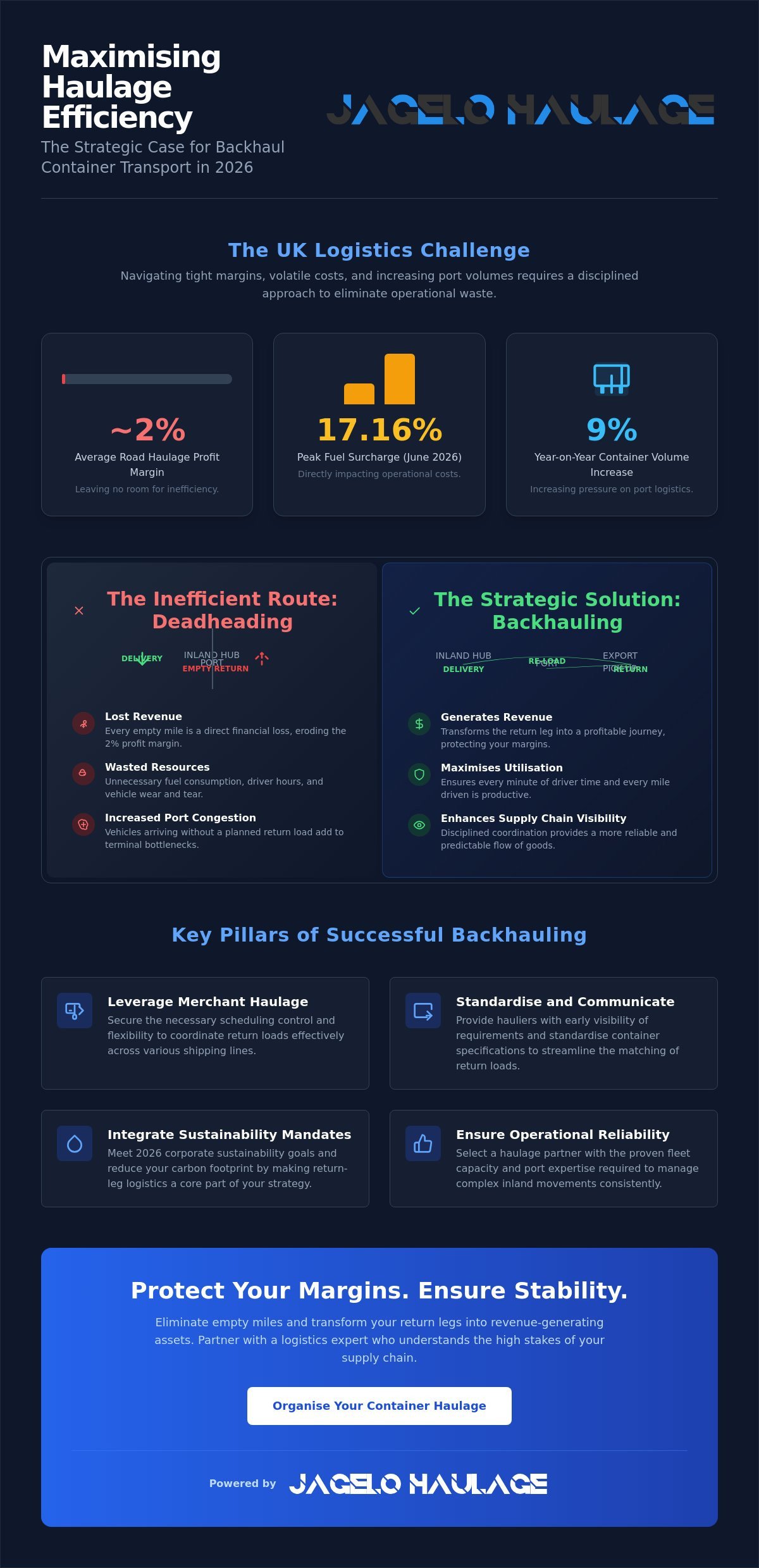
With average road haulage profit margins compressed to approximately 2%, every empty mile represents a direct threat to your operational stability. Managing a fleet in 2026 requires more than just movement; it demands the strategic elimination of wasted capacity. You understand that fuel surcharges, which reached as high as 17.16% in June 2026, leave no room for inefficiency. Implementing backhaul container transport UK is the most direct method to recover these costs and transform return legs into revenue-generating assets.
We recognise the difficulty in coordinating port collections with inland deliveries whilst under pressure to reduce your carbon footprint. This article provides a clear framework for reducing empty miles and securing lower per-container transport rates through disciplined logistics management. You'll discover how professionally managed port logistics can enhance your supply chain efficiency and provide the operational security your business requires. By focusing on the fundamentals of return leg logistics, you can protect your margins against rising port fees and volatile fuel markets.
Key Takeaways
- Distinguish between productive backhauling and costly "deadheading" to identify where operational revenue is being lost to empty miles.
- Utilise merchant haulage to secure the scheduling control necessary for successful backhaul container transport UK across various shipping lines.
- Fulfil 2026 corporate sustainability mandates and reduce transport overheads by integrating return-leg logistics into your core strategy.
- Standardise container specifications and provide hauliers with early visibility of requirements to streamline the matching of return loads.
- Ensure operational reliability by selecting a haulage partner with the fleet capacity and port expertise to manage complex inland movements.
Backhaul Container Transport: A Strategic Definition for UK Logistics
In the high-pressure environment of the 2026 supply chain, backhaul container transport UK represents a fundamental shift from reactive haulage to disciplined capacity management. This process involves the movement of a shipping container on the return leg of a journey, ensuring that a vehicle remains productive throughout its entire transit cycle. Whilst standard transport models often focus solely on the delivery of an import, a strategic backhaul approach integrates the subsequent export movement into the same operational loop. This level of coordination is essential as UK businesses face continued volatility, including fuel surcharges that peaked at 17.16% in mid-2026. Effective haulage requires a masterly command of the fundamentals to ensure no resource is wasted.
Professional fleet management plays a critical role in synchronising these movements. By utilising real-time data and advanced telematics, operators can align port collections with inland deliveries with high precision. This is not merely a matter of convenience; it's a necessary response to the 9% year-on-year increase in container units seen at major UK ports like Felixstowe. Managing this volume requires a partner that understands the high stakes of the supply chain and follows strict protocols to ensure every vehicle movement provides a protected outcome for the client.
The Mechanics of a Successful Backhaul Leg
A successful backhaul operation begins with the completion of an import delivery. Once the container is emptied at an inland hub, the vehicle does not return to the port unladen. Instead, the haulier coordinates a secondary task, such as collecting an export load from a nearby facility using the same equipment. Backhaul is the strategic elimination of empty vehicle movements between UK ports and inland hubs. This requires careful consideration of container type compatibility, as matching a 20ft export with a vehicle currently carrying a 40ft chassis requires specific planning. Technical expertise in Backhaul (trucking) allows professional container haulage providers to maintain a steady, predictable flow of goods even during peak demand periods.
Why "Empty Miles" are the Enemy of Efficiency
Running unladen trucks, often referred to as "deadheading", creates a significant drain on operational revenue. These empty miles contribute to unnecessary wear on the UK motorway network and exacerbate port congestion. When vehicles arrive at terminals without a pre-planned return load, they contribute to the bottlenecks that disrupt just-in-time logistics models. In 2026, the industry has shifted toward high-utilisation transport models to mitigate these risks. Every unladen mile represents a failure to optimise the available capacity. By eliminating these gaps, businesses can achieve more reliable outcomes and lower their overall transport overheads. This methodical approach to logistics ensures that every mile driven contributes directly to the stability and efficiency of the broader supply chain.
The Economic and Environmental Case for Eliminating Empty Miles
Profit margins for road haulage operators were recorded at approximately 2% in 2024. In 2026, these narrow margins leave no room for operational waste. Backhaul container transport UK provides a necessary buffer against this economic volatility. By ensuring vehicles don't run unladen, operators can better absorb fuel surcharges that fluctuated between 7% and 17% in the first half of 2026. This strategy enhances the resilience of the national supply chain against external price shocks and ensures that every mile driven contributes to the bottom line.
Driver time is another finite resource that requires careful management. The introduction of Smart Tachograph Version 2 in July 2026 for international transport has placed even stricter controls on driving hours and rest periods. Backhauling ensures that every minute a driver spends behind the wheel is productive. This methodical approach helps maintain strict compliance with UK working time regulations whilst maximising the output of your existing fleet capacity. It's a disciplined way to manage human and mechanical resources in a high-stakes environment.
Cost-Effective Container Haulage Through High Utilisation
One-way container transport carries significant hidden costs that often go unexamined. When a vehicle returns to a port empty, the client effectively pays for the fuel and driver time of a non-productive journey. High utilisation models allow for more competitive container transport costs by spreading fixed overheads across two revenue-generating legs. Merchant haulage provides the necessary flexibility to coordinate these movements across different shipping lines. This reduces the average rate per movement and provides a more stable pricing structure for long-term contracts.
Sustainability as a Strategic Logistics Outcome
Corporate sustainability is no longer an optional extra; it's a core requirement for 2026 procurement tenders. Large-scale logistics contracts now frequently demand evidence of high vehicle utilisation as a prerequisite for partnership. Reducing empty miles is the most direct method to lower total fleet emissions without requiring immediate, wholesale changes to vehicle technology. Government initiatives focused on decarbonising road freight have highlighted that unladen running is a primary target for industry-wide improvement.
Positioning backhaul efficiency as a key performance indicator (KPI) allows businesses to meet their green logistics targets whilst maintaining operational safety. As the EU Emissions Trading System expands in 2026 to cover more greenhouse gases, the financial implications of inefficient transport will only increase. Adopting a high-utilisation model is a masterly way to future-proof your operations against these regulatory shifts. You can request a bespoke haulage assessment to determine how these efficiency gains can be applied to your specific supply chain requirements.
Leveraging Merchant Haulage for Superior Backhaul Flexibility
Merchant haulage provides the operational autonomy required to synchronise diverse logistical requirements. Unlike shipping line haulage, which is confined to the carrier's specific inventory, merchant haulage allows for the cross-pollination of import and export tasks. This is the cornerstone of effective backhaul container transport UK. You gain the ability to coordinate with multiple shipping lines simultaneously. This flexibility is essential for finding backhaul opportunities that would otherwise be missed under a single-carrier model. It's about maintaining control over your own supply chain assets.
Professional hauliers with a dedicated fleet can adjust to same-day changes, ensuring that a vehicle never waits unproductively at a terminal. This level of responsiveness is vital when port congestion or off-schedule vessel arrivals threaten to disrupt your delivery windows. By choosing an independent partner, you prioritise the safety and efficiency of your own operations rather than being beholden to a carrier's internal scheduling priorities. This methodical approach ensures that your cargo moves with the consistency and protection that a serious corporate operation demands.
Merchant Haulage vs Shipping Line: The Strategic Choice
Shipping lines often operate on rigid structures that don't account for your specific inland delivery windows. A strategic comparison of merchant haulage vs shipping line options reveals that independent control is the most reliable way to maximise backhaul potential. Merchants prefer to control their own transport to ensure they aren't locked into a single line's equipment availability. This independence allows for the immediate adjustment of routes when port conditions change, ensuring that return legs are always utilised to their full capacity.
Coordinating Across Major UK Ports
Navigating the complexity of UK maritime hubs requires a partner with broad operational reach. Whether collecting from Felixstowe, London, or Liverpool, your logistics provider must manage specific terminal requirements and customs documentation with precision. This includes handling the £70.51 Import Security fee at Liverpool or the £38.06 Security and Infrastructure charge at Felixstowe without delay. Such expertise is a key component of a UK government report on supply chain resilience, which highlights the need for transport efficiency and decarbonisation.
A dedicated fleet of over 40 trucks ensures that you have the reliable capacity needed for complex inland container deliveries. Professional haulage providers use this scale to provide the responsiveness required for same-day backhaul adjustments. This methodical coordination ensures that backhaul container transport UK remains a viable, cost-saving strategy for your business. By standardising your approach across all major UK ports, you create a more stable and predictable logistics framework that can withstand the high stakes of the modern supply chain.
Best Practices for Organising Efficient Return Leg Logistics
Success in backhaul container transport UK depends on the methodical exchange of information between the merchant and the haulier. You must provide haulage partners with visibility of both import and export requirements at least 48 hours before the vessel arrives. This early communication allows for the strategic pre-allocation of return loads, ensuring that a vehicle's journey remains productive. Standardising container sizes simplifies the matching process significantly. It's more efficient to secure a backhaul for a 40ft high cube if the export requirement matches the incoming equipment type, as this avoids the need for chassis swaps at the port.
Digital logistics platforms are now a core requirement for real-time fleet tracking and scheduling. These systems provide the transparency needed to manage inland container haulage with high precision. Prompt container turnaround at your distribution centres is equally critical for maintaining schedule integrity. If a container isn't emptied and ready for collection within the agreed two-hour window, the vehicle may miss its subsequent port booking slot. This creates a ripple effect of delays and additional costs, including waiting time charges that typically range from £30 to £50 per hour after the initial free period.
Navigating Port Booking Systems (VBS)
UK terminals such as Felixstowe, London Gateway, and Southampton utilise Vehicle Booking Systems (VBS) to regulate terminal traffic. Professional hauliers manage these slots with disciplined precision to ensure backhaul synchronisation. A missed VBS window can result in terminal penalties and the loss of a productive return leg. Reliable port logistics providers understand these strict delivery windows and follow rigorous protocols to ensure timely entry and exit. This level of organisation is essential for maintaining the just-in-time logistics model in high-pressure port zones.
Site Access and Container Handling
Your inland sites must be organised for rapid container exchange to maintain the stability of the supply chain. Modern trailers and high-specification equipment facilitate secure container transport, but they require adequate space to operate safely. To verify site suitability for 40ft container movements, you must ensure that access roads are clear of obstructions and that turning circles meet the minimum requirements for standard HGVs. This preparation protects the safety of the operation and minimises the risk of mechanical damage or delivery failures. To optimise your return leg logistics, request a professional haulage assessment today.
Ensuring Operational Stability with Professional Container Haulage
Maintaining operational stability in the UK logistics sector requires a partner that understands the high stakes of the 2026 supply chain. Jagelo Haulage brings 15 years of industry experience to every movement, providing the technical expertise needed to navigate complex port regulations and terminal bottlenecks. This depth of knowledge is essential for managing the variables of backhaul container transport UK, where timing and equipment compatibility are paramount. A disciplined approach to logistics ensures that import deliveries and export collections are handled with the precision required to protect your business margins.
Reliability in this sector is built on the foundation of consistent performance and rigorous protocols. Nationwide operators require responsive customer support that can provide immediate updates and resolve scheduling conflicts before they impact the bottom line. By positioning transport as a strategic outcome rather than a mere physical task, you can ensure your cargo moves through a managed system designed for maximum efficiency. This stoic focus on the fundamentals allows your team to focus on core operations whilst we manage the complexities of the road network.
A Modern Fleet for a 2026 Supply Chain
The technical advantages of a professionally maintained fleet cannot be overstated. Jagelo Haulage operates a modern fleet of over 40 trucks, providing the reliable capacity necessary to absorb the fluctuations of port demand. This scale is vital for ensuring same-day delivery responsiveness, as it provides the operational buffer needed when vessels arrive off-schedule. A larger fleet allows for the flexible allocation of resources, making it easier to secure the return loads that define successful backhaul container transport UK.
Each vehicle in our fleet meets strict equipment standards to ensure the safety and security of every container movement. You can review our container transport fleet guide to understand the specifications we maintain to support UK port logistics. High-specification trailers and Euro VI compliant engines ensure that your goods are transported using equipment that meets both environmental mandates and operational requirements. This methodical investment in hardware is a hallmark of a professional haulage partner committed to long-term stability.
Your Strategic Partner in Port Logistics
Choosing a haulage partner is a decision that impacts the entire resilience of your supply chain. Jagelo Haulage provides more than simple transport; we deliver strategic logistical outcomes that align with your corporate objectives. Our no-nonsense approach to complex haulage requirements means that we prioritise performance over self-promotion. We understand that punctuality and protocol are the benchmarks of a successful partnership in the industrial sector. This disciplined mindset ensures that every container, whether an import or a backhaul export, is treated with the same level of professional care.
Initiating a partnership for optimised UK container transport begins with a clear assessment of your current requirements. We work with you to identify where empty miles can be eliminated and where merchant haulage can provide greater flexibility. By integrating our 15 years of experience into your logistical framework, you secure a partner that is as committed to your operational safety as you are. Secure your supply chain today by contacting our team for a bespoke consultation on your nationwide container movements.
Securing Your Supply Chain for the Future of UK Logistics
Optimising return leg logistics is no longer a secondary consideration but a core requirement for operational resilience. You've seen how merchant haulage provides the scheduling control needed to eliminate empty miles and meet 2026 sustainability mandates. Implementing a disciplined strategy for backhaul container transport UK ensures that every vehicle movement contributes to your bottom line whilst reducing unnecessary port congestion.
Jagelo Haulage provides the steadfast professionalism required to manage these complex inland movements. With 15+ years of industry experience and a modern fleet of over 40 trucks and trailers, we offer the specialist expertise in major UK port logistics your business demands. We follow strict protocols to ensure your cargo is handled with the highest level of security and efficiency. Contact Jagelo Haulage for a professional container transport quote to begin optimising your nationwide logistics. We look forward to securing your operational outcomes through reliable, managed transport.
Frequently Asked Questions
What is the difference between backhaul and drayage in UK logistics?
Drayage refers to short-distance transport between a port and a nearby terminal, rail hub, or warehouse. Backhaul involves the strategic movement of a container on the return leg of a longer journey. Whilst drayage is a specific task within port logistics, backhauling is a comprehensive strategy used to eliminate empty miles across the wider UK road network.
How much can backhaul container transport save on shipping costs?
Utilising backhaul container transport UK reduces the average rate per movement by spreading fixed operational costs across two revenue-generating legs. It eliminates the wasted expense of running unladen vehicles. This strategy provides a necessary buffer against fuel surcharges, which reached 17.16% in June 2026, and helps maintain stable transport overheads for long-term contracts.
Can backhauling be used for both 20ft and 40ft containers?
Backhauling is compatible with both 20ft and 40ft containers. However, matching is most efficient when the import and export requirements share the same equipment specifications. This avoids the need for time-consuming chassis swaps at the terminal or distribution centre. Standardising your container requirements is a key best practice for maintaining a steady, predictable logistics flow.
What are the main challenges in organising a backhaul return leg?
The primary challenges involve scheduling synchronisation and equipment compatibility. Coordinating an export collection immediately after an import delivery requires precise timing to meet strict port booking (VBS) slots. Any delay at the inland site can disrupt the subsequent leg, making early communication and real-time fleet tracking essential for successful return-leg logistics.
Do I need different insurance for backhaul container movements?
Standard Goods in Transit insurance typically covers backhaul movements, but you must verify that the policy limits reflect the value of the specific cargo being transported. Some high-value or hazardous goods require specialised coverage. Professional hauliers maintain rigorous insurance protocols to ensure every movement provides a protected outcome for the client's assets.
How does backhauling help with UK port congestion in 2026?
Backhauling helps mitigate port congestion by reducing the total number of vehicle movements required to move the same volume of goods. By ensuring trucks don't enter or leave terminals unladen, the industry can better manage the 9% year-on-year increase in container units seen in early 2025. This high-utilisation model is a masterly way to ease terminal bottlenecks.
Is backhaul transport available from all major UK ports?
Backhaul transport is available from all major UK maritime hubs, including Felixstowe, London Gateway, Southampton, and Liverpool. Professional logistics partners with a nationwide operational reach can coordinate return legs across these diverse terminals. This ensures that your supply chain remains resilient regardless of which port your cargo enters or exits.
Can same-day delivery be combined with a backhaul strategy?
Same-day delivery can be combined with a backhaul strategy if the logistics provider maintains a sufficiently large fleet. A modern fleet of over 40 trucks provides the capacity needed for this level of responsiveness. Precise scheduling and real-time data analysis allow for the rapid scaling of operations to meet urgent delivery requirements whilst still utilising return-leg capacity.