Just-in-time container haulage: examples that actually work

Just-in-time container haulage is the scheduled movement of shipping containers from port to door, timed to a “container ready” signal rather than a vessel’s estimated arrival. The distinction matters because ETAs are marketing dates; container-ready status is an operational fact. Four patterns cover most of what freight forwarders and supply-chain managers actually commission:
- Same-day port lift — urgent replenishment via pre-booked terminal slot
- Off-port pre-staging — holding yards feeding frequent micro-deliveries
- Scheduled multi-drop runs — one trailer, several warehouse appointments, minimal empty mileage
- Synchromodal flexible routing — active replanning when a terminal or service slips
The most reliable route to all four is a specialist, GPS-tracked haulier that treats pre-arrival planning and appointment discipline as core service, not an add-on.
Key Takeaways
JIT container haulage succeeds when schedules trigger on container-ready status, not vessel ETA, and when a single accountable party owns the booking-to-delivery chain.
| Point | Details |
|---|---|
| Trigger on container-ready, not ETA | Vessel arrival does not guarantee release; customs and terminal pickup determine the real delivery window. |
| Match the pattern to the need | Use same-day lifts for urgent stock, multi-drop runs for consolidated volume, staging for micro-deliveries. |
| Lock VBS slots and chassis early | Pre-arrival planning prevents the appointment scarcity that causes most missed windows. |
| Plan street turns from the outset | Reusing containers for export loads cuts empty mileage and detention risk. |
| Commission a specialist haulier | Jagelo Haulage runs GPS-tracked, 24/7 port-to-door services built around this exact checklist. |
Table of Contents
- Examples of just-in-time warehouse logistics in port-to-door haulage
- How to set up JIT container haulage: an implementation checklist
- Why JIT container haulage schedules break down
- How Jagelo Haulage runs these patterns as a pilot
- Sources
Examples of just-in-time warehouse logistics in port-to-door haulage
Most guides to JIT inventory management talk about production lines and safety stock. Container haulage sits one layer upstream: it is the physical mechanism that makes JIT replenishment possible in the first place. Here are four scenarios you can lift almost directly into a haulier brief.
1. Same-day port lift for urgent replenishment. The trigger is simple: the container shows “available for collection” on the terminal system, and a Vehicle Booking System (VBS) slot is already reserved against it. The haulier tasks a driver the moment both conditions are met, not when the ship docks. This suits retailers and manufacturers running lean stock who cannot absorb a delayed delivery. The critical task here sits with whoever owns port account access — usually the freight forwarder or the haulier’s port desk — because a missed VBS slot can push the whole job into the following day’s congestion.
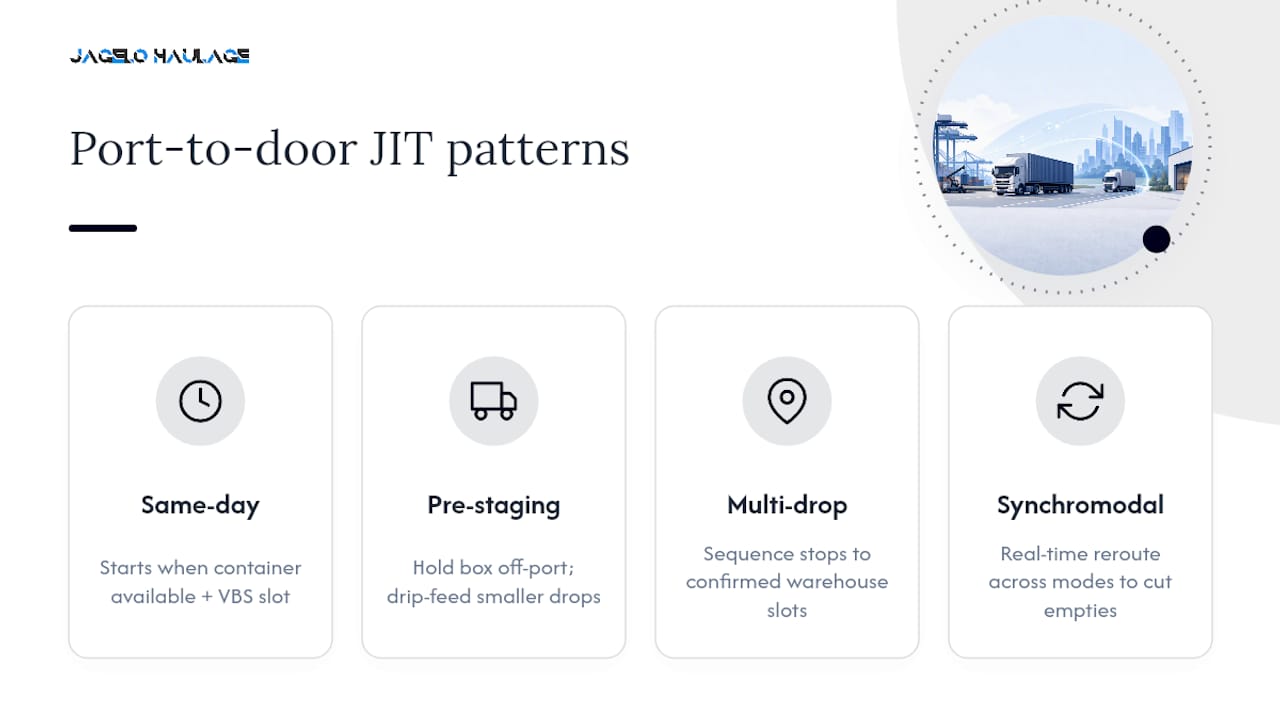
2. Off-port pre-staging for micro-delivery bursts. When a warehouse needs several small drops across a week rather than one bulk delivery, the haulier collects the full container and holds it at an off-port yard, then breaks the run into smaller loads timed to receiving windows. Weekend and after-hours gate access becomes useful here, since terminal congestion during standard weekday hours often makes bulk collection slower than staging the box early and drip-feeding deliveries when the warehouse actually has dock space.
3. Scheduled multi-drop runs aligned to warehouse appointments. Instead of one container to one door, a single trailer load plan serves multiple recipients on fixed appointment windows. This only works when the haulier’s transport management system (TMS) can sequence stops against confirmed warehouse slots rather than guesswork, and it materially reduces empty running between deliveries. Distribution centre operators managing several smaller consignees tend to find this the most cost-effective pattern once volumes justify consolidation.

4. Synchromodal or flexible rerouting. When a scheduled sailing, rail leg, or terminal slot falls through, the load moves to whichever mode or route is next available rather than waiting for the original plan to recover. Research into synchromodal co-planning shows that jointly replanning container routes and vehicle deployment, rather than treating each leg as fixed, reduces empty-mile peaks and improves fleet utilisation compared with passive scheduling. The underlying technique, model predictive control applied to container and vehicle routing, allows planners to re-optimise in real time rather than rebuild a schedule from scratch every time a link breaks.
Pro Tip: Brief your haulier on which of these four patterns you need before asking for a quote. A same-day lift and a multi-drop run require different fleet allocation, and conflating them in a single RFQ usually produces a vague, padded price.
How to set up JIT container haulage: an implementation checklist
Commissioning a JIT haulage service works best as a sequence, not a wish list handed to a haulier and hoped for. Work through these five items before you sign off a pilot or a standing contract.
- Confirm the VBS slot and chassis availability before fixing a delivery window. A terminal appointment without a matching chassis is not a booking, it is a placeholder, and chassis shortages are one of the most common reasons a “confirmed” slot slips.
- Pre-file customs so “container ready” is a real, visible event. If clearance is still pending when the box hits the yard, your trigger point moves days later than planned, and every downstream appointment inherits the delay.
- Mandate specific GPS/TMS alerts, not general tracking. Ask for container-ready, gate-out, and estimated-arrival-at-warehouse notifications by name; a haulier offering only a map pin is not offering visibility, it is offering reassurance.
- Agree receiving-window tolerances and a written contingency plan. Define what happens to a missed appointment: reschedule fee, next available slot, or escalation contact, and put it in the SLA rather than assuming goodwill will cover it.
- Set empty-return and street-turn rules up front. Allowing the haulier to reuse a container for an outbound export load, rather than sending it back to the terminal empty, reduces empty mileage and detention exposure considerably.
The reason ETA-based planning keeps failing is structural, not incidental: port-to-door reliability depends on everything that happens after the vessel arrives — customs release, terminal pickup, and drayage — and none of that is guaranteed by an on-time berthing. A punctual ship with a slow customs queue behind it still produces a late delivery.
A dedicated GPS tracking system closes the visibility gap this checklist depends on, turning “container ready” from a terminal notification into an alert your warehouse team can plan against directly.
Why JIT container haulage schedules break down
Vessel ETA and container availability are not the same thing, and treating them as interchangeable is the single most common planning error in JIT haulage. A ship can dock on time while the container sits behind customs hold or a full discharge queue for another two days. Build schedules around terminal release and clearance status, not the shipping line’s arrival notice.
Terminal appointment scarcity causes the second most frequent failure. Ports running near capacity release VBS slots in narrow windows, and hauliers without pre-arrival planning end up chasing whatever is left. Specialist operators run a form of pre-arrival “war room” coordination days before berthing, securing primary slots and identifying alternates so a cancelled booking has a fallback rather than a scramble.
Driver hours and road congestion account for a third failure pattern, particularly on tight same-day runs. Weekend and night gate access, where terminals offer it, lets hauliers move critical loads outside statutory driving-hour pinch points and away from peak road congestion. Combine that with disciplined street-turn and empty-return planning, and you remove two of the most common sources of both cost and delay: wasted empty trips and demurrage clocks that start running before anyone notices.
How Jagelo Haulage runs these patterns as a pilot
Jhaulage is built around exactly the checklist above, not as marketing language but as daily operating procedure. Its fleet of more than 40 GPS-tracked trucks and trailers covers the UK’s major container ports, and 24/7 support means a container-ready alert at 2am on a Sunday gets a response rather than a voicemail.
Each of the four example patterns maps to a service Jagelo already runs. Same-day port lifts are handled through pre-booked slot management across ports including Felixstowe, Tilbury, Southampton, and Liverpool. Multi-drop runs are planned against confirmed warehouse appointment windows rather than approximate delivery days. Off-port staging and street-turn management reduce both dwell time and empty mileage, keeping detention and demurrage exposure down for consignees running lean stock. For a broader view of port coverage and the practical differences between terminals, Jagelo’s guide to UK port logistics is worth reading before you brief a pilot.
If you are testing JIT haulage for the first time, request a quote through Jagelo Haulage and have three things ready: your typical container volume per week, the receiving windows your warehouse can realistically hold open, and whether you need standing capacity or a short trial run. That information lets Jagelo scope a pilot against real numbers rather than generic service tiers, and get a driver briefed before your first container even clears customs.
Sources
- A real-time synchromodal framework with co-planning for routing of containers and vehicles (TRC, 2023)
- Simultaneous planning of container and vehicle-routes using model predictive control (ECC, 2019)
- Port-to-door freight reliability in 2026 | Movargo
- Street-turn solution discovered — it will work, expert advice | FreightWaves