Part of our guide to container haulage from Southampton
In an era of escalating port tariffs and volatile energy adjustments, operational discipline remains the only effective hedge against supply chain disruption. You likely understand the frustration of watching port demurrage fees accumulate whilst waiting for a delivery window that never materialises. These logistical bottlenecks, often exacerbated by poor communication and limited fleet capacity, create unnecessary financial strain on your operations. This guide provides a professional framework for managing Southampton container haulage with the precision required to eliminate these delays and stabilise your logistics costs.
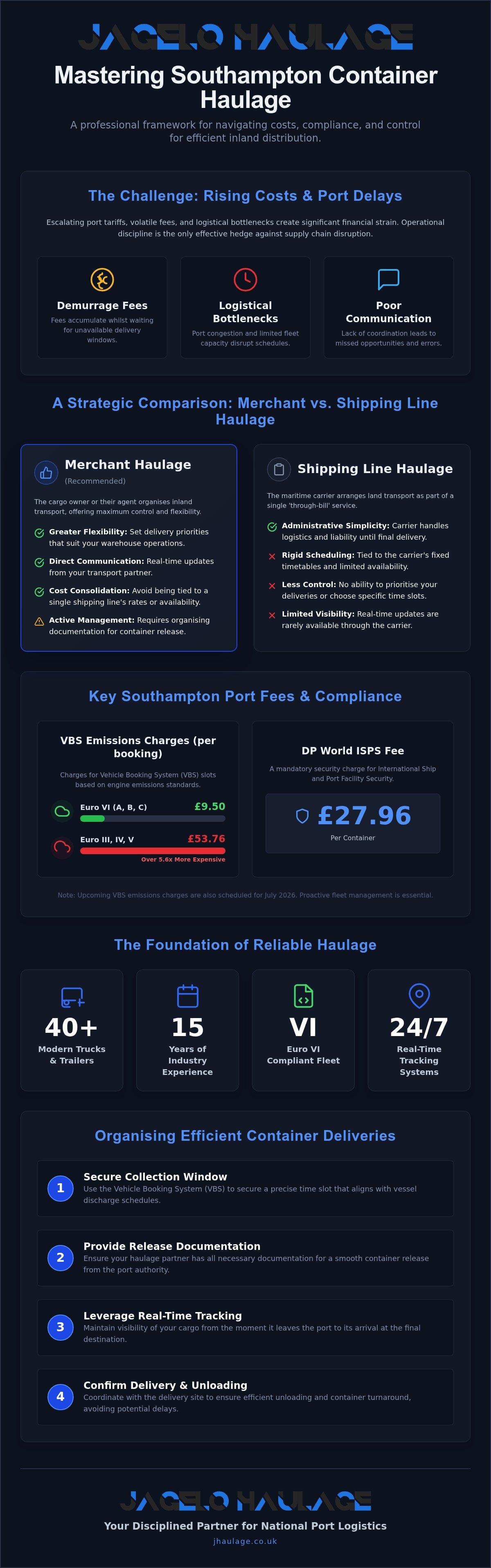
Reliability in port-to-door transport is built upon technical competence and a commitment to strict protocols. As the industry faces new challenges, such as the July 2026 VBS emissions charges and the £27.96 ISPS fee at DP World Southampton, the need for a strategic partner becomes paramount. You'll learn how to navigate these regulatory shifts, maintain consistent delivery schedules, and leverage a modern fleet of over 40 trucks to protect your cargo. We will outline the essential steps for securing merchant-controlled haulage that prioritises your delivery deadlines over port-side convenience.
Key Takeaways
- Learn how operational discipline serves as a safeguard against port congestion and escalating storage fees.
- Evaluate the strategic benefits of merchant haulage to achieve greater flexibility and control over your inland distribution.
- Identify the fleet capacity and maintenance standards necessary for reliable Southampton container haulage and secure transit.
- Master the step-by-step requirements for organising efficient container deliveries from major UK ports to inland destinations.
- Discover why professional management and a modern fleet are the primary indicators of a dependable long-term logistics partner.
The Critical Role of Professional Container Haulage in the Supply Chain
Professional container haulage provides the critical bridge between maritime arrival and inland distribution. This service anchors a global system of intermodal freight transport by ensuring that goods move efficiently from the terminal to the final warehouse. Southampton container haulage requires a disciplined operational framework. Port logistics are inherently complex; a lack of coordination leads to immediate storage fees and supply chain disruptions. Choosing a partner with a permanent presence at major UK maritime hubs is a strategic necessity to maintain the integrity of the national supply chain.
Navigating Port Logistics Challenges
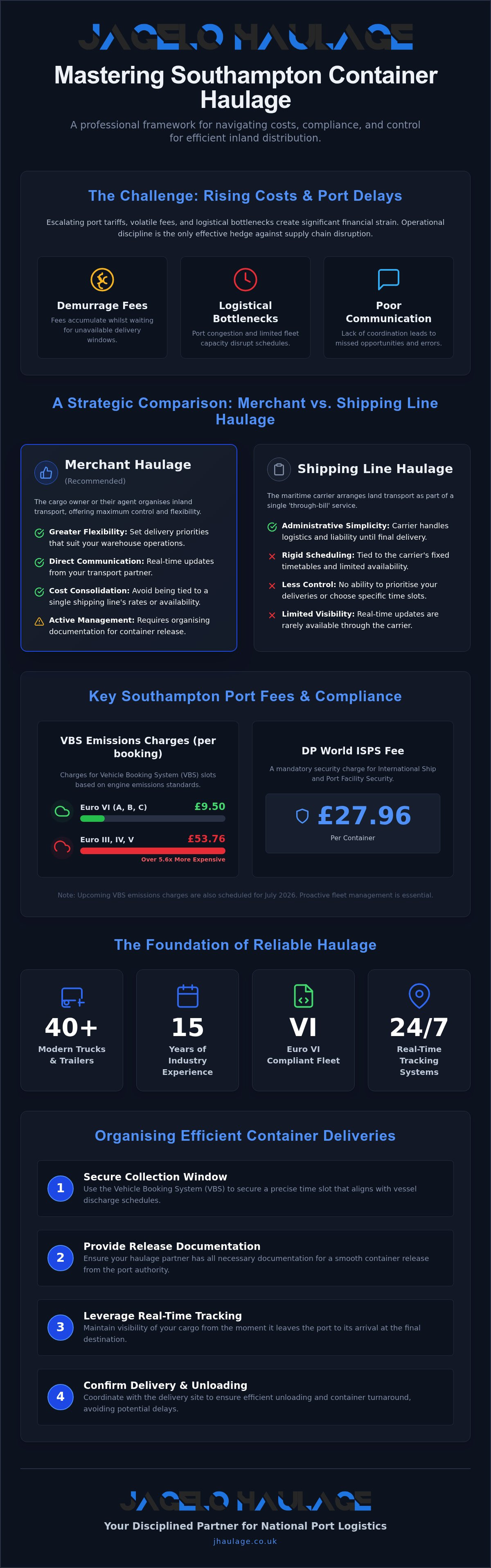
Port congestion is a constant variable that requires active management to prevent escalating costs. We use the Vehicle Booking System (VBS) to secure precise collection windows that align with vessel discharge schedules. Clear communication between the port authority, the transport provider, and the delivery site is essential to avoid demurrage. A disciplined approach ensures compliance with port regulations, such as the VBS emissions charges. These include a £9.50 fee for Euro VI A, B, and C vehicles, whilst Euro III, IV, and V engines face a £53.76 charge per booking. Managing these variables is fundamental to protecting your operational budget.
The Value of an Established Haulage Fleet
Operational resilience is a direct result of fleet scale and technical expertise. Jagelo Haulage manages a modern fleet of over 40 trucks and trailers, offering the capacity required for large-scale Southampton container haulage. This resource allows us to maintain delivery schedules even when port conditions fluctuate. Our fleet is equipped with real-time tracking systems and Euro VI compliant engines to meet the environmental standards of DP World terminals. This investment in modern equipment reduces the risk of mechanical failure and ensures that your goods are moved by a professional team that understands the high stakes of the supply chain.
With 15 years of industry experience, we provide a structured approach to both merchant and shipping line haulage. Strict maintenance protocols ensure consistent transit performance and cargo security. We treat every container delivery as a strategic priority, following strict safety protocols to protect your inventory from the moment it leaves the port. We focus on the fundamentals of logistics to deliver reliable outcomes for every client.
Merchant Haulage vs Shipping Line Haulage: A Strategic Comparison
Choosing between merchant haulage and shipping line haulage is a fundamental decision that dictates the level of control you maintain over your supply chain. Merchant haulage occurs when the cargo owner or their agent instructs an independent contractor to collect a container from the port. In contrast, shipping line haulage involves the maritime carrier arranging the land-based transport as part of a combined freight rate. Within the UK road freight transport market, the demand for merchant-controlled solutions is rising because it allows businesses to bypass the rigid scheduling of large carriers. When organising Southampton container haulage, understanding these nuances ensures that your transport model aligns with your operational priorities.
The Benefits of Merchant Haulage
Logistics managers often prefer merchant haulage for the increased flexibility it provides at the terminal. You gain the ability to set delivery priorities and select specific time slots that suit your warehouse operations. This model requires more active management, as you're responsible for ensuring the haulier has the necessary documentation for container release. However, this administrative requirement is offset by the ability to consolidate your transport spend. When you manage your own Southampton container haulage, you aren't tied to the operational constraints or limited fleet availability of a single shipping line. Direct communication with the transport manager provides real-time updates that are rarely available through carrier-arranged services, which is vital for maintaining consistent inland container deliveries.
When to Utilise Shipping Line Haulage
Shipping line haulage remains a viable option for businesses that prioritise administrative simplicity over granular control. This 'through-bill' approach means the carrier retains liability for the cargo until it reaches its final destination, which can be beneficial for high-value goods. It simplifies the initial booking process by bundling sea freight and land transport into a single transaction. Whilst this convenience is attractive, it often comes at the cost of transparency and response times during peak periods when shipping lines may struggle to secure third-party capacity. For a deeper analysis of these trade-offs, you can read our strategic comparison of merchant and shipping line haulage to determine which model suits your current requirements.
Jagelo Haulage supports both transport models, providing the operational versatility needed to manage diverse logistics portfolios across all major UK ports. Our team understands the specific documentation requirements for merchant-controlled moves and the coordination needed for carrier-arranged bookings. If you require a tailored transport solution that prioritises security and performance, you can request a professional haulage assessment to see how our fleet can support your national distribution needs.
Assessing Operational Reliability and Fleet Capacity
Operational reliability in the UK logistics market depends heavily on a haulier's ability to maintain consistent fleet availability. A haulier's fleet size serves as a primary indicator of their capacity to absorb sudden volume spikes without compromising delivery windows. When managing Southampton container haulage, you require a partner that possesses enough resource to navigate terminal delays whilst keeping your inland schedule intact. Smaller operators often lack this resilience, leading to the unreliable delivery windows that result in costly port demurrage fees. Professional management protocols ensure that every container is tracked, giving you the transparency needed to manage your inventory levels with precision.
Maintaining a disciplined transport operation requires more than just vehicle numbers. It demands a rigorous approach to maintenance and equipment standards. Every truck in a professional fleet must undergo regular safety inspections to prevent transit failures that could stall your supply chain. Fully insured transport is not merely a formality; it is a fundamental safeguard for high-value cargo. We frame cargo protection as a strategic outcome, ensuring that your goods are moved under the supervision of a seasoned professional who understands the financial stakes involved in every shipment.
The Importance of a Modern Fleet
A modern fleet is essential for meeting the strict environmental and operational standards of major UK ports. Euro 6 compliant vehicles are now a requirement for cost-effective Southampton container haulage, as older engines face significantly higher emissions charges at terminals like DP World. Telematics and real-time tracking systems provide the data-driven transparency that modern logistics managers expect. These tools allow for precise monitoring of vehicle location and driver behaviour, ensuring that every delivery follows the most efficient route. We prioritise driver professionalism through continuous training, ensuring that our team follows all port protocols and safety regulations to the letter.
Security and Cargo Protection
Protecting the integrity of your cargo requires a multi-layered security strategy. We implement secure protocols for every shipping container, including the use of monitored transit routes and secure parking facilities for overnight stops. Jagelo Haulage prioritises a 'safety first' approach that covers everything from vehicle loading to the final gate-in at the destination warehouse. This disciplined focus on security reduces the risk of theft or damage, providing peace of mind for clients moving sensitive or high-value goods. By combining 15 years of experience with a fleet of over 40 modern trucks, we provide the secure environment necessary for a stable national logistics operation.
Organising Efficient Inland Container Deliveries
Transitioning a container from a maritime terminal to its final inland destination requires a sequence of disciplined actions. Inefficient data transfer is a primary cause of collection delays; therefore, you must provide your haulier with the container number, the release PIN, and the specific vessel name at least 24 hours before the desired collection. This allows the transport manager to secure a Vehicle Booking System (VBS) slot that aligns with your warehouse intake schedule. Managing the 'last mile' involves more than just driving. It requires precise coordination with site staff to ensure the trailer is turned around quickly, which prevents additional waiting time charges and keeps your yard clear.
Providing accurate information is a fundamental responsibility that protects the efficiency of the entire operation. When data is incorrect, VBS slots are wasted and administrative costs escalate. We frame every inland move as a strategic outcome rather than a mere physical task. This perspective ensures that our drivers and transport managers prioritise the security and punctuality of your goods. Efficient Southampton container haulage depends on this level of professional discipline to bypass the common pitfalls of port-to-door logistics.
Scheduling for Consistency
Long-term transport planning is the most effective way to secure fleet capacity during peak import seasons. By forecasting your volumes, you enable your partner to allocate resource more effectively, reducing the risk of your cargo being left on the quay. Consistent scheduling also allows you to target off-peak terminal windows, which lowers the risk of congestion-related delays. For those concerned with budget management, we recommend you explore our guide to understanding container transport costs to see how planning impacts your bottom line.
Handling Same-Day and Emergency Requests
Emergency requests often occur when vessel delays or production shortages disrupt your standard schedule. Triggering a same-day delivery requires a haulier with significant operational reach and a flexible fleet. Jagelo Haulage maintains the responsiveness needed for these high-pressure scenarios by leveraging our fleet of over 40 modern trucks. Whilst scheduled discipline is our priority, our 15 years of experience allow us to re-route assets quickly to meet nationwide requirements. If you're facing a logistical bottleneck and need immediate support, you can book a secure container delivery to stabilise your operations.
Jagelo Haulage: Your Disciplined Partner for National Port Logistics
Partnering with a seasoned, independent haulage contractor provides a level of accountability that larger, carrier-aligned organisations often lack. Our Suffolk-based operational centre serves as the command hub for managing national transport requirements with precision. We manage every aspect of Southampton container haulage with a commitment to steadfast professionalism and functional reliability. We don't rely on marketing jargon; instead, we focus on the disciplined management of our fleet to ensure your cargo moves according to strict protocols. This grounded approach ensures that your supply chain remains secure and predictable.
Jagelo Haulage operates with a clear focus on the technical requirements of the UK transport sector. We provide a structured environment where every container delivery is managed by a team that understands the high stakes of maritime logistics. Our centre coordinates national moves with the same precision we apply to Southampton container haulage. By choosing a partner that values operational discipline, you secure a stable foundation for your inland distribution. We frame our service as a strategic outcome designed to protect your cargo and your reputation.
Fifteen Years of Proven Competence
We have supported major UK ports and logistics hubs for 15 years, building a reputation for quiet competence and security. This history has allowed us to refine our approach to the fundamentals of port logistics and inland distribution. We understand that reliability is the result of disciplined fleet management and strict maintenance standards. As a privately owned business, we offer a direct line of communication that prioritises your specific operational needs. We treat your delivery deadlines with the same seriousness as our own safety protocols, ensuring a dependable partnership.
Contacting Our Transport Team
Integrating our fleet into your supply chain begins with a professional assessment of your transport requirements. Providing your container volumes, destination profiles, and preferred scheduling early allows our team to build a bespoke haulage solution. Early engagement is particularly vital for high-volume port logistics projects to ensure consistent capacity during seasonal peaks. A clear exchange of information allows us to allocate the necessary resource to your account. You can contact Jagelo Haulage to discuss your container transport requirements and secure a professional quote for your next inland move.
Securing Your Supply Chain Through Operational Discipline
Effective port logistics require a transition from reactive transport to strategic planning. By prioritising merchant-controlled solutions, you gain the transparency needed to eliminate unreliable delivery windows and reduce port demurrage fees. This framework demonstrates how a disciplined approach to fleet management and terminal coordination creates a stable bridge between maritime arrival and inland distribution.
Jagelo Haulage provides the technical competence required for consistent Southampton container haulage across the UK. With 15 years of operational expertise and a fleet of over 40 modern trucks, we deliver the resilience needed to manage national transport requirements safely. Our nationwide port coverage ensures that your goods are protected by a partner that follows strict protocols and understands the high stakes of your supply chain.
Secure your logistical outcomes by engaging with a transport partner that prioritises performance over self-promotion. You can request a professional container haulage quote from Jagelo Haulage to begin stabilising your inland distribution today. We look forward to supporting your operational goals with the precision your cargo deserves.
Frequently Asked Questions
What is the difference between merchant and shipping line haulage?
Merchant haulage is controlled by the cargo owner through an independent transport partner, whilst shipping line haulage is arranged by the maritime carrier. Merchant haulage offers superior flexibility for Southampton container haulage because you select the haulier and schedule directly. This avoids being subject to the carrier's internal capacity constraints or fixed delivery routes. It's a strategic choice for businesses that require granular control over their inland distribution.
How do I avoid demurrage fees at major UK ports?
You avoid demurrage fees by ensuring containers are collected within the port's free time window. This requires precise coordination between your warehouse, the clearing agent, and the haulier. Providing release documentation 24 to 48 hours before the deadline allows your transport partner to secure a Vehicle Booking System (VBS) slot and prevent expensive storage charges. Discipline in data sharing is the most effective safeguard against these costs.
What information is needed to book a container haulage service?
You must provide the container number, the release PIN, the vessel name, and the final delivery address to book a service. Accurate data is essential to prevent terminal gate-in failures or administrative delays. Including the specific container size and any hazardous cargo declarations ensures the haulier allocates the correct vehicle and trailer combination. This information allows for a seamless transition from the port to your facility.
Can you provide same-day container delivery for urgent cargo?
Same-day container delivery is available for urgent cargo, provided there is immediate fleet availability and a valid VBS slot. Whilst we prioritise scheduled moves for consistency, our fleet of over 40 trucks allows us to respond to emergency requests across the UK. You should contact our transport team as early as possible to verify terminal status and driver location for rapid-response tasks. We treat these requests with professional urgency.
Do you operate from all major UK container ports?
We provide nationwide haulage from all major UK container ports, including Southampton, Felixstowe, London Gateway, and Tilbury. Our Suffolk-based operational centre manages these national requirements with a disciplined focus on port-to-door efficiency. This comprehensive coverage allows you to consolidate your logistics with a single partner, regardless of where your maritime freight arrives. We maintain a consistent standard of professionalism across all maritime hubs.
What is the standard fleet size for a reliable haulage partner?
A reliable haulage partner should operate a fleet large enough to absorb terminal delays without impacting your delivery schedule. Jagelo Haulage manages over 40 modern trucks and trailers, which provides the resilience needed for high-volume logistics. This scale ensures that mechanical issues or port congestion don't result in cancelled deliveries. It's a primary indicator of a haulier's ability to support a stable supply chain and provide protected outcomes.
How does Jagelo Haulage ensure the security of my containers during transit?
We ensure container security through strict transit protocols and the use of modern telematics. Every vehicle is tracked in real-time, and drivers follow established safety procedures for secure parking and overnight stops. This disciplined approach to cargo protection is a core component of our professional haulage service. It provides the security needed for high-value or sensitive shipping containers throughout the national road network, ensuring the integrity of your supply chain.
What is a Vehicle Booking System (VBS) and why does it matter?
The Vehicle Booking System (VBS) is an online platform used by UK ports to manage HGV traffic and terminal congestion. Hauliers must book a specific time slot to collect or return a container. Efficient Southampton container haulage depends on a haulier's ability to navigate the VBS effectively. Missing a slot can result in missed deliveries and additional port fees, making VBS management a critical operational discipline for any transport partner.