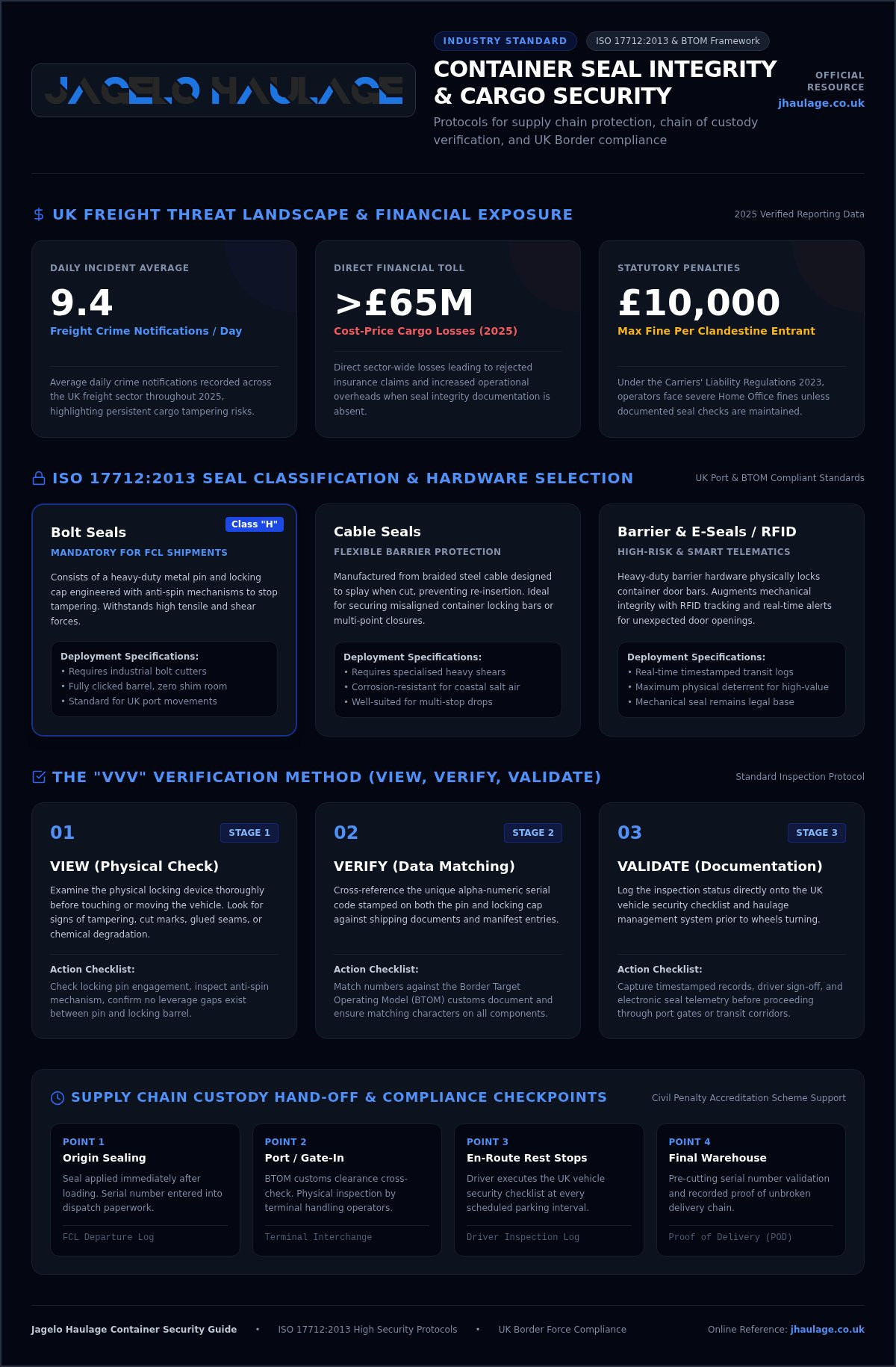
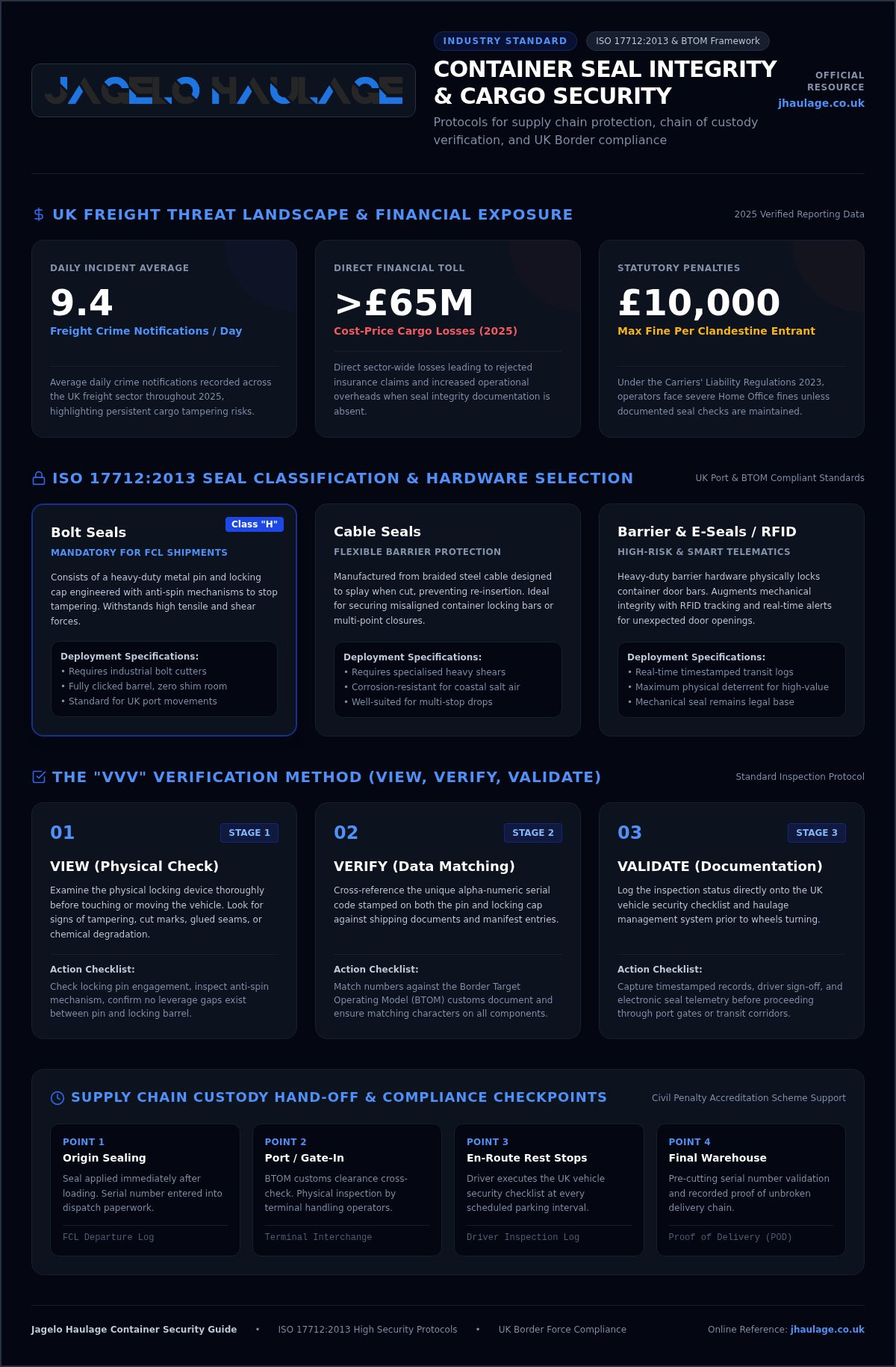
UK freight crime notifications averaged 9.4 reports per day throughout 2025, leading to direct cost-price losses exceeding £65 million. For logistics managers at Jagelo Haulage and across the wider sector, these figures represent more than just statistics; they highlight the persistent risk of cargo tampering and the potential for severe insurance claim rejections. Implementing rigorous container seal integrity procedures is the most effective way to safeguard your shipments and maintain a disciplined chain of custody. You likely recognise that a broken seal or a documentation error can lead to significant operational delays and substantial Home Office penalties.
This professional guide outlines the protocols required to protect your cargo within the UK supply chain. You'll learn to apply the ISO 17712:2013 high-security standards and the VVV verification method to every movement. We provide a clear framework for maintaining compliance with the latest UK Border Force requirements and the Civil Penalty Accreditation Scheme. By following these structured steps, you can reduce liability and ensure your haulage operations meet the highest industry benchmarks for security and reliability.
Key Takeaways
- Identify the technical differences between ISO 17712:2013 bolt and cable seals to ensure your cargo meets international high-security standards.
- Implement the "VVV" (View, Verify, Validate) method as the core of your container seal integrity procedures to detect tampering before transit begins.
- Maintain a disciplined chain of custody by documenting seal numbers at every transfer point, from the port to the final warehouse delivery.
- Reduce your liability for Home Office penalties by ensuring drivers are trained in rigorous inspection protocols and real-time discrepancy reporting.
What is Container Seal Integrity and Why Does it Matter?
Container seal integrity refers to the uncompromised state of a mechanical locking device from the moment it's applied at the origin to its final removal at the destination. It serves as the primary indicator that a shipment's contents remain exactly as packed. For businesses operating in the UK, maintaining this integrity is vital for preventing cargo theft, smuggling, and unauthorised access. With UK cargo crime reports reaching an average of 9.4 incidents per day in 2025, a robust seal represents the first line of physical defence against organised criminal targeting.
A breach in seal integrity often leads to severe financial consequences. Insurance providers frequently reject claims if documentation for container seal integrity procedures is missing or flawed. Beyond the immediate loss of goods, businesses face rising premiums and potential fines from UK Border Force. Under the 2023 Carriers’ Liability Regulations, operators can be fined up to £10,000 per clandestine entrant found in a vehicle, but maintaining secure, documented seals helps mitigate these risks.
The Legal and Commercial Stakes of Seal Security
The concept of the chain of custody defines who's responsible for the cargo at any given time. Liability typically rests with the party currently in possession of the goods, making the hand-off point critical. Accurate record-keeping protects hauliers and cargo owners from fraudulent claims of tampering that may have occurred elsewhere. Implementing these standards is a core component of professional logistics for shipping containers, ensuring that every movement is tracked and verified.
ISO 17712 Standards for 2026
The industry recognises three distinct categories of ISO 17712 security seals: indicative, security, and high-security. Indicative seals are usually plastic and only show evidence of entry, whilst security seals offer a medium level of barrier protection. For international and UK port movements, High Security (H) seals are mandatory. These bolt or cable seals must withstand significant tensile and shear forces to prevent opportunistic opening. The ISO 17712 standard is the global benchmark for mechanical seal testing. Using compliant seals ensures your operations align with the 2025 Border Target Operating Model (BTOM) requirements, where matched seal numbers are essential for customs clearance.
Selecting the Correct Container Seal for Your Cargo
Selecting the appropriate hardware is the first physical step in your container seal integrity procedures. A seal must do more than just provide a visual check; it must offer a physical barrier that matches the cargo's risk profile. In the UK, seals must withstand harsh coastal environments where salt-laden air can corrode inferior metals and compromise the locking mechanism. High-quality seals are uniquely numbered and tamper-evident, ensuring that any attempt to bypass the lock is immediately visible to the driver or port authority during inspection.
By 2026, many professional operators have adopted electronic seals (e-seals) and RFID tracking to augment traditional mechanical locks. These devices provide real-time alerts and time-stamped logs if a container door is opened unexpectedly during inland transit. Even with these digital advancements, the mechanical seal remains the legal benchmark for customs compliance. Drivers must use the UK vehicle security checklist to record seal numbers accurately after every loading event and at every rest stop along the route.
Bolt Seals: The Industry Standard for FCL
Bolt seals are the standard choice for Full Container Loads (FCL) due to their high tensile strength and durability. They consist of a heavy-duty metal pin and a locking cap that requires industrial bolt cutters for removal at the destination. To prevent criminals from using "spinning" techniques to unscrew the seal, modern ISO 17712:2013 compliant bolts include anti-spin mechanisms. Correct application involves ensuring the pin is fully clicked into the barrel, leaving no room for shims or cutting tools to gain leverage between the components.
Specialised Seals for High-Value or Sensitive Goods
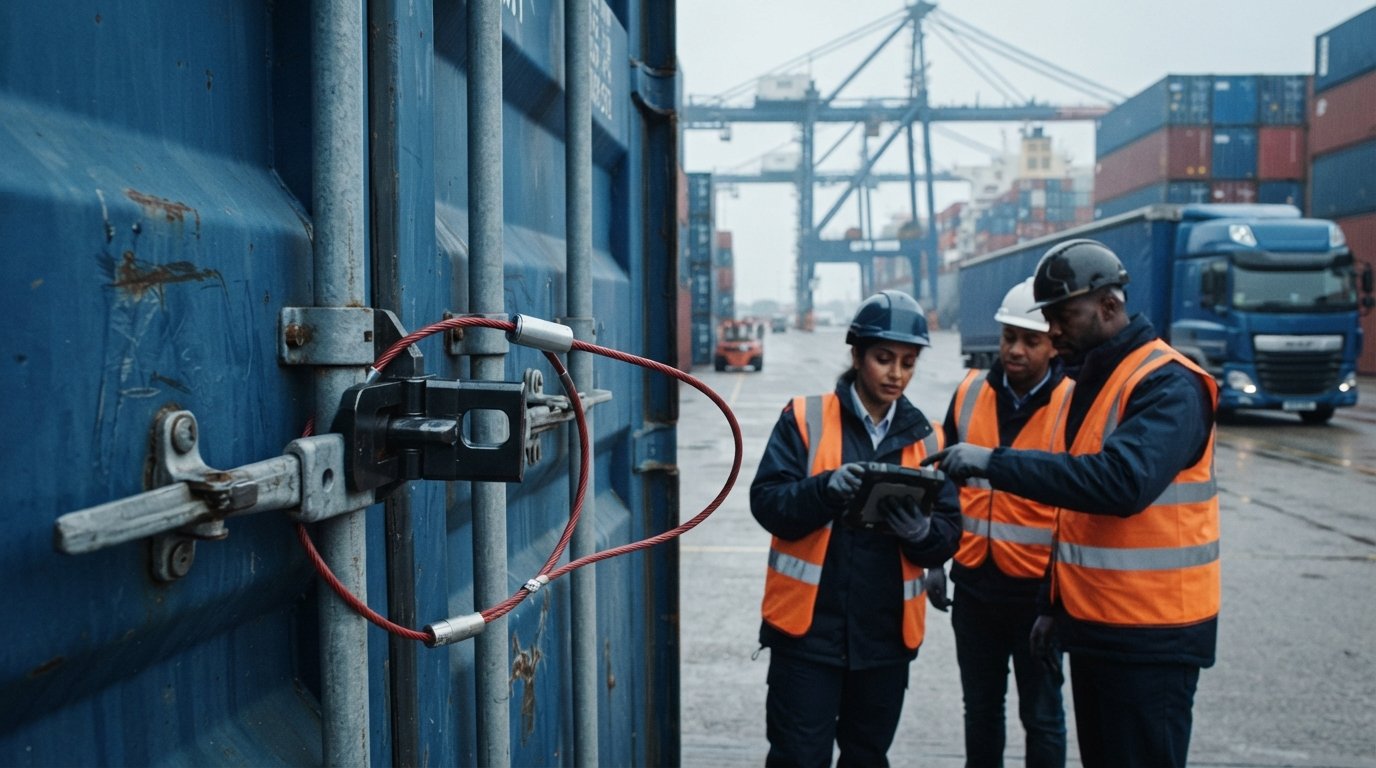
Cable seals offer greater flexibility for containers with misaligned locking bars or for multi-stop deliveries where multiple points must be secured. Their braided steel construction is difficult to cut without specialised heavy-duty shears, making them a deterrent against opportunistic theft. For high-risk movements, barrier seals provide an additional layer of protection by physically blocking the locking rods themselves. Integrating these hardware choices into a broader secure container transport strategy ensures that the hardware matches the operational threat level of the goods. If you require expert advice on the best equipment for your specific cargo requirements, you can request a professional haulage consultation to secure your supply chain.
Step-by-Step Container Seal Inspection Procedure
A physical inspection is the only way to confirm that your container seal integrity procedures are functioning as intended. Security is not a passive state; it requires active verification at every hand-over point in the supply chain. Before checking the seal itself, staff must examine the container's structural integrity. Criminals often target door hinges or locking cams to bypass the seal entirely. Ensure there are no signs of drilling, welding, or false bolt heads that could allow entry without disturbing the locking device. Check the locking bars for any pre-existing damage that might compromise the seal's seat.
Photography protocols are a vital part of a modern security record. Drivers should capture a wide shot showing the container doors and the seal in one frame to prove the context of the shipment. This should be followed by a high-resolution close-up of the engraved seal number. These time-stamped images provide an irrefutable digital audit trail if an insurance claim arises later. Capturing multiple angles ensures that any subtle tampering remains visible to investigators.
The VVV Method Explained
The industry standard for physical verification is the VVV method. This structured approach ensures no detail is overlooked during a busy port or warehouse hand-over:
- View: Conduct a visual assessment of the seal and locking hardware. Look for stress marks, glue residue, or any alteration to the metal surface. Ensure the seal is placed in the correct locking hole on the right-hand door.
- Verify: Confirm the engraved seal number against the Bill of Lading or the Goods Vehicle Movement Service (GVMS) record. Even a single digit discrepancy indicates a potential security breach.
- Validate: Execute a physical pull-test. Firmly grasp the seal and pull downwards and outwards. A properly seated bolt seal will not move; if it slides or detaches, the internal locking mechanism has failed or been bypassed. Rotate the seal to ensure an anti-spin mechanism is active.
Common Signs of Seal Tampering
Sophisticated tampering often involves "sleeving," where a cut seal is hidden inside a metal tube, or using superglue to reattach a severed bolt. Check for misaligned fonts or inconsistent spacing in the engraved numbers. These variations often suggest a counterfeit replacement seal has been applied. Discolouration or fresh paint around the locking bars can also hide evidence of forced entry. If any of these signs are present, the container must be held for a full internal inspection before the driver accepts the load. Strict adherence to these container seal integrity procedures reduces the risk of undetected tampering during inland transit.
Documentation and Managing Seal Discrepancies
Documentation is the final pillar of robust container seal integrity procedures. It serves as the legal evidence that a shipment remained secure throughout its transit. Liability in the UK supply chain is often determined by the last recorded point of verification. If a seal is found compromised at the warehouse but was documented as intact at the port gate, the responsibility for the loss typically shifts to the haulier. Maintaining a precise chain of custody requires recording seal numbers at every point of transfer, including the port terminal, the haulier's possession, and the final delivery point.
Drivers play a central role in this process during inland container haulage. They are responsible for verifying that the physical seal matches the paperwork before leaving the port. If UK Border Force or HMRC selects a container for inspection, they will break the original shipper's seal and apply a new Customs Seal. In these instances, the driver must ensure the new seal number is recorded on the CMR or delivery note and countersigned by the inspecting officer. This step is vital to prove that the change was authorised and not the result of unauthorised access.
The Seal Integrity Log
A professional seal integrity log must capture specific data points to remain valid for insurance and regulatory audits. These include the unique seal number, the date and time of inspection, the exact location, and the name of the individual performing the check. Whilst paper logs remain common, many UK fleets are transitioning to digital security reporting in 2026 to provide real-time visibility to shippers. Any discrepancy must be reported before the container is moved from its current location. Moving a container with a mismatched or broken seal without prior notification can be interpreted as an admission of negligence, potentially voiding insurance cover.
Emergency Protocols for Breached Seals
If a driver discovers a broken or tampered seal during transit, they must follow a strict emergency protocol. The vehicle should be secured immediately, and the driver must notify the fleet controller, the shipper, and the insurer. It's critical that the container is not opened until an official witness or a surveyor is present to document the contents. This disciplined approach helps in mitigating container transport costs associated with prolonged security investigations and legal disputes. To ensure your cargo is handled by professionals who follow these rigorous standards, you can get a quote for secure container haulage with Jagelo Haulage and protect your supply chain today.
Partnering with Professionals for Secure UK Haulage
Professional haulier standards represent the final line of defence in maintaining cargo security across the country. Whilst hardware and documentation are essential, the human element, consisting of the driver and the operations team, determines the success of your container seal integrity procedures. Jagelo Haulage leverages over 15 years of industry experience in UK port logistics to provide a service rooted in functional reliability. Our disciplined approach ensures that every shipment is treated with the seriousness that high-stakes supply chains require. We understand that security isn't merely a box-ticking exercise; it's a fundamental operational requirement that protects your commercial interests.
A modern fleet equipped with GPS tracking offers more than just location data. It provides a layer of oversight that deters tampering and facilitates rapid response if a discrepancy is found. When you partner with a professional haulier, you aren't just buying transport; you're investing in a strategic outcome where cargo safety is a core performance metric. This level of protection is vital when navigating the complexities of merchant and shipping line haulage protocols. Our operational reach ensures that your cargo remains secure from the port gate to the final warehouse delivery point.
The Value of Disciplined Haulage Operations
Jagelo Haulage prioritises driver competence through rigorous training on seal protocols and physical inspection standards. Every member of our team understands that a seal is only as effective as the verification process behind it. We combine traditional security fundamentals with a modern fleet of over 40 trucks to ensure consistent protection for every load. This synergy allows us to maintain a secure chain of custody even within the high-pressure environment of national port operations. Our drivers are trained to spot the subtle signs of tampering, ensuring that your cargo remains protected against increasingly sophisticated criminal tactics.
Next Steps for Secure Container Transport
Maintaining cargo security requires a continuous commitment to excellence and a refusal to cut corners. You should review your current security checklists against the ISO 17712:2013 standards and the practical methods outlined in this guide. Selecting a haulage partner that prioritises these fundamentals is the most effective way to reduce liability and prevent insurance claim rejections. A reliable partner acts as an extension of your own security team, providing the quiet confidence that your goods will arrive exactly as they were sealed. To secure your supply chain with professional transport and industry-leading standards, request a container haulage quote from Jagelo Haulage. Our team is ready to provide the disciplined logistical support your business requires.
Securing Your Supply Chain Through Professional Integrity
Maintaining uncompromised container seal integrity procedures is a continuous operational requirement. By adopting the VVV method and ensuring strict ISO 17712:2013 compliance, you protect your business from the rising risks of UK cargo crime and regulatory penalties. Disciplined documentation at every hand-over point remains the most effective way to manage liability and ensure insurance claim validity.
Partnering with a specialist haulier provides the final layer of security needed for complex port logistics. Jagelo Haulage offers over 15 years of operational expertise and a modern fleet of more than 40 GPS-tracked vehicles. We prioritise the safety of your goods through rigorous driver training and steadfast professional standards. This approach transforms haulage from a simple physical movement into a strategic, protected outcome for your business.
Take the next step in protecting your cargo by upgrading your security protocols today. Request a Secure Haulage Quote to work with specialists in secure port-to-door logistics. We look forward to ensuring your shipments remain protected throughout the UK.
Frequently Asked Questions
How do I check a container seal is properly locked?
You must perform a physical pull-test as the primary step in your container seal integrity procedures. Grasp the seal firmly and pull downwards and outwards to ensure the pin is fully engaged within the locking barrel. If the seal slides or detaches, it hasn't been seated correctly. You should also attempt to rotate the seal; ISO 17712:2013 compliant bolts shouldn't spin freely if they feature anti-spin mechanisms.
What should I do if the container seal number doesn’t match the paperwork?
Stop the vehicle immediately and don't move the container from its current location. You must report the discrepancy to your fleet controller, the shipper, and the port authority. Document the mismatch with high-resolution, time-stamped photographs of the seal and the shipping documents. Moving the load implies you've accepted the discrepancy, which can void insurance cover and leave you liable for any missing cargo or unauthorised entry.
Who is responsible for applying the seal to a shipping container?
The party that finishes the loading process is responsible for applying the seal. Usually, this is the exporter or the warehouse staff at the point of origin. Once the seal is applied, the unique number must be recorded on the Bill of Lading or the CMR note. The haulier's responsibility begins with verifying that the seal is present, locked, and matches the provided documentation before starting the journey.
Can a container be opened for customs inspection without breaking the seal?
No, a container cannot be opened without breaking the seal. If UK Border Force or HMRC selects a container for a physical check, they'll cut the original seal to gain entry. After the inspection, they'll apply a unique Customs Seal. Drivers must ensure this new number is recorded on the transit documents and countersigned by the inspecting officer to maintain a secure and documented chain of custody.
What are the different types of ISO 17712 container seals?
The ISO 17712:2013 standard classifies mechanical seals into three categories: Indicative, Security, and High Security. Indicative seals are light-duty and only show evidence of entry. Security seals offer medium strength. High Security (H) seals are the industry standard for UK port movements. These bolt or cable seals undergo rigorous testing for tensile, shear, and impact resistance to ensure they provide a significant physical barrier against tampering.
How long should I keep records of container seal numbers?
It's best practice to keep seal records for at least seven years to align with standard UK commercial and tax audit requirements. You should also check your specific insurance policy, as some insurers require records for the entire duration of the liability period. Digital logs with time-stamped photos are the most reliable way to store this data, providing a permanent audit trail for any future security investigations.
What is a "High Security" bolt seal and when is it required?
A High Security bolt seal is a heavy-duty metal pin and barrel lock that meets the ISO 17712 "H" class standard. These are required for all international cross-border container movements and most UK port haulage operations. They provide a robust physical barrier that requires industrial bolt cutters to remove. Using these seals is essential for complying with the 2025 Border Target Operating Model (BTOM) and preventing opportunistic theft.
Do I need a new seal if the container is opened at the port?
Yes, if the original seal is broken for any reason, including a port authority or customs inspection, a new high-security seal must be applied immediately. The new seal number must be updated on all shipping documents, such as the CMR or GMR record. This ensures that your container seal integrity procedures remain intact and that there's no gap in the security log during the inland transit phase.