Seven haulage errors that cause false “delivered” events
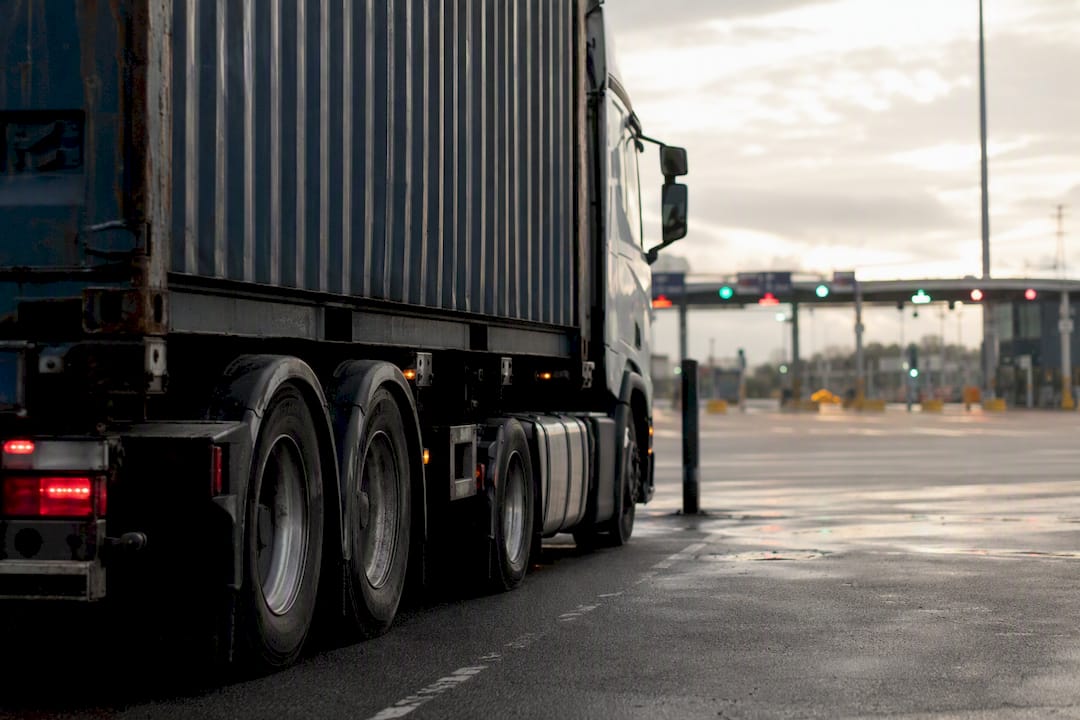
Most warehouse disruptions blamed on receiving staff actually start on the road. A carrier marks a container “delivered,” the Warehouse Management System shows nothing arrived, and the two records disagree for hours or days. The most common haulage-specific receiving errors are misdelivery to the wrong facility, containers staged at a carrier yard, chassis swaps, false driver Proof of Delivery (POD), in-transit theft, incorrect booking or manifest data, and missed delivery slots.
Each has a fast first check:
- Misdelivered facility — confirm the geofence-verified address against the booking, then call the driver.
- Staged at carrier yard — pull container telemetry, not just tractor GPS.
- Chassis swap — match chassis ID against the booking record before accepting.
- False driver POD — demand a photo, geo-tagged POD, not a status tap.
- In-transit theft — check tamper and door-open alerts immediately.
- Wrong booking/manifest data — validate against the DCSA booking standard fields before dispatch.
- Missed slot — reconfirm appointment windows 24 hours ahead.
Insist on container-level telemetry, geofence-verified arrival, and photo-based POD as your baseline trust signals. Without them, you’re reconciling guesswork.
Key Takeaways
Stopping false “delivered” events comes down to replacing driver-reported status with independent, geofence-verified evidence at every handover.
| Point | Details |
|---|---|
| Verify, don’t trust status taps | Treat carrier “delivered” events as claims requiring geofence and photo POD confirmation, not fact. |
| Prioritise container-level telemetry | Choose sensors that travel with the box over tractor-only GPS, which goes silent on chassis swaps. |
| Reconcile ASN against WMS automatically | Flag any delivered status lacking a matching inbound check-in within hours, not at end-of-day counts. |
| Write trust signals into SLAs | Require tamper alerts, geofence verification and KPI reporting in every haulage contract, not as extras. |
| Act fast within the first four hours | Fast triage on telemetry, POD and driver contact prevents a timing lag becoming a formal dispute. |
| Choose a haulage partner built for verification | Jhaulage’s GPS-tracked fleet and tracked container transport supply the evidence this playbook requires by default. |
Table of Contents
- Common warehouse receiving errors haulage teams see in their systems
- Why do haulage receiving errors actually happen?
- What should you monitor to catch haulage receiving errors early?
- Operational controls that stop errors at the handover
- What should haulage SLAs require to prevent receiving disputes?
- How do you resolve a carrier’s “delivered” claim with no WMS receipt?
- How do you vet a haulage partner before problems start?
- Training staff to stop haulage receiving errors before they start
- Root cause analysis methods for haulage receiving errors
- Getting your TMS and WMS to agree with each other
- What receiving errors actually cost your supply chain
- How operators have reduced haulage receiving errors in practice
- How Jagelo Haulage addresses these failure modes
- A faster way to close the haulage visibility gap
- Frequently asked questions
- Sources
Common warehouse receiving errors haulage teams see in their systems
Each failure mode leaves a distinct trace across your TMS, EDI feed and WMS, once you know where to look.
- Misdelivered facility — TMS shows “delivered,” but the geofence coordinates sit miles from the consignee address.
- Staged at carrier yard — a delivered timestamp lands inside a yard geofence, not the warehouse perimeter.
- Chassis swap — the chassis ID on the gate record doesn’t match the booking confirmation.
- False driver POD — a POD photo exists but carries no warehouse sign-off or timestamp mismatch.
- In-transit theft — tamper alert fires, then the delivered status appears minutes later.
- Wrong booking data — no Advance Shipping Notice (ASN) arrives, yet the TMS shows a completed leg.
- Missed slot — WMS has no inbound check-in against a confirmed appointment window.
Pro Tip: Triage exceptions by cargo value, customer sensitivity and perishability first — a temperature-controlled load sitting undetected for several hours costs more than a delayed pallet of dry goods, even if both show the same data mismatch.
Not every mismatch is fraud. Sometimes it’s a driver clearing a slot early. Either way, the signal is the same: TMS and WMS disagree, and someone needs to look before it becomes a customer-facing problem.
Why do haulage receiving errors actually happen?
The root cause is rarely malice. It’s a structural gap between what a carrier’s system records and what your warehouse physically receives. A carrier’s “completed/delivered” status is generated by the carrier’s own system, and it can disagree with the WMS “received” event by hours, days, or permanently, according to Hubble Network’s analysis of drayage visibility. Structured messages like EDI 214 look authoritative, but they’re only as accurate as the human or system entering the data.
Driver incentives compound this. Clearing a slot early, avoiding detention charges, or hitting a shift deadline all create pressure to tap “delivered” before the container is actually on the dock.
Gate-arrival geofences are not the same as successful delivery. Drivers can trigger a “completed” status at a nearby yard or simply to clear a slot, which is why terminal or receiving sign-off should confirm delivery, not driver taps alone.
Chassis swaps and yard staging produce confident, well-formed records that are still wrong.
What should you monitor to catch haulage receiving errors early?
Container-level telemetry beats tractor-only GPS because the sensor travels with the box, not the truck. If a driver swaps trailers, drops a container at a yard, or hands off to a subcontractor, tractor GPS goes silent on the real story. A container-mounted sensor with an independent data path keeps reporting regardless of what the driver taps into the app.
Build your monitoring stack around these signals:
- Geofence-verified timestamp at the consignee gate, not a yard or nearby postcode.
- Tamper or door-open alerts logged against the container ID.
- Photo plus geo-tagged POD, timestamped within minutes of arrival.
- Chassis ID match between booking, gate record, and delivery.
- ASN-to-WMS inbound reconciliation, run automatically, not manually.
Set measurable SLA metrics: time-to-detect (how fast a mismatch surfaces), misdelivery rate (percentage of loads requiring dispute), and time-to-reconcile (how long resolution takes once flagged). A carrier that can’t report these numbers monthly probably isn’t tracking them internally either. Our guide to GPS tracking for container haulage fleets breaks down what “good” telemetry coverage looks like in practice.
Operational controls that stop errors at the handover
Fixing the data starts before the truck even leaves the port.
- Validate every booking against manifest data before dispatch, catching quantity or container-type mismatches early.
- Enforce ASN issuance as a non-negotiable step; a missing ASN is one of the most common triggers of receiving delays reported by 3PLs.
- Reconfirm appointment slots the day before delivery, not just at booking.
At the dock, driver Standard Operating Procedures (SOPs) should require a geo-tagged photo of the container seal and chassis plate, a named warehouse sign-off, and an explicit definition of what counts as “accepted” delivery (not just gate arrival).
- Refuse-on-arrival if the seal number doesn’t match the booking record.
- Hold inventory in a temporary status pending reconciliation, rather than posting it as received.
- Have a documented fallback for receiving without an ASN, so staff aren’t improvising under pressure.
Our piece on how haulage booking affects warehouse efficiency covers the upstream booking discipline that makes these dock-level controls actually stick.
What should haulage SLAs require to prevent receiving disputes?
Contracts, not goodwill, are what force reliable data out of a carrier. Your Service Level Agreement (SLA) should specify:
- Mandatory container-level telemetry, independent of driver-reported status.
- Geofence-verified arrival tied to the consignee’s actual perimeter, not a broad postcode radius.
- Photo, geo-tagged POD delivered within a defined window (commonly 15 to 30 minutes of arrival).
- Tamper and door-open alerting, with minimum battery life covering the full intermodal cycle, port dwell included.
- KPI reporting on on-time delivery, misdelivery rate, time-to-detect, and time-to-reconcile, reviewed monthly.
- Audit trail access via EDI or Application Programming Interface (API), so your team can reconcile carrier and WMS records without waiting on a support ticket.
If a provider resists including these in writing, that resistance is itself useful diagnostic information. Read more on tracked container transport and what a properly specified telemetry clause looks like in a real contract.
How do you resolve a carrier’s “delivered” claim with no WMS receipt?
When the TMS says delivered and the WMS shows nothing, speed matters more than certainty.
0 to 4 hours: reconcile the ASN against the booking, request the photo POD, pull container telemetry for the geofence event, and call the driver or yard directly.
- Confirm whether the container geofence ever touched the consignee perimeter.
- Check for a tamper alert in the same window as the delivered timestamp.
- Verify chassis ID against the original booking.
24 to 72 hours: escalate to carrier operations, initiate a yard search, and lock any related billing until evidence is sufficient.
- Preserve all telemetry, photo and EDI evidence before it ages out of the carrier’s system.
- Notify the customer proactively if fulfilment timing is at risk.
Beyond 72 hours: move to a formal dispute, engage insurance or claims processes, and adjust inventory or fulfilment commitments if recovery looks unlikely.
How do you vet a haulage partner before problems start?
Ask directly: does the provider offer container-level telemetry, tamper alerts, geo-tagged POD, and geofence verification tied to your delivery address, not just the port gate? Do they give you API access to raw events, or only a summary dashboard?
- Request a sample telemetry report from a recent live delivery.
- Ask for proof of battery life and coverage across a full port-to-door cycle.
- Run a trial delivery before committing to volume.
Red flags include inconsistent or missing PODs, GPS that tracks only the tractor, refusal to put KPIs in the SLA, and frequent excuses about yard staging. Our container haulage provider selection checklist expands each of these into a scoring framework you can use with procurement.
Training staff to stop haulage receiving errors before they start
Technology catches errors after they happen. Training prevents many of them from occurring at all. Warehouse receiving teams need clear instruction on what a “confirmed” delivery actually requires: a geofence-verified arrival, a photo POD tied to the correct container ID, and a chassis match, not just a driver knocking on the door.
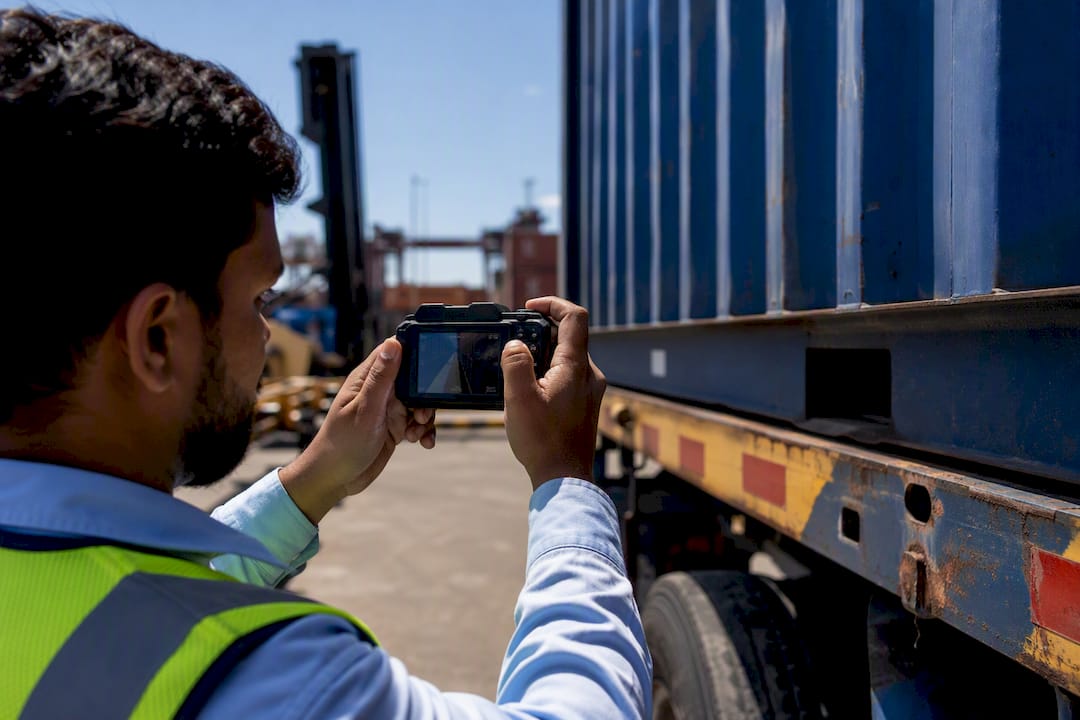
Run scenario-based drills rather than policy memos. Show staff an actual mismatched chassis ID or a POD photo missing a warehouse signature, and walk through the refusal decision in real time. Teams that only read a procedure document tend to freeze when the exception doesn’t match the example in the handbook.
Haulage-side drivers need equivalent training on your specific requirements, not generic carrier onboarding. If your SOP requires a geo-tagged photo before a delivery counts as accepted, that expectation has to be communicated at the contract stage and reinforced at every handover, not assumed.
Change management works best when it’s incentive-aligned. If warehouse staff are measured purely on receiving speed, they’ll wave through ambiguous deliveries to hit throughput targets. Build a small time allowance into receiving Key Performance Indicators (KPIs) for verification steps, so accuracy doesn’t compete directly against speed.
Rotate a monthly review of flagged exceptions with both warehouse and haulage supervisors present. Shared visibility into where errors actually originate does more to change behaviour than a policy update ever will.
Root cause analysis methods for haulage receiving errors
Treating every mismatch as a one-off incident guarantees you’ll see it again. Structured root cause analysis turns scattered exceptions into a pattern you can actually fix.
The “5 Whys” technique works well for haulage-specific failures because the chain usually runs through more than one party. A delivered status without a WMS receipt might trace back through: driver tapped delivered early, to avoid detention charges, because the appointment window was too tight, because the booking confirmation arrived late, because the manifest data required manual correction. Each “why” points to a different fix, from driver SOPs to booking validation.
Categorise exceptions by type before analysing them. Separate chassis mismatches from false PODs from missed slots, since each has different upstream causes and different owners. A monthly exception log, tagged by failure mode, reveals whether your problem concentrates in one carrier, one route, or one warehouse shift.
Cross-reference exception data against the DCSA booking standard’s required fields. Many booking processes still rely on manual data entry, and a lack of standardisation produces errors and rejections that cascade into delivery and receiving problems well downstream of the original mistake.
Don’t stop at the carrier. Operational readiness at the consignee, meaning appointment discipline, unloading capacity and staff availability, is just as often the actual variable that turns a clean drayage move into a failed receipt.
Getting your TMS and WMS to agree with each other
The visibility gap between “delivered” and “received” is fundamentally an integration problem. Your Transportation Management System (TMS) tracks the carrier’s version of events; your WMS tracks what physically crossed the dock door. When these two systems don’t talk to each other in near real time, every discrepancy has to be found manually, usually after a customer complains.
Start with a shared event taxonomy. If your TMS logs “delivered” the moment a geofence triggers, but your WMS only logs “received” after a full inbound check-in, you need an intermediate status, something like “arrived, unconfirmed”, that both systems recognise and that triggers an automatic reconciliation check rather than silently overwriting one status with the other.
Integration failures often show up at the data-mapping level before they show up as a process problem. Known cases involving container type or quantity mismatches in booking confirmation payloads can cause automation to fail silently, leaving mismatched records that nobody notices until an audit. Specify exact field mapping requirements with any carrier or technology partner, and test them against edge cases like split shipments or chassis substitutions, not just the happy path.
API-based reconciliation beats batch EDI file processing for anything time-sensitive. If your systems only reconcile overnight, a misdelivery from Tuesday morning won’t surface until Wednesday, by which point the container could be anywhere. For a broader look at where EDI feeds fall short, Worldwide Express’s guide to EDI tracking covers the practical limitations logistics teams run into.
What receiving errors actually cost your supply chain
A single false “delivered” event rarely stays contained. It cascades through inventory accuracy, order fulfilment, and eventually customer-facing service levels, and the further it travels before detection, the more expensive it gets to fix.
The immediate hit is inventory accuracy. If the WMS never logs a receipt but the TMS shows delivered, your stock system either shows a phantom shortfall or, worse, someone manually reconciles it incorrectly and creates a phantom surplus. Either error propagates into replenishment planning and can trigger unnecessary reorders or missed fulfilment commitments.
Downstream, order promising takes the next hit. If your fulfilment system draws from inventory that technically hasn’t arrived, customer orders get confirmed against stock that isn’t there, and cancellations or delays follow. This is where the cost stops being internal and starts touching customer satisfaction directly.
Detention and demurrage charges compound the financial exposure. A container staged at a yard while your systems show it delivered means nobody is chasing its actual release, and per diem charges accrue quietly in the background.
Time-to-detect is the single metric that determines how much damage a given error causes. An exception caught within four hours is usually a phone call and a correction. The same exception, undetected for three days, is a formal dispute, a customer escalation, and potentially a chargeback. That’s the real argument for the telemetry and reconciliation practices covered earlier: they compress detection time, and detection time is what the total cost curve actually runs on.
How operators have reduced haulage receiving errors in practice
The pattern across operators that have meaningfully cut receiving errors is consistent: they stopped treating carrier-reported status as ground truth and built independent verification into the process instead.
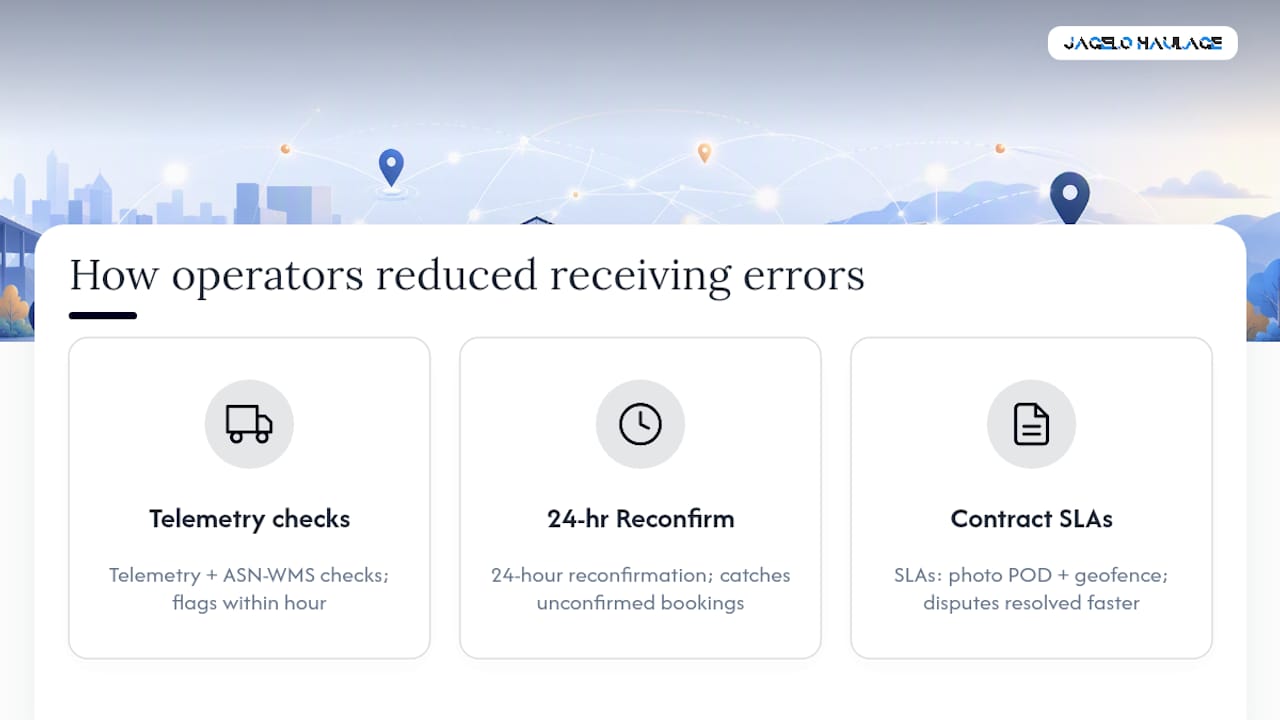
One recurring approach involves pairing container-level telemetry with automated ASN-to-WMS reconciliation, so that any delivered status without a matching inbound check-in gets flagged within the hour rather than discovered at end-of-day stock counts. Teams that implement this typically report that most flagged exceptions turn out to be timing lags rather than genuine misdeliveries, but the ones that are genuine get caught while recovery is still realistic.
Another effective change is shifting appointment confirmation from a one-time booking step to a 24-hour reconfirmation cycle. Warehouses running this found that a meaningful share of missed-slot errors weren’t scheduling failures at all. They were bookings made days earlier that never got reconfirmed as circumstances changed on either side.
Contract-level change matters just as much as operational tooling. Freight forwarders who moved from ad hoc carrier relationships to SLAs specifying photo POD, geofence verification and monthly KPI reporting found disputes resolved faster, simply because the evidence needed to resolve them existed by default rather than needing to be requested after the fact.
None of these fixes require replacing your entire technology stack. They require deciding that a carrier’s “delivered” tap is a claim to be verified, not a fact to be trusted, and building the verification step into the process rather than treating it as optional.
How Jagelo Haulage addresses these failure modes
We built our fleet operations around the assumption that “delivered” needs proof, not just a status update. Our GPS-tracked fleet and tracked container transport across major UK ports give freight forwarders the telemetry and photo POD evidence this playbook demands, backed by 24/7 support when a discrepancy needs resolving fast.
A faster way to close the haulage visibility gap
Most of the checklist above exists because carrier-reported status and warehouse reality don’t automatically agree. Jhaulage closes that gap at source: every container move runs through a GPS-tracked fleet with a significant number of trucks and trailers, with real-time monitoring across major UK ports including Felixstowe, Tilbury, Southampton and Liverpool.
That means the trust signals this article has been recommending, geofence-verified arrival, photo-based POD, and tamper visibility, aren’t a negotiation with your carrier. They’re built into how we run port-to-door delivery by default. Combined with 24/7 support, that gives your team a much shorter time-to-detect when something needs checking, rather than waiting on a carrier’s support desk to respond. If you’re currently reconciling delivered-versus-received gaps manually, get in touch with Jagelo Haulage to talk through your port lanes and see how our tracked container transport fits your SLA requirements.
Frequently asked questions
What is the most common haulage-related receiving error? Misdelivery to the wrong facility and chassis swaps are among the most frequent, but false driver POD and missed slots occur just as often across port-to-door moves.
Why does my TMS show “delivered” when the WMS shows nothing received? The carrier’s system generates its own status independently of your warehouse. It can disagree with your WMS “received” event by hours or permanently if the underlying driver tap or geofence data was wrong.
Can EDI 214 messages be trusted for delivery confirmation? EDI 214 is structured, but it’s only as accurate as whoever entered the underlying data, so it should be cross-checked against telemetry and POD evidence, not used alone.
What should I ask a haulage provider before signing a contract? Ask whether they provide container-level telemetry, geofence verification tied to your actual delivery address, photo-based POD, and API access to raw event data for reconciliation.
Sources
- Marked as Delivered but the Container Never Arrived: The Drayage Visibility Problem – Hubble Network Community
- DCSA Standard for the Booking Process
- Freight forwarding explained: what it is & how it works | Jay Group
- Geofences in logistics — three use cases | Kestrel Insights