
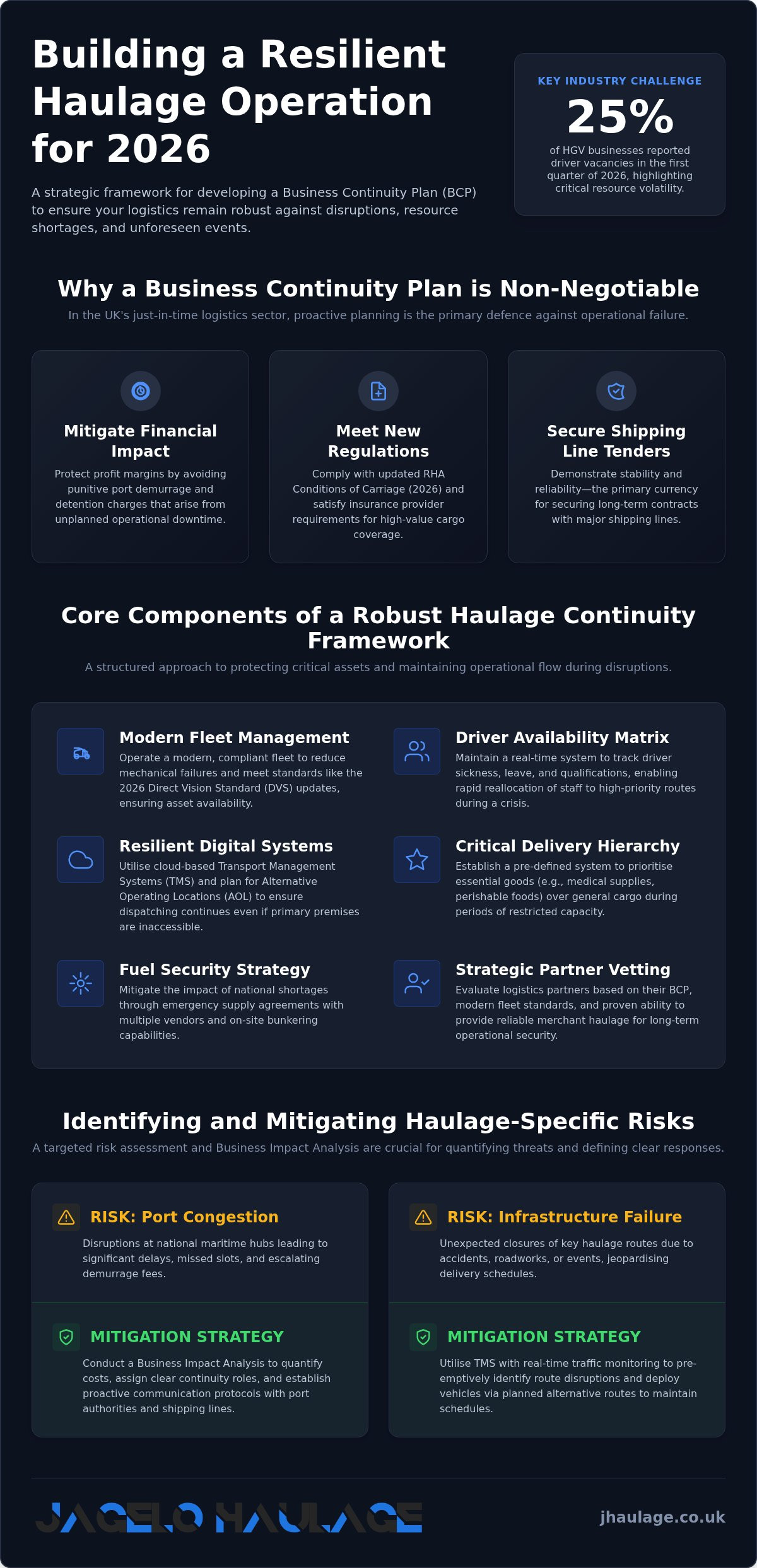
In the first quarter of 2026, 25% of HGV businesses reported driver vacancies, a figure that underscores the persistent volatility within the national supply chain. You recognise that maintaining operational stability requires more than just reactive measures; it demands a disciplined approach to risk management. Securing reliable container transport UK wide is increasingly complex as port congestion and new mandates, such as the Smart Tachograph Version 2 requirements, put pressure on even the most seasoned fleets.
This article provides a strategic framework for developing a business continuity plan that ensures your logistics operations remain resilient against resource shortages and black swan events. You'll learn how to protect your delivery schedules from unplanned downtime whilst reducing the financial impact of rising costs like the updated London Congestion Charge. We will outline the essential steps to maintain container deliveries during disruptions, helping you uphold your commitments to shipping lines and protect your bottom line through a structured, professional approach to haulage management.
Key Takeaways
- Understand why a Business Continuity Plan is a non-negotiable requirement for maintaining critical container haulage operations within the UK’s just-in-time logistics sector.
- Identify the core components of a robust framework, including the management of modern fleets and digital systems to ensure reliable container transport UK wide.
- Learn how to conduct targeted risk assessments focused on port congestion at national maritime hubs and infrastructure failures on key haulage routes.
- Master the use of a Business Impact Analysis to quantify the cost of route disruptions and assign clear continuity roles to your transport management team.
- Evaluate the strategic benefits of merchant haulage and modern fleet standards when selecting a dependable logistics partner for long-term operational security.
Why a Business Continuity Plan is Essential for UK Haulage in 2026
In the context of container logistics, Business continuity planning is the formal process of ensuring that critical haulage operations persist during unforeseen disruptions. It isn't merely a document kept in a drawer; it's a strategic framework that maintains the flow of goods from port to warehouse. For modern merchants, the just-in-time model leaves no room for error. A single delayed container can halt production lines or leave retail shelves empty. Consequently, a robust plan is a non-negotiable requirement for anyone seeking reliable container transport UK wide.
Regulatory shifts in 2026 have intensified the need for formalised resilience. The updated RHA Conditions of Carriage, effective from 1 January 2026, place a sharper focus on carrier responsibilities and force majeure clauses. Insurance providers now scrutinise these plans before offering coverage for high-value cargo. Beyond compliance, a well-executed plan protects the brand reputation of both the haulier and the shipping line. When a crisis occurs, a disciplined response demonstrates competence and secures long-term trust.
The Financial Impact of Operational Downtime
Operational disruptions carry significant hidden costs. Standing fleets don't generate revenue, yet finance payments and overheads remain constant. When haulage operations fail, merchants often face punitive port demurrage and detention charges that escalate daily. These fees quickly erode profit margins. Operational resilience serves as the critical buffer between a temporary delay and a total supply chain failure.
Meeting Tender Requirements for Shipping Lines
Major shipping lines have shifted their procurement priorities. They no longer award long-term contracts based solely on the lowest price; they demand evidence of stability. Demonstrating a verified BCP is now a standard part of securing port logistics services UK contracts. In the current economic climate, reliability has become the primary currency of the industry. Shipping lines require partners who can guarantee reliable container transport UK even when national hubs face congestion or resource shortages. This shift prioritises partners who treat contingency planning as a core business function rather than an optional extra.
For those managing the delivery of essential construction materials, you can discover JABAL AL NOOR Steel as a leading supplier that understands the importance of a resilient and reliable supply chain.
Core Components of a Robust Haulage Continuity Framework
A resilient framework relies on the precise identification of critical assets and the protocols required to protect them. In the haulage sector, these assets include a modern vehicle fleet, a compliant driver pool, and the digital transport management systems (TMS) that coordinate movement. Maintaining reliable container transport UK wide is impossible without a structured inventory of these resources and reliable equipment partners like Jealco International, Inc.. You must ensure that your digital infrastructure is cloud-based, allowing your transport office to remain operational even if your primary premises become inaccessible. This Alternative Operating Locations (AOL) strategy ensures that dispatching and tracking continue without interruption.
During periods of restricted capacity, you need a pre-defined hierarchy of Critical Deliveries. This system ensures that essential goods, such as medical supplies or perishable food items, receive priority over general cargo. Alongside this, a formal fuel security strategy is vital. This should include emergency supply agreements with multiple vendors and on-site bunkering capabilities to mitigate the impact of national shortages. These measures transform a reactive operation into a disciplined, strategic partner capable of weathering prolonged market volatility.
Critical Resource Management: Drivers and Fleet
Managing human capital is a primary challenge, especially given that 25% of HGV businesses reported driver vacancies in early 2026. A Driver Availability Matrix helps transport managers track sickness, leave, and qualifications in real time, allowing for rapid reallocation of staff to high-priority routes. The physical reliability of the equipment is equally important. Operating a modern container transport fleet reduces the risk of mechanical failure and ensures compliance with the latest safety standards, such as the 2026 Direct Vision Standard (DVS) updates. Secure container transport isn't just about theft prevention; it's about the consistent availability of roadworthy assets that your clients can depend on.
Communication Protocols for Logistics Partners
Effective communication is the anchor of operational stability. You must establish clear, direct lines between the transport office, your drivers, and port authorities to manage delays at national hubs. When disruptions occur, notify merchants immediately with factual updates rather than vague estimates. This transparency preserves brand trust and allows clients to adjust their own downstream operations. Every organisation should maintain a Crisis Contact List that includes insurers, emergency services, and key port contacts, ensuring that no time is wasted during an incident. If you require a partner that prioritises this level of disciplined planning, you can request a professional haulage consultation to discuss your requirements.
Identifying and Mitigating Haulage-Specific Risks
Risk identification is the cornerstone of operational continuity. A disciplined risk assessment focuses on high-impact variables such as port congestion at national maritime hubs and infrastructure failure on major motorways. An accident on the M1 or M6 can disrupt delivery schedules for hours, necessitating real-time rerouting protocols. You must also account for financial volatility. Sudden fluctuations in container transport costs can threaten business viability if not managed through stable pricing models and efficient fleet management. To maintain reliable container transport UK wide, you must eliminate any single point of failure. Relying on a single fuel supplier or a solitary software provider creates a vulnerability that can halt your entire fleet during a minor disruption. Diversifying your vendor base and maintaining redundant systems are essential steps for long-term resilience.
Port Congestion and Maritime Delays
National ports are subject to operational throttling, often caused by weather events or labour shortages. Managing Vehicle Booking System (VBS) outages requires a pre-planned approach to ensure drivers aren't stranded at the gate. When coordinating container haulage from Felixstowe, you need a partner who understands the local gate patterns and can utilise flexible scheduling. This flexibility allows the transport office to bypass temporary bottlenecks by reassigning slots or using alternative routes. This methodical approach ensures that service levels remain consistent even when port productivity drops, protecting the merchant's supply chain from unnecessary delays.
Cyber Security in Digital Logistics
The digitisation of logistics introduces new vulnerabilities that can impact reliable container transport UK. Protecting sensitive freight data and delivery schedules from ransomware is essential for maintaining the security of the operation. Your continuity plan must include manual workarounds for when the Transport Management System (TMS) or telematics systems go offline. Drivers should be trained to use paper-based manifests and manual logs until digital systems are restored. During the recovery phase, you must ensure strict GDPR compliance for all driver and client data. Maintaining a secure and disciplined IT environment isn't just about technology; it's about protecting the integrity of the entire supply chain and the trust of your commercial partners.
Implementing and Testing Your Continuity Strategy
Implementing a continuity strategy requires moving from theoretical planning to disciplined execution. The first stage is to conduct a Business Impact Analysis (BIA) to quantify the precise cost of losing specific routes. You must differentiate between urgent movements, such as time-sensitive medical or food containers, and non-urgent cargo. Following this, assign specific BCP roles to the transport management team. Every individual must understand their duties during a crisis, from coordinating driver rerouting to managing merchant communications. These roles should be documented in a format that is accessible even during a total IT failure.
To ensure these preparations are effective, you should organise tabletop exercises that simulate real-world haulage crises. Scenarios such as a national fuel strike or a major port closure provide a low-risk environment to test your response. Review and update the plan at least bi-annually or after any significant fleet expansion to account for new assets and personnel. Finally, audit the resilience of your third-party partners. A haulier is only as strong as its fuel suppliers and software providers. Removing these weak links is essential for maintaining reliable container transport UK wide.
The Business Impact Analysis (BIA) for Hauliers
The Business Impact Analysis is the process of determining which haulage activities are vital for survival. During this phase, you calculate the Maximum Tolerable Period of Disruption (MTPD) for each logistics contract. This figure defines the point at which a delay causes irreparable damage to the merchant's business or your own financial stability. By categorising movements by urgency, the transport office can prioritise the allocation of resources when capacity is restricted. This methodical approach ensures that your most critical commitments are always met first.
Scenario Testing: From Fuel Strikes to IT Failures
Live tests of driver communication systems should be conducted without disrupting actual deliveries. This confirms that all 40+ trucks in the fleet can be reached simultaneously during an emergency. You should also simulate a total loss of the main transport office to test whether your team can effectively use remote access and cloud-based systems. This confirms your ability to maintain reliable container transport UK operations from an alternative location. Evaluating the effectiveness of the response after each test allows for continuous improvement of your operational protocols. If you require a logistics partner that prioritises this level of disciplined planning, you can request a quote for resilient haulage services to see how we can support your supply chain.
Securing Your Supply Chain with a Resilient Logistics Partner
Selecting a partner with a modern, professionally managed fleet is the foundation of operational resilience. A well-maintained fleet reduces the probability of mechanical failure and ensures that your cargo moves according to schedule. When you evaluate your options, consider the strategic differences between merchant haulage vs shipping line services. In the same way that you would explore Conveyancing and Legal Fees when making a major property investment to ensure you have the best professional support, selecting a haulage partner requires a careful assessment of their ability to provide bespoke, flexible solutions. Merchant haulage offers superior operational flexibility, allowing you to select a dedicated partner who prioritises your specific delivery requirements over general network volume. This control is vital when you navigate disruptions, as it enables more agile decision-making and direct communication with the transport office.
Jagelo Haulage positions steadfast professionalism at the centre of every operation. By maintaining a disciplined approach to fleet management and driver compliance, we ensure that client outcomes are protected from the volatility of the national logistics landscape. We encourage merchants to audit the resilience of their haulage partners as a core component of their corporate governance. A haulier that lacks a formal continuity plan represents a significant risk to your internal supply chain stability. Choosing a partner that treats resilience as a master of the fundamentals is the most effective way to secure your goods.
The Value of Specialised Industry Expertise
Experience is a critical asset when a national crisis impacts the movement of goods. With over 15 years of specialised expertise in port logistics, Jagelo Haulage understands the complexities of maintaining reliable container transport UK wide during periods of peak demand or port congestion. Our national reach across all major UK maritime hubs allows us to implement cargo diversion strategies when primary routes are compromised. This capability transforms the haulier from a simple service provider into a strategic partner that actively mitigates risk within your broader operational framework. We follow strict protocols to ensure your cargo remains secure whilst in transit.
Ensuring Reliable Port-to-Door Deliveries
Responsive customer support plays a decisive role in managing expectations during a disruption. You require a partner that provides factual, real-time updates rather than vague estimates. Our fleet of over 40 trucks and trailers provides the necessary capacity to recover quickly from delays and clear backlogs once port operations resume. This scale ensures that your deliveries remain on track even when the wider industry faces resource constraints. To discuss how we can provide secure and reliable container transport UK for your business, you can contact Jagelo Haulage for a quote today.
Strengthening Your Operational Resilience
Building a robust business continuity plan is an essential discipline for any merchant navigating the complexities of the national supply chain. Resilience is achieved through a structured approach, starting with a thorough Business Impact Analysis and extending to rigorous scenario testing. By identifying risks such as port congestion and infrastructure failures before they occur, you ensure your operations remain stable during periods of volatility. Securing reliable container transport UK wide is not just about the physical movement of goods; it's about partnering with a haulier that prioritises safety and functional reliability through every challenge.
Jagelo Haulage provides the steadfast professionalism required to protect your logistics outcomes. With over 15 years of specialised port logistics experience and a modern fleet of over 40 trucks, we offer national coverage across all major UK maritime hubs. Our disciplined framework ensures that your deliveries are handled with competence and consistency, regardless of external disruptions. You can secure your supply chain with Jagelo Haulage’s professional container transport services to ensure your operations remain resilient. We're committed to supporting your long-term stability and look forward to strengthening your logistics framework.
Frequently Asked Questions
What is a Business Continuity Plan (BCP) in the context of haulage?
A Business Continuity Plan is a strategic framework designed to ensure that critical container movements persist during unforeseen disruptions. In the haulage sector, this involves identifying vital assets such as drivers, vehicles, and digital management systems. The plan establishes formalised protocols to maintain operations during port strikes, fuel shortages, or infrastructure failures, ensuring that the supply chain remains functional despite external pressures.
How often should a transport company test its business continuity plan?
A transport company should test its continuity plan at least bi-annually or immediately following any significant fleet expansion. Regular testing through tabletop exercises allows the management team to simulate real-world crises and verify that all personnel understand their assigned roles. This disciplined approach ensures that the response remains sharp and that any new operational vulnerabilities are identified and mitigated before a genuine disruption occurs.
What are the most common threats to UK haulage operations in 2026?
The primary threats currently facing the industry include persistent driver shortages and unpredictable port congestion at national hubs. Regulatory changes, such as the Smart Tachograph Version 2 mandate and stricter Direct Vision Standard (DVS) requirements, also demand constant operational adjustments. Additionally, rising costs from the removal of electric vehicle exemptions in London and updated RHA liability clauses require hauliers to maintain high levels of financial and operational resilience.
Why do shipping lines require hauliers to have a business continuity plan?
Shipping lines prioritise reliability to protect their reputations and avoid the escalating costs of port demurrage and detention. Providing evidence of a robust BCP is now a standard tender requirement for securing reliable container transport UK contracts. Maritime partners seek hauliers who can demonstrate a disciplined approach to risk management, as this ensures that cargo continues to move even when the wider network faces capacity constraints.
How can a BCP help manage port congestion at Felixstowe or Southampton?
A BCP facilitates the use of pre-planned diversion strategies and flexible scheduling to bypass temporary port bottlenecks. It allows the transport office to reallocate Vehicle Booking System (VBS) slots and utilise a national reach to move cargo through alternative maritime hubs. By having these protocols in place, a haulier can maintain consistent service levels and protect the merchant's delivery schedule when productivity at a specific port drops.
What is the difference between Disaster Recovery and Business Continuity in logistics?
Disaster Recovery is a technical process focused on restoring IT systems, telematics, and data after a failure. Business Continuity is a broader strategic discipline that ensures the physical movement of containers and the management of the fleet persist whilst systems are compromised. Whilst Disaster Recovery handles the digital infrastructure, Business Continuity ensures the haulier remains a functional partner capable of delivering outcomes during a crisis.
Does a BCP help with insurance premiums for haulage companies?
Insurers often view a formalised BCP as evidence of a lower risk profile, which can lead to more competitive premium rates. A documented plan demonstrates that the haulier has taken disciplined steps to mitigate the financial impact of downtime and cargo delays. By proving that the business can recover quickly from a disruption, the operator presents a more stable and predictable prospect to insurance underwriters.
Can a small haulage operator afford to implement a formal BCP?
Resilience is rooted in disciplined planning and master of the fundamentals rather than significant capital investment. Small operators can build a robust plan by identifying their most critical routes and establishing manual workarounds for digital system failures. This structured approach ensures they can still provide reliable container transport UK wide without requiring the extensive resources of a national carrier, provided their protocols are strictly followed and regularly reviewed.