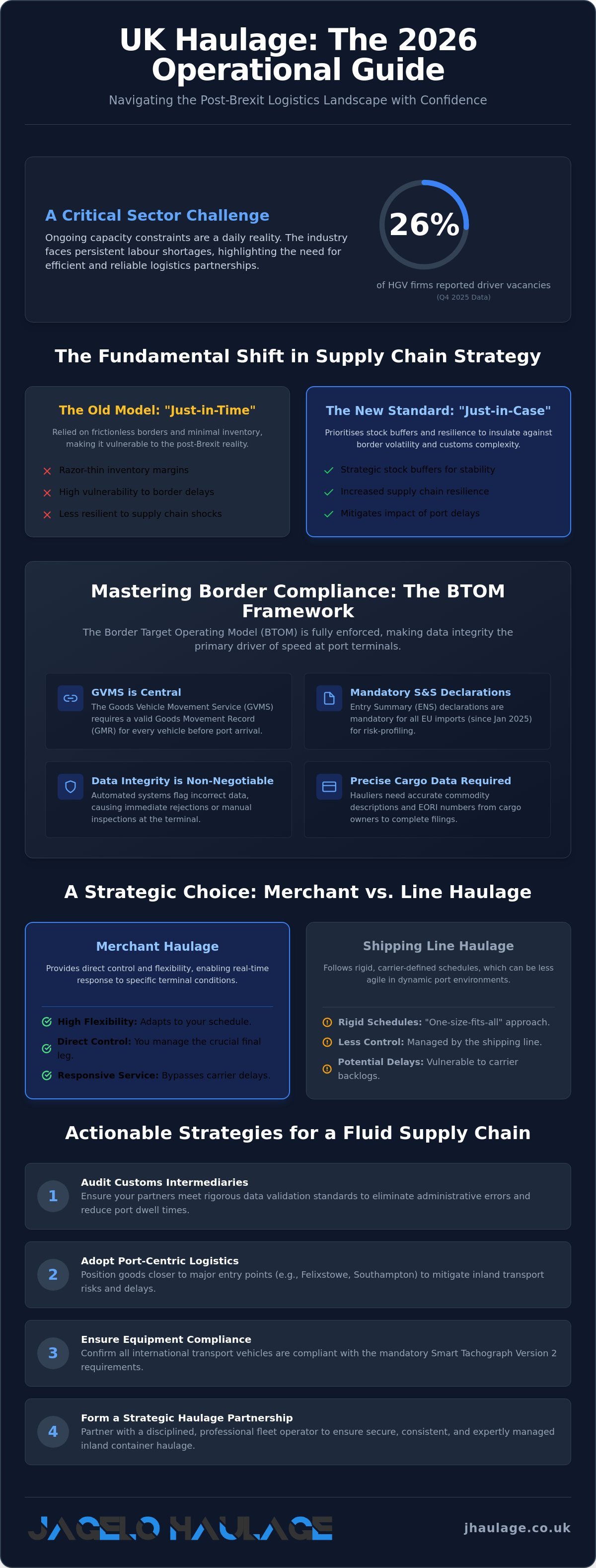
26% of UK HGV businesses reported driver vacancies in the final quarter of 2025, a statistic that highlights the ongoing capacity constraints within the logistics sector. You likely face the daily reality of these pressures through unexpected delays at port terminals and the increasing administrative burden of customs declarations. The Brexit impact on UK haulage has transitioned from an acute crisis into a permanent operational standard where strict compliance is the only path to efficiency. It's clear that maintaining a stable supply chain now requires a more disciplined approach to border logistics than ever before.
This article provides a definitive guide to the long-term structural changes in UK haulage and the strategies required to maintain a fluid supply chain in 2026. We will examine the full enforcement of the Border Target Operating Model (BTOM), methods to reduce port dwell times, and the role of reliable merchant haulage in securing your cargo movements. You will gain the technical insight needed to optimise your response to the Smart Tachograph Version 2 mandates and ensure your operations remain compliant with the latest cabotage and safety regulations. By the end of this guide, you will understand how to turn regulatory requirements into a predictable, professionally managed logistics routine.
Key Takeaways
- Understand the transition from "Just-in-Time" to "Just-in-Case" logistics and how this shift provides a more resilient framework for modern container movements.
- Master the rigorous data validation requirements of the Border Target Operating Model (BTOM) to eliminate administrative errors and reduce port dwell times.
- Analyse the long-term Brexit impact on UK haulage by reviewing current cabotage restrictions and the mandatory Smart Tachograph Version 2 requirements for international transport.
- Identify actionable strategies for maintaining supply chain fluidity, including the audit of customs intermediaries and the use of scheduled container deliveries.
- Discover how a disciplined partnership with a professional fleet operator ensures secure, consistent, and professionally managed inland container haulage.
The Structural Evolution of UK Road Haulage Since Brexit
The landscape of British logistics has undergone a fundamental transformation since the end of the transition period. The Brexit impact on UK haulage is most visible in the transition from "Just-in-Time" to "Just-in-Case" supply chain models. Businesses don't rely on the razor-thin inventory margins that defined the pre-2021 era anymore. Instead, they prioritise stock buffers to insulate against border volatility. This shift has altered freight lane density, as hauliers must now account for more complex customs routing and the permanent separation from the EU Single Market.
Port-centric logistics have become a standard requirement for mitigating inland transport delays. By positioning goods closer to major entry points like Felixstowe, Southampton, and London Gateway, operators reduce the risk of missed delivery slots. This environment makes professional fleet management a critical asset for any business moving containers. Jagelo Haulage maintains a modern fleet of over 40 trucks to ensure consistent availability. We understand that modern logistics is about managing data as much as moving physical units. The Predicted Impact of Brexit suggested significant shifts in trade patterns; in 2026, we see this realised through a more structured, albeit more regulated, movement of goods across the UK.
From Friction to Fluidity: The 2026 Landscape
UK ports have fully integrated increased customs inspection requirements into their daily workflows. Digitised border systems, such as the Goods Vehicle Movement Service (GVMS), now facilitate more predictable container turnaround times for hauliers who maintain high data integrity. While the early years following the transition were marked by administrative friction, the industry has reached a new equilibrium. Trade volumes have stabilised around these new protocols. This makes the Brexit impact on UK haulage a manageable operational factor rather than an unpredictable crisis. Compliance is no longer an option but the primary driver of speed at the port terminal.
The Rise of Merchant Haulage as a Strategic Choice
Many businesses now choose merchant haulage to gain direct control over their supply chain movements. Unlike shipping line haulage, which often follows rigid, "one-size-fits-all" schedules, merchant haulage offers the flexibility to respond to specific terminal conditions in real-time. Independent contractors provide a more responsive service. This allows cargo owners to bypass the delays often associated with larger, less agile carriers that struggle with port dwell times. This strategic choice provides the security and punctuality that modern corporate operations demand. It ensures that the final leg of the journey is as efficient as the ocean transit.
Mastering the Border Target Operating Model (BTOM) and Compliance
The Brexit impact on UK haulage has transitioned from a period of adaptation to a rigorous, data-driven environment. In 2026, the Border Target Operating Model (BTOM) is fully enforced, moving beyond the "soft-touch" approach of previous years. Enforcement agencies now prioritise data integrity, with automated systems flagging generic or incorrect customs declarations immediately. The Goods Vehicle Movement Service (GVMS) remains the central pillar of this framework. It requires a valid Goods Movement Record (GMR) for every vehicle before it arrives at the port. Any discrepancy between the GMR and the underlying customs declarations results in the vehicle being turned away or held for manual inspection.
Safety and Security (S&S) declarations are a primary tool for risk-profiling in the current regulatory landscape. Since January 2025, Entry Summary (ENS) declarations have been mandatory for all EU imports. Hauliers require precise data from cargo owners to complete these filings, including detailed commodity descriptions and accurate EORI numbers. Without this information, the haulier cannot generate the necessary border codes, which leads to immediate delays at the terminal. Maintaining a disciplined flow of information between the cargo owner and the transport provider is the only way to ensure the security and punctuality of the movement.
The Mechanics of Modern Port Logistics
Pre-lodgement of customs data is the standard protocol for preventing terminal congestion. By submitting all declarations in advance, hauliers ensure that the vehicle receives a "cleared" status upon arrival at the port. This process is particularly complex for containers carrying food or plant products, as these are subject to Sanitary and Phytosanitary (SPS) checks. These goods must enter through designated Border Control Posts (BCPs) where they may undergo physical inspections. To protect your supply chain from unexpected stops, you must ensure your port logistics services are fully aligned with these 2026 compliance standards. Professional management of these steps reduces the risk of goods being categorised as high-risk during the automated profiling stage.
Avoiding Penalties and Dwell Time Charges
Documentation errors remain the most frequent cause of container holds at UK terminals. Generic descriptions such as "general cargo" or "mixed goods" are no longer sufficient for HMRC systems and will likely trigger a hold. These inaccuracies lead to significant demurrage and detention charges as the container occupies valuable space at the terminal. You should coordinate closely with your haulage partner to verify that all commodity codes and weights match the physical load before the truck is dispatched. The Single Trade Window acts as a unified digital gateway that allows businesses to submit all required border data to multiple agencies through a single electronic entry, streamlining the 2026 logistics workflow. For businesses seeking a dependable partner to manage these complexities, you can request a quote for secure container haulage to ensure your operations remain efficient and protected.
Operational Challenges: Labour, Cabotage, and Equipment
The end of free movement has fundamentally reshaped the UK labour market. This structural change is a primary driver of the Brexit impact on UK haulage, as the industry can no longer rely on a fluid supply of European drivers to fill capacity gaps. Cabotage restrictions further complicate the movement of goods. EU-registered hauliers are limited to a maximum of two domestic movements within seven days of arrival. These rules prevent international carriers from subsidising UK domestic capacity as they did pre-2021. Consequently, cargo owners must secure reliable inland container haulage from dedicated UK-based fleets to avoid the 23% of missed deliveries reported by businesses struggling with driver vacancies in late 2025.
The reduction in EU-based capacity means that the "Just-in-Case" model relies heavily on the technical and physical capability of the domestic fleet. When international carriers are restricted by cabotage limits, the burden of nationwide distribution falls entirely on UK providers. This makes the partnership between cargo owners and hauliers a strategic outcome rather than a simple transaction. Fully insured container haulage is now a non-negotiable requirement. It protects the financial interests of the cargo owner against the heightened risks of a more complex, high-stakes supply chain environment.
Addressing the Driver Shortage in 2026
Jagelo Haulage addresses these labour challenges through a disciplined operational model. We maintain a professional driver workforce by prioritising functional reliability and strict adherence to safety protocols. Our drivers receive specialised training in the use of new digital border tools, ensuring they can navigate terminal environments with competence. This internal stability allows us to provide consistent service levels despite wider industry volatility. We understand that punctuality is a result of both driver retention and well-managed administrative support.
Equipment Standards and Environmental Compliance
Maintaining a modern container transport fleet is now a regulatory necessity for international operations. As of July 1, 2026, all vehicles over 2.5 tonnes used for international transport must be fitted with a Smart Tachograph Version 2 (ST2). Additionally, all newly manufactured HGVs must include Advanced Emergency Braking (AEB) systems as of July 7, 2026. These equipment standards intersect with UK Net Zero targets, making Euro VI compliance the baseline for port-centric logistics. Managing heavy container haulage under these stricter road safety protocols requires a fleet that exceeds standard safety specifications. This approach ensures long-term operational resilience and protects your cargo during every movement.
Strategies for Maintaining Supply Chain Fluidity
The Brexit impact on UK haulage necessitates a move from reactive problem-solving to proactive strategic planning. Supply chain fluidity in 2026 depends on the precision of your operational protocols. You must implement a structured approach to manage the moving parts of port-centric logistics. Businesses that prioritise administrative accuracy and fleet reliability are better positioned to navigate the current regulatory environment. We suggest following these five steps to protect your inland movements:
- Step 1: Audit your customs intermediaries. Accuracy and speed are the primary metrics for success in a data-driven border system.
- Step 2: Transition to scheduled container deliveries. This ensures slot availability at busy terminals and reduces the risk of demurrage.
- Step 3: Utilise inland container haulage specialists. Expertise in specific ports like Felixstowe or London Gateway is essential for navigating local terminal rules.
- Step 4: Implement real-time tracking. Professional customer support allows for an immediate response to unexpected delays or port holds.
- Step 5: Review container transport costs against service reliability. A lower rate often results in higher total expenditure if compliance fails or deliveries are missed.
Planning for Peak and Port Congestion
Use historical data to predict and avoid seasonal port bottlenecks. Peak periods require earlier booking and more robust contingency plans. You should develop a protocol for potential GVMS or port system outages to ensure your drivers have clear instructions during technical downtime. Whilst same-day delivery services provide a solution for urgent movements, they rely on the haulier's ability to maintain high fleet availability. A disciplined partner will have the operational reach to manage these surges without compromising on punctuality or safety.
Optimising Port-to-Door Logistics
Reducing the "empty leg" problem is a vital step in lowering overall freight expenditure. You should collaborate with hauliers who serve multiple major maritime hubs to ensure your transport provider can balance loads across different routes effectively. Data transparency between the client and the haulier is the single most effective tool for driving operational efficiency. By sharing real-time information, you enable your partner to provide a more protected and predictable outcome for every container movement. This level of cooperation transforms a simple service into a strategic logistical advantage. If you require a disciplined partner to manage your inland movements, request a quote for professional container haulage to secure your 2026 supply chain.
Strategic Haulage Partnerships with Jagelo Haulage
The Brexit impact on UK haulage has created a permanent need for logistics partners who prioritise operational discipline over simple task execution. Jagelo Haulage provides a steadfast, professional response to these regulatory shifts by focusing on the fundamentals of container transport. With over 15 years of industry experience, we understand the high stakes of the modern supply chain. Our operations are designed to provide the stability your business requires in an environment where compliance and punctuality are inseparable. We position ourselves not merely as a service provider, but as a strategic partner capable of delivering protected outcomes for every container movement.
Our modern fleet of over 40 trucks provides the necessary capacity for consistent nationwide container movements. We maintain a specialised focus on major UK maritime hubs, including Felixstowe, Southampton, and London Gateway. This port-specific expertise allows our drivers and administrative teams to navigate terminal-specific protocols with precision. By managing a fleet of this scale, we ensure that our clients have access to reliable inland container haulage even during periods of peak demand or market volatility. We don't rely on third-party capacity; we utilise our own professionally managed assets to maintain total control over service quality.
Professionally Managed Transport Operations
We remain committed to security and consistency in every aspect of our transport operations. Jagelo Haulage supports both merchant haulage and shipping line haulage requirements, offering the flexibility needed to manage diverse cargo types. Our internal systems are fully aligned with 2026 border requirements, ensuring that all data validation and safety protocols are strictly followed. You benefit from responsive, UK-based customer support that understands the nuances of the local market. This direct communication line is essential for resolving terminal issues quickly and maintaining the fluid movement of your goods from port to door.
Secure Your 2026 Logistics Strategy
Choosing a haulage partner in 2026 requires an assessment of their ability to handle technical and regulatory complexity. Jagelo Haulage is the strategic choice for operators nationwide because we prioritise functional reliability. We understand that your supply chain depends on the seamless integration of customs data and physical transport. Our disciplined approach ensures that your cargo moves without friction, protecting you from the costs associated with port delays and administrative errors. We invite you to Contact Jagelo Haulage today to discuss your container transport requirements and secure a dependable foundation for your 2026 logistics strategy.
Securing Your Supply Chain for 2026 and Beyond
The 2026 landscape requires a transition from reactive measures to a disciplined, data-driven strategy. Success now depends on mastering the Border Target Operating Model and maintaining a modern, Euro VI compliant fleet to navigate ongoing capacity constraints. These factors ensure that the Brexit impact on UK haulage remains a manageable operational standard rather than a source of constant supply chain disruption. By prioritising administrative accuracy and fleet reliability, your business can insulate itself against terminal volatility.
Jagelo Haulage provides the necessary stability through our fleet of 40+ modern trucks and over 15 years of port logistics expertise. Our fully insured and professionally managed operations offer the protection your cargo requires at every major UK terminal. We understand the high stakes of the current regulatory environment and provide the technical competence needed to maintain punctuality. A strategic partnership with a seasoned operator is the most effective tool for driving long-term efficiency.
Request a professional container haulage quote from Jagelo Haulage to secure your inland transport movements. With the right strategic partner, you can turn complex regulatory requirements into a consistent and functional logistics routine.
Frequently Asked Questions
How has Brexit affected container haulage rates in 2026?
Container haulage rates in 2026 are influenced by the mandatory installation of Smart Tachograph Version 2 units and persistent labour shortages. These technical requirements, coupled with a 26% driver vacancy rate reported by HGV businesses in late 2025, have created a higher baseline for operational costs. Businesses must account for these structural expenses and increased compliance overheads when budgeting for inland container movements.
What is the Border Target Operating Model (BTOM) and why does it matter?
The Border Target Operating Model (BTOM) is the UK's final framework for border controls on imports. It matters because it replaces previous "soft-touch" enforcement with rigorous data validation and risk-based inspections. In 2026, automated systems flag generic or incorrect customs declarations immediately. This makes precise data entry the primary requirement for maintaining a fluid supply chain and avoiding terminal holds.
Can EU-registered trucks still perform domestic haulage in the UK?
EU-registered hauliers are permitted to perform a maximum of two cabotage movements within the UK. These trips must be completed within seven days of the vehicle arriving and unloading its international load. These restrictions significantly limit the domestic capacity available from international carriers, making the Brexit impact on UK haulage a key driver for securing dedicated domestic fleet partnerships.
How does the GVMS system impact my container delivery times?
The Goods Vehicle Movement Service (GVMS) links customs declarations with the physical movement of goods. It impacts delivery times by requiring a valid Goods Movement Record (GMR) before a truck reaches the port. Any discrepancy in this digital link results in the vehicle being held or turned away, which directly increases port dwell times and risks missing scheduled delivery slots.
What is the difference between merchant haulage and shipping line haulage?
Merchant haulage allows the cargo owner to appoint an independent transport provider, whereas shipping line haulage is managed by the ocean carrier. Choosing merchant haulage provides greater operational control and responsive customer support. This strategic choice allows businesses to bypass the rigid, "one-size-fits-all" scheduling often associated with larger shipping line carriers during periods of terminal congestion or administrative volatility.
How can I avoid port delays for my shipping containers?
You can avoid port delays by ensuring all customs data is pre-lodged and validated before the vehicle reaches the terminal. Auditing your customs intermediaries for accuracy is essential, as generic commodity descriptions are a frequent cause of container holds. Implementing scheduled container deliveries also ensures that your transport provider has secured a specific slot, reducing the risk of unexpected demurrage and detention charges.
Are there new safety and security requirements for UK haulage?
Safety and Security (S&S) requirements now include mandatory Entry Summary (ENS) declarations for all EU imports. Additionally, as of July 1, 2026, all goods vehicles over 2.5 tonnes used for international transport must be equipped with a Smart Tachograph Version 2. New HGVs manufactured after July 7, 2026, must also feature Advanced Emergency Braking (AEB) systems to comply with updated safety protocols.
What documents do I need to provide my haulier for port collection?
Your haulier requires a valid release note, the container number, and a specific PIN or gate code for collection. You must also provide accurate EORI numbers and detailed commodity codes to ensure the Brexit impact on UK haulage does not result in administrative holds. Clear documentation is the most effective tool for ensuring a secure and punctual handover at the port terminal.