API tracking for shippers: real-time ETAs and SLAs

Carrier-provided API tracking for shippers is the GPS and milestone data feed that a haulage or carrier partner supplies directly, giving freight teams live container location, accurate ETAs, and exception alerts tied to contracted moves. Unlike developer-focused aggregator platforms that aggregate multi-carrier events for application builders, this is a single-party feed with contractual accountability behind every data point.
What it delivers, in practice:
- Live latitude/longitude and bearing, updated as frequently as every 1–5 minutes on the final truck leg
- Timestamped milestone events: terminal gate in/out, yard arrival, delivery arrival, empty return, and proof-of-delivery (POD) receipt
- Exception alerts for missed milestones, door-open events, shock, or temperature deviation (where sensors are fitted)
- Authenticated delivery via REST webhooks or polling endpoints, with batch SFTP available for high-volume feeds
Key takeaways
Carrier-provided API tracking for shippers delivers contractually accountable GPS and milestone data that reduces demurrage risk, improves ETA accuracy, and creates audit evidence that third-party aggregators cannot match.
| Point | Details |
|---|---|
| Require specific data fields | Contract for container number, lat/long, timestamps, milestone events, and exception alerts as named fields. |
| Set written SLA metrics | Define event delivery success rate, MTTD, and uptime percentage before signing. |
| Run a phased pilot first | Start with 10–20 containers on high-risk lanes for 6–12 weeks before fleet-wide rollout. |
| Confirm data ownership | The contract must state that raw streams and derived ETAs belong to the shipper, with export rights included. |
| Jhaulage for UK port moves | Jagelo Haulage Limited provides GPS-tracked container haulage across Felixstowe, Tilbury, Southampton, and Liverpool with 24/7 support. |
Table of Contents
- What carrier API tracking is — and what it is not
- Operational and commercial benefits of haulage API tracking
- What data and events a haulage tracking API should deliver
- Technical checklist for integrating a haulage tracking API
- SLA and operational commitments to negotiate with your haulage partner
- How to run a pilot and scale a carrier API tracking deployment
- Three multimodal use cases showing haulage API tracking in practice
- Security, data ownership, and compliance in haulage API tracking
- Questions to ask your haulage partner and clauses to include in the contract
- Why haulage API tracking is now a procurement priority
- Jhaulage’s tracked container haulage for freight forwarders
- Sources
What carrier API tracking is — and what it is not
A haulage-provided tracking API is not a developer aggregator. The distinction matters operationally. When your haulage partner supplies the feed, they own the raw device stream, they define the SLA on event delivery, and they carry contractual responsibility for the accuracy of every timestamp. That accountability is absent from third-party aggregators, which consolidate carrier events they do not control.
Typical delivery mechanisms include:
- Authenticated REST endpoints with OAuth 2.0 or API-key tokens, scoped to your contracted shipments only
- Webhooks that push events to your nominated URL as they occur, with retry logic for failed deliveries
- Secure SFTP batch feeds for operations that prefer scheduled file ingestion over real-time push
A modern tracking stack combines GPS, AIS, RFID, and carrier milestone feeds to produce continuous visibility, but the haulage-provided layer is the one tied to your specific contracted moves and the one you can hold to a written SLA.
Choose haulage-provided tracking when you need integrated service accountability, contractual visibility, and timestamped evidence for dispute resolution.
Pro Tip: Ask your haulage partner to confirm in writing which data fields are carrier-owned versus sourced from third-party terminal feeds. The distinction affects SLA enforceability.
Operational and commercial benefits of haulage API tracking
The operational case for real-time shipment tracking from your haulage partner is strongest at the points where visibility has historically been weakest: the dray leg and the final mile.
Timestamped gate events and live GPS on the drayage leg prevent demurrage charges, reduce idle labour, and create audit evidence for billing disputes. Without them, operations teams rely on phone calls and driver self-reporting, both of which introduce delay and ambiguity.
Commercial benefits compound quickly:
- Demurrage and detention risk reduction: gate timestamps let you prove when a container was collected or returned, shifting liability where it belongs
- Billing dispute evidence: a timestamped event log is far stronger than a driver’s verbal account
- Inventory optimisation: container GPS data feeds dynamic ETAs that are materially more accurate than static schedule estimates, allowing tighter inbound planning
- Customer experience: proactive exception notifications replace reactive status calls, reducing inbound enquiries
Industry adoption has reached a scale that makes carrier IoT coverage a reasonable procurement expectation; see how to enhance supply chain efficiency with container tracking. By mid-2024, Hapag-Lloyd had equipped roughly 90% of its dry container fleet with IoT devices, enabling position updates every 15 minutes on land and approximately every six hours at sea, with more than 2 million containers carrying live positioning data. That benchmark sets a credible standard for what a well-equipped haulage fleet should offer.
What data and events a haulage tracking API should deliver
Operationally useful container tracking captures location, ETA/ETD, terminal milestones, customs checkpoints, exception alerts, and condition metrics so teams can act on deviations before they become demurrage events.
Core data fields your integration should receive:
| Field | Type | Notes |
|---|---|---|
| container_number | String | ISO container number format |
| latitude / longitude | Float | Latitude/longitude coordinates with sufficient precision |
| timestamp | Standard timestamp format | UTC, event time not receipt time |
| accuracy_metres | Integer | GPS fix quality indicator |
| bearing | Integer | 0–359 degrees |
| speed_kmh | Float | Ground speed |
| device_id | String | Unique tracker identifier |
| event_type | Enum | See milestone list below |
| seal_status | Boolean | Intact / broken |
| door_open | Boolean | Where sensor fitted |
| shock_event | Boolean | Threshold-triggered |
| temperature_celsius | Float | Reefer/condition units only |
Milestone event types to require contractually:
- Terminal gate in / terminal gate out
- Outgate (container leaves terminal on truck)
- Yard arrival / yard departure
- Delivery arrival / delivery departure
- Empty return confirmed
- POD receipt timestamp
Update cadence varies by mode. Truck legs near delivery should ping every 1–5 minutes; rail and short-sea legs suit adaptive low-frequency pings to preserve battery life. Multimodal IoT trackers with mode-aware ping rates can deliver multi-year battery life while maintaining last-mile accuracy across truck, rail, and short-sea legs.
Example webhook payload (JSON):
{
  "event_id": "evt_8a3f2c",
  "container_number": "TCKU3953742",
  "event_type": "DELIVERY_ARRIVAL",
  "timestamp": "2026-03-14T09:42:11Z",
  "latitude": 51.509865,
  "longitude": -0.118092,
  "accuracy_metres": 4,
  "bearing": 270,
  "speed_kmh": 0.0,
  "device_id": "dev_4412b"
}
Pro Tip: Require the event_id field to be globally unique and immutable. This is your deduplication key — without it, retry logic on both sides will create duplicate milestone records in your TMS.
Technical checklist for integrating a haulage tracking API
Integration is straightforward when both sides agree on the contract before a single line of code is written. Work through this checklist with your haulage partner’s technical contact before go-live.
Authentication and access:
- Confirm token type (OAuth 2.0 client credentials or API key) and rotation policy
- Request IP allowlisting or mutual TLS (mTLS) for webhook endpoints handling sensitive cargo
- Define role-based access scopes: read-only for ops, write for acknowledgement endpoints
Delivery mode and reliability:
- Prefer webhooks over polling; polling at high frequency wastes quota and increases latency
- Agree retry windows (typically 3 attempts over 30 minutes) and negative acknowledgement (NACK) handling
- Confirm idempotency: your endpoint must return 200 for duplicate deliveries without double-processing
Schema and mapping:
- Obtain the full schema with versioning policy before integration begins
- Map
container_numberandevent_typeto your internal shipment IDs and TMS status codes - Request a changelog process: schema changes should carry at least 30 days’ notice
Operational readiness:
- Insist on a sandbox environment with realistic sample data before connecting production
- Run end-to-end verification: inject a test event and confirm it appears correctly in your TMS
- Centralise feeds from carriers and terminals into a single platform to avoid fragmented views and manual reconciliation
Pro Tip: Run a reconciliation check on gate timestamps from the carrier feed against terminal-published records during acceptance testing. Discrepancies of more than a few minutes indicate a data-source mismatch that will undermine your demurrage dispute evidence.
SLA and operational commitments to negotiate with your haulage partner
SLA language in haulage contracts rarely covers tracking feeds by default. You need to add it explicitly.
Metrics to define and measure:
- Event delivery success rate: percentage of milestone events delivered within the agreed latency window (target: 99%+)
- Mean time to deliver (MTTD) an event: from device trigger to webhook receipt (realistic target: under 3 minutes for truck legs)
- False-positive exception rate: proportion of alerts that do not correspond to a real operational deviation
- API uptime: availability of the endpoint or webhook infrastructure (target: 99.9% monthly)
Support and escalation:
- Confirm 24/7 support coverage for tracking incidents, not just haulage operations
- Define incident severity tiers: a complete feed outage during active deliveries is Severity 1
- Agree escalation paths and maximum response times for each severity tier
Data retention:
- Require a minimum 12-month retention of raw event logs for dispute resolution
- Confirm export rights: you must be able to pull your own data in a standard format (JSON or CSV) on demand
Pro Tip: Include a sustained-failure clause: if event delivery success rate falls below threshold for more than 48 consecutive hours, you retain the right to withhold tracking-related service fees pending remediation.
How to run a pilot and scale a carrier API tracking deployment
A phased rollout is the recommended approach: pilot high-value or high-risk lanes first to build competence, refine workflows, and demonstrate ROI before fleet-wide deployment.
Pilot selection criteria:
- Choose lanes with measurable demurrage history or frequent ETA disputes
- Include at least one multimodal leg (truck plus short-sea or rail) to test mode-switching behaviour
- Limit the initial pilot to a manageable asset set: 10–20 containers is sufficient to generate statistically meaningful data
Phased timeline:
- Discovery (2–4 weeks): agree data fields, schema, authentication, and sandbox access; complete integration to test environment
- Controlled pilot (6–12 weeks): connect production feed on selected lanes; measure KPIs against pre-pilot baseline
- Scale decision: review pilot KPIs, confirm operational readiness, and agree phased fleet expansion
KPIs to track during the pilot:
- Event delivery rate vs. agreed SLA
- ETA accuracy delta: predicted vs. actual arrival time
- Exceptions detected automatically vs. exceptions reported manually in the same period
- Battery and device lifecycle data from the carrier
Pro Tip: Assign a named operations contact on both sides for the pilot period. Ambiguity about who owns an incident during a pilot is the most common reason pilots stall before reaching the scale decision.
Three multimodal use cases showing haulage API tracking in practice
The measurable value of carrier-provided tracking shows up most clearly in three recurring operational patterns.
Use case A — last-mile ETA improvement
A freight forwarder managing port-to-distribution-centre moves integrated truck-leg pings and gate timestamps from their haulage partner. Warehouse staff received automated ETA notifications 90 minutes before arrival, eliminating the standing labour cost of waiting for unconfirmed deliveries. Gate-out timestamps from the terminal feed confirmed collection time, removing the most common source of detention disputes.

Use case B — damage and event attribution
A shipper receiving high-value goods used shock-event data combined with yard arrival and departure timestamps to identify that damage was occurring during terminal dwell, not in transit. The timestamped evidence shifted liability to the terminal operator and supported a successful insurance claim. Without the carrier feed, the root cause would have remained contested.
Use case C — container pool optimisation
An importer running a leased container pool used end-to-end tracking data to measure actual dwell time at each node. The data showed that safety stock in the pool was notably larger than actual peak demand required. Reducing the pool size to match real utilisation cut leasing costs without increasing the risk of container shortages.
Operational leaders increasingly view visibility as an exception-management tool rather than just location tracking. The measurable value is in earlier interventions that prevent costly escalations, not in the map view itself.
Multimodal IoT deployments confirm that a single tracker with mode-aware pinging can cover the full intermodal journey, from port gate to final delivery, on a single battery charge spanning multiple years.
Pro Tip: In use case C, the key enabler was empty-return timestamps. If your carrier feed does not include confirmed empty-return events, pool utilisation data will be systematically overstated.
Security, data ownership, and compliance in haulage API tracking
The contract, not the technology, determines who owns the tracking data. Clarify data ownership, export rights, and retention obligations before integration begins — not after a dispute arises.
Data ownership and access controls:
- The contract must state explicitly that raw device streams and derived ETAs are the shipper’s data, not the carrier’s proprietary asset
- Role-based access controls should limit who within your organisation can query the feed
- Audit logs of API access should be available on request for compliance and security reviews
Security baseline:
- All data in transit must use TLS 1.2 or higher; TLS 1.3 is preferable for new integrations
- Tokens must have defined expiry periods and a documented rotation process
- Data at rest should be encrypted; confirm the carrier’s storage standard before signing
Privacy and GDPR:
- If the tracking feed includes driver telemetry (speed, location tied to a named driver), it constitutes personal data under UK GDPR
- Apply data minimisation: request only the fields your operations genuinely need
- Confirm the carrier’s lawful basis for processing driver location data and their data-processing agreement obligations
Operational controls:
- Define an access-revocation process for when staff leave or roles change
- Schedule annual penetration testing of the API endpoint and webhook infrastructure
- Maintain a change-management log for schema updates and access-permission changes
For practical guidance on telematics hardware and fleet security configuration, GPS trackers and smart dashcams for commercial fleets covers the device-level controls that underpin a secure tracking feed.
Pro Tip: Request a copy of the carrier’s most recent penetration test summary or ISO 27001 certificate before connecting your production systems. A carrier unwilling to share either is a procurement risk.
Questions to ask your haulage partner and clauses to include in the contract
Procurement teams rarely ask the right questions about tracking feeds when contracting haulage services. The checklist below closes that gap.
Questions for procurement:
- Which data fields are provided, and are any subject to additional cost?
- What is the delivery method: webhooks, polling, or SFTP batch?
- How are schema changes communicated, and what is the minimum notice period?
- What are the incident SLAs for a complete feed outage?
- Is a sandbox environment available before go-live?
Contract schedule items:
- SLA definitions: event delivery success rate, MTTD, uptime percentage, and measurement period
- Data ownership clause: raw streams and derived data belong to the shipper
- Export rights: shipper may extract full event history in JSON or CSV at any time
- Sustained-failure remedy: fee adjustment or credit for SLA breaches exceeding 48 hours
- Acceptance testing criteria: webhook delivery under load, deduplication validation, gate-timestamp reconciliation
Onboarding tasks:
- Provision sandbox credentials and share sample datasets before production go-live
- Complete at least one full reconciliation run: carrier events vs. terminal records
- Provision user access in your TMS and run role-based access verification
- Agree a named technical contact on each side for the first 90 days
For a detailed breakdown of port handoff procedures and onboarding timelines, tracked container transport UK explained covers the operational model in full.
Pro Tip: Build acceptance testing into the contract as a formal go-live gate, not an informal check. A carrier that resists written acceptance criteria is signalling that the feed may not meet the SLAs they are quoting.
Why haulage API tracking is now a procurement priority
The case for making carrier-provided API tracking a contractual requirement rather than a nice-to-have has shifted decisively in the past two years. IoT fleet coverage has reached the point where a haulage partner without a structured tracking feed is the exception, not the norm. Hapag-Lloyd’s 90% IoT coverage across its dry container fleet is the headline figure, but the same trajectory is visible across road haulage fleets as GPS hardware costs have fallen and telematics platforms have matured.
What operations leaders often underestimate is that the value is not in the map view. It is in the exception-management workflow that the feed enables: automated alerts that trigger rerouting decisions, customer notifications, and demurrage-avoidance actions before the clock starts running. Shippers who treat tracking as a reporting tool rather than an intervention tool leave most of the commercial value on the table.
The practical implication is straightforward. If your current haulage contracts do not include explicit SLA language on event delivery, data ownership, and export rights, they need to be renegotiated at the next renewal. The technology is available. The operational case is proven. The gap is contractual discipline.
Jhaulage’s tracked container haulage for freight forwarders
Freight forwarders and logistics operators who need GPS-tracked container moves across UK ports have a direct route to contractual visibility with Jhaulage. Jagelo Haulage Limited operates a fleet of over 40 GPS-equipped trucks and trailers serving Felixstowe, Tilbury, Southampton, and Liverpool, with 24/7 operational support and port-to-door delivery as standard.
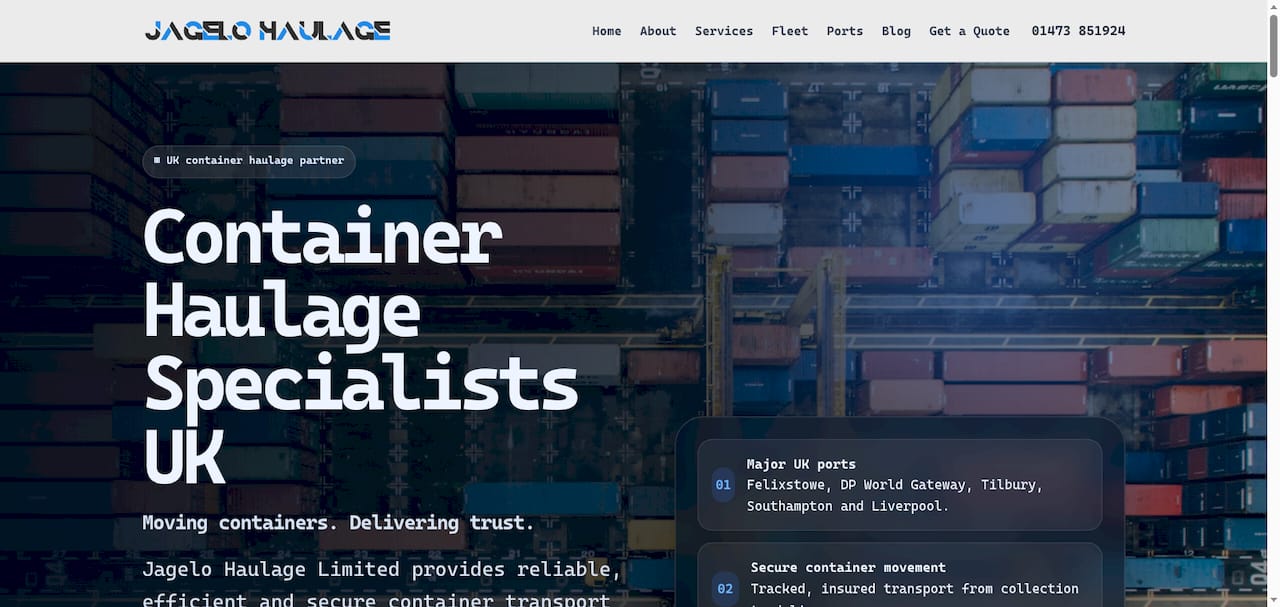
Every contracted move carries live location data and milestone timestamps, giving your operations team the gate events, ETA updates, and exception alerts covered in this guide. Jhaulage’s onboarding process includes test-environment access, sample data for integration validation, and a named technical contact for the first 90 days. For freight forwarders who need a tracked container haulage partner with documented SLAs and port coverage across the UK’s major container terminals, contact Jhaulage directly to discuss your lanes and integration requirements.
Sources
For technical and industry background on the topics covered in this guide:
- Hapag‑Lloyd: Live positioning streamlining supply chains | SAP News Center
- Three real‑world multimodal tracking use cases | Sensolus
- Real‑time container tracking: what data should you actually track | Frayto
- How to track your shipping container: complete guide to container tracking in 2026 | Sarab DXB