The types of UK freight documentation required for every shipment

Nine documents cover most UK export and import shipments: an EORI number, a Customs Declaration Service (CDS) filing carrying a Declaration Unique Consignment Reference (DUCR), a correct commodity code under the UK Global Tariff, a commercial invoice, a packing list, a certificate of origin where needed, transport paperwork such as a bill of lading or air waybill, an Export Cargo Shipping Instruction (ECSI) or Standard Shipping Note (SSN), and, for hazardous cargo, a Dangerous Goods Declaration (DGD/DGN) plus a Safety Data Sheet (SDS).
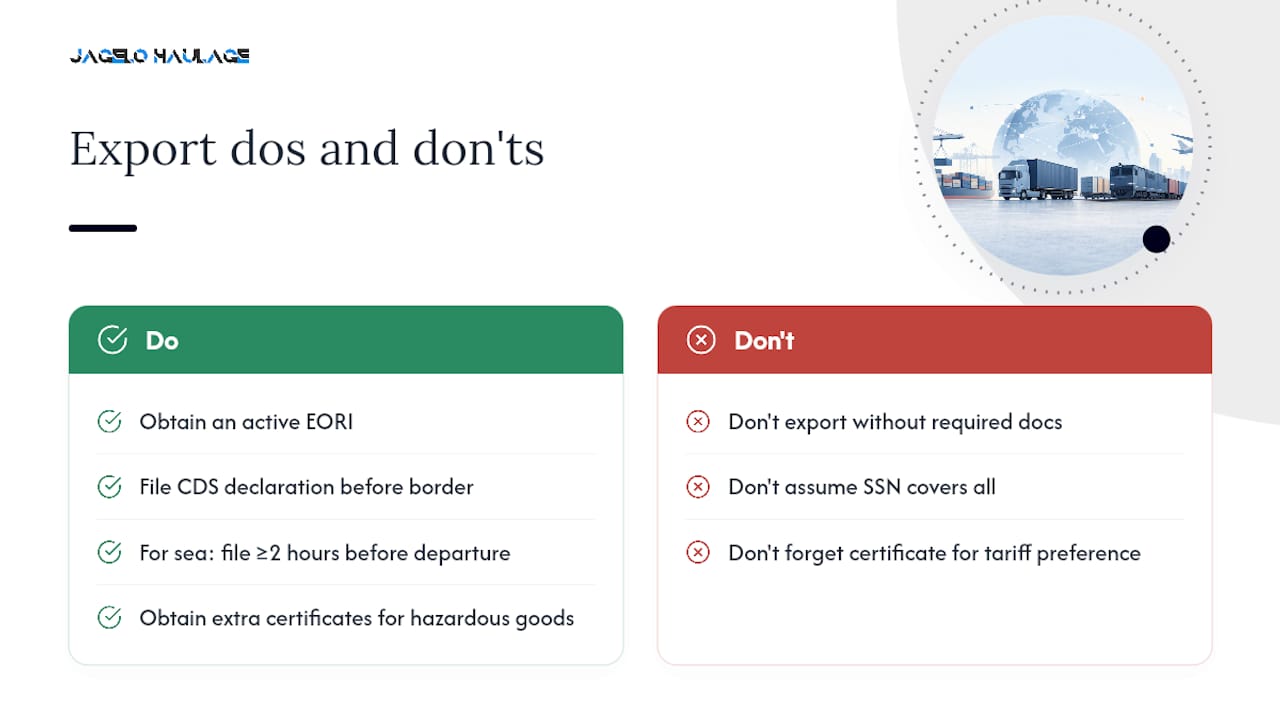
For containerised sea exports, CDS declarations must typically be submitted before goods are presented at the border, with a practical working rule of at least two hours before the vessel departs. Miss that window and your box waits for the next sailing, with demurrage clocking up while you sort the paperwork out.
Your first moves today: confirm the exporter’s EORI is active, select the correct commodity code, draft the commercial invoice and packing list, and agree who files the CDS declaration, whether that is you, a customs agent, or your freight forwarder.
- EORI number and CDS registration
- CDS declaration with a valid DUCR
- Commodity code from the UK Global Tariff
- Commercial invoice and packing list
- Certificate of origin (where the trade lane requires it)
- Bill of lading or air waybill
- ECSI or Standard Shipping Note
- Dangerous Goods Declaration and Safety Data Sheet (hazardous cargo only)
Key Takeaways
Accurate, cross-checked documentation, filed within CDS deadlines, is what keeps containers moving without detention or demurrage costs.
| Point | Details |
|---|---|
| Register EORI early | Confirm your EORI is active before you attempt any CDS filing. |
| File ahead of the deadline | Submit CDS export declarations well before the two-hour containerised sea-freight cut-off. |
| Match every document | Reconcile invoice, packing list, ECSI, and transport documents before cargo presentation. |
| Treat ECSI as essential | Use a standing ECSI template to prevent transcription errors and disputes over handling. |
| Assign clear ownership | Name one document owner per shipment and confirm who files under the agreed Incoterm. |
For a full walkthrough of container-specific compliance, see our container transport compliance checklist, and if your consignment involves hazardous goods, our hazardous cargo haulage guide covers DGD and SDS requirements in more depth. If you need a haulier who reconciles this paperwork before collection rather than after, Jhaulage handles port-to-door container movement across the UK’s major terminals with that check built into every job.
Table of Contents
- What customs filings does UK freight documentation require?
- Which commercial documents does a shipment need?
- What transport documents do carriers require?
- What paperwork applies to dangerous or perishable goods?
- Who is responsible for filing, and when?
- What should a field-ready ECSI checklist include?
- What common documentation mistakes cause delays?
- A haulier’s view on documentation as risk management
- Where to check current filing rules
- Frequently asked questions
- Sources
What customs filings does UK freight documentation require?
Every UK export or import consignment moving internationally by sea, air, or road needs a formal customs declaration, and that declaration cannot exist without three building blocks: an EORI number, an accurate commodity code, and a DUCR.
Your EORI number is the identifier HMRC uses to link your business to every customs transaction you make. Without one, you cannot submit a declaration through the Customs Declaration Service, full stop. If you trade with the EU as well as further afield, check whether you need a second EORI recognised by EU customs authorities, since the UK number alone will not cover both directions.
The CDS declaration itself is where the detail lives. A full export declaration needs the correct commodity code, the applicable customs procedure code, consignor and consignee details, transport information, and the DUCR, which functions as the master reference tying your shipment’s documents, declaration, and physical movement together. Get the DUCR wrong or leave it off supporting paperwork, and your consignment can be held at the terminal while everyone tries to work out which declaration belongs to which box.
Commodity codes deserve particular care. The UK Global Tariff sets the duty rate and regulatory treatment for thousands of goods categories, and misclassification is one of the most common reasons declarations get queried or rejected outright.
- Register for EORI before you need to file, not on the morning of collection
- Confirm the commodity code against the current UK Trade Tariff
- Lock the DUCR early and use it consistently across invoice, packing list, and transport documents
- Decide who files the CDS declaration and confirm they have your authority to do so
Pro Tip: Validate your commodity code against the UK Trade Tariff tool before you finalise the commercial invoice. A code correction after filing usually means resubmitting the declaration, which can push your container past its loading cut-off.
HMRC guidance confirms that declarations must generally be submitted before goods reach the border or begin their journey to one, and containerised sea exports commonly need filing at least two hours ahead of departure.
Which commercial documents does a shipment need?
Customs officers and buyers both scrutinise the same handful of commercial documents, and getting the fields right the first time saves you a query cycle that can add days to clearance.
The commercial invoice is the backbone. It should show the seller and buyer in full, a precise commodity description (not “goods” or “parts”), the HS code, unit and total value, the currency, the agreed Incoterm, and an invoice number and date. Vague descriptions are one of the fastest routes to a customs hold.
The packing list does a different job. Where the invoice states value, the packing list states physical reality: package counts, gross and net weights, dimensions, and a breakdown of what sits in which container. Port handlers and customs both use it to verify what they are looking at against what was declared.

A certificate of origin becomes necessary when you are claiming preferential tariff treatment under a trade agreement, when a buyer’s contract demands one, or when the destination country requires it for regulatory reasons. Your local Chamber of Commerce can issue and verify these certificates when the rules are unclear for a specific commodity or destination.
| Document | Core purpose |
|---|---|
| Commercial invoice | States value, parties, and commodity detail for customs and payment |
| Packing list | Confirms physical contents, weights, and dimensions |
| Certificate of origin | Supports preferential duty or destination-country requirements |
Some commodities also need an export licence, particularly dual-use goods, defence-related items, and certain chemicals. Check licence requirements before you commit to a shipping date, not after.
What transport documents do carriers require?
The bill of lading (B/L) and air waybill (AWB) both serve as the carrier’s formal acknowledgement that goods have been received, but they carry different legal weight. A B/L can act as a document of title, meaning ownership can transfer with it, and an original may be needed at destination to release the cargo. The AWB carries no such title function. It is a non-negotiable receipt for air freight, meaning the named consignee, and only the named consignee, takes delivery.
Sitting alongside those, the Standard Shipping Note (SSN) and Export Cargo Shipping Instruction (ECSI) tell the carrier and port authority how to handle a non-hazardous consignment. The SSN applies across air and sea for non-hazardous goods, while the ECSI, though not compulsory, is widely treated as best practice because it doubles as a single authoritative record covering handling instructions, customs formalities, and how charges are split between exporter and forwarder.
- Bill of lading: evidence of receipt, contract of carriage, potentially a document of title
- Air waybill: non-negotiable receipt naming a fixed consignee
- SSN: standard handling instruction for non-hazardous cargo
- ECSI: broader instruction covering handling, customs, and cost allocation
Pro Tip: Reconcile your ECSI or shipping instruction against the commercial invoice and packing list before you send it. A mismatched weight or commodity description between the two is one of the most common causes of a query at the terminal gate.
Carriers won’t load without this paperwork in hand, and a B/L that doesn’t match the CDS declaration’s DUCR is a fast route to a hold at the container terminal.
What paperwork applies to dangerous or perishable goods?
Hazardous, perishable, and otherwise regulated cargo carries an extra documentation layer, and skipping it is not a paperwork oversight, it is a safety and legal failure.
For dangerous goods moving by sea or road, you need a Dangerous Goods Declaration (DGD/DGN). Air freight uses the IATA Dangerous Goods Declaration instead, reflecting the stricter handling rules aviation applies to hazardous cargo. Get the wrong declaration type attached to the wrong mode, and carriers will refuse the booking outright rather than risk the consequences.
Alongside the DGD sits the Safety Data Sheet (SDS), which gives handlers the technical hazard data, labelling references, and emergency information they need before they touch the cargo. Perishable and agricultural goods bring their own layer again: phytosanitary certificates, health certificates, or veterinary certificates depending on the product and destination.
- DGD/DGN for hazardous cargo by sea or road; IATA DGD for air
- SDS supplied with every hazardous consignment
- Phytosanitary or health certificates for perishable and agricultural goods
- Licences and permits checked against destination-country rules before booking
Non-hazardous cargo still needs an SSN even where a DGD isn’t required, so don’t assume “no hazard” means “no transport document” at all.
Who is responsible for filing, and when?
Incoterms decide who prepares which document, and getting this wrong mid-shipment is one of the most expensive mistakes in freight. Under terms like EXW, the buyer typically arranges export clearance; under DAP or DDP, the seller carries far more of that burden, including customs filing and, under DDP, import duties too. Consulting a forwarder early when setting Incoterms avoids the awkward discovery, mid-transit, that nobody actually filed the export declaration.
Timing follows the transport mode. Build your paperwork around this order:
- Draft the commercial invoice and packing list as soon as the order is confirmed
- File the CDS declaration ahead of the border presentation deadline, allowing for the two-hour sea-freight rule
- Issue the ECSI or SSN to the carrier before collection
- Run a final cross-check of invoice, packing list, and transport documents before cargo presentation
- Assign a single document owner per shipment, not a shared responsibility nobody actually holds
- Set the filing deadline against the transport mode, not a generic date
- Budget for customs handling fees and the cost of rework if a declaration bounces
What should a field-ready ECSI checklist include?
Before collection, run through this sequence: confirm the EORI is active, check the invoice fields are complete, verify the commodity code, confirm the packing list matches the physical load, and attach an SDS if any part of the consignment is hazardous.
- Confirm EORI and CDS filing status
- Verify commodity code against the invoice description
- Cross-check packing list against actual container contents
- Attach SDS for any hazardous line items
- Issue the ECSI to the forwarder or haulier with full field detail
| ECSI field | What to enter |
|---|---|
| Consignor / consignee | Full legal names and addresses |
| DUCR | Matching the CDS declaration reference |
| Commodity HS code | Matching the commercial invoice |
| Container number | Confirmed at gate-in |
| Gross / net weight | Matching the packing list |
| Incoterms | As agreed in the sales contract |
| Special handling notes | Hazard class, temperature control, stacking limits |
At Jhaulage, we treat the ECSI as the single document that keeps a container moving without a query. Pro Tip: Keep a standing ECSI template in your shipping SOPs rather than drafting one from scratch each time. Consistency across shipments is what stops small transcription errors turning into terminal holds.
What common documentation mistakes cause delays?
Most port holds trace back to a handful of repeat offenders: an incorrect commodity code, an invoice that doesn’t match the packing list, a transport document that disagrees with the CDS declaration, or a missing licence for controlled goods.
Watch for these red flags specifically:
- A missing or incorrect DUCR on any supporting document
- An unsigned certificate of origin
- Consignee details that don’t match between invoice and bill of lading
- No SDS attached where the cargo is hazardous
Prevention beats correction every time. Run a pre-shipment checklist, use software validation on commodity codes before filing, and talk to your Chamber of Commerce or forwarder early when a destination country has unfamiliar requirements. A five-minute call before booking is cheaper than a container sitting in demurrage.
A haulier’s view on documentation as risk management
We’ve seen a mismatched weight between an ECSI and a packing list hold a container for two days at the port, purely because nobody caught the discrepancy before gate-in. Reconciling the ECSI against the invoice at booking stage, rather than after collection, is what stopped that becoming a detention charge on a later load.
Treat your paperwork as risk management, not admin. A container doesn’t get delayed because a form is dull to complete. It gets delayed because two documents disagree with each other and nobody spotted it in time.
Where to check current filing rules
- Making a full export declaration for CDS filing timing and requirements
- Transport document completion for SSN, DGN, and ECSI field guidance
- Customs declaration completion requirements for Great Britain for CDS field-level detail
- Our guide to freight forwarding responsibilities for how Incoterms affect who files what
Frequently asked questions
What documents are needed for freight leaving the UK? At minimum, you need an EORI number, a CDS export declaration with a DUCR, a correct commodity code, a commercial invoice, a packing list, and transport paperwork such as a bill of lading or air waybill. Hazardous or regulated goods need additional certification.
Do I need an EORI number for every shipment? Yes. Any business filing a CDS declaration needs an active EORI, and if you also trade with the EU, check whether a second EORI recognised there is required for that leg.
How far in advance must I file a CDS declaration? For containerised sea exports, HMRC guidance points to filing at least two hours before the vessel departs, and declarations generally need submitting before goods reach the border.
What is the difference between an SSN and an ECSI? The Standard Shipping Note covers non-hazardous cargo across air and sea. The ECSI is broader, covering handling instructions, customs formalities, and cost allocation, and is treated as best practice even though it isn’t compulsory.
When do I need a certificate of origin? You need one when claiming preferential tariff treatment under a trade agreement, when a buyer’s contract requires it, or when the destination country mandates it for that commodity category.
This article is general information, not a substitute for advice from a qualified lawyer. Consult a qualified legal professional about your own circumstances before acting on anything here.