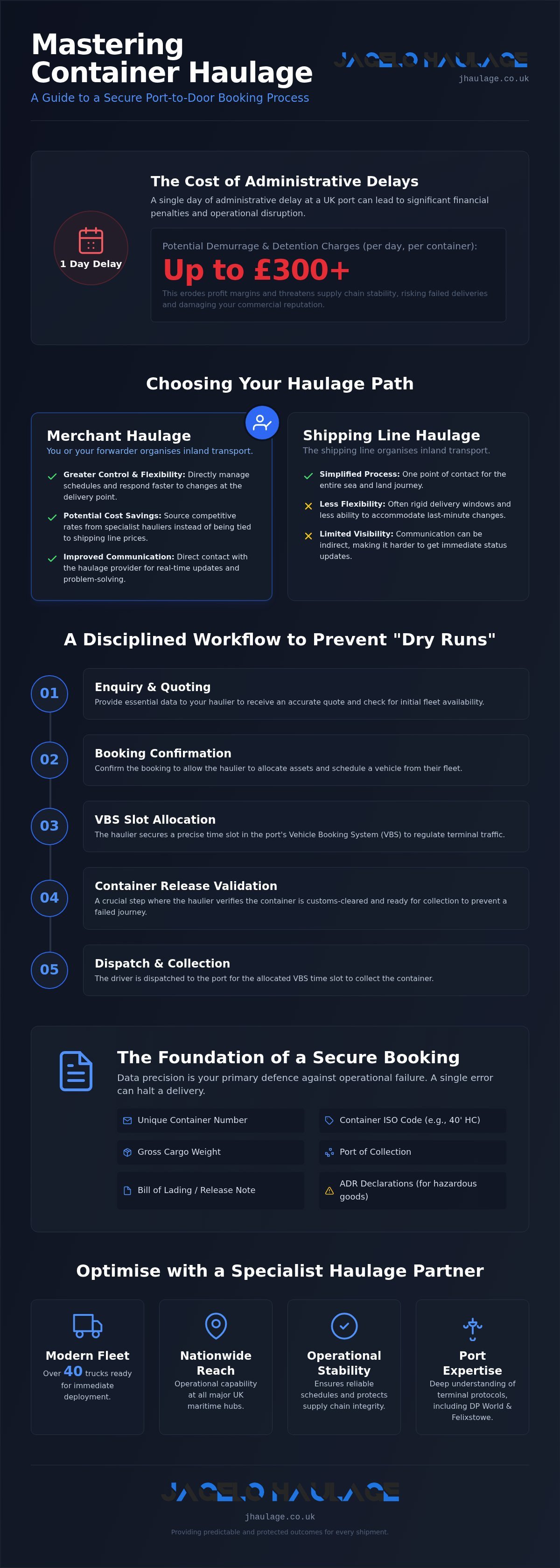
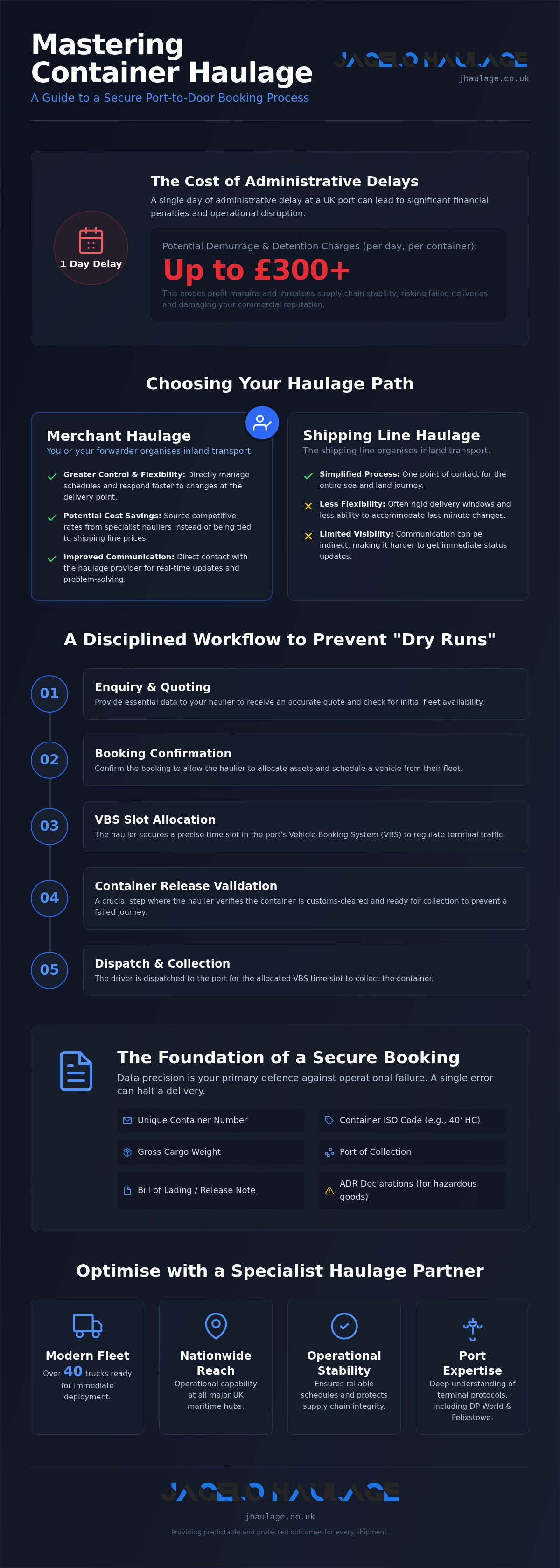
A single day of administrative delay at a UK port in 2026 can cost your business upwards of £300 in demurrage and detention charges. Managing the container haulage booking process is no longer a simple task of moving goods; it is a high-stakes coordination of precise data and port timing. You understand that inconsistent communication and a lack of visibility often lead to expensive operational bottlenecks. These disruptions threaten the stability of your supply chain and your commercial reputation whilst increasing the risk of failed deliveries.
Jagelo Haulage, a specialist in professional logistics, provides this definitive guide to help you master port-to-door movements and secure a reliable delivery schedule. We'll show you how to organise your workflow and ensure your documentation meets current standards. You'll learn the specific steps to manage Merchant and Shipping Line haulage whilst avoiding common pitfalls. We'll examine mandatory customs requirements, the essential data needed for a successful booking, and how to maintain disciplined oversight from the quay to the warehouse door. Our objective is to help you achieve a predictable and protected outcome for every shipment.
Key Takeaways
- Understand how a structured container haulage booking process acts as the primary coordination point to prevent supply chain bottlenecks and administrative delays.
- Identify the essential data points and ISO codes required to secure accurate haulage quotes and eliminate security-related discrepancies.
- Evaluate the strategic benefits of Merchant Haulage versus Shipping Line Haulage to maintain better control over your inland logistics.
- Master a disciplined booking workflow that validates transport orders early to prevent expensive "dry runs" and port congestion issues.
- Discover how leveraging a specialist partner with a modern fleet of over 40 trucks provides the operational stability needed for reliable UK port-to-door delivery.
Understanding the Essentials of the Container Haulage Booking Process
The container haulage booking process is the formal coordination between the cargo owner, the port terminal, and the haulier. It functions as the primary mechanism for moving freight from maritime arrival to inland distribution. This phase is the most critical point for preventing supply chain bottlenecks. Without a structured booking, the movement of goods becomes reactive rather than planned. A disciplined booking workflow ensures that every party understands their responsibilities before the container even touches the quay.
In the context of the global containerization system, the haulier provides the essential link between sea and land. Professional providers like Jagelo Haulage operate with a nationwide reach to service all major UK maritime hubs. This operational scale is necessary to manage the complexities of port logistics. It requires a partner that understands the specific protocols of different terminals whilst maintaining a fleet ready for immediate deployment. Effective booking is a strategic outcome that protects the integrity of the entire supply chain.
The Strategic Importance of Early Booking
Timing is a fundamental factor in logistics costs. When a container sits at the quay beyond its allocated free time, it incurs demurrage and detention charges. In 2026, these fees often range from £100 to over £300 per day, which quickly erodes profit margins. Securing fleet capacity amongst national providers is a competitive task. Early booking allows a haulier to allocate their assets, such as a fleet of over 40 trucks, with greater precision. This foresight is especially vital during peak seasons when port congestion increases. By booking early, you ensure your cargo isn't left waiting whilst others compete for limited transport slots.
Key Stakeholders in the Booking Chain
A successful booking relies on the cooperation of three main stakeholders. The freight forwarder typically initiates the transport request by providing the haulier with release notes and container details. The Port Authority then manages the physical collection through a Vehicle Booking System (VBS). This system regulates terminal traffic and requires precise time slots for every vehicle. Finally, the haulier verifies the container’s release status before dispatching a driver. This step is vital to prevent "dry runs" where a truck arrives at the port only to find the goods aren't ready. A professional haulier's role is to validate this information, ensuring a seamless transition from the port to the final delivery point.
Documentation and Data: The Foundation of a Secure Booking
Data precision is the primary defence against operational failure in the container haulage booking process. A single digit error in a container number or an incorrect ISO code can halt a delivery before it leaves the terminal. These identifiers are essential for terminal security and compliance with UK container safety regulations. Accuracy ensures that the haulier matches the correct trailer type to the specific unit, whether it is a standard 40ft high cube or a specialised reefer. This documentation phase transforms a generic transport request into a secure, executable inland transport order.
UK ports, including DP World London Gateway and Felixstowe, rely on sophisticated Vehicle Booking Systems (VBS) to manage traffic flow. A haulier cannot simply arrive at the gate; they must have a pre-allocated time slot linked to a valid release reference. If the data provided during the booking phase is incomplete, the VBS entry will fail. This results in missed slots and potential congestion charges. Professional haulage partners validate these references against port systems to ensure the container is cleared and ready before dispatching a vehicle from the fleet.
The Bill of Lading serves as the source of truth for the inland transport order. It contains the essential cargo descriptions and gross weight data that dictate vehicle selection. For hazardous shipments, ADR declarations must be organised well before fleet assignment. A haulier needs this information to ensure the driver has the correct training and the vehicle carries the necessary safety equipment. This disciplined approach to data management protects both the cargo and the haulier's operational integrity.
Mandatory Information for Your Haulier
To initiate a booking, you must provide the unique container number and specify its type. This allows the haulier to distinguish between 20ft and 40ft units or identify if a flat rack is required for oversized goods. The release reference or pin code is the "golden key" required for port exit authorisation. Finally, you must declare the gross weight and payload. This information is vital for ensuring the haulier assigns a vehicle with the correct axle weight capacity to remain compliant with UK road laws.
Delivery Site Requirements
Accuracy extends to the final destination. You must provide a full delivery address, including the postcode and specific site contact details. It is essential to identify site constraints early. If your facility requires a "drop and swap" service rather than "wait and load", this must be specified during the booking. Providing complete data from the outset allows for a professional haulage quote and a more stable delivery schedule.
Merchant Haulage vs Shipping Line Haulage: Choosing Your Path
The choice between merchant and shipping line haulage is a strategic decision that dictates the level of control you maintain over your supply chain. Merchant haulage occurs when the cargo owner or their freight forwarder appoints a private haulier to collect the container from the port. Shipping line haulage, often called carrier haulage, is a service where the ocean carrier manages the final inland leg as part of a combined transport contract. This choice fundamentally alters the container haulage booking process, shifting the responsibility for coordination and data management between the cargo owner and the carrier.
Professional operators often favour the transparency of merchant haulage. It allows for a direct relationship with the transport provider, ensuring that specific site requirements and time-sensitive constraints are understood. When you manage your own haulage, you retain the ability to verify that your partner adheres to the official load securing guidance and other safety protocols. This level of oversight is often lost in carrier-managed logistics, where the shipping line may subcontract the work to various third-party fleets with varying degrees of service quality.
The operational data requirements also differ between these two paths. In merchant haulage, you must provide the haulier with the release pin and port references directly. In carrier haulage, the shipping line uses its internal systems to manage these details. Whilst carrier haulage might appear simpler, it often lacks the agility required to handle port disruptions or sudden changes in delivery schedules. Choosing the right path depends on whether you value administrative ease or operational precision.
The Benefits of Merchant Haulage
Merchant haulage provides direct access to the fleet manager. This eliminates the need to navigate global call centres when you require a status update or a schedule adjustment. It offers superior flexibility, allowing you to organise same-day or time-critical deliveries that a larger carrier might struggle to accommodate. Pricing is typically more transparent, as you negotiate rates directly and avoid the hidden surcharges often applied by shipping lines. For a deeper analysis, you can read our guide on Merchant Haulage vs Shipping Line Haulage: A Strategic Comparison.
When to Use Shipping Line Haulage
Shipping line haulage is often suitable for low-volume importers with standard delivery requirements. It offers the "through-bill" advantage, where a single document covers the entire journey from the origin port to the final inland destination. This simplifies the billing process and reduces the number of individual transport orders you must manage. However, users should understand that responsiveness can be limited during periods of port congestion. When disruptions occur, carrier-managed haulage often faces longer delays as the shipping line prioritises its own internal logistics over individual client needs.
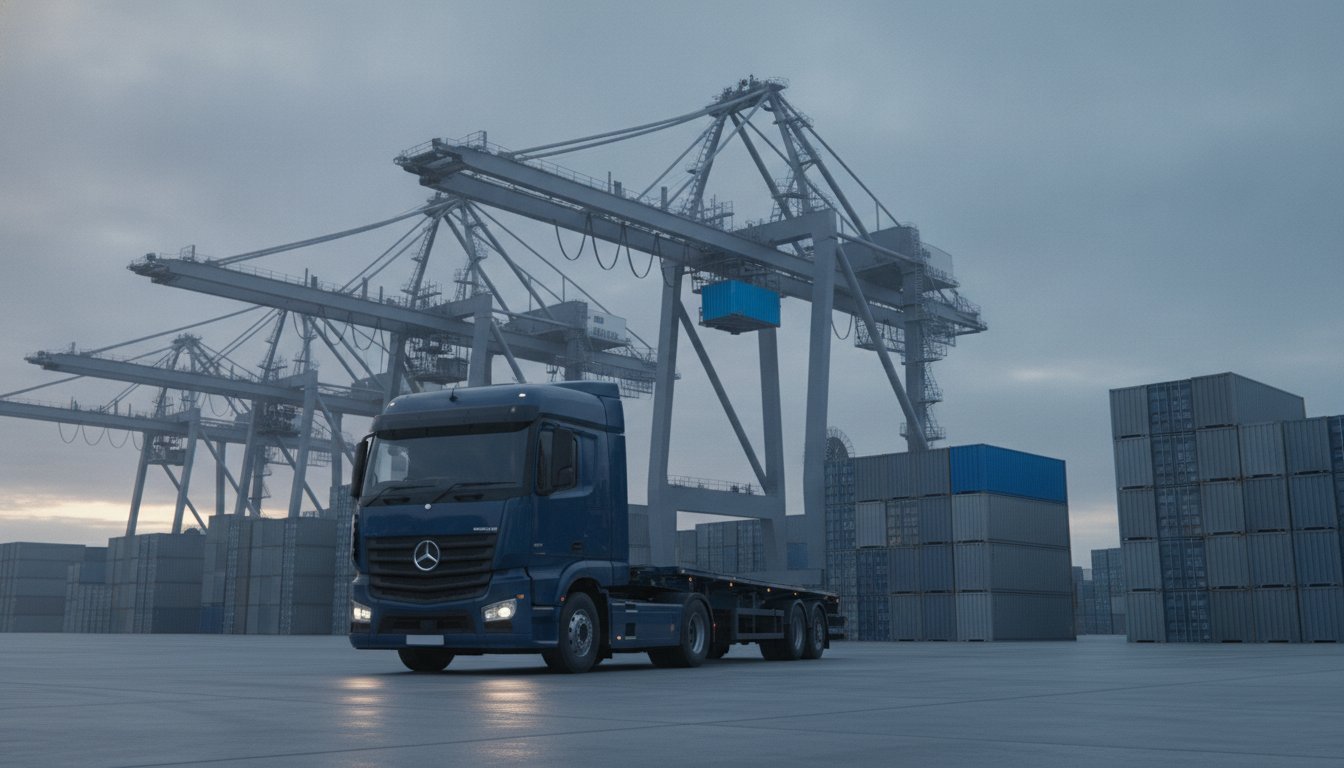
The Step-by-Step Booking Workflow: From Enquiry to Delivery
A disciplined container haulage booking process follows a logical, step-by-step sequence to ensure operational success. This systematic approach guarantees that every transport order is fully executable before a vehicle is dispatched from the depot. It moves beyond simple administrative entry to include the rigorous validation of port data and terminal availability. By following a structured lifecycle, a haulier can eliminate the variables that often lead to delays and additional costs at the quay.
Reliable logistics providers use this workflow to maintain a high standard of functional reliability. The process bridges the gap between the initial enquiry and the final offloading at your facility. It requires a partner that understands the high stakes of the supply chain and follows strict protocols to protect your cargo. This methodical flow mirrors the reliability of the physical operations, providing a sense of long-term stability for your inland distribution needs.
Phase 1: Quote and Confirmation
The workflow begins when you submit a transport request containing the specific data points identified in Section 2. The haulier then provides a formal rate based on the route, container type, and any specialised requirements. Understanding the components of a container transport quote is essential for approving costs with confidence. Once the rate is approved, the haulier enters the booking into their Transport Management System (TMS). This digital entry triggers the operational planning phase and secures your place in the delivery schedule.
Phase 2: Port Coordination and VBS
The haulier must verify the "freight-release" and "customs-clearance" status of the container with the shipping line. This verification is a critical step to prevent "dry runs" where a driver arrives at the terminal only to find the container isn't ready for collection. Once cleared, the haulier secures a Vehicle Booking System (VBS) slot at the port, such as Felixstowe or Southampton. These slots are strictly timed and must align perfectly with your requested delivery window. The haulier then assigns a driver from the fleet and transmits the container pin code to the port terminal for authorisation.
Phase 3: Execution and Completion
Execution starts with the vehicle's arrival at the port during its allocated slot. Real-time transit monitoring allows the operations team to track the container's progress whilst it's on the road. Upon arrival at your site, the driver manages the offloading according to your preferred method, whether it's a standard wait-and-load or a drop-and-swap arrangement. The process concludes with a digital POD (Proof of Delivery). This document provides immediate confirmation of completion and serves as a vital record for your financial reconciliation. To ensure your cargo is managed through this disciplined workflow, you can request a professional haulage quote for your next shipment.
Optimising Your Logistics with a Specialist Haulage Partner
Selecting a specialist partner is the final stage in refining your container haulage booking process. It represents a shift from transactional transport to a strategic operational alliance. A partner with over 15 years of industry experience understands that port interactions require more than just a vehicle. They require a deep knowledge of terminal protocols at hubs like London Gateway, Southampton, and Felixstowe. This expertise allows a haulier to navigate sudden administrative shifts or VBS updates at the quay with quiet confidence. This competence ensures that your goods remain protected throughout the inland journey.
Stability in logistics is built on the foundation of a professionally managed fleet. When a haulier operates over 40 modern trucks, they possess the operational depth to absorb the fluctuations of the UK port environment. This scale allows for a more disciplined approach to scheduling and resource allocation. It moves your business away from the unpredictability of aggregators and towards a model based on functional reliability. A dedicated fleet manager can prioritise your shipments, ensuring that your delivery schedule remains predictable even during periods of high demand or port disruption.
Modern Fleet Capabilities
Modern telematics and GPS tracking improve the transparency of the booking experience. These systems provide real-time data that allows for precise arrival estimates and better coordination at the delivery site. Specialised trailers are also essential for handling varied cargo requirements with the necessary safety standards. Rigorous fleet maintenance serves as a protective measure, reducing the risk of mechanical failure whilst on the road. This technical capability ensures that the promises made during the booking phase are fulfilled during execution.
The Jagelo Haulage Advantage
Jagelo Haulage maintains a commitment to steadfast professionalism in every transport order. Our nationwide reach covers all major UK maritime hubs, providing a consistent service regardless of the port of entry. We understand that the high stakes of the supply chain require a partner who follows protocols strictly and understands the importance of punctual delivery. Responsive customer support during the booking phase ensures that communication remains clear and that any site-specific constraints are addressed before the vehicle is dispatched. At Jagelo Haulage, we take stoic pride in our ability to provide protected outcomes for our clients. Positioning your business with a disciplined logistics partner provides the long-term stability needed to thrive in a competitive market.
Learn more about our Container Haulage services to see how our expertise can support your operations.
Contact our team today to discuss your booking requirements and establish a reliable port-to-door workflow.
Securing Operational Stability in Your Supply Chain
Mastering the container haulage booking process requires a commitment to data accuracy and strategic coordination. You've seen how precise container numbers and valid VBS slots prevent expensive bottlenecks at the quay. By choosing a merchant haulage model, you maintain direct control over your inland logistics and avoid the lack of visibility often associated with carrier-managed services. This disciplined approach ensures your supply chain remains resilient against port disruptions whilst maintaining a predictable cost structure.
Jagelo Haulage provides the steadfast professionalism needed to execute these movements with functional reliability. We leverage over 15 years of port logistics expertise and a modern fleet of 40+ trucks and trailers to deliver a reliable nationwide service from all major UK ports. Our team understands the specific protocols of every terminal, ensuring your cargo moves safely from the quay to the warehouse door. We pride ourselves on being a dependable partner that prioritises the safety and efficiency of your operations above all else.
Request a professional container haulage quote from Jagelo Haulage today to secure your 2026 delivery schedule. We look forward to establishing a stable and productive partnership for your long-term logistics needs.
Frequently Asked Questions
How far in advance should I book my container haulage?
You should ideally book your haulage five to seven days before the vessel's scheduled arrival. This lead time allows the haulier to secure preferred Vehicle Booking System (VBS) slots and allocate specific assets from the fleet. During peak periods or times of high port congestion, extending this window to ten days ensures greater operational stability and protects your delivery schedule from capacity shortages.
What is a container release pin and why is it needed for booking?
A container release pin is a unique security code issued by the shipping line once all freight charges and terminal fees are settled. It acts as the final authorisation for the port terminal to release the cargo to a specific vehicle. A haulier cannot complete the container haulage booking process or enter the port gates without this pin, as it serves as the primary security verification.
Can I change my delivery address after the haulage is booked?
You can change the delivery address provided the driver hasn't yet departed from the port terminal. You must notify the haulier immediately to update the transport order and verify if the new destination impacts the agreed rate. Late changes often require a new VBS slot or may result in additional mileage charges, so early communication is essential to maintain a streamlined workflow.
What happens if my container is not cleared by customs in time for the booking?
The haulier must cancel the planned collection if the container fails to clear customs. A vehicle cannot exit the port with uncleared goods, and attempting to do so results in a "dry run" charge. You'll need to re-book the transport once clearance is confirmed, which may lead to demurrage costs whilst the container sits at the quay beyond its free-time allowance.
Do I need different bookings for 20ft and 40ft containers?
Yes, you must specify the container size during the container haulage booking process because it dictates the trailer type required. A 40ft container requires a standard long-bed trailer, whilst 20ft units may be moved on specialised sliding skeletal trailers or grouped for efficiency. Providing the correct ISO code ensures the haulier assigns a vehicle with the appropriate payload capacity and axle configuration for UK road compliance.
What is the difference between "wait and load" and "drop and swap" in a booking?
"Wait and load" is a service where the driver remains on-site whilst the container is emptied, typically within a two-hour window. "Drop and swap" involves the haulier leaving a full container at your premises and immediately collecting an empty one from a previous delivery. Your choice depends on your warehouse's offloading speed and available space for container storage.
How do I track my container once the haulier has collected it from the port?
Professional hauliers use GPS-integrated telematics to monitor the real-time position of the fleet. You can receive status updates directly from the traffic office or through a dedicated customer portal. This visibility allows you to prepare your warehouse team for the vehicle's arrival and provides a precise audit trail from the port quay to the final delivery point.
Are there extra charges if the port is congested and the driver is delayed?
Extra charges, often termed "waiting time," may apply if a driver is delayed at the port or delivery site beyond an agreed free period. This free time is typically set at one or two hours. If congestion at major hubs like Felixstowe or Southampton causes significant delays, these costs are applied to cover the vehicle's standing time and the disruption to the subsequent delivery schedule.