The assumption that sustainable logistics must compromise operational reliability is no longer a valid concern for the UK supply chain. Many logistics managers feel the mounting pressure of corporate ESG targets; they often worry that transitioning to greener methods might disrupt the consistency of their deliveries. Finding reliable container haulage UK wide requires a partner that understands how to balance environmental responsibility with the strict demands of port logistics. It's a challenge of discipline rather than just technology.
We understand that your primary goal is the secure and punctual movement of goods from major hubs like Felixstowe or Southampton. This guide will show you how modern haulage fleets and strategic port logistics are driving the transition to a more sustainable UK supply chain without sacrificing performance. We'll explore the impact of 2026 regulations, including the mandatory adoption of Advanced Emergency Braking (AEB) systems and the expansion of Clean Air Zones across the country. By focusing on operational efficiency and the elimination of waste, you can protect both your margins and your environmental commitments.
Key Takeaways
- Understand how integrating low-emission technology with disciplined logistics management defines modern sustainable transport for the 2026 UK market.
- Learn why Euro VI engine compliance and aerodynamic trailer designs are essential for reducing the environmental impact of long-haul container deliveries.
- Identify the strategic balance between rail freight and road transport to ensure your "Last Mile" logistics remain both efficient and sustainable.
- Discover the specific vetting criteria, such as FORS accreditation, required to secure reliable container haulage UK services that meet corporate ESG targets.
- Explore how professionally managed port logistics from major UK hubs can eliminate operational waste and strengthen your supply chain's long-term resilience.
What is Sustainable Container Transport in the UK?
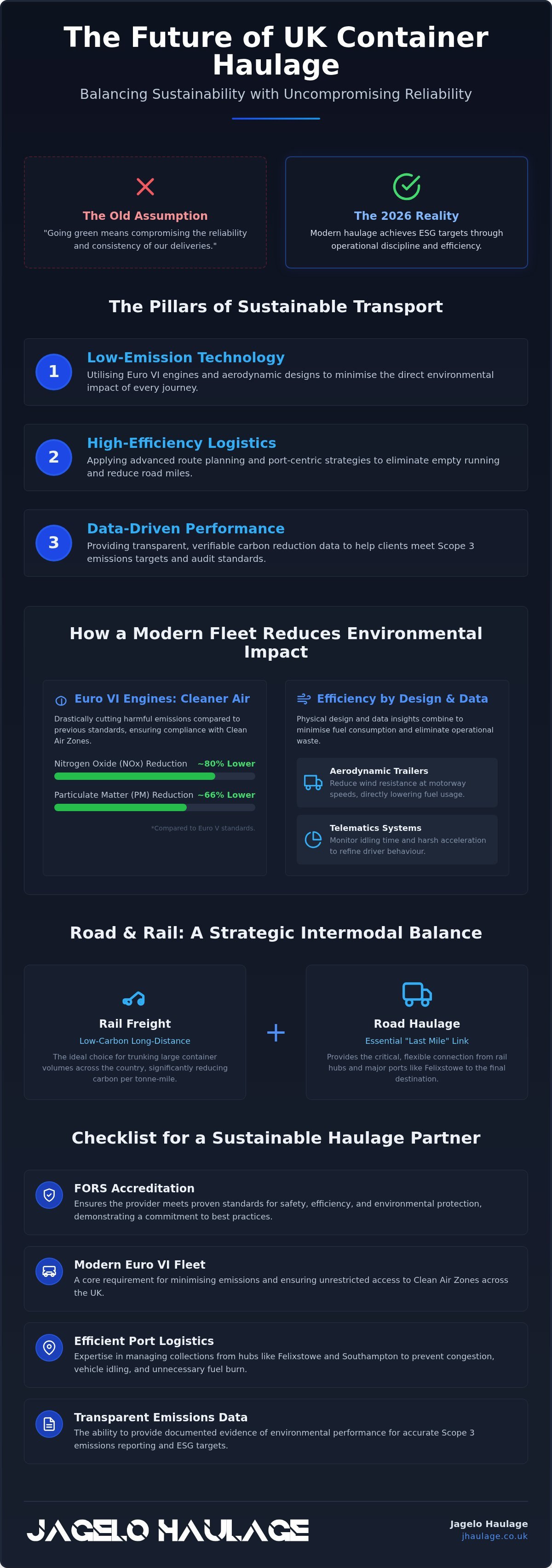
Sustainable container transport in the UK involves the disciplined integration of low-emission engine technology and high-efficiency logistics management. It isn't simply a matter of purchasing newer vehicles. It's a strategic approach to moving goods that reduces environmental impact through technical compliance and operational precision. In the context of the UK Green Logistics framework for 2026, this means adhering to strict Euro VI emissions standards and utilising advanced route planning software to eliminate empty running. Every mile travelled must serve a specific logistical purpose to avoid unnecessary fuel consumption.
Procurement teams across the country now treat sustainability as a mandatory requirement rather than a secondary preference. This shift is driven by the need for transparent, verifiable data. Measurable carbon reduction is the only way to distinguish professional logistics providers from those engaging in greenwashing. Real progress is found in the maintenance records of a fleet and the accuracy of its tracking data. Businesses require a partner that provides documented evidence of their environmental performance to meet internal audit standards.
The Importance of Scope 3 Emissions in Logistics
Transport activities usually represent the largest portion of a company's Scope 3 emissions. These are the indirect emissions occurring in a business's value chain. Because the UK government has set firm net-zero targets for 2050, businesses must account for every mile their goods travel. Selecting reliable container haulage UK partners who invest in modern, fuel-efficient equipment is the fastest way to improve these supply chain metrics. It provides an immediate reduction in the carbon footprint of every container moved without requiring a total overhaul of your internal operations.
Sustainable Port Logistics: Beyond the Engine
True sustainability extends beyond the engine of a truck. Efficient port logistics services UK focus on reducing total road miles through port-centric strategies. This involves collecting containers promptly to prevent terminal congestion and vehicle idling. Whilst Intermodal railfreight in Great Britain provides a low-carbon alternative for long-distance trunking, road haulage remains the essential link for the final delivery. Professional port logistics ensure this link is as efficient as possible. By minimising wait times at major hubs like Southampton or Felixstowe, hauliers reduce unnecessary fuel burn and support broader environmental targets. This level of coordination is a hallmark of reliable container haulage UK providers who prioritise operational discipline.
The Role of Modern Fleets in Reducing Environmental Impact
Modern road haulage fleets are the primary tool for reducing the carbon footprint of inland container movements. Whilst some critics focus on the environmental costs of heavy goods vehicles, the reality of the 2026 logistics sector is defined by technical advancement. Maintaining reliable container haulage UK standards involves more than just punctuality; it requires the use of high-specification equipment. Euro VI engine standards have transformed the industry by significantly reducing nitrogen oxide and particulate matter emissions. These improvements are not just about compliance; they represent a fundamental shift in how transport energy is managed.
Physical vehicle design also plays a critical role in fuel conservation. Aerodynamic trailer designs are now standard for long-haul deliveries, as they reduce wind resistance at motorway speeds. This technical refinement directly lowers fuel consumption and carbon output. However, even the most advanced vehicle requires disciplined maintenance to remain efficient. Regular servicing schedules ensure that engines operate at peak thermal efficiency, preventing the fuel waste associated with worn components or incorrect tyre pressures. A well-maintained fleet is a more predictable fleet, which is essential for secure port logistics.
Telematics systems provide the data required to refine driver behaviour. By monitoring metrics such as idling time and harsh acceleration, operators can identify and eliminate inefficient driving patterns. This data-driven approach is a core component of providing reliable container haulage UK services. It ensures that every litre of fuel is used productively, supporting the Road Haulage Association's net zero goals through measurable operational improvements. Professional drivers who follow these protocols contribute directly to the overall sustainability of the supply chain.
Euro VI Standards and Clean Air Zones
Operating in the UK now requires navigating an increasing number of Clean Air Zones (CAZ) in cities such as Birmingham, Sheffield, and Bristol. Modern engines are essential for these routes to avoid daily penalties and ensure uninterrupted service. There is a clear technical gap between older equipment and a modern container transport fleet. Euro VI standards represent the current benchmark for low-emission diesel transport. These vehicles utilise advanced exhaust after-treatment systems to neutralise pollutants before they leave the tailpipe, allowing them to operate freely within restricted urban centres.
Investing in Fleet Technology for the Future
The industry is currently transitioning towards alternative fuels and electric HGVs to meet long-term decarbonisation targets. Vehicle age is directly related to carbon output; older trucks are consistently less efficient than their modern counterparts. Jagelo Haulage maintains a fleet of over 40 modern trucks to ensure maximum operational reliability and lower emissions across all major UK ports. This commitment to equipment quality protects your supply chain from both regulatory risks and environmental waste. If you require a partner that prioritises fleet efficiency, you can request a professional haulage quote to discuss your specific requirements.
Road vs. Rail: Finding the Sustainable Balance
Choosing between road and rail transport requires a realistic assessment of your cargo's journey, volume, and required delivery speed. Whilst rail is often highlighted for its ability to move large volumes over long distances with lower emissions per tonne-kilometre, road haulage provides the essential flexibility that the UK's rail infrastructure cannot match. The "Last Mile" remains the most critical part of the supply chain. Even when containers travel by rail to an inland terminal, they still require reliable container haulage UK services to reach their final destination. Road transport is an indispensable component of any sustainable chain, providing the door-to-door precision that keeps operations moving without delay.
For many specific port-to-door routes, modern road haulage can rival rail in terms of practical sustainability. This is achieved through aggressive route optimisation and the use of the latest Euro VI equipment. When a delivery point is not directly served by a railhead, the extra handling and shunting involved in intermodal transport can sometimes offset the carbon gains of the rail leg. Professional hauliers focus on maximising the efficiency of every journey, ensuring that road transport is used where it provides the most direct and least wasteful path to the customer.
Eliminating Empty Miles and Waste
The most significant environmental cost in the haulage sector is the "empty mile," where a vehicle travels without a payload. Disciplined logistics providers solve this through back-hauling and strategic planning from major hubs like Felixstowe or Southampton. By coordinating import collections with export deliveries, operators can ensure that trucks are utilised for both legs of a journey. This approach drastically reduces the total mileage required to move the same volume of goods. Effective logistics for shipping containers rely on this level of operational foresight to minimise waste and lower the carbon footprint of every delivery.
Intermodal Logistics in the UK
Sustainable transport is rarely about choosing one mode over another; it's about finding a hybrid balance. Road haulage acts as the vital support system for rail terminals and deep-sea ports, ensuring that the efficiency of long-haul sea or rail journeys isn't lost during the inland transit. Merchant haulage offers particular advantages in this area, as it allows cargo owners more flexibility to plan sustainable routes based on real-time port conditions. Using reliable container haulage UK partners allows businesses to maintain a nimble supply chain that can adapt to infrastructure changes whilst still meeting strict environmental targets. This strategic coordination ensures that your logistics framework remains robust, secure, and professionally managed.
Choosing a Reliable Container Haulage UK Partner: A Checklist
Selecting a logistics provider requires a rigorous evaluation of their operational standards and equipment quality. To secure reliable container haulage UK, you must look beyond the initial price and assess the underlying discipline of the organisation. A provider's fleet age and maintenance records offer the most accurate insight into their commitment to efficiency. Newer vehicles are designed for lower emissions, but only consistent, professional maintenance ensures they operate at those intended levels throughout their service life. It's essential to request documented proof of these standards during the vetting process.
- Fleet Age and Standards: Confirm that the provider operates Euro VI compliant vehicles to ensure access to all UK Clean Air Zones without penalty.
- FORS Accreditation: Look for the Fleet Operator Recognition Scheme (FORS) certification as a benchmark for safety, efficiency, and environmental protection.
- Data Transparency: Ensure the partner can provide verifiable fuel efficiency data and carbon reporting to support your corporate ESG targets.
- Port Coverage: Verify that the haulier has a permanent presence at major hubs such as Felixstowe, Southampton, and London Gateway to ensure responsive service.
The Link Between Safety and Sustainability
Operational safety and environmental performance are intrinsically linked. A safe driver prioritises smooth braking and maintains optimal speeds, which naturally reduces fuel consumption and wear on the vehicle. This disciplined approach ensures that container transport costs remain stable by preventing the waste associated with aggressive driving or vehicle downtime. Professional management systems that monitor these behaviours provide the consistency needed for long-term sustainability. When safety protocols are followed strictly, the result is a more predictable and protected supply chain that doesn't compromise on its green commitments.
Merchant Haulage for Greater Control
Merchant haulage offers a level of control that shipping line haulage often lacks. By choosing an independent, disciplined contractor like Jagelo Haulage, you gain the ability to implement bespoke, sustainable route planning tailored to your specific delivery windows. This flexibility allows for better integration of back-hauling opportunities and the direct reduction of empty miles. You can integrate your haulage partner directly into your sustainability reporting, ensuring that every container moved contributes to your broader environmental goals. If you're ready to partner with an expert in reliable container haulage UK, you can request a professional haulage quote today to begin your operational assessment.
Jagelo Haulage: Reliable and Efficient UK Port Logistics
Jagelo Haulage provides secure and professionally managed transport solutions across the United Kingdom. With over 15 years of industry experience, the company has established a reputation for operational discipline and functional reliability. Our focus remains on delivering protected outcomes for every client, regardless of the cargo's complexity. We understand the high stakes involved in the supply chain. This understanding drives our commitment to providing reliable container haulage UK services that meet the rigorous demands of modern commerce. Our team understands the nuances of UK port regulations and the importance of meeting strict delivery windows.
Our commitment to excellence is backed by a modern fleet of over 40 trucks and trailers. This capacity allows us to maintain a consistent presence at major maritime hubs whilst providing the flexibility required for bespoke logistics. We don't just move containers; we provide a strategic service that prioritises the safety and efficiency of your operations above all else. By choosing a partner with a proven track record, you can ensure that your supply chain remains resilient against the logistical challenges of the 2026 market.
A Modern Fleet for National Delivery
Our operational hub at Bridge Farm represents a significant investment in the future of UK logistics. By maintaining a modern fleet of over 40 trucks, we ensure that our vehicles meet the highest standards of fuel efficiency and mechanical reliability. This investment is central to our ability to offer same-day delivery services for urgent logistics requirements. Our operations centre manages every route with precision, utilising disciplined scheduling to minimise waste and ensure punctuality. Newer vehicles naturally produce lower emissions, which directly supports the sustainability goals discussed throughout this guide. This methodical approach allows us to provide consistent service levels that corporate clients can depend on for their daily operations.
Strategic Partnering for UK Ports
Strategic coordination with major maritime hubs is essential for maintaining a resilient supply chain. Jagelo Haulage provides comprehensive coverage for all major UK ports, including DP World London Gateway, Liverpool, Tilbury, Felixstowe, and Southampton. This nationwide reach ensures that we can support operators regardless of their primary port of entry. Our role extends beyond simple transport; we act as a strategic partner in our clients' broader logistical frameworks. Our focus on reliable container haulage UK ensures that your containers are handled with the highest level of care and professional oversight.
We provide responsive customer support to ensure that every collection and delivery is executed according to protocol. Our expertise in merchant and shipping line haulage allows us to navigate the complexities of terminal handling and port logistics without unnecessary delays. We maintain a high level of organisational discipline to protect your cargo and your reputation. For businesses seeking a partner that prioritises performance and security, the choice is clear. You can take the next step in securing your supply chain today.
Request a secure and efficient container haulage quote from Jagelo Haulage.
Securing Operational Excellence in Sustainable Logistics
The transition to a sustainable supply chain depends on the disciplined management of modern equipment and the elimination of operational waste. As discussed, the integration of Euro VI engine standards and strategic port logistics allows businesses to meet corporate ESG targets without compromising on delivery consistency. By choosing a partner with FORS accreditation and a transparent approach to data, you protect your operations from regulatory risks and rising environmental pressures.
Jagelo Haulage provides the stability required to navigate these changes. With a modern fleet of over 40 trucks and 15 years of industry experience, we deliver nationwide coverage from all major UK ports. Our focus remains on providing secure, professionally managed outcomes that support your long-term growth. Securing reliable container haulage UK is a matter of selecting a partner that understands the high stakes of your logistics framework.
You can ensure your cargo reaches its destination efficiently and sustainably. Get a reliable container haulage quote for your 2026 logistics requirements and take control of your environmental performance today.
Frequently Asked Questions
What makes container haulage sustainable in the UK?
Sustainable container haulage is defined by the disciplined integration of low-emission engine technology and high-efficiency logistics management. It involves using modern vehicles that meet strict environmental standards whilst employing strategic route planning to eliminate operational waste. Professional management ensures that every journey serves a specific purpose, reducing the overall carbon footprint of the supply chain.
How does a modern truck fleet reduce carbon emissions?
A modern fleet utilises Euro VI engine technology to significantly lower nitrogen oxide and particulate matter emissions. These engines are designed for peak thermal efficiency, meaning they consume less fuel per mile than older equipment. Regular, professional maintenance ensures these vehicles continue to operate at their intended efficiency levels, preventing the fuel waste associated with mechanical wear.
Is rail transport always more sustainable than road haulage for containers?
Rail is not always the most sustainable option for every logistical requirement. While rail handles long-distance bulk movements efficiently, road haulage provides the direct door-to-door precision needed for the "Last Mile." Road transport often eliminates the additional handling and shunting required at rail terminals, which can sometimes offset the carbon benefits of the rail leg on shorter routes.
What are empty miles and how do they affect sustainability?
Empty miles occur when a heavy goods vehicle travels without a payload, representing a total waste of fuel and operational capacity. These journeys produce emissions without delivering any logistical value to the supply chain. Strategic planning and back-hauling are essential to eliminate these miles, ensuring that every vehicle journey is as productive and environmentally responsible as possible.
How can I verify if a haulage company is environmentally responsible?
You can verify a provider's environmental commitments by reviewing their FORS accreditation level and fleet age. A company providing reliable container haulage UK wide should be transparent with their maintenance records and emissions data. This documentation provides the verifiable evidence required by procurement teams to meet corporate ESG targets and net-zero obligations.
Do modern HGVs have to meet specific emission standards in the UK?
Yes, modern HGVs must meet Euro VI standards to operate within the various Clean Air Zones established across UK cities like Birmingham and Bristol. These standards are the current benchmark for low-emission diesel transport. Additionally, from July 2026, all newly manufactured trucks in the UK must be equipped with Advanced Emergency Braking (AEB) systems to improve both safety and operational efficiency.
How does route optimisation contribute to green logistics?
Route optimisation reduces environmental impact by ensuring vehicles take the most direct and efficient path to their destination. Advanced planning software identifies routes that avoid heavy congestion and excessive idling, both of which contribute to unnecessary fuel burn. Disciplined scheduling ensures that vehicle movements are coordinated to minimise total mileage across the entire transport network.
Can sustainable haulage actually reduce my total logistics costs?
Sustainable haulage often reduces total logistics costs by improving fuel efficiency and avoiding the daily charges associated with non-compliant vehicles in Clean Air Zones. By minimising empty miles and optimising routes, a reliable container haulage UK partner lowers the total energy required for each delivery. These operational efficiencies protect your margins whilst simultaneously supporting your environmental commitments.