Six Day Trap: Portsmouth Clean Air Zone Rules for Fleet Managers
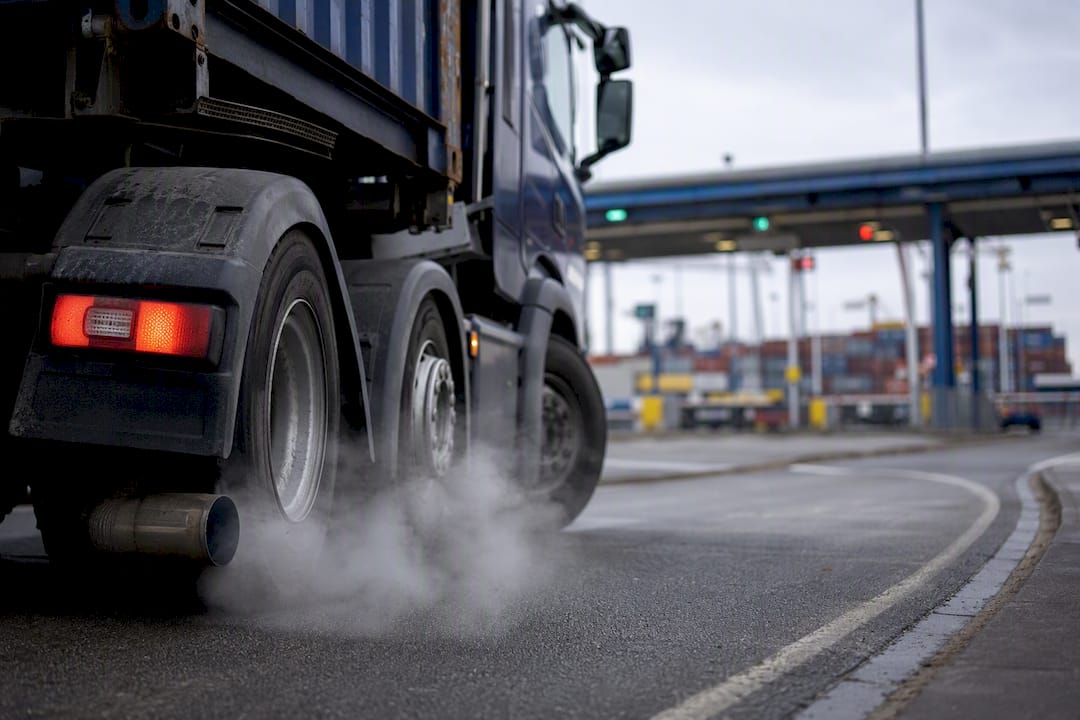
Portsmouth’s Clean Air Zone charges non-compliant taxis, private hire vehicles, buses, coaches and HGVs entering the city centre; private cars, vans and motorcycles pay nothing. Standard daily charges are £10 for taxis and PHVs and £50 for heavier commercial vehicles, with a six-day window either side of travel to pay. If you operate or drive one of the affected vehicle classes, check your registration on the GOV.UK vehicle checker before you enter the zone.
TL;DR:
- Vehicles most likely to face charges include older diesel taxis, pre-2014 coaches, and large motorhomes registered as HGVs, which may catch operators off guard.
- Automatic enforcement relies on 55 cameras around the zone boundary, but penalties can escalate from £60 to £120 if unpaid after the initial 14-day discount period.
- Exemptions for emergency, disabled, and some historic vehicles require direct application and early processing to avoid charges.
- Fleet managers should implement routine compliance checks, centralize payments, and plan routes to prevent penalties caused by overlooked registrations or map errors.
Table of Contents
- Which vehicles does the Portsmouth Clean Air Zone charge?
- Charges, operating hours and how to pay
- Exemptions, local concessions and how to apply
- Checking compliance and finding the Portsmouth CAZ map
- What happens if you get a penalty charge notice
- Portsmouth’s clean air strategy and what it means for operators
- A fleet manager’s pre-trip checklist for Portsmouth compliance
- Where Portsmouth’s Clean Air Zone fits for haulage operators
- Why the six-day window is the real trap here
- Sources
Which vehicles does the Portsmouth Clean Air Zone charge?
Portsmouth runs a Class B Clean Air Zone, one of the narrower CAZ categories under the national framework. That means it targets commercial and public transport vehicles rather than private motoring, a deliberate choice that keeps the burden on operators whose fleets produce the bulk of roadside nitrogen dioxide.
The zone charges taxis, private hire vehicles, buses, coaches and HGVs that fail to meet Euro 6 diesel or Euro 4 petrol emission standards. Private cars, vans and motorcycles are exempt regardless of their emissions rating, which surprises drivers who assume any older vehicle is at risk.
One quirk catches out leisure drivers and small operators alike: some large motorhomes are classed as HGVs by the DVLA, not as private vehicles, which pulls them into the charged category even though they feel like a car on the road.
Vehicle types most commonly caught out include:
- Older diesel taxis and PHVs registered before Euro 6 became standard
- Pre-2014 coaches and buses running on Euro 5 engines or earlier
- HGVs on port-feeder routes that haven’t been upgraded or retrofitted
- Large motorhomes and campervans registered in the DVLA’s HGV class
Charges, operating hours and how to pay
The zone runs 24 hours a day, seven days a week. There’s no quiet window and no weekend exemption, so a Sunday delivery run into the city centre is charged exactly the same as a Tuesday one.
Charges are counted per calendar day, midnight to midnight. A vehicle that enters just before midnight and exits shortly after can technically rack up two separate daily charges, which matters if you’re scheduling overnight collections or drop-offs near the port.
The daily charge is £10 for non-compliant taxis and private hire vehicles, and £50 for non-compliant HGVs, buses and coaches. These rates apply per vehicle, per chargeable day, regardless of how many times that vehicle crosses the boundary within the same day.
To pay:
- Use the official Gov and enter your registration.
- Call the national support line on 0300 029 8888 if you’d rather pay by phone or need help confirming your vehicle’s status.
- Pay any time from six days before your journey up to six days after it. There’s no requirement to pay on the day itself.
- If you’ve already received a penalty charge notice, follow the payment instructions printed on that notice rather than the standard portal route.
Exemptions, local concessions and how to apply
National exemptions cover emergency service vehicles and vehicles registered in the disabled tax class, and these apply automatically without a separate Portsmouth application. Portsmouth also grants a handful of local concessions, typically for specialist heavy vehicles used in niche trades and some historic vehicles that fall outside standard emissions testing.
Applying for a local exemption means contacting the council directly rather than relying on the national portal:
- Email [email protected] with your vehicle registration and the reason for the exemption request
- Call 023 9283 4593 if you need to discuss your case or check what’s required
- Expect to provide vehicle registration documents, proof of vehicle use, and in some cases evidence of a retrofit or planned upgrade
Pro Tip: Apply for any local exemption well before you need it. Council teams process these requests in the order they arrive, and a late application won’t stop charges accruing while you wait for a decision.
Checking compliance and finding the Portsmouth CAZ map
The fastest way to settle the question is the GOV.UK vehicle checker: enter your registration and it tells you immediately whether that vehicle would be charged in Portsmouth or any other UK CAZ. It’s the same tool referenced across every official Portsmouth CAZ information.
For the physical boundary and enforcement detail, Cleaner Air Portsmouth publishes the definitive CAZ map showing the zone edge and camera locations. Worth knowing before you plan a route:
- The zone is enforced by 55 ANPR cameras positioned around the boundary, backed by physical signage at every entry point
- There’s no manual check-in or ticket machine; cameras read plates automatically and match them against the compliance database
- Large motorhomes should have their DVLA vehicle class confirmed before travel, since HGV classification isn’t always obvious from the vehicle’s appearance
- Drivers of goods vehicles working port routes can cross-reference boundary data using tools like Logivo’s DVS zone map when planning multi-zone journeys across the UK
What happens if you get a penalty charge notice
Nobody sends you a reminder when you enter the zone. It’s entirely on the driver or operator to check liability and pay within the six-day window, and missing that window triggers automatic enforcement.
If the charge goes unpaid, the process runs as follows:
- A Penalty Charge Notice is issued once the six-day payment window closes without payment.
- Paying within 14 days of the notice reduces the fee to £60; after that it rises to £120.
- Further non-payment escalates to debt recovery action, which carries additional costs and can affect fleet vehicles more severely if it involves multiple registrations.
- Appeals are possible where there’s a legitimate reason, such as a booking error or an exemption that should have applied, and should be lodged in writing with supporting documentation.
Fleet managers running multiple vehicles through the zone regularly should centralise payment tracking rather than leaving it to individual drivers. A single missed registration check across a fleet of 20 vehicles can generate several PCNs from what was really one routing mistake, and contesting them individually wastes far more time than preventing them would have.
Portsmouth’s clean air strategy and what it means for operators
Portsmouth didn’t draw the CAZ boundary arbitrarily. Council monitoring identified specific pollution hotspots concentrated around key traffic corridors, and the zone was placed to intercept the heaviest emitters at those precise points rather than blanket the whole city.
That targeted approach reflects a broader principle in UK clean air policy: concentrated measures at known hotspots tend to shift air quality faster than city-wide restrictions that spread enforcement thin. The CAZ sits alongside other Portsmouth initiatives, including zero-emission bus deployment and expanded EV charging, both funded partly through reinvested CAZ revenue.
For operators, the direction is clear even if the exact timeline isn’t fixed:
- Expect infrastructure support (charging points, retrofit grants) to expand as the strategy matures
- Expect compliance thresholds to tighten over time rather than loosen
- Expect enforcement data and camera coverage to inform future zone adjustments
A fleet manager’s pre-trip checklist for Portsmouth compliance
Before any vehicle crosses into the zone, we run three checks: registration status on GOV.UK, DVLA vehicle class confirmation for anything borderline, and a route review to avoid junctions near the port that funnel HGVs into the zone with no easy way back out.
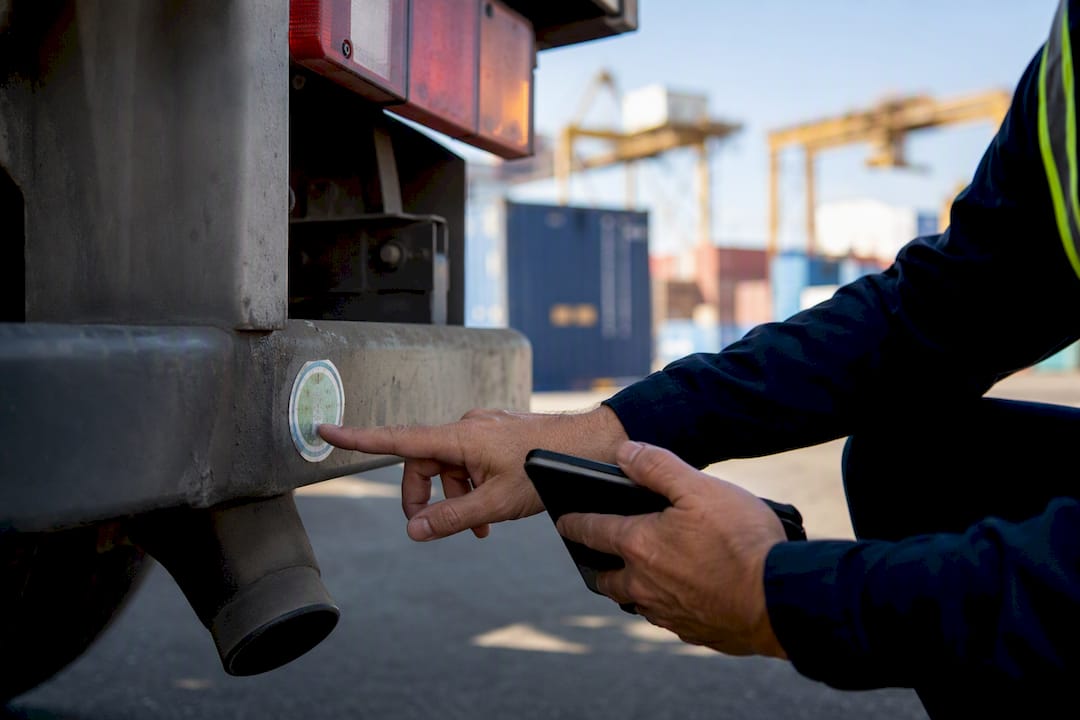
At fleet level, that means auditing Euro compliance across every vehicle, scheduling retrofits or replacements for anything that falls short, and centralising CAZ payments so no single driver is left guessing. Jagelo Haulage builds this discipline into daily operations across every port route we run, because a five-minute check beats a £120 penalty every time.
Where Portsmouth’s Clean Air Zone fits for haulage operators
Compliance here isn’t a one-off task. It’s a routine that needs to sit inside every dispatch decision, particularly for operators moving containers through Portsmouth’s port-adjacent routes where junction layout and zone boundaries interact awkwardly. Jagelo Haulage’s fleet management approach across major UK ports is built around exactly this kind of recurring regulatory check, and our container transport compliance checklist sets out the documentation practices that keep a fleet clear of avoidable PCNs.
If you’re contracting container haulage through Portsmouth or any other major UK port and want a partner who treats Clean Air Zone compliance as standard practice rather than an afterthought, Jagelo Haulage’s container haulage services run GPS-tracked fleets built for exactly this kind of route.
Why the six-day window is the real trap here
Most guidance on the Portsmouth Clean Air Zone focuses on the charge amounts, and understandably so. But the detail that catches people out isn’t the £10 or £50 figure. It’s the six-day payment window, because nothing tells you the clock has started.
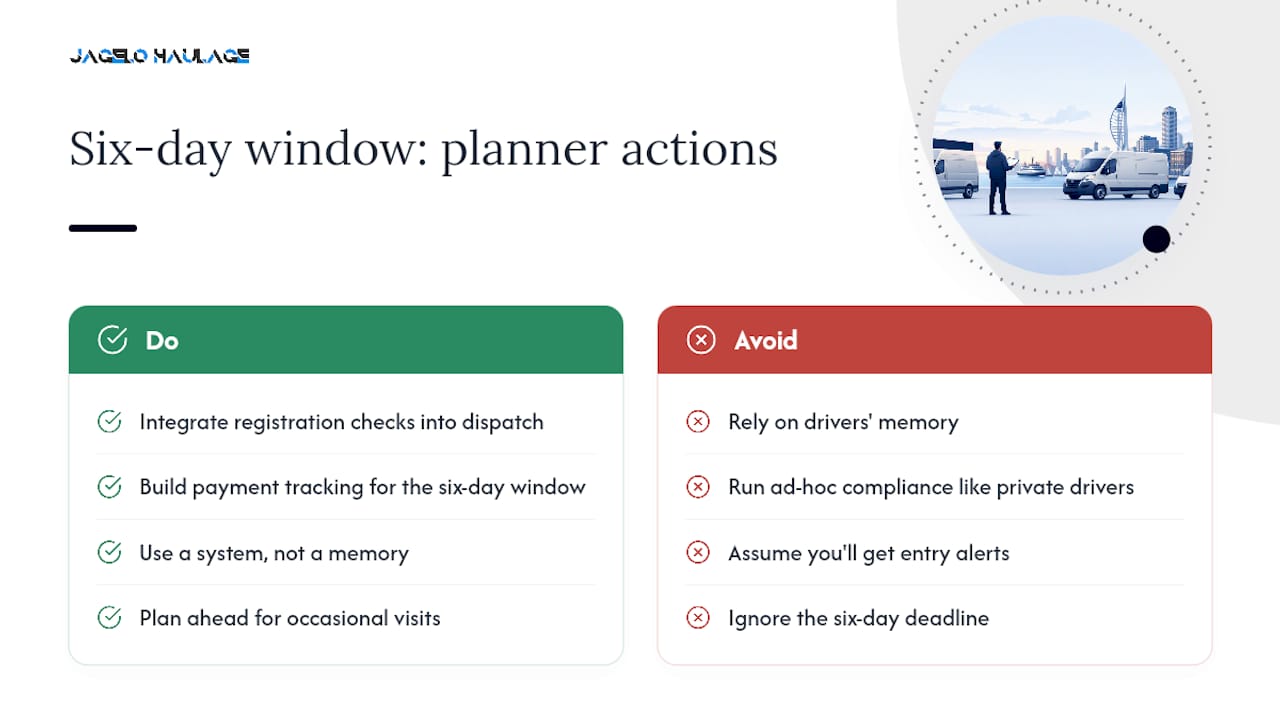
There’s no text alert, no email, no flashing sign confirming your entry has been logged. You find out you owe money either because you remembered to check, or because a Penalty Charge Notice lands weeks later. That silence is deliberate policy design, not an oversight, and it puts the entire compliance burden on the driver’s own diligence.
For occasional visitors, that’s manageable with a bit of forward planning. For fleet operators running the same Portsmouth routes daily, it’s a structural risk that demands a system, not a memory. The operators who get burned repeatedly by Portsmouth PCNs are rarely careless. They’re just running compliance checks the same ad hoc way private drivers do, on a scale where ad hoc stops working. A logistics business moving containers through the city several times a week needs registration checks and payment tracking built into dispatch, not left to whoever happened to remember last time.
— Vytautas