Port Community Systems: Badges, MRN and REL03 for UK Operators

A port community system (PCS) is the shared digital layer that coordinates who can touch a container at a UK port and when it may leave. Get the badge and the customs timing right, and you avoid gate delays. Get either wrong, and a container sits. The immediate action: confirm which Community System Provider (CSP) covers your arrival port, apply for a badge before cargo lands, and align your customs clearance so the release message arrives before your driver does.
TL;DR:
- Confirm the correct Community System Provider for each port, and apply for badges and technical connection well before cargo lands.
- Automate customs declarations and MRN linking before vessel discharge to prevent delays caused by data mismatches or late submissions.
- Use REL03 release messages and accurately nominate drivers against UCNs to avoid unnecessary gate rejections and delays on arrival.
- Rely on multiple system registration and separate login processes, as the UK markets maintain a fragmented PCS landscape with varying providers.
- Future innovations like sensors, blockchain, and AI aim to improve real-time tracking, gate scheduling, and data integrity but do not replace core procedures like badge validation and MRN linkage.
Table of Contents
- What is a port community system?
- UK CSPs and which ports they cover
- Getting access: badges, registration and typical charges
- How PCS connects to UK customs: CDS, MRN and the release handback
- PCS transactions and terms drivers need to know
- Why PCS matters: efficiency, emissions and UK port volumes
- Where operators actually lose time (and how to avoid it)
- How UK port community systems developed
- The technology behind modern PCS platforms
- Security and data privacy in port community systems
- How UK systems compare with port community platforms abroad
- What comes next: blockchain, IoT and smarter gate systems
- Author perspective: what actually saves time at the gate
- A specialist haulage partner cuts the on‑site burden of PCS complexity
- Sources
What is a port community system?
A PCS is the electronic platform that links terminals, shipping lines, freight forwarders, hauliers and HMRC into one data exchange, so a status update entered once by a terminal operator is visible to everyone downstream immediately. That is the “report once” principle: instead of a forwarder ringing a terminal to check if a box has landed, then a haulier ringing the forwarder, the PCS holds a single, live inventory record everyone can query.
The people who actually use it day to day include:
- Terminal operators, who log discharge, gate moves and hold status
- Shipping lines, who confirm cargo manifests and release instructions
- Freight forwarders, who track consignments and manage customer updates
- Hauliers, who need to know the moment a box is clear to collect
- HMRC and Border Force, who apply customs holds and releases within the same inventory record
For a haulage operator, the practical payoff is fewer phone calls and fewer wasted trips to a gate that will not release the box.
UK CSPs and which ports they cover
Coverage in the UK is fragmented by design. No single system runs every port, so knowing the right CSP for your destination is the first task, not an afterthought.
- Destin8, operated by MCP, is an inventory‑linking PCS used across a wide network of UK container and Ro‑Ro ports. Its information pack sets out the full community list, connection routes and sample fees.
- Community Network Services (CNS) runs at a separate group of UK ports and terminals, handling similar inventory and release functions for its own community.
- CCS‑UK covers another distinct set of port communities, again with its own registration and messaging conventions.
Coverage shifts as terminals switch providers or as new facilities come online, so treat any list as a snapshot rather than gospel. GOV.UK publishes an official directory of Community System Providers with contact details for each, and that page is the fastest way to confirm which system actually governs the port you are shipping into before you commit a driver.
Getting access: badges, registration and typical charges
Registration follows a fairly consistent pattern across UK CSPs, even though the paperwork differs slightly between them.
- Verify the port’s CSP. Check the GOV.UK provider list or ask the terminal directly, since applying to the wrong system wastes time and money.
- Complete the company application. You will supply company registration details, a nominated administrator and the port communities you need to join.
- Receive your company badge. This is the organisational credential that lets your business appear in the system as a recognised party to a consignment.
- Allocate user IDs. Each individual who needs access, whether an office planner or a driver checking status on a handheld, gets their own login under the company badge.
- Set up the technical connection. Choose browser access for occasional use or an EDI feed for automated, high‑volume operations.
Destin8’s own information pack publishes sample charges covering a community subscription plus per‑user or concurrent‑user access fees, which is worth budgeting for if your operation touches multiple port communities rather than just one.
Pro Tip: If you handle containers across more than one port community, price the recurring subscription and user fees for each CSP separately before you commit. Costs stack quickly once you are registered with three or four systems rather than one.
For EDI connections, expect the CSP to ask for a static IP address and to require whitelisting before your feed goes live, so raise this with your IT team well ahead of your first live shipment rather than on the morning cargo arrives.
How PCS connects to UK customs: CDS, MRN and the release handback
A PCS does not clear customs. It coordinates cargo status and inventory holds, but the legal release comes from HMRC’s Customs Declaration Service (CDS), and that separation trips up more operators than any other part of the process.
- A declaration submitted through CDS generates a Movement Reference Number (MRN), the unique identifier tied to that specific consignment.
- Once HMRC clears the declaration, that clearance is communicated back into the PCS, which lifts the inventory hold against the MRN.
- Only once the hold is lifted can a haulier legally collect the box, regardless of whether the vessel has discharged.
The tightest delays happen when MRN generation lags behind the vessel manifest, or when data mismatches between CDS and the PCS trigger a validation error rather than a clean release, and teams that automate declaration submission and MRN injection consistently see the fastest gate turnarounds. Best practice is straightforward: prepare and submit your declaration before the vessel berths, then confirm the MRN has actually linked to the inventory record rather than assuming it has, especially during peak sailings when volumes strain the messaging queue.
PCS transactions and terms drivers need to know
A handful of message types account for most of the day‑to‑day interaction between a haulage team and a PCS.
- REL03 is the release instruction message, issued once a hold is lifted and confirming a container is legally available for collection.
- The Unique Consignment Number (UCN) identifies a specific consignment within the system; hauliers often need to self‑nominate against a UCN to register that their vehicle is the one collecting that box.
- CODECO and COPINO are the standard EDI messages used for gate confirmations, container discharge/loading events and pre‑notification of collection, and they tie directly into the terminal’s own gate system rather than sitting separately in the PCS.
Knowing these terms by name matters because a driver quoting a REL03 reference at a gate resolves a dispute in seconds; a driver who cannot name what they are looking for gets sent away to “check with the office.”
Why PCS matters: efficiency, emissions and UK port volumes
UK ports handled a substantial volume of freight in 2025, with many major ports carrying the bulk of that traffic, according to GOV.UK port freight statistics.
At that scale, manual coordination simply cannot keep up. The World Bank describes PCS platforms as the “nervous system” of a port, automating information exchange so that data is reported once and shared everywhere it is needed rather than re‑keyed by every party in the chain. That efficiency gain has a sustainability dimension too: fewer unnecessary terminal visits and shorter dwell times cut idling, which lowers emissions at exactly the pinch points, gates and yards, where congestion is worst.
Where operators actually lose time (and how to avoid it)
Most delays are self‑inflicted, and they follow a predictable pattern.
- Assuming one badge works everywhere. A badge for one community will not necessarily grant release at another port; always confirm the port’s CSP before booking a collection.
- Submitting declarations too late. Synchronise MRN timing with the vessel’s actual discharge schedule, not its published ETA, since discharge often runs later at busy terminals.
- Mismatched EDI formats. Confirm your transport management system and customs software both support the CODECO/COPINO formats your chosen CSP expects, before you go live rather than after a failed message queue backs up.
Pro Tip: Build a five‑minute pre‑departure check into your dispatch process: confirm the REL03 has issued and the MRN has linked, before the driver leaves the yard. It is far cheaper than an hour idling at a terminal gate.
How UK port community systems developed
Port community systems grew out of a much older problem: paper. Before electronic data interchange became viable in ports, every discharge, customs clearance and gate release depended on physical documents passing between terminals, agents, customs officers and hauliers, often duplicated at each handoff.
The UK’s PCS landscape took shape from the 1980s onward as EDI standards matured and individual ports began digitising their own gate and inventory systems. Destin8 emerged from this period as an inventory‑linking system built specifically to connect terminal inventory with the wider trading community, rather than serve a single terminal in isolation. Other communities developed their own platforms, which is why the UK ended up with several parallel systems, Destin8, CNS, CCS‑UK, rather than one national standard.
That fragmented history still shapes operations today. Ports that grew up under different commercial ownership or regional trade patterns adopted different providers, and consolidation has been slow because switching a live PCS carries real operational risk for a working port. The World Customs Journal documents this pattern internationally: PCS evolution rarely follows a single national blueprint, and coverage models vary considerably even between countries with comparable trade volumes.
For UK operators, the practical legacy of that history is simple. There is no single login, no single badge and no single fee structure. You register separately with whichever CSP actually governs your port of call, and that reality has not meaningfully changed since the systems first went live, even as the underlying technology has moved from batch EDI files to near real‑time messaging.
The technology behind modern PCS platforms
Early PCS platforms ran on batch EDI file transfers, often overnight, which meant status updates could lag reality by hours. Modern systems have largely moved to near real‑time messaging, though the underlying EDI message types, CODECO, COPINO and their relatives, remain the common language even as the transport layer around them has modernised.
Most current UK CSPs offer two parallel connection routes. A browser‑based web interface suits occasional users, office staff checking a handful of consignments a day, without any development effort. An EDI or API integration suits operators moving high volumes, where a transport management system needs to query status automatically rather than have a person check a screen.
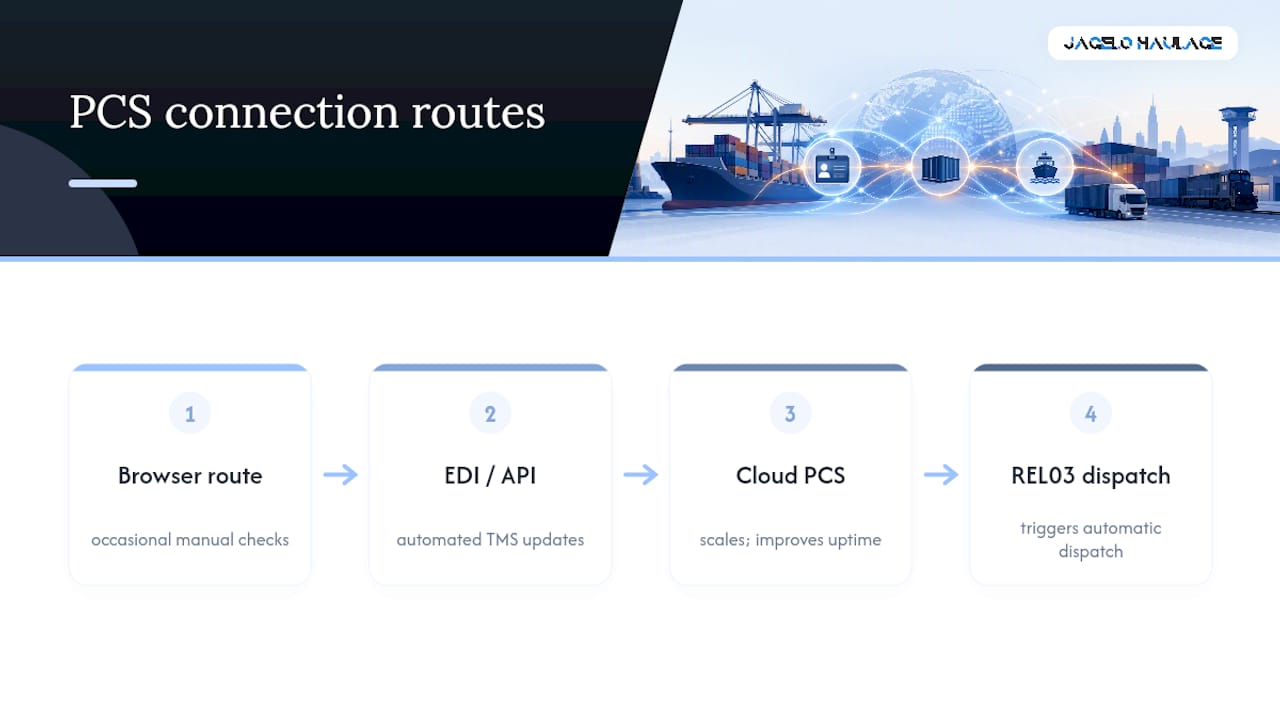
Cloud hosting has become the default architecture for these platforms, replacing the on‑premises servers many CSPs ran a decade ago. That shift matters operationally because it improves uptime and lets providers scale processing capacity during peak shipping seasons without the community feeling the strain of a single overloaded server.
API integration is where the more sophisticated haulage and forwarding operations are investing now. Rather than a person logging into Destin8, CNS or CCS‑UK to check a box’s status, a well‑built API connection pushes that status directly into a transport management system, triggering a dispatch instruction automatically the moment a REL03 issues. This is precisely the kind of integration Destin8’s own information pack anticipates when it lays out EDI connection requirements alongside the simpler browser route, recognising that different operators need very different levels of technical depth from the same underlying platform.
Security and data privacy in port community systems
A PCS sits at the intersection of commercially sensitive cargo data and legally sensitive customs information, which makes access control the single most important security feature of the whole architecture. Every user operates under a company badge, and every action a user takes is tied to that badge, creating an audit trail that matters when a dispute arises over who released a container or amended a consignment record.
Static IP whitelisting for EDI connections, a requirement Destin8 sets out explicitly in its connection guidance, exists precisely because customs and inventory data cannot be allowed to flow from an unverified source. If your infrastructure changes IP addresses dynamically, you need to resolve that with your CSP before going live, not after a rejected connection attempt during a live shipment.
Data privacy within a PCS also has a commercial dimension beyond regulatory compliance. Competing freight forwarders and shipping lines often share the same platform, so systems are built to expose only the data each badge holder is entitled to see, a consignment’s status to the party moving it, not the commercial terms behind it. That segmentation is what allows a genuinely shared community platform to function without competitors seeing each other’s client relationships.
For haulage operators specifically, the practical security takeaway is narrower than the platform’s full architecture: keep your user credentials tied to named individuals, never shared logins, since a badge misused by the wrong person creates liability for the whole company registered against it, not just the individual who typed the password.
How UK systems compare with port community platforms abroad
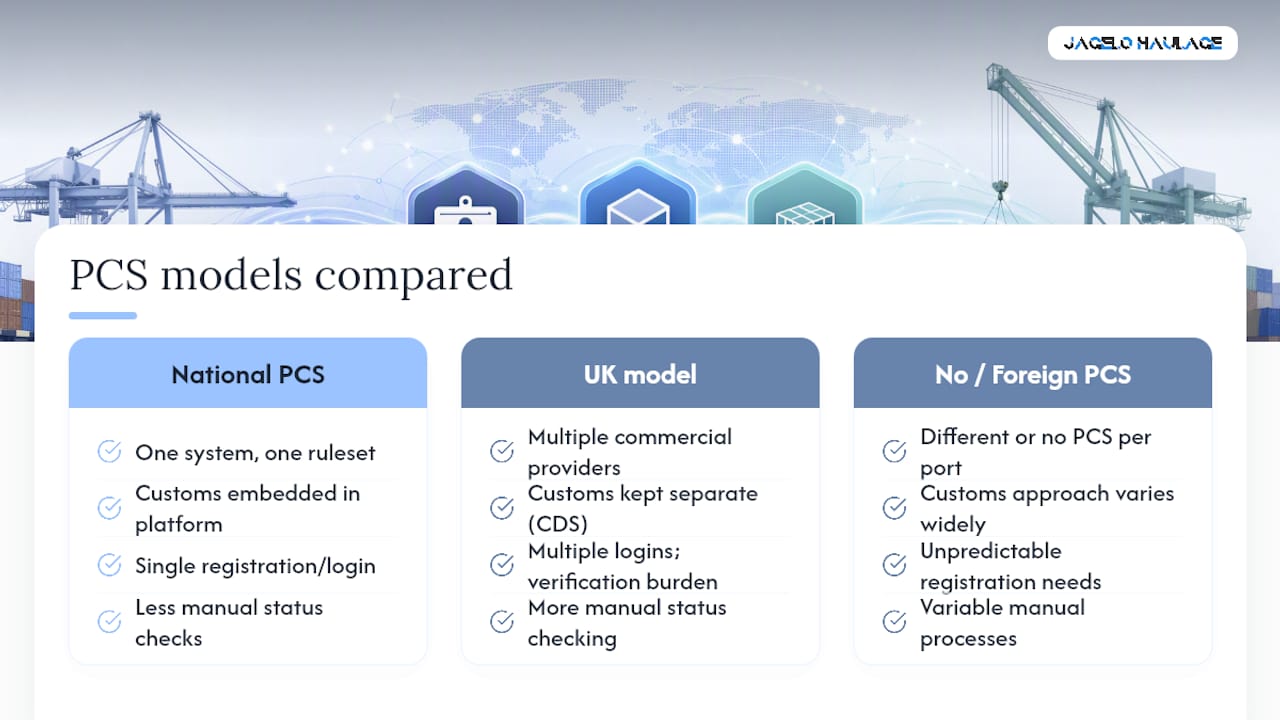
The UK’s fragmented, multi‑provider model is not unusual internationally, though the degree of fragmentation varies considerably. Some countries run a single national PCS mandated by government, giving every port and every trading party one system and one set of rules. Others, like the UK, allow multiple commercial providers to compete for different port communities, which creates flexibility but also the verification burden UK operators now face.
The World Customs Journal survey of PCS evolution notes that national approaches differ substantially in how tightly customs authorities are integrated into the platform itself, versus treated as a separate system the PCS simply hands data to, which is broadly the UK model with CDS sitting alongside rather than inside Destin8, CNS or CCS‑UK.
What UK operators can usefully take from the international picture is less about copying a specific country’s model and more about the direction every mature PCS market is heading: tighter API integration between customs and inventory systems, less reliance on manual status checking, and consolidation of the number of separate logins a single haulier needs to manage. Ports and communities that have reduced the number of separate systems a forwarder or haulier must register with tend to report faster average gate turnaround, a pattern consistent with the World Bank’s broader argument that PCS value scales with how completely a community adopts the “report once” principle rather than running it alongside parallel manual processes.
UK operators moving cargo internationally should expect to encounter a different PCS, or no PCS at all, at a foreign port of loading, which is exactly the kind of variance flagged in broader analysis of global shipping trends as ports worldwide continue investing unevenly in digital infrastructure.
What comes next: blockchain, IoT and smarter gate systems
The most discussed innovation in port technology circles is blockchain‑based cargo tracking, which promises an immutable, shared ledger of custody events that no single party can alter retroactively. In principle, that would strengthen the audit trail a PCS already provides through badge‑based logging, though widespread blockchain adoption across UK port communities remains more discussed than deployed at scale.
Internet of Things sensors are further along in practical terms. Container‑mounted tracking devices that report location, temperature and door‑seal status directly into a PCS record would let a haulier see genuine real‑time condition data rather than a status flag updated manually by a terminal worker. For refrigerated cargo especially, that kind of direct sensor feed closes a gap that currently depends on someone physically checking a reefer unit and logging the reading.
Artificial intelligence applications are emerging around predictive gate scheduling, using historical discharge and clearance patterns to forecast when a specific container will actually become available, rather than relying on a static ETA that ignores terminal congestion. That would meaningfully help haulage planning, since the biggest source of wasted driver time today is arriving before a release has genuinely issued.
None of this displaces the fundamentals covered above. Whichever technology layer gets added, the badge, the MRN linkage and the REL03 release instruction remain the operational backbone a haulier needs to understand, because innovation tends to accelerate the existing workflow rather than replace it outright.
Author perspective: what actually saves time at the gate
Coordinating a tracked haulage crew at a major UK port comes down to a short checklist: confirm the CSP, confirm the badge, confirm the REL03 has issued, and only then dispatch. GPS‑tracked fleets and round‑the‑clock support help most at the margins, resequencing a driver the moment a hold lifts unexpectedly early, or diverting them when a terminal reports congestion. The realistic time savings sit there, in avoided dead time, not in some dramatic acceleration of the customs process itself, which still runs on its own regulatory clock regardless of how good your fleet software is.
— Vytautas
A specialist haulage partner cuts the on‑site burden of PCS complexity
Managing badges, tracking MRN linkage and timing gate arrivals across multiple CSPs is a genuine administrative load, and it sits on top of the actual job of moving a container. Jhaulage is the operational alternative to carrying that burden in‑house: a specialist container haulage provider whose tracked fleet covers major UK ports including Felixstowe, Tilbury, Southampton and Liverpool, backed by 24/7 support so a release that lifts at an awkward hour does not sit waiting for the next shift.
Contracting a specialist reduces gate risk because the sequencing, checking release status, confirming badge validity, timing arrival against terminal discharge, becomes someone else’s daily discipline rather than an occasional task squeezed between other work. With GPS‑tracked vehicles and dedicated port coverage, the haulage team handles the collection window so your own staff are not left monitoring a PCS screen waiting for a hold to lift.
If your operation is juggling multiple port communities and struggling to keep gate turnaround tight, get in touch with Jhaulage to discuss container haulage across your ports of call.
Sources
- Destin8 information pack
- Port community systems: driving trade in the 21st century — World Bank
- Port community systems — World Customs Journal (Long, A.)