How to organise cross-docking container shipments in the UK
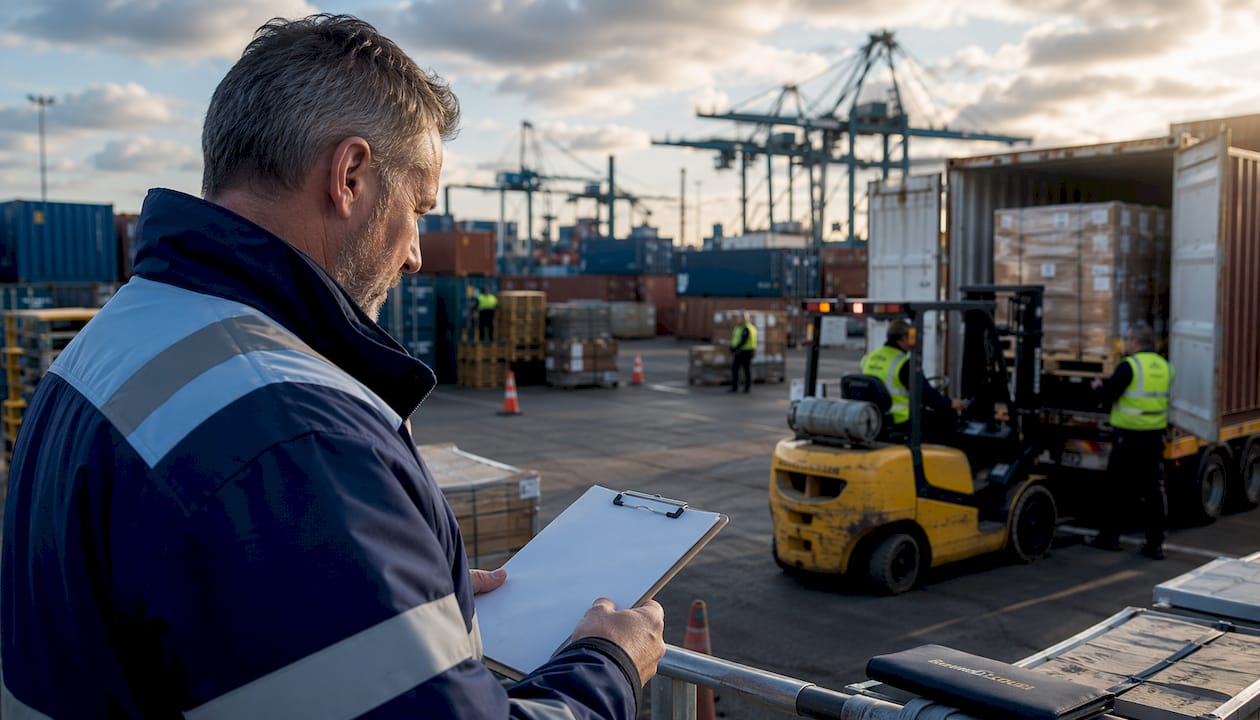
Cross-docking container shipments in the UK means unloading goods from an inbound container at a warehouse facility, then immediately reloading them onto standard trailers or smaller delivery vehicles for onward distribution, with no intermediate storage. The process, known operationally as devanning, is a vital service for clients whose facilities cannot accept direct container deliveries of palletised goods. Turnarounds are typically same-day or next-day: the inbound container is devanned, and the outbound trailer arrives within hours to collect the reloaded freight. For UK logistics professionals managing import container logistics, getting this sequence right is the difference between a fluid supply chain and costly demurrage charges.
Jagelo Haulage Limited (trading as Jhaulage) operates as a specialist UK container haulage provider, covering major ports including Felixstowe, Tilbury, Southampton, and Liverpool, with a modern fleet of over 40 GPS-tracked trucks and trailers and 24/7 operational support.
Table of Contents
- Types of cross-docking relevant to UK container logistics
- What are the key advantages of cross-docking for UK container freight?
- What are the main challenges in cross-docking container shipments?
- Best practices and key technologies for successful UK container cross-docking
- Which UK industries rely most heavily on cross-docking?
- How does Jhaulage organise cross-docking container shipments in the UK?
- What regulatory and compliance requirements apply to UK cross-docking container shipments?
- How do you plan and schedule cross-docking shipments within UK networks?
- Which KPIs should you track to measure cross-docking performance in UK logistics?
- Examples of successful cross-docking container shipments in the UK
- Jhaulage: your specialist partner for UK container cross-docking
- Key takeaways
Types of cross-docking relevant to UK container logistics
Cross-docking is not a single, uniform process. Four distinct models apply across UK container freight handling, and choosing the right one depends on your shipment profile and downstream delivery requirements.
- Pre-distribution cross-docking: The supplier or manufacturer pre-sorts and labels each unit or case for a specific end destination before the container departs. On arrival at the cross-dock facility, goods simply need scanning and loading onto the correct outbound vehicle. This is the fastest model and demands tight coordination with overseas suppliers.
- Post-distribution (deconsolidation) cross-docking: A full container load (FCL) arrives unsorted. The cross-dock operation receives, sorts by route or customer, and consolidates onto outbound vehicles. Common in B2B distribution and retail replenishment, where a single large inbound shipment is broken into smaller loads for regional delivery.
- Consolidation cross-docking: Multiple smaller inbound shipments from different suppliers are combined into a single consolidated outbound delivery. This reduces freight costs where individual supplier volumes are too small to fill a vehicle economically.
- Multi-stage or continuous cross-docking: Goods transfer from inbound to outbound vehicles with minimal interruption and no reorganisation. Products are unloaded and placed directly into outgoing trucks, ideally without any dwell time. This model suits high-velocity, pre-sold stock flows.
Each model carries different documentation and scheduling demands. Pre-distribution requires supplier-level ASN capability; deconsolidation requires more handling resource at the facility itself.
What are the key advantages of cross-docking for UK container freight?
Cross-docking replaces storage with rapid flow-through handling, reducing labour costs and the risk of goods damage from repeated handling. When stock sits waiting for space or picking, costs accumulate through extra storage time and repeated touches. Cross-docking removes that delay entirely.
- Reduced storage and handling costs: Eliminating put-away and pick cycles cuts warehouse labour and space requirements directly.
- Faster supply chain lead times: Goods arriving in the morning can leave the same afternoon, achieving next-day delivery to end customers without ever occupying a storage bay.
- Lower inventory damage risk: Fewer handling touches mean fewer opportunities for goods to be dropped, mislabelled, or lost within a warehouse.
- Environmental benefits: Consolidating outbound loads reduces trailer movements and associated CO2 emissions. Flexible pop-up cross-docking infrastructure further reduces the need for permanent warehouse footprint.
- Improved customer service: Faster throughput translates directly into shorter delivery lead times and more consistent stock availability for retailers and end customers.
Key operational fact: Warehousing within the UK’s Golden Triangle, the logistics zone bounded by London, Birmingham, and Leeds, can reach 90% of UK postcodes efficiently within a standard overnight delivery radius, making facility location an important variable in cross-docking economics.
What are the main challenges in cross-docking container shipments?
The absence of a storage buffer is cross-docking’s defining characteristic and its greatest operational risk. Any delay or misidentification causes immediate bottlenecks with no buffer to absorb the disruption.
- Synchronisation demands: Outbound trailers must arrive aligned with inbound container devanning schedules. A late outbound vehicle means goods sit on the dock with no home, risking yard storage fees or container detention charges from the shipping line.
- Documentation precision: SKU-level accuracy in advance shipment notices (ASNs) is non-negotiable. Mismatches between the manifest and physical goods, such as incorrect pallet counts or SKU confusion, stall operations and cause dock congestion.
- Error recovery difficulty: In conventional warehousing, a picking error can be corrected before despatch. In cross-docking, moving incorrect goods straight through to outbound creates errors that are far harder to correct downstream.
- Yard and detention cost exposure: Container-to-trailer cross-docking success hinges on timing; outbound trailers often must arrive the same or next day after devanning to avoid costly port-related charges.
- Capacity volatility: Demand spikes, seasonal peaks, or unexpected container arrivals can overwhelm a fixed-capacity cross-dock facility without contingency infrastructure in place.
Best practices and key technologies for successful UK container cross-docking
A well-run cross-docking operation depends on three pillars: accurate data before the container arrives, real-time visibility during devanning, and disciplined outbound scheduling.

Warehouse Management Systems (WMS) with real-time tracking are the operational backbone. Advanced WMS platforms transform the facility into a high-speed throughput terminal rather than a storage site, enabling immediate sorting, allocation, and despatch. RF scanning and barcode verification keep the digital record aligned with physical stock at every stage.
Advance Shipment Notices (ASNs) allow warehouse teams to pre-allocate inbound units to outbound orders before the container even arrives. This pre-allocation is what enables a two-to-four-hour inbound-to-outbound cycle. Without an accurate ASN, the operation reverts to reactive sorting, which is slower and more error-prone.
Coordination with UK port and rail operators requires booking outbound trailer slots through the relevant Vehicle Booking System (VBS) at ports such as Felixstowe or Southampton, aligning container release times with devanning schedules. Reviewing UK port logistics practices helps teams anticipate port-side delays and build realistic inbound windows.
Staging, sorting, and marshalling discipline at the cross-dock facility prevents mis-sorts. Goods should be verified against shipping paperwork, sorted by route, customer, or delivery window, and allocated into clearly labelled marshalling lanes before outbound loading begins.
Pro Tip: Use flexible “pop-up” cross-docking infrastructure during peak periods. Temporary modular facilities can be positioned wherever space and a power supply exist, accommodating all vehicle sizes from vans to double-deck lorries, without long-term capital commitment.
Which UK industries rely most heavily on cross-docking?
Cross-docking container freight is not sector-specific, but certain industries in the UK depend on it structurally.
- Retail distribution: High street and supermarket chains use cross-docking to replenish Regional Distribution Centres (RDCs) and direct-to-store deliveries overnight, keeping shelves stocked without holding excess warehouse inventory.
- E-commerce fulfilment: Fast-selling SKUs benefit from pre-allocated inbound stock flowing directly to outbound despatch, achieving next-day delivery without storage.
- FMCG and grocery: Short shelf-life products require rapid throughput. Cross-docking, particularly with temperature-controlled infrastructure, reduces dwell time for chilled and ambient goods.
- Electronics and automotive parts: High-value, time-sensitive components suit cross-docking because minimal handling reduces damage risk and accelerates delivery to assembly lines or retail.
- B2B distributors: Companies breaking down FCL shipments into retailer-specific or region-specific deliveries use deconsolidation cross-docking as a standard operating model.
- Courier and parcel operators: Parcel hubs operate on continuous cross-docking principles, transferring inbound bags and cages directly onto outbound trunking vehicles with no storage.
- Cold chain logistics: Modular cross-docking facilities with attached chill or freeze stores enable fast transfer of temperature-sensitive goods without breaking the cold chain.
How does Jhaulage organise cross-docking container shipments in the UK?
Jhaulage’s operational model as a specialist container haulage provider positions it at the critical junction between UK port collection and onward cross-docking distribution. The company’s coverage of Felixstowe, Tilbury, Southampton, and Liverpool, combined with GPS-tracked fleet management and 24/7 support, gives clients real-time visibility from port gate to cross-dock facility.
Jhaulage’s process integrates port collection, devanning, and outbound reload into a single managed workflow. Clients who cannot receive containers directly at their own premises benefit from Jhaulage handling the full sequence: port collection, transport to the cross-dock facility, devanning, immediate reload, and onward delivery.
Key service features and operational strengths:
- Modern fleet of over 40 trucks and trailers, all GPS-tracked for real-time cargo monitoring
- Coverage across major UK container ports with established port-side relationships
- Same-day and next-day cross-docking turnarounds for time-critical shipments
- 24/7 operational support, reducing exposure to out-of-hours delays
- Coordination of outbound trailer scheduling to avoid demurrage and detention charges
- Digital dispatch timing aligned with container release and devanning completion
| Operational factor | Jhaulage capability |
|---|---|
| Port coverage | Felixstowe, Tilbury, Southampton, Liverpool |
| Fleet size | Over 40 GPS-tracked trucks and trailers |
| Turnaround speed | Same-day or next-day cross-docking |
| Support availability | 24/7 operational support |
| Cargo visibility | Real-time GPS tracking throughout |
Pro Tip: When booking cross-docking with a haulage provider, confirm that outbound trailer scheduling is managed as part of the same workflow as port collection. Separating these two bookings is a common source of timing mismatches and detention charges.
What regulatory and compliance requirements apply to UK cross-docking container shipments?
Post-Brexit, cross-docking container shipments in the UK operate under a distinct customs and compliance framework that differs materially from pre-2021 procedures.
Customs declarations and CHIEF/CDS: All goods arriving from outside the UK must be cleared through HMRC’s Customs Declaration Service (CDS). The container’s customs entry must be completed and goods released before devanning can begin. Attempting to cross-dock goods that have not been formally cleared exposes the operator to seizure risk and HMRC penalties.
Commodity codes and tariff classification: Each SKU within a container must carry the correct commodity code under the UK Global Tariff. Errors at this stage affect duty liability and can trigger HMRC examination, delaying the entire cross-docking sequence.
ISPM 15 compliance for wooden packaging: Any wooden pallets or dunnage within inbound containers must comply with ISPM 15 (International Standards for Phytosanitary Measures), the international standard governing heat treatment of wood packaging. Non-compliant packaging can result in the container being held at the port.
Dangerous goods (ADR) requirements: If the container includes any goods classified under the European Agreement Concerning the International Carriage of Dangerous Goods by Road (ADR), the cross-dock facility and outbound vehicles must be appropriately certified and the relevant documentation carried.
Food and plant health controls: Containers carrying food products, plants, or animal-derived goods require inspection by the Animal and Plant Health Agency (APHA) or Port Health Authority before release. Cross-docking operators must factor inspection lead times into their devanning schedules.
Operator licence compliance: Haulage operators moving goods from the cross-dock facility to onward destinations must hold a valid Standard National or Standard International Operator’s Licence, issued by the Traffic Commissioner. Vehicles must meet DVSA roadworthiness standards throughout.
How do you plan and schedule cross-docking shipments within UK networks?
Effective scheduling is what separates a profitable cross-docking operation from one that generates detention charges and dock congestion. The planning sequence below applies to container-based cross-docking within UK logistics networks.
Step 1: Confirm container ETA and port release. Obtain the confirmed estimated time of arrival from the shipping line and monitor the container’s progress through the port’s tracking system. At Felixstowe, this means checking the Felixstowe Port Health portal; at Southampton, the DP World booking system. Build a realistic release window that accounts for customs clearance and port examination time.

Step 2: Issue the ASN to the cross-dock facility. Send the advance shipment notice with full SKU-level detail, pallet counts, and any special handling requirements at least 24 hours before the container is due to arrive at the facility. This allows the WMS to pre-allocate inbound units to outbound orders and schedule dock resources.
Step 3: Book outbound trailer slots. Confirm outbound vehicle bookings aligned with the expected devanning completion time. For same-day turnarounds, outbound trailers should be booked to arrive within two to four hours of devanning start. Coordinate with your container transport logistics provider to align port collection and facility arrival times.
Step 4: Assign dock doors and marshalling lanes. Pre-assign inbound and outbound dock doors to avoid vehicle queuing. Allocate marshalling lanes within the facility by outbound route, customer, or delivery window before the container arrives.
Step 5: Execute devanning with live WMS scanning. As goods come off the container, scan every unit against the ASN. Flag discrepancies, shortages, or damage immediately. Do not allow unverified goods to enter the outbound flow.
Step 6: Load and despatch outbound vehicles. Build outbound loads in the correct sequence for the delivery route. Complete final documentation checks, including delivery notes and carrier-specific labelling, before releasing the vehicle.
Step 7: Confirm despatch and update the client. Send despatch confirmation with vehicle details and estimated delivery times. For clients with WMS integration, update the inventory record in real time.
Which KPIs should you track to measure cross-docking performance in UK logistics?
Performance measurement in cross-docking differs from conventional warehousing because throughput speed and synchronisation matter more than storage utilisation. The following KPIs give a complete picture of operational health.
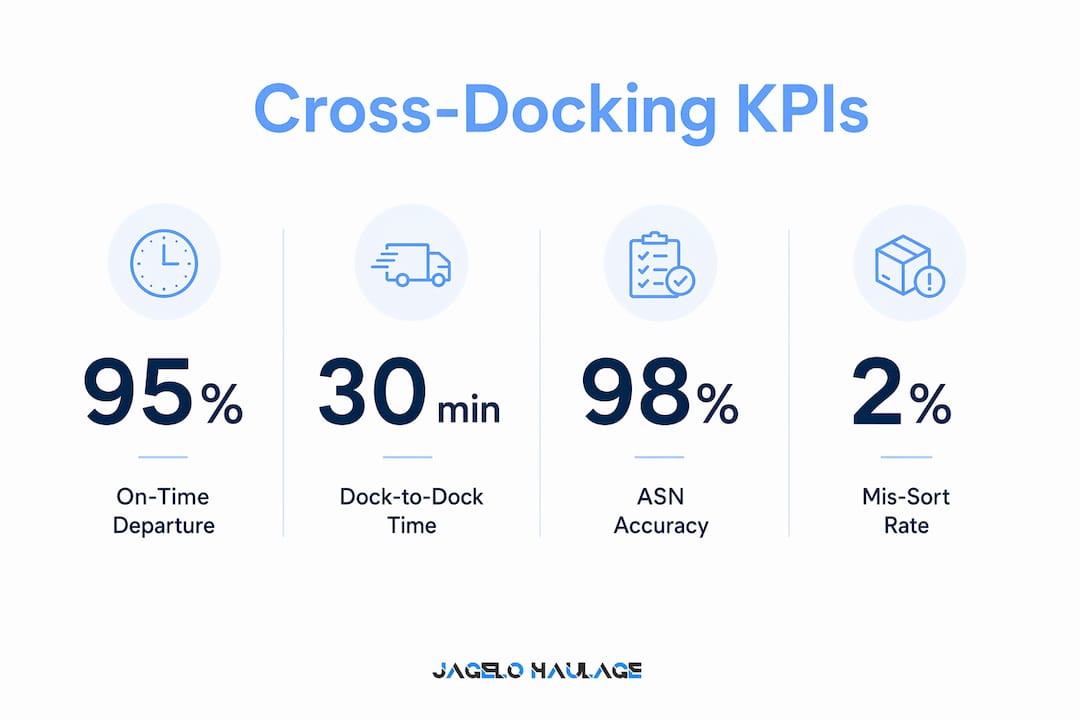
Dock-to-dock cycle time measures the elapsed time from inbound container arrival to outbound vehicle departure. A well-run operation targeting same-day despatch should achieve a two-to-four-hour cycle for pre-allocated, ASN-backed shipments.
On-time outbound departure rate tracks the percentage of outbound vehicles departing within the scheduled window. Consistent underperformance here points to either inbound timing failures or insufficient dock resource.
ASN accuracy rate measures how closely the advance shipment notice matches the physical goods received. A low ASN accuracy rate is the single most reliable predictor of dock delays and downstream errors.
Detention and demurrage incidence counts the number of shipments incurring port-side detention or container demurrage charges per period. Even one or two incidents per month can erode the cost savings cross-docking is designed to deliver.
Mis-sort rate tracks units loaded onto the wrong outbound vehicle as a proportion of total units processed. In a high-velocity cross-dock, even a small mis-sort rate generates disproportionate downstream cost through failed deliveries and returns.
Throughput volume per dock door per shift measures facility efficiency and helps identify capacity constraints before they become bottlenecks during peak periods.
Damage rate records the proportion of units arriving at the end customer in a damaged or unsatisfactory condition. Because cross-docking minimises handling touches, a rising damage rate often indicates a problem at the devanning stage rather than in transit.
Examples of successful cross-docking container shipments in the UK
Cross-docking has proven its value across a range of UK supply chain contexts, from retail replenishment to e-commerce fulfilment.
Retail overnight replenishment: UK high street retailers operating overnight replenishment cycles use cross-docking to receive containers at a central facility during the day, devanning and sort by store, and despatch to stores overnight for next-morning shelf availability. This model eliminates the need for a regional distribution centre to hold buffer stock, reducing warehousing costs while maintaining shelf fill rates.
E-commerce product drops: Online retailers launching new product ranges use pre-distribution cross-docking to move inbound container stock directly to outbound courier collections on launch day. Goods arriving before a 2pm cut-off can be despatched the same afternoon, achieving next-day delivery to customers without the range ever entering a storage bay.
B2B FCL deconsolidation: An importer receiving a 40-foot container of mixed electronics from an overseas manufacturer uses deconsolidation cross-docking to break the load into retailer-specific deliveries. Each retailer’s allocation is sorted, labelled with the correct compliance documentation, and loaded onto a dedicated vehicle, all within a single shift.
Cold chain FMCG distribution: Temperature-sensitive food products arriving at a UK port are collected, transported to a cross-dock facility with attached chill storage, and transferred to refrigerated delivery vehicles within hours. The cold chain remains unbroken, and the goods reach regional distribution centres the same day.
Port-adjacent container haulage: For clients importing through Felixstowe or Tilbury who cannot receive containers at their own premises, specialist haulage providers collect the container from the port, transport it to a nearby cross-dock facility, devan the goods, and reload onto standard trailers for final delivery. This model, which Jhaulage executes across its major UK port network, is particularly effective for palletised goods destined for multiple delivery points from a single container.
Jhaulage: your specialist partner for UK container cross-docking
Organising cross-docking container shipments across UK ports demands a haulage partner with genuine port-side relationships, a GPS-tracked fleet, and the operational discipline to hit same-day turnarounds consistently.
Jhaulage delivers exactly that. As a specialist container haulage provider operating across Felixstowe, Tilbury, Southampton, and Liverpool, Jhaulage manages the full sequence from port collection through devanning to outbound reload, with 24/7 support and real-time cargo visibility throughout. For businesses that cannot accept direct container deliveries at their own facilities, or that need a reliable partner to coordinate outbound trailer scheduling and avoid detention charges, Jhaulage offers a proven, port-to-door solution.
The fleet of over 40 GPS-tracked trucks and trailers means you always know where your cargo is. The 24/7 support structure means timing issues are resolved before they become demurrage events. Get in touch with the Jhaulage team via jhaulage.co.uk to discuss your container cross-docking requirements and receive a tailored quote.
Key takeaways
Efficient cross-docking of container shipments in the UK requires accurate ASNs, real-time WMS tracking, and disciplined outbound scheduling to achieve same-day or next-day turnarounds without incurring detention charges.
| Point | Details |
|---|---|
| Devanning is the starting point | Cross-docking begins with devanning the inbound container and immediately reloading onto outbound vehicles, typically same-day or next-day. |
| ASN accuracy drives performance | SKU-level advance shipment notices allow pre-allocation in the WMS and are the single most reliable predictor of a smooth cross-docking cycle. |
| Location affects delivery reach | Facilities within the UK Golden Triangle can reach 90% of UK postcodes within a standard overnight delivery radius. |
| Compliance cannot be skipped | Customs clearance via CDS, ISPM 15 wood packaging compliance, and valid operator licences are all mandatory before cross-docking can proceed. |
| Jhaulage covers the full sequence | Jhaulage manages port collection, devanning, and outbound reload across Felixstowe, Tilbury, Southampton, and Liverpool with GPS tracking and 24/7 support. |