Avoid £550 DVS fines: London ULEZ HGV checklist for fleet managers
HGVs over 3.5 tonnes gross vehicle weight (GVW) do not pay the daily Ultra Low Emission Zone (ULEZ) charge, but that exemption is where the simplicity ends. Every one of those vehicles remains subject to the London-wide Low Emission Zone (LEZ) emissions standard, and anything over 12 tonnes generally needs an HGV Safety Permit under the Direct Vision Standard (DVS). Run your registration through TfL’s Check your vehicle tool before you dispatch, not after a penalty notice lands.
TL;DR:
- Vehicles over 3.5 tonnes GVW are exempt from ULEZ charges but still subject to LEZ emissions standards and may require an HGV Safety Permit over 12 tonnes.
- Non-compliance with Euro VI emissions standards or lack of valid permits results in daily charges or penalties that stack with each zone entry, potentially costing thousands.
- Route planning tools and fleet segmentation are essential to avoid accidental zone breaches and reduce both emissions-related costs and risks of regulatory action.
- Regular use of TfL’s vehicle check tool and proper documentation are critical for timely compliance verification and effective dispute management.
- A comprehensive compliance approach including retrofit, fleet renewal, and disciplined routing best suits high-frequency London operations, with real-time tracking improving accuracy.
Table of Contents
- London ULEZ HGV liability: which vehicles the rules apply to
- LEZ emission standards for HGVs and what non-compliance actually costs
- Direct Vision Standard and HGV Safety Permit rules
- How to check compliance and pay charges the right way
- Compliance options for fleets: retrofit, replacement, and routing
- Enforcement, penalties, and the regulatory risk beyond the fine
- Practical operator checklist before an HGV enters London
- Daily ULEZ charges by HGV category and weight
- How ULEZ compares with the Congestion Charge and other London schemes
- Paying the ULEZ and LEZ charge: methods and deadlines that matter
- Compliance strategies in practice: three fleet types compared
- A haulage operator’s view on staying ahead of London’s rules
- Sources
London ULEZ HGV liability: which vehicles the rules apply to
The vehicle weight threshold is what determines your exposure, and it catches operators out more often than the charges themselves. ULEZ, as designed, targets cars, vans, and smaller commercial vehicles up to 3.5 tonnes GVW. Anything heavier sits outside the ULEZ daily charge entirely, which is confirmed directly in TfL’s guidance for larger vehicles.
That exemption does not mean a free pass through Greater London. The LEZ operates across the same boundary and applies specifically to goods vehicles above 3.5 tonnes, plus buses and coaches above 5 tonnes. Where ULEZ ignores your rigid or artic, the LEZ picks it up immediately.
Typical vehicle classes affected include:
- Rigid HGVs (two, three, and four axle) used for distribution and construction supply.
- Articulated lorries and tractor units used for container haulage and long haul freight.
- Specialist heavy vehicles: tippers, mixer trucks, and refuse vehicles.
- Coaches and minibuses above the 5 tonne LEZ threshold.
- Panel vans and box vans under 3.5 tonnes remain in the ULEZ regime, not the LEZ, since they fall below the goods vehicle threshold.
Geography matters as much as vehicle class. The ULEZ and LEZ both cover the same area, spanning every London borough out to (but not including) the M25. Driving the motorway itself does not trigger either charge, a point TfL states explicitly. Problems start the moment a driver leaves the M25 for a delivery address, a distribution centre, or a shortcut through outer London boroughs that a satnav has quietly routed them through. Fleet planners who treat the M25 as a hard operational boundary, rather than a rough guideline, avoid a large share of accidental zone entries.
LEZ emission standards for HGVs and what non-compliance actually costs
Euro VI is the standard that decides whether your goods vehicle pays the daily LEZ charge or drives through for free. It governs nitrogen oxide (NOx) and particulate matter (PM) output, and TfL requires it for all goods vehicles above 3.5 tonnes and buses or coaches above 5 tonnes operating anywhere within the zone.
Registration date is a useful, if imperfect, first check. Most HGVs first registered from around 2014 onward were built to Euro VI as standard, but this varies by manufacturer rollout and vehicle type, so registration date alone should never be your final word. The only reliable confirmation is running the vehicle through TfL’s checker or reading the compliance plate and Certificate of Conformity against Euro VI thresholds.
LEZ penalty at a glance: a non-compliant HGV faces a daily LEZ charge, with separate Penalty Charge Notices issued for each day the vehicle is detected inside the zone without payment. Charges stack per calendar day, not per journey, so a two-day round trip without compliance can generate two separate liabilities.
Enforcement runs on automatic number-plate recognition (ANPR) cameras positioned across the zone boundary and internal roads. There is no manual check, no warning flash, and no grace period for a driver who simply did not know. The camera reads the plate, TfL’s system cross-references it against the vehicle database, and a charge or penalty follows automatically.
For older vehicles that cannot economically be replaced, retrofit is the recognised route to compliance, but only through certified kits. TfL only accepts equipment approved under the Clean Vehicle Retrofit Accreditation Scheme (CVRAS), which tests emissions-reduction hardware against the LEZ’s NOx and PM criteria before it can be registered as compliant. Fitting an uncertified aftermarket system, however well-marketed, will not update your vehicle’s status on TfL’s checker and will not stop the daily charges.
Operators weighing retrofit against fleet renewal should treat CVRAS certification as a checklist item, not a formality:
- Confirm the specific kit is listed as CVRAS-approved for your exact vehicle make, model, and engine variant.
- Get written confirmation from the installer that the certification will be registered with TfL post-fitment.
- Keep the certificate on file indefinitely. It is the evidence you will need if a PCN is issued in error after retrofit.
Direct Vision Standard and HGV Safety Permit rules
Any HGV over 12 tonnes GVW operating in Greater London needs a valid HGV Safety Permit, and driving without one is treated as seriously as driving without LEZ compliance. TfL introduced the DVS to address blind spots in cab design that contribute to collisions with cyclists and pedestrians, and it applies regardless of whether the vehicle already meets Euro VI.
The permit hinges on a star rating, from zero to five, based on how much a driver can see directly through the cab windows without relying on mirrors or cameras. A zero-star vehicle can still get a permit, but only by fitting a Progressive Safe System: a package of camera monitoring, sensors, and audible warnings that compensates for the restricted direct vision. This is where lead times bite. Sourcing and fitting a Progressive Safe System, rather than filling in the permit application itself, is typically the bottleneck operators underestimate, according to TfL’s own DVS guidance. Installer capacity, part availability, and workshop scheduling can push fitment out by weeks, not days.
Get this wrong and the penalty is steep. Driving an HGV over 12 tonnes into Greater London without a valid permit attracts a Penalty Charge Notice of £550, reduced to £275 if paid within the 14-day early payment window. That is per detected entry, not per week or per month, which means a vehicle running daily London deliveries without a permit can accumulate penalties far faster than most compliance budgets anticipate.
Pro Tip: Apply for the HGV Safety Permit at least eight weeks before a vehicle needs to operate in London, even if you believe it will achieve a high star rating. TfL’s assessment and any required system fitment both take longer than operators expect, and the permit is free but not instant.
Practical steps for fleet managers bringing a vehicle into scope:
- Check the star rating using the vehicle’s Certificate of Conformity or manufacturer documentation before assuming compliance.
- Apply for the permit online well ahead of the vehicle’s first planned London job.
- If a Progressive Safe System is required, book installation with a reputable fitter and retain all documentation.
- Re-check permit validity annually. Permits are not indefinite and lapse if not renewed.
How to check compliance and pay charges the right way
TfL’s Check your vehicle tool is the single reference point that removes guesswork from ULEZ, LEZ, and DVS status, and every fleet office should be running it as standard practice, not as a fallback when something goes wrong.
- Enter the registration number and country of registration. The tool works for UK and many non-UK plates, which matters for operators running European trailers or hired continental units.
- Read the full result, not just the headline. The checker returns ULEZ status, LEZ compliance, and DVS/permit status separately, since a vehicle can pass one scheme and fail another entirely.
- Screenshot or save the result with a timestamp. This becomes your evidence trail if a charge is disputed later.
- Register for Auto Pay if the vehicle regularly enters the zones. Auto Pay automatically settles ULEZ and LEZ charges and can reduce the daily rate, removing the risk of a missed manual payment turning into a PCN.
- Use the Pay to Drive in London app, the TfL website, or the phone payment line for one-off or occasional trips.
Charging periods run midnight to midnight. A vehicle that enters the zone late on one day and exits after midnight can be charged twice, once for each calendar day, which is a detail that trips up long-haul drivers running overnight legs more than most other compliance issues combined.
Temporary exemptions exist for specific vehicle categories and circumstances, but they are narrow and must be applied for in advance through TfL directly. Do not assume an exemption applies without written confirmation on file.
Compliance options for fleets: retrofit, replacement, and routing
Three levers exist for bringing an HGV fleet into line with the LEZ and DVS, and most operators end up using all three in combination rather than picking one.
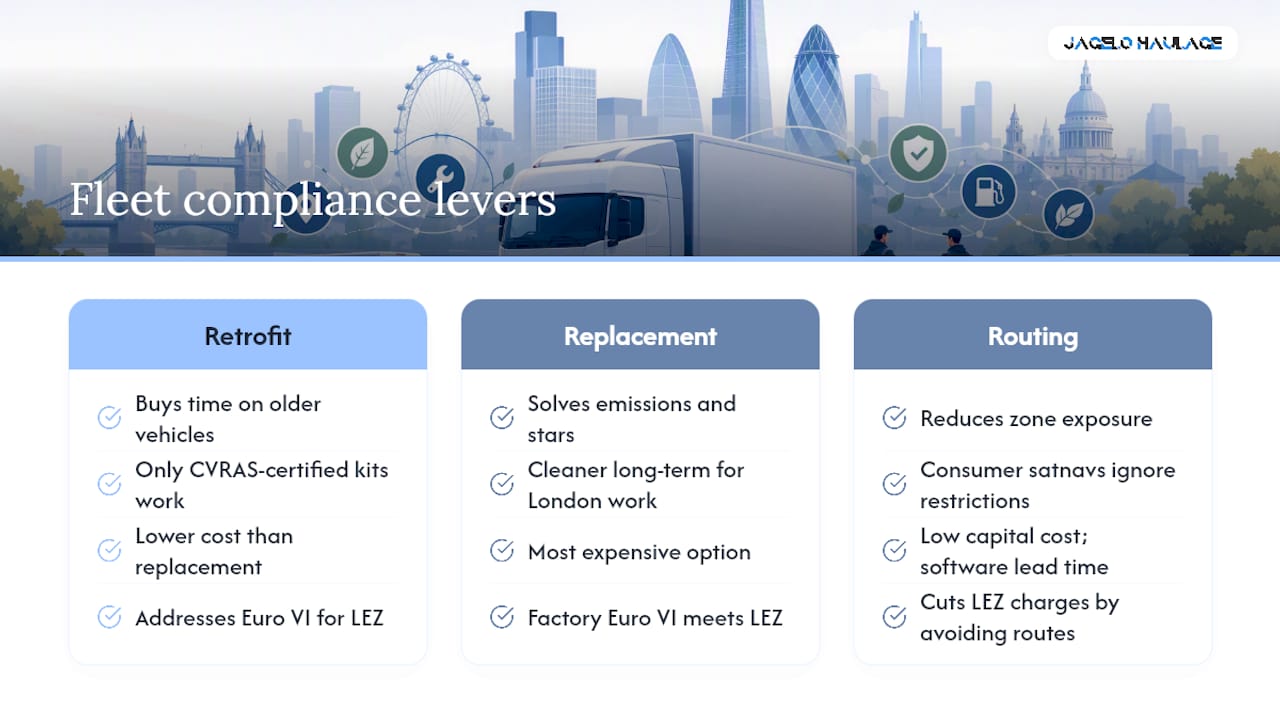
Retrofit buys time on older vehicles without the capital outlay of replacement, but only through CVRAS-certified kits, as covered above. The cost sits well below a replacement vehicle, and fitment can often be scheduled around existing maintenance windows rather than requiring the vehicle to be taken off the road for an extended period. The trade-off is that retrofit addresses Euro VI compliance; it does nothing for DVS star ratings, so a retrofitted vehicle over 12 tonnes may still need a Progressive Safe System separately.
Replacement to a factory Euro VI vehicle with a strong DVS star rating solves both problems at once and tends to be the cleaner long-term answer for vehicles doing regular, high-frequency London work. It is also the most expensive route, and lead times on new HGV builds have stretched in recent years, which means operators planning a phased fleet renewal should start ordering well ahead of any known LEZ or DVS deadline rather than reacting to one. Our guide to UK haulage sustainability practices covers how fleet renewal decisions intersect with wider emissions strategy.
Routing and scheduling is the lever operators underuse. Generic consumer satnav systems are not built to understand LEZ boundaries, DVS-restricted roads, or London’s separate Lorry Control Scheme, and will happily route a driver straight through a road they should never enter. HGV-specific routing tools, or the London Lorry Route Approver system for routes outside the designated network, give drivers a route that respects both weight restrictions and emissions zone geography. Pairing this with scheduling that consolidates London-bound jobs, rather than sending a vehicle in and out of the zone multiple times a day, cuts unnecessary exposure to both LEZ charges and DVS permit checks.
For fleets running frequent port-to-door container movements into or through London, the decision often comes down to which vehicles are dedicated to zone work and which are not. Segregating a smaller number of fully compliant, high-star-rating vehicles for regular London runs, while keeping older stock on non-London routes, is a pragmatic middle path many operators land on rather than retrofitting or replacing an entire fleet at once.
Pro Tip: Build a simple traffic light spreadsheet across your fleet: green for Euro VI plus five-star DVS, amber for compliant but needing retrofit or a Progressive Safe System, red for non-compliant. Assign London jobs only to green vehicles until amber vehicles are upgraded. It sounds basic, but it stops dispatchers assigning the wrong vehicle under time pressure.
Operators managing customs and port-side timing alongside emissions compliance may also find it useful to review UK customs rules for importing goods, since port dwell time and zone entry scheduling often need to be planned together rather than as separate problems.
Enforcement, penalties, and the regulatory risk beyond the fine
ANPR cameras do the enforcement work across ULEZ, LEZ, and DVS boundaries, and the system does not distinguish between a first-time mistake and a deliberate breach. Every detected non-compliant entry generates a charge or a PCN, and the costs compound quickly across a working fleet.
A single vehicle running daily non-compliant entries into the LEZ, stacked with a missing HGV Safety Permit, can generate multiple separate penalties in the same week. LEZ daily charges accumulate per calendar day of entry. DVS PCNs sit at £550, reduced to £275 within 14 days. None of this is capped per vehicle or per operator, so the financial exposure scales directly with how many non-compliant vehicles keep entering the zone.
The bigger risk sits beyond the invoice. Persistent or repeated breaches can be reported and may lead to action by the Traffic Commissioner, which holds real consequences for an operator’s licence, including curtailment, suspension, or revocation in serious cases. A licence review triggered by repeated PCNs is a far more damaging outcome than the penalties themselves, since it threatens the operator’s ability to trade at all, not just the margin on a single job.
Practical mitigation comes down to three habits:
- Keep detailed compliance records for every vehicle: checker results, permit numbers, retrofit certificates, all timestamped and stored centrally rather than left with individual drivers.
- Brief drivers properly on which vehicles are cleared for London work and which routes to use, ideally reinforced through the kind of structured driver compliance programme that turns this into routine practice rather than a one-off memo.
- Contest genuinely erroneous PCNs promptly, using the saved checker evidence and retrofit certification as your supporting documentation. TfL does uphold appeals where the vehicle record clearly shows compliance at the time of the alleged breach.
Practical operator checklist before an HGV enters London
Run this sequence before any HGV over 3.5 tonnes is dispatched into Greater London, and make it standard dispatch procedure rather than an occasional check.
- Run the TfL checker on the specific vehicle registration, not a sister vehicle of the same model, since compliance status is tied to the individual plate.
- Confirm DVS Safety Permit status if the vehicle is over 12 tonnes, checking both permit validity and expiry date.
- Verify Euro VI status or confirm CVRAS retrofit certification is on file and registered with TfL.
- Register the vehicle for Auto Pay if it makes regular zone entries, to remove manual payment risk.
- Save compliance evidence centrally, accessible to dispatch, not just to the driver’s cab folder.
- Plan the route using HGV-specific routing software rather than a standard consumer satnav.
- Brief the driver on the confirmed compliance status and permitted route before departure, not en route.
- Log the check date and result so evidence exists if a PCN is disputed weeks later.
Cost reality check: a single missing DVS permit costs £550 per detected entry (£275 if settled within 14 days), and that is before any LEZ daily charge on the same journey. A five-minute pre-trip check against these eight steps costs nothing and removes both risks in one pass.
Fleet operators managing high volumes of port-to-door container movements benefit most from building this checklist into dispatch software rather than relying on manual sign-off, since the check needs to happen every time, not most times.
Daily ULEZ charges by HGV category and weight
The daily ULEZ charge itself does not apply once a vehicle crosses 3.5 tonnes GVW, which means most rigid and articulated HGVs sit outside the ULEZ fee structure entirely. That is a genuinely different position from vans and other light commercial vehicles under 3.5 tonnes, which do pay the standard ULEZ daily charge if non-compliant with ULEZ emissions standards.
Where weight class does matter is in determining which other charge regime applies:
- Vehicles up to 3.5 tonnes GVW: subject to the ULEZ daily charge if they fail to meet ULEZ emissions standards; not covered by the LEZ.
- Goods vehicles above 3.5 tonnes GVW: exempt from ULEZ but subject to the LEZ daily charge if they fail to meet Euro VI.
- Buses and coaches above 5 tonnes GVW: same LEZ Euro VI requirement, separate from the goods vehicle threshold.
- HGVs above 12 tonnes GVW: LEZ Euro VI requirement applies as above, plus the separate DVS Safety Permit requirement layered on top.
The practical upshot for fleet operators: your weight class decides which scheme you are checked against, not whether you are checked at all. A 44 tonne artic and a 7.5 tonne rigid both face zero ULEZ liability, but only the 44 tonne unit needs to clear the DVS Safety Permit hurdle as well as LEZ Euro VI status.
How ULEZ compares with the Congestion Charge and other London schemes
ULEZ, the LEZ, and the Congestion Charge are three separate schemes with different vehicles, different triggers, and different exemptions, and treating them as one combined “London charge” is where operators most often miscalculate their exposure.
The Congestion Charge applies within a smaller central London zone and is based on entering that area during charging hours, regardless of emissions standard. Most HGVs are not automatically exempt from the Congestion Charge simply because they are exempt from ULEZ. This means a compliant, Euro VI-rated HGV delivering into central London can still owe a Congestion Charge fee on top of a clean LEZ record, since the two schemes are assessed independently.
The LEZ and ULEZ share the same boundary but different vehicle scope and different standards, as covered earlier. An HGV can pass ULEZ (by being exempt outright) while failing the LEZ (by falling short of Euro VI), or pass both while still owing a Congestion Charge fee for entering central London during charging hours.
The practical takeaway is that no single check clears an HGV for every London scheme. Operators need to verify ULEZ or LEZ status, DVS permit status where relevant, and Congestion Charge liability as three distinct questions for every central London job, not one combined assumption based on a single green light from the vehicle checker.
Paying the ULEZ and LEZ charge: methods and deadlines that matter
Payment mechanics differ slightly depending on whether the vehicle makes occasional or regular trips into the zones, and choosing the wrong method is a common source of avoidable penalty notices.
For occasional entries, payment can be made via the Pay to Drive in London app, the TfL website, or by phone, and must be settled by midnight on the third day after the day of travel. Miss that window and the charge escalates into a formal penalty rather than a straightforward payment.
For vehicles making regular London trips, registering for Auto Pay removes the manual step entirely. The system automatically detects the vehicle via ANPR, applies the correct daily charge, and bills the registered account, which is the more reliable option for any fleet running scheduled or frequent zone entries rather than one-off jobs.
Because charging periods run midnight to midnight, a single overnight journey spanning two calendar days can generate two separate daily charges. Fleet operators running long-haul night trunking through London should factor this into cost calculations, since it is easy to budget for one charge per journey and end up billed for two.
Keep dated payment confirmations and checker results together as your evidence file. If a PCN is issued in error, for instance against a vehicle that was actually compliant or already charged, this record is what supports a successful appeal rather than a drawn-out dispute.
Compliance strategies in practice: three fleet types compared
Different fleet profiles carry genuinely different compliance priorities, and the right strategy for one is often the wrong one for another.
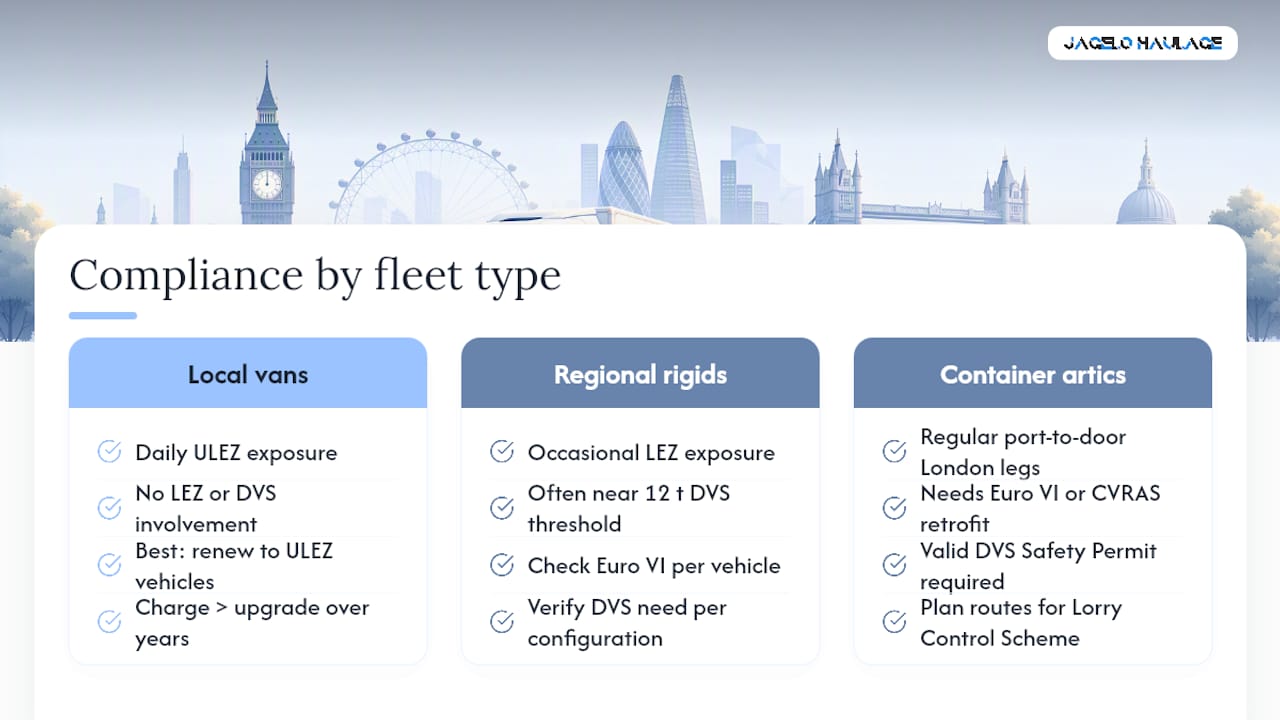
A local delivery operator running vans under 3.5 tonnes into central London daily faces pure ULEZ exposure with no LEZ or DVS involvement. The most efficient strategy here is usually straightforward fleet renewal to ULEZ-compliant vehicles, since the volume of daily entries makes the ongoing charge more expensive over a few years than the vehicle upgrade itself.
A regional distribution fleet running 18 tonne rigids into outer London boroughs occasionally faces LEZ exposure but sits under the 12 tonne DVS threshold in some cases, though many rigids in this class exceed 12 tonnes and do need the Safety Permit. For this profile, checking Euro VI status and DVS threshold individually per vehicle matters more than blanket assumptions based on vehicle type alone, since “18 tonne rigid” covers vehicles both above and below the permit threshold depending on configuration.
A container haulage fleet running artics on regular port-to-door work, the profile closest to Jhaulage’s own operations, needs the fullest compliance stack: Euro VI or CVRAS retrofit for LEZ, a valid DVS Safety Permit with confirmed star rating or Progressive Safe System, and route planning that accounts for both the zone boundary and London’s Lorry Control Scheme. Segregating a core group of fully compliant vehicles for regular London legs, while running older stock on non-London routes, tends to be the most cost-effective approach for this fleet type, since it avoids retrofitting or upgrading an entire fleet simultaneously.
A haulage operator’s view on staying ahead of London’s rules
Compliance in this space rewards operators who treat it as a live operational discipline rather than a paperwork exercise completed once and filed away. At Jhaulage, running a fleet of over 40 trucks and trailers into major UK ports and through London on a regular basis means the TfL checker, permit records, and retrofit certificates are not occasional lookups. They are part of the same pre-trip routine as checking a load plan or confirming a delivery slot.
GPS tracking across the fleet plays a quieter role in compliance than most operators expect. Real-time visibility on where a vehicle actually travels, not just where it was scheduled to go, means route deviations into restricted zones get caught and corrected before they become a pattern, rather than surfacing weeks later as a stack of unexplained PCNs. It also means that when a customer or a Traffic Commissioner query does arise, there is a precise record of the vehicle’s movements to draw on, not a driver’s best recollection.
The wider point is this: the operators who struggle most with London’s emissions and safety rules are rarely the ones running the oldest fleets. They are the ones without a system for knowing, vehicle by vehicle and trip by trip, exactly where their compliance stands. Fix that visibility gap and the rules themselves stop being a threat and become just another line on the dispatch sheet. For businesses looking for a container haulage partner that already runs this discipline as standard, Jhaulage’s port haulage services are built around exactly this level of operational control.
— Vytautas
Sources
- HGVs, lorries, vans, buses/minibuses, coaches and specialist heavy vehicles - Transport for London
- Gov