Transporting empty steel across national road corridors is the single quietest drain on any freight operating budget. Having container triangulation explained in clear operational terms reveals how disciplined logistics teams convert wasted repositioning runs into balanced, revenue-generating cargo legs. Every transport planner recognises the relentless friction of escalating fuel surcharges, punitive detention fees, and unforgiving vehicle booking slots at container terminals. Moving empty boxes simply to reset shipping line depot balances consumes valuable driving hours without delivering commercial value.
Triangulation resolves this systemic waste by directing a discharged import container straight to an exporter for immediate reloading, bypassing the port depot entirely. This coordinated method eliminates unnecessary road miles, curbs detention penalties, and streamlines national supply chains against strict quay deadlines. In this guide, you'll discover the precise mechanics of container triangulation and street-turning, identify the operational conditions required to implement them successfully, and learn how to lessen your carbon footprint whilst optimising road fleet asset utilisation.
Key Takeaways
- Explore container triangulation explained through practical mechanics that match discharged import boxes directly with outbound export consignments.
- Understand the vital role of explicit shipping line authorisation and street-turn protocols in maintaining regulatory compliance and avoiding carrier penalties.
- Examine operational metrics comparing triangular routing against traditional linear port runs, focusing on saved driver hours and suppressed fuel burn.
- Identify the core physical and timing criteria required to synchronise equipment grades, cargo cleanliness, and tight export quay cut-offs across national road networks.
- Discover strategic frameworks for transport planners to identify recurring cargo corridor overlaps and elevate road fleet asset utilisation.
What Is Container Triangulation? Core Principles and Operational Concepts
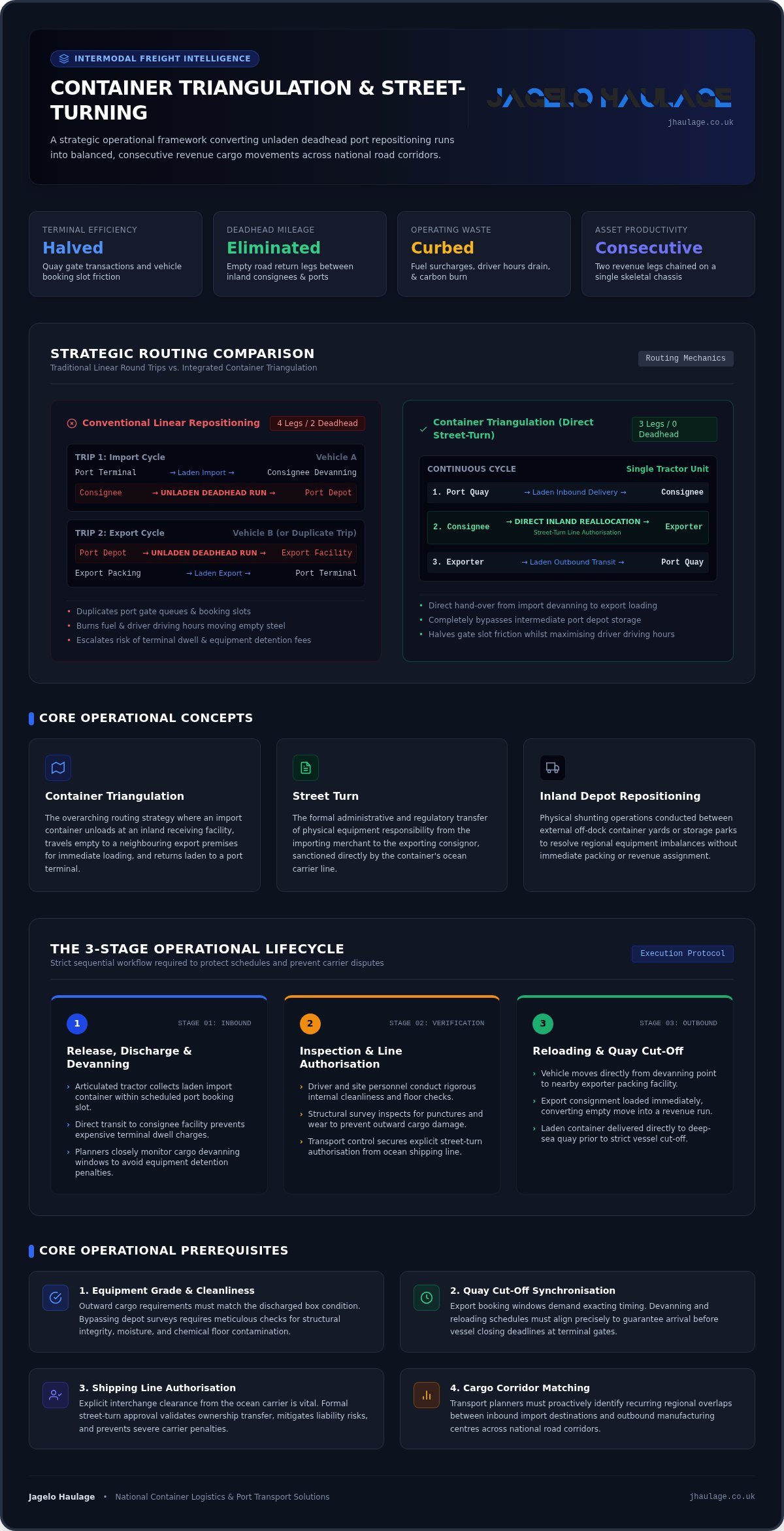
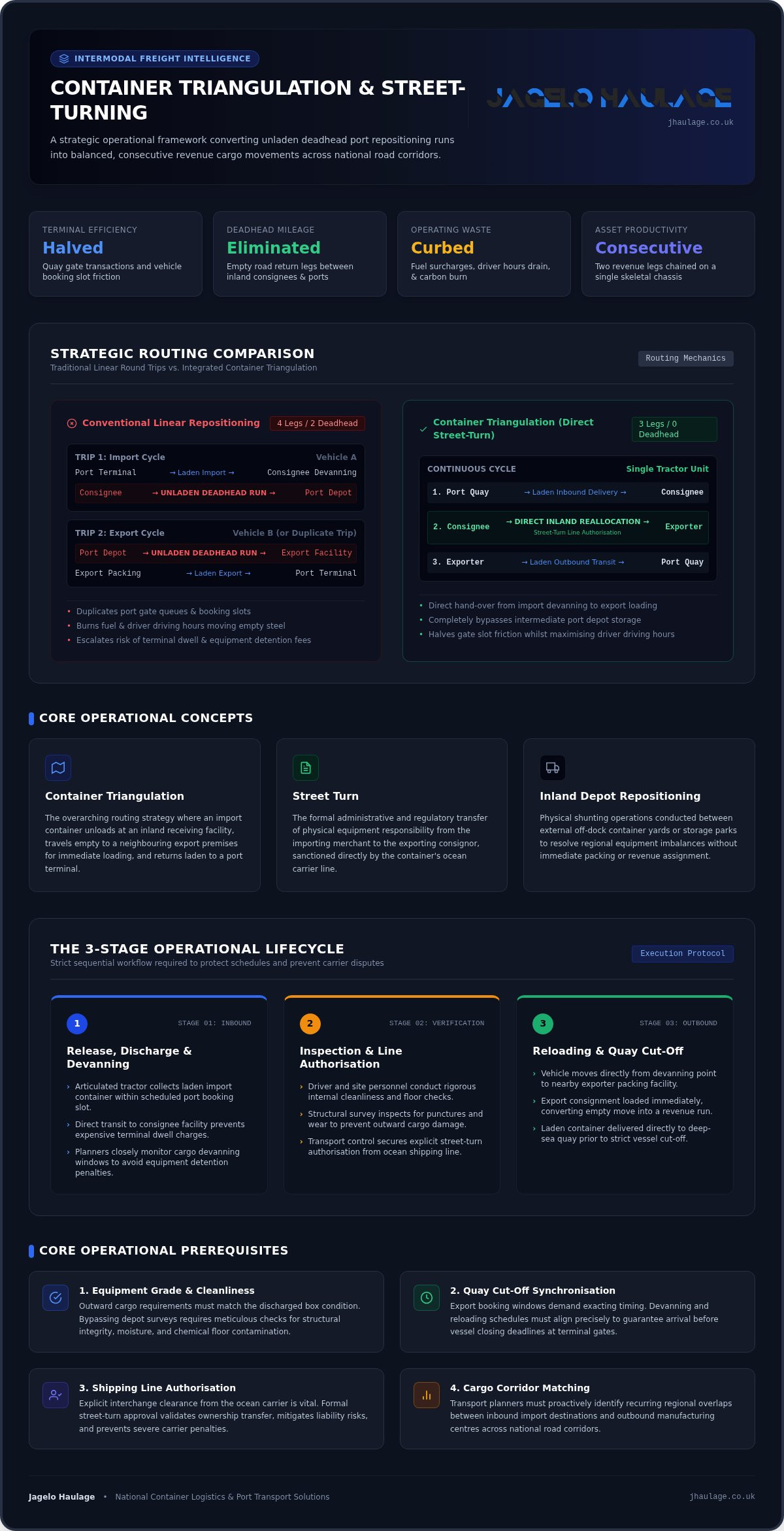
At its operational core, container triangulation reallocates an empty import container directly to an outbound export booking without routing through an intermediate storage yard. Within modern intermodal freight transport, standardised shipping equipment represents both cargo space and rolling capital. Conventional movements treat import deliveries and export collections as separate assignments, introducing excessive deadhead mileage where a vehicle hauls an empty trailer across busy freight arteries. Having container triangulation explained reveals how synchronising these cargo legs transforms empty runs into revenue movements, protecting transport schedules while lowering operating waste.
Industry terminology often blurs the line between distinct container movements. Clarifying these terms avoids costly operational missteps:
- Container Triangulation: The overall routing strategy where an import container unloads at an inland facility, travels empty to a nearby export premises for immediate loading, and returns laden to a port terminal.
- Street Turn: The formal administrative transfer of responsibility for the physical container from the importing entity to the exporting merchant, sanctioned directly by the container's ocean line.
- Inland Depot Repositioning: Physical shunting between external off-dock storage parks to resolve regional equipment imbalances without immediate reloading.
The Mechanics of Conventional Container Repositioning
Standard port logistics relies on linear round trips. An articulated vehicle collects an import box from the dock, delivers it to the receiving customer for devanning, and hauls the empty equipment back to the congested port storage park. Later, an export assignment prompts a second vehicle to travel to the port, collect another empty unit, and position it at an inland manufacturing site before returning laden. This sequence duplicates gate queues and burns fuel unnecessarily.
The Triangulated Model: Eradicating the Deadhead Leg
Container triangulation cuts out the port return leg entirely. Once an import container discharges its contents, the transport operator matches the empty box with a nearby export consignment. The vehicle moves directly from the import premises to the export packing facility, eliminating miles of unladen driving.
With container triangulation explained through physical asset routing, the commercial advantages become clear. A single skeletal trailer completes two revenue legs consecutively, halving gate transactions and sparing drivers extensive vehicle booking queues across busy coastal quays.
How Container Triangulation Operates: The Step-by-Step Logistics Cycle
Executing an effective street turn demands exacting operational discipline. With container triangulation explained across practical road operations, the process requires structured coordination between the haulier, shipping line, importer, and exporter. Skipping verification stages introduces severe liability risks, carrier disputes, or detention penalties. Managing this lifecycle requires a sequential, three-stage workflow across the national network.
Step 1: Release, Discharge, and Inbound Devanning
The operational sequence begins at deep-sea container terminals. An articulated tractor unit collects the laden import box within an allocated booking slot and moves directly to the consignee facility. Punctual transit prevents terminal dwell penalties. Once on site, transport planners monitor cargo devanning windows to keep turnarounds tight, preventing detention charges from accruing before equipment release.
Step 2: Equipment Inspection and Line Authorisation
Because the unit bypasses an intermediate depot survey, skipping rigorous checks increases the risk of transport damage for outbound cargo. Drivers and site personnel conduct thorough inspections for internal cleanliness, floor contamination, punctures, and structural wear. Simultaneously, transport controllers lodge an official street-turn request with the ocean carrier. The shipping line must grant explicit interchange authorisation, confirming container ownership, structural integrity, and equipment suitability for the outbound export manifest.
Step 3: Repositioning, Outbound Stuffing, and Port Return
Following formal carrier approval, the haulier repositions the cleaned box straight to the designated exporter. The loading team stuffs the container, balances axle distribution, and affixes high-security ISO seals. The tractor unit then hauls the laden export container directly back to the port terminal, completing gate-in before strict vessel cut-off deadlines expire. Coordinating with seasoned professionals in inland container haulage ensures each milestone complies with shipping line rules and terminal booking deadlines.
Traditional Port Haulage vs Container Triangulation: Strategic Comparison
Linear port transport generates structural inefficiencies that reduce haulage margins. In a typical two-way cycle, a tractor unit completes four separate legs to service one import and one export: port to receiver (laden), receiver to port (empty), port to exporter (empty), and exporter to port (laden). Triangular routing collapses these four movements into three connected legs. Reviewing container triangulation explained through a comparative framework reveals how this consolidation transforms road operations.
| Operational Metric | Traditional Linear Haulage | Container Triangulation |
|---|---|---|
| Total Legs per Cycle | 4 legs (2 laden, 2 unladen) | 3 legs (2 laden, 1 short unladen transit) |
| Terminal Gate Moves | 4 gate transactions (in/out twice) | 2 gate transactions (one collection, one drop) |
| Lift / Interchange Fees | Charged at port or inland depot twice | Eliminated entirely between consignees |
| Driver Hours Consumption | High; inflated by dual gate delays | Optimised; continuous loaded transit |
| Fuel Consumption | Elevated deadhead diesel burn | Suppressed non-revenue fuel usage |
Financial and Operational Efficiency Gains
Consolidating four transit legs into three removes the redundant return-and-collect cycle. Bypassing off-dock container yards avoids double-handling lift tariffs and storage interchange charges. For the haulier, suppressing unladen road hours frees driver shift capacity, allowing transport planners to allocate scarce driving hours toward revenue-producing freight rather than motorway queues.
Environmental Impact and Supply Chain Decarbonisation
Heavy goods vehicles consume substantial fuel when deadheading unladen trailers across national corridors. Eliminating an entire cross-country leg reduces tailpipe greenhouse gas emissions and particulate pollution immediately. For cargo owners managing corporate sustainability targets, container triangulation provides verifiable Scope 3 carbon reduction by directly cutting contracted diesel mileage.
Modern fleets of commercial vehicles and skeletal trailers extract peak efficiency from this model. When container triangulation is explained to logistics directors, the strategic takeaway remains clear: removing dead miles simultaneously bolsters fleet resilience and satisfies national emissions standards without sacrificing supply chain velocity.
Key Challenges in Triangulation and Operational Solutions
Executing continuous container reuse across national road routes presents genuine operational hurdles. Without clear container triangulation explained through real-world mechanics, operators risk equipment refusals, tainted cargo claims, or demurrage penalties. Solving these operational frictions requires disciplined oversight, active line communication, and systematic fleet control.
Navigating Ocean Carrier Equipment Ownership
Shipping lines control container inventory across global imbalances. A carrier may refuse a street-turn request if they need empty equipment repositioned to a specific port to meet overseas vessel allocations. Additionally, triangulation requires the inbound and outbound shipments to operate under the same ocean line or through reciprocal equipment agreements. Hauliers resolve this barrier by submitting early interchange applications, securing written authorisation that formally shifts liability from the importer to the exporter.
Commodity Compatibility and Equipment Cleanliness
Cargo compatibility dictates reuse suitability. High-grade export freight, including packaged foodstuffs, pharmaceuticals, and sensitive consumer electronics, requires completely clean, odourless boxes. Loading these products into an unwashed unit previously carrying industrial parts or raw chemicals results in cargo rejection. Professional hauliers prevent cross-contamination by implementing strict driver inspection checklists, mobile sweeping routines, and tare-weight verifications to keep running weights compliant with national axle limits.
Temporal Synchronisation and Route Scheduling
Timing remains the tightest variable. Inbound vessel delays, prolonged customs clearances, or unloading bottlenecks at the receiver's dock directly threaten export loading schedules. When export booking deadlines are tight, an unexpected delay on the devanning leg can cause missed vessel cut-offs.
Professional transport planners overcome timing friction through proactive schedule monitoring and fleet flexibility:
- Active Milestone Tracking: Continual tracking of container devanning progress identifies unloading bottlenecks before scheduled exporter collection times.
- Pre-Planned Contingency Drops: Establishing buffer protocols, such as dropping an alternative pre-inspected box if devanning stalls, protects downstream export vessel bookings.
- Direct Communication Channels: Real-time coordination between freight forwarders, terminal booking desks, and drivers keeps all commercial parties aligned.
Managing these intricate variables demands seasoned operational competence. Partnering with specialists who manage haulage from UK ports provides the structured control needed to execute compliant triangular movements without demurrage exposure.
Executing Successful Container Triangulation in National Logistics
Implementing a successful street-turn programme requires turning procedural theory into physical transport execution. When transport managers study container triangulation explained alongside real-world freight data, they quickly realise that success relies on consistent volume profiles, reliable haulage assets, and clear carrier lines of communication. Merely identifying two loads on a map does not guarantee a compliant move. Logistics planners must evaluate recurring freight balance across their supply networks before committing vehicles to triangular routing.
Assessing Internal Freight Flows for Triangulation Viability
The evaluation starts by auditing historical shipping records to uncover overlapping corridors. Supply chain controllers look for predictable cadence where import receiving sites sit within close proximity to active export packing facilities. Matching box sizes, payload limits, and equipment types across these lanes establishes the baseline for regular reuse. Whether cargo moves under carrier haulage or private commercial control also dictates routing freedom; comparing merchant haulage vs shipping line haulage illustrates how distinct contractual terms govern equipment repositioning rights and street-turn approvals.
Selecting a Capable Road Haulage Partner
Executing triangular legs across national road networks demands an experienced transport operator with dedicated equipment and proven terminal relationships. Reviewing the fundamentals of logistics for shipping containers demonstrates why asset ownership and active dispatch supervision remain indispensable. A dependable partner must meet explicit operational criteria:
- Modern Fleet Scale: Access to a modern fleet of over 40 commercial vehicles and specialised skeletal container trailers ensures consistent asset availability across major port corridors.
- Disciplined Traffic Management: Over 15 years of industry experience managing nationwide container freight provides the operational foresight required to navigate tight vehicle booking slots and strict export quay cut-offs.
- Cross-Sector Capabilities: Specialised operational capabilities across both merchant haulage and shipping line haulage allow seamless coordination with ocean carriers for swift equipment releases.
- Real-Time Communication: Active monitoring systems update distribution hubs on transit milestones, giving exporters accurate equipment arrival times.
Aligning with established container haulage specialists like Jagelo Haulage provides the operational reach and precision needed to convert complex triangular routings into reliable supply chain performance.
Optimising Your National Haulage Network
Understanding container triangulation explained from an operational perspective allows supply chain leaders to convert costly repositioning runs into streamlined, revenue-earning cargo legs. Eliminating unladen transit across nationwide corridors directly reduces fuel burn, relieves port gate congestion, and mitigates punitive detention tariffs. Success hinges on precise schedule synchronisation, strict equipment inspection, and transparent communication with shipping lines.
Executing these complex triangular schedules requires an established road transport partner with proven operational scale. Backed by over 15 years of dedicated experience across nationwide port logistics, Jagelo Haulage operates a modern fleet of over 40 commercial vehicles and specialised skeletal trailers. With specialised operations across both merchant haulage and shipping line haulage, our traffic team coordinates each equipment interchange with methodical discipline. Contact Jagelo Haulage today to streamline your national container movements, cut wasted deadhead mileage, and build lasting resilience into your freight operations.
Frequently Asked Questions
What is the precise definition of container triangulation in road freight?
Container triangulation is a haulage routing strategy where an empty import container is dispatched directly from a consignee's devanning site to a nearby exporter for outbound packing, entirely bypassing intermediate port storage yards. Instead of executing two unladen repositioning runs, the transport operator links the inbound delivery and outbound collection into a continuous three-leg cycle. This method keeps road haulage assets loaded across national transit corridors while suppressing wasted running.
How does container triangulation differ from a container street turn?
While the terms are frequently interchanged, container triangulation describes the physical routing and vehicular movement across national road networks, whereas a street turn refers to the formal administrative transfer of equipment custody. When having container triangulation explained by logistics controllers, the street turn represents the contractual clearance from the shipping line that officially reassigns the container from the importing merchant to the outbound exporter without physical depot interchange.
Why do shipping lines sometimes reject container triangulation requests?
Ocean carriers primarily reject requests due to global container imbalances, maintenance schedules, or equipment ownership mismatches. A line may urgently require specific containers repositioned to deep-sea terminals to fulfil vessel bookings elsewhere. Rejections also happen when the import and export legs involve competing shipping alliances that lack reciprocal equipment agreements, or when the container's structural condition or physical grade doesn't meet the outbound shipper's cargo criteria.
What cost savings can a business achieve through container triangulation?
Triangulation generates savings by eliminating redundant deadhead mileage, reducing spent driver hours, and cutting heavy goods vehicle fuel burn. Shippers also avoid secondary terminal handling charges and container storage fees associated with off-dock depot drop-offs. By synchronising drop-offs and reloads, cargo owners curb detention penalties and terminal dwell tariffs, converting two fragmented transport legs into a single, cost-effective freight movement.
Who assumes financial liability if a triangulated container is damaged?
Financial liability transfers according to the formal interchange agreement sanctioned by the ocean carrier. If damage occurs before export loading, the party in physical custody during devanning remains accountable. Because units bypass depot gate inspections, hauliers perform rigorous on-site surveys and capture photographic evidence upon collection. Clear inspection logs protect hauliers and merchants, establishing exactly when structural damage or interior contamination occurred during the transport chain.
Can any shipping container be triangulated across different operators?
Not every container qualifies for triangular reuse. The physical box must belong to the same ocean carrier or participating equipment pool servicing both the import and export bookings. Additionally, container specifications, internal cleanliness standards, and payload ratings must precisely match the outbound cargo profile. Transport managers must verify carrier interchange permissions and equipment suitability before scheduling the street turn across national corridors.
How does container triangulation assist corporate supply chain decarbonisation?
Triangulation directly cuts greenhouse gas emissions by removing unladen heavy goods vehicle runs from national motorways. Eliminating an entire deadhead leg suppresses diesel consumption and reduces exhaust particulates per cargo unit moved. With container triangulation explained as a verifiable efficiency strategy, logistics directors can document reduced contracted road mileage, providing transparent carbon accounting data to support corporate Scope 3 sustainability targets.